Those two villages lie on the railway between Ashford and Canterbury. The line ran first to Wye, so that, during the war when all station names etc were obliterated, the porters on the platform at Ashford would call out the trains. For that line it was always “Why, kill’em, and cart’em to Canterbury”
Sorry, it was a serious thread.
That is good news indeed.
Of course I intended to say that it was essential to have the dead prop feathered ASAP in order to maintain flying speed and control.
Luckily I never experienced the Whitley, but I doubt very much it could keep going on one engine with the other prop windmilling, the resultant drag would be too much for the pilot to hold.
The much vaunted Mossie would only do about 155 knots flat out on one, unless diving. Min speed for the pilot to maintain control was 138 knots, after that it rolled over the dead engine. I am talking about a late model night fighter. The load on the rudder was considerable at the lower speed, endurance depended upon the pilot having a strong leg. I remember a pilot getting a green commendation for bringing one home about 200 miles on one.
The prop stopped very quickly so I assume it was not under power. The pilot no doubt was able to switch off and cut the fuel, but did not have time to feather the prop, so it was still being driven round by the airflow.
Still expensive in the engine/reduction gear and possibly a bent airframe ?
A very quick way for the passenger to dye his pants a fetching shade of light brown.
Typical newspaper exageration, They call him a fighter pilot and show a picture of him wearing an Engineer brevet.
All the same these guys deserve great respect, whatever they did.
I was amazed at the price this lot made and also very curious as to how Private William MacDonald was in an Officers camp, any suggestions?
Simple Robin ……. Batman
The APS at Acklington used Druridge Bay for an air to air range.
Although we normally fired at the towed flag targets, at the end of one detachment I can remember being allowed one go at a towed glider target.
It had a split tow line which attached to each wing at about half span, the wing was straight to that point and then tapered.
My pilot was extremely cross because the first man on the target cut one of the lines so that the damn thing flew all skewed with one wing down, and he just could not line the gunsight up on it.
In fact of the four aircraft detailed to shoot, not one scored a hit, except for the the man who cut the tow.
😀
Or anywhere in Essex:rolleyes:
For me of course it has to be the Mosquito, a real multirole aircraft.
Talk of the Wellington reminded me of my days under training as a night fighter nav.
When it was not ones turn to sweat over a hot AI set, one sat with ones back to the spar in the crash position looking down to the rear. It was quite entertaining watching the tail unit struggling to keep up in steep turns, and then taking its time to regain its composure whrn the aircraft was back straight and level again.
257 and 263 were at Whatashame at the time. This pic was posed for the press with aircraft from both squadrons.
Standard FC squadron establishment at the time was 16 aircraft and 20 pilots, plus 20 navs in the case of an NF sqdn.
Cartridge starting reminds me of an incident at Wattisham when the Hunters were new there. Sorry if I am treading on Canberra peoples toes but.
The Hunter had a cartridge start system with one or two spare cartridges in case of a problem, these were rotated into place as required.
Anyway, Hunter being started one day, first cartridge didn’t work, so No.2 rotated into place. This fired OK, but also set off No.1, which faced directly at a fuel tank. Said tank was holed and set on fire. Fire section very smartly covered the front of the aircraft in foam and contained the fire. WingCo Tech rushed to scene as fast as his little legs would carry him, determined to find the cause of the fire. He instructed the fire chiefy, a very wise and wily old NCO, to hose off the foam so that WingCo Tech could solve the mystery. Chiefy said “But sir I wouldn’t do that because…” but was cut short. “Flight Sergeant, do as I say!”
Hunter therefore became Cat 5 in resultant blaze. WingCo Tech not a happy bunny, fire crew hardly able to contain themselves.

Ah well, I’ll do my bit of boasting.
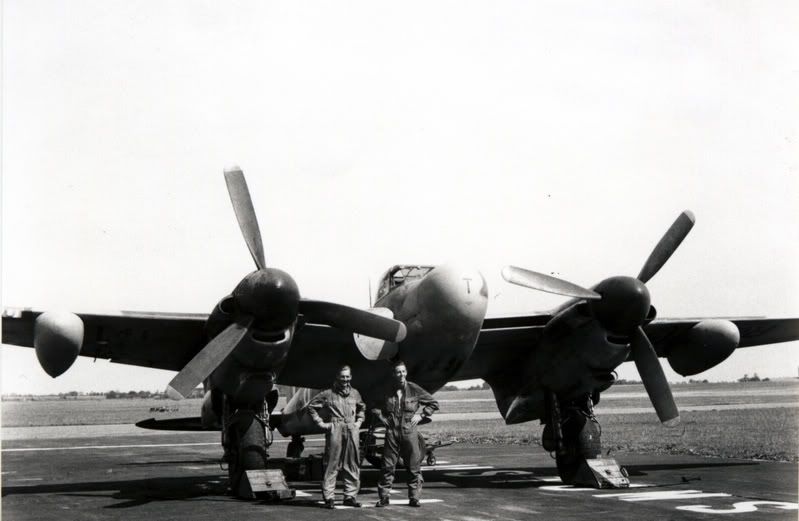
Here is the last Mosquito NF36 delivered into Benson In July 1953 by Sqn Ldr Cogill and self. And we were looking forward to amonths respite from The Canal Zone.
ISTR Hunter mainwheels were 180psi. Tyres were supposed to be good for 8 landings, but very often did not survive 4.
de Havilland undercarriages are very reliable. :cool::rolleyes:
Not too sure about that.
Have you ever tried a gentle swing in a Mosquito :D:D