I remember that the RAF used to circulate a magazine type document in which selected accident reports were reviewed. the idea being that both ground and aircrew, could learn from their errors.
One that sticks in my mind contained a photo of a reassembled pair of pliers which had been left in a jet intake and had subsequently passed through the engine. It had been very neatly chopped into about 8 pieces, but had not done the engines internals any favours either.
Returning to the OPs original question, I always understood that the German engines suffered from blades burning out because they did not have the exotic alloys to withstand the very high temperatures reached in a jet.
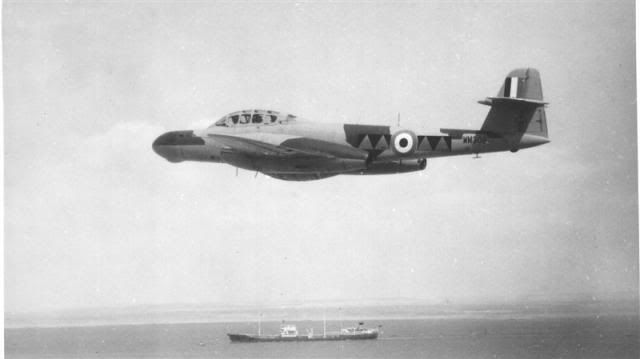
Have just come across this entertaining thread. Here is my contribution, an NF13 in its natural habitat, guarding the Suez Canal, LOL
Don’t quote me but I think all targets in WW11 were sleeves about 20 ft long and 4 ft dia.
In the ’50’s the “banner” target was introduced, from memory about 20 ft long by 6 ft deep.
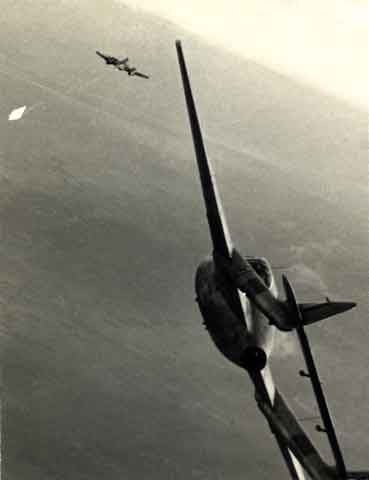
I have a picture stolen from a Vampire sqdn site, of such a thing being towed by a Meteor for a Vampire to attack. I trust the author, if he sees this, will forgive me for publishing it here.
*Tries to imagine how a D-Day-striped USAAF C47 would fit into the Dambusters re-make…and fails* 🙂
Surely they would need something to transport the Tallboys from the American inventor and manufacturer.
A flock of sheep recently donated most of it to a wunch of bankers.
d.
Yes, and the remainder we donate to the EU to p*ss up against the wall
Oh mad impetuous youth
The clinical diagnosis is “premature ejaculation”
or opening fire at too great a range, a very common fault in the young and inexperienced
At the risk of being silly, the first Grand Prix I ever attended was the 1952 Kabrit GP held on Boxing Day.
I can see from my pic that it also shows the SHUT and OPEN markings. A great pity I did not have my current little digital camera instead of the 120 rollfilm Agfa I had then. F4.5 and 3 speeds, focus by guesswork and exposure by God.
If people would like a little piece about aerial gunnery in those days, we did plenty and it was great fun, just say.
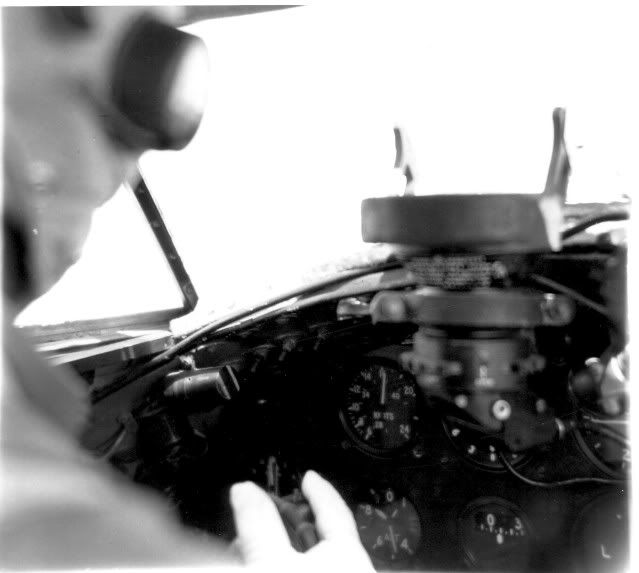
Please see this pic of interior of Mosquito NF36 cockpit. I know we had a simple ring gunsight, there is a setting ring to input the target wingspan. This adjusts the size of the ring such that when the wingspan of the target fills the ring then the range is 350 yards.

Does this look similar ?
Having watched from our garden various fighters chasing, and shooting at, Doodlebugs, I well remember the original cruise missile. Some were easier to catch than others, the crude engines possibly varied in power. the worst incident I remember was seeing a Mustang diving on one which was headed straight over us. He did not quite have the speed and fired in desperation, I suddenly realised that the rustling noise I heard was his bullets going through the hedge behind us.
I feel the main reasons why the Meatbox became a big exportee were:–
1 They were readily available, rolling off the production lines. In addition the government was desperate for exports and foreign currency and so were quite happy to see RAF aircraft diverted.
2 It was an early 1940s design, simple to maintain and run by inexperienced Air Forces, and with well tried technology.
3 It was easy and generally very safe to fly, well suited to inexperienced pilots. I heard it referred to as “a gentlemans aeroplane”, and as a totally untrained nav, was allowed to give it a whirl to the extent of barrel rolling it.

I guess many airfields which were used during the war will have many small arms rounds lying just below the surface. When aircraft were rearmed in wet weather and odd rounds or short lengths of belted ammo were cleared they dropped in the mud and disappeared. I can remember when the housing was built on Martlesham Heath in the ’70s and ’80s, there were several stoppages of work to clear quite large quantities of just such ammo.
As an aside, when I was a boy during the war the soldiers were happy to give us their blank 303s to save fouling their rifle barrels. We also acquired a considerable amount of live ammo of various calibres both English and German. I well remember disposing of some 300 rounds by lighting a big fire in a slit trench, and pitching the ammo in and diving into another slit trench which the Army had conveniently dug close by. Petrol anyone? We used to collect it by the pint from discarded 4 gallon tins the Army used to refuel their tanks. Second vehicle I ever drove, age about 9, was a Churchill tank.
I remember hearing that in the attack on the Schornhorst and Gneisenau that, while under attack from FW190s, many of the shells were going straight through the fabric covered wings without exploding.
The lack of honours demonstrates just what mean minded politicians we have had in charge over the last 50 years.
Now of course none of the party heirarchy has seen action and very few have even done a “proper” job, much less served in the Forces.
I despair for the future of this country, my lowly 8 years was wasted.
Hear hear!