 Flipflopman
Without water the Harrier cannot hover. The F-35B is not so limited. Period.
Yes it can.
With the newer Mk107 Pegasus engines, the aircraft is only carrying the water as ballast, and with the later GR9/9a mods, provision is installed for ballast weights to be added when the aircraft is using 107 engines. Even the Mk105 engined aircraft can hover without water, however, the engines will be operating slightly over their usual JPT limit. With water selected in the Harrier, it also raises the DECS top JPT limit, and allows the engine to run hotter. During the course of the Harrier display, the water usually runs out mid way through the ‘reversing’ hover sequence, and is compensated for with more throttle input. Throughout the ‘nodding’ manouvers, the aircraft is hovering without water. As I mentioned previously though, the Mk107 engined aircraft can do all of this completely without the need for water at all.
The Water injection system on the Harrier is used primarily for cooling the turbine and allowing more fuel to be pumped in, and not an increase in air density and Mass Flow as has previously been suggested. There are injectors placed in the combustion chambers, and also just upstream of the HP turbine, in order to keep the turbines operating at optimum temperature, while more fuel is automatically added to compensate for this, thus allowing more fuel to be burnt, thus producing more thrust.
Just throwing a few facts into the discussion there!!
Flipflopman (Harrier Airframe/Propulsion engineer)
FlipflopmanAs I’ve mentioned to Matt, I still have all of my Jag Propulsion ‘Q’ course notes, and the 104 – 106 engine upgrade notes which the lads can happily copy, plus I’m not all that averse to spending the odd day at Brunty rebuilding an old aircraft!!! 😀
Flipflopman
FlipflopmanIt would be a shame to see B.2A XJ824 broken up.:confused:
Without meaning to be pedantic, there is no such thing as a B2a. This is somewhat of an urban myth spread around after the Vulcan fleet recieved 301 engines, It was never an official designation, and does not appear in any of the official Vulcan Air Publications.
Sorry for being a k**b, but that’s a little pet issue with me. 😀 I know I’m a loser!!
Flipflopman
FlipflopmanDuckworth,
Currently every 10 landings as Out Of Phase maintenance on the Port main U/C casting and bogie, with an absolute limit of 50 on the leg. This was the initial leg through the refurbishment program at Kearsley’s and will be replaced during the winter service this year, with a recently refurbished unit that will not require such frequent NDT checks.
Hope that answers your question.
Flipflopman
Flipflopman:rolleyes:
Before everyone starts to actually pop all of the veins in their forehead at this ‘ridiculous and appaling outrage!!’
Can I point out to you all, that this £120k figure that has you all up in arms, and in an incandescant rage, has no factual basis, and is a figure pulled from the ether by ZRX61, from
a post I read a while back…
Oh really?
Perhaps if you could come up with any actual evidence of this post, and further, any evidence of the “apparent” salary of £120,000 paid to Robert Pleming, then I could perhaps explain your ire. As it goes, it seems to me that yet again the more vocal members of Key have whipped theirselves up into an outraged frenzy over nothing more than an ungrounded and frankly ridiculous rumour.
For the record, I do not know Dr Plemings exact salary details, however, neither do any of you, so perhaps it would all be wise to calm down a little, and concentrate on the fact that there will be a flying Vulcan at the Farnborough Air Show this weekend, for the first time in 16 years.
Flipflopman
FlipflopmanPeter,
As Ramshornvortex says, it really is typical of not only the Olympus, but also of the Gas Turbine engines of the period. The main cause of which can be attributed to the efficiency of the combusters and the fuel burners.
Early jets, in the main, used Simplex and Duplex burners, which basically gushed the fuel out into the combustion chamber. Simplex burners having one single orifice for all flows, and the duplex having two, a Primary orifice for starting and low RPM, and a Main orifice for everything else. When in use, the burners delivered the fuel directly into the combustion chamber, forming a “Tulip” effect on the head of the burner, much as you see on the end of an open hosepipe. This, as you’d imagine, is not a very effective way of igniting your fuel, so a fair proportion of it doesn’t ignite and burn fully or completely, thus giving the efflux a smoky appearance. As time and technology progressed, so did the burners, leading to Spray burners as found in the Adour, fitted to the Jag and Hawk, and further to Vapourisers and Atomisers, fitted to modern Gas Turbines, which pretty much do exactly what they say on the tin. As you’d imagine, these are highly efficient, so produce little smoke.
A further reason for the smokiness of older engines, is that they tend to be straight through Turbojets, as with the Olympus. This means that there is no clean, bypassed air to mix with the efflux and clean it up, so what you see coming out of the jetpipe is the pure, unadulterated filth of the engine! :D:D
Hope that helps a bit.
Flipflopman
FlipflopmanAs has been posted here by others, it is indeed the front spar Mod 2429 that is outstanding, however this is scheduled to take place during one of the forthcoming winter sevices.
As goes FI, she will be far lighter on the fatigue than some may think, even during her display years, she only consumed FI at a rate of 3 – 4 units per year. After recieving Mod 2429, she will have in the region of 70 FI units remaining, so as you can see, fatigue is not really a major issue with the aircraft.
Engines, however, are a different story, with their revised lifing schedule of 1200 cycles. A cycle is considered to be one excursion from Idle – Max – Idle. There are calculations for partial cycles, however, these are not something I know off the top of my head!! However, this illustrates the fact that it will be the engine life that dictates XH558’s future on the circuit, as once these cycles are gone, there is no option to re-life or rebuild the engines, so 558 will be grounded. To this end, the engines will be cycled through the airframe at 50 hr intervals, to ensure that usage and wear is spread evenly throughout the 8 spare engines that TVOC have.
Hope that answers a few questions.
Flipflopman
FlipflopmanAnon,
Sorry mate, wrong again there. The components you see pictured are all from the main body of the aircraft, and as you can see from the torching pictures, would still have been in place during the burning operations.
The legs would not have been blown away, but simply have PE charges placed to allow the aircraft to fall upon its U/C. Pictures 1 and 2 show a badly crumpled main undercarriage door, Pic 3 shows the Red Steer pressurisation panel, which lives in the tailcone of the aircraft, just aft of the rearmost access door, Pics 4 and 5 show sections of the Radome and Radome latches, which can clearly be seen on the pictures of the aircraft on the dump, Pic 6 shows one of the nosewheels which clearly displays fire damage, Pic 7 shows the Hyd distribution block, which lives on the roof of the Nose U/C bay, and Pic 8 shows fuel tank items, which from the pump, shows that they are wing tank items, and a fuel sequencing timer, which also lives in the Power Bay in the tailcone of the aircraft.
I must admit to being a little bemused as to why you don’t seem to accept that these are items from XL392 and insist that we could be wrong and they may be from other aircraft, despite all evidence being to the contrary?
Flipflopman
FlipflopmanFlipflopman,
It’s a common pattern which is also on my Meteor wheels.
If someone can find a size and we can relate that to a particular aircraft that might get us a little further forward.
Otherwise, I’m not doubting your experience and expertise FFman.Anon
No worries mate, apologies if my post seemed a little snippy.
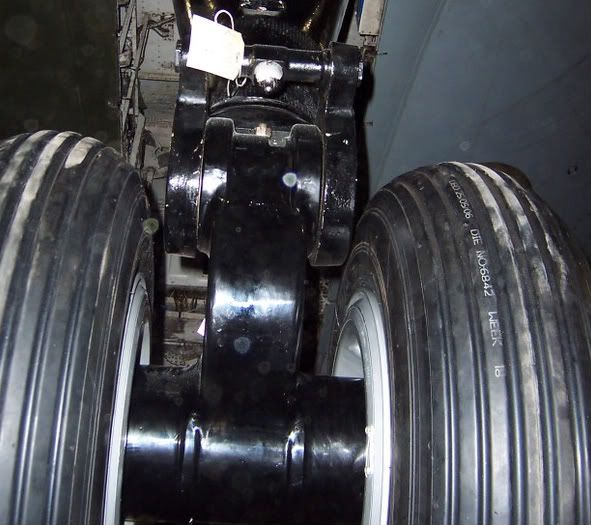
Just to help s little with the ident, here are a couple of pictures of XH558’s flight wheels, with brand new tyres fitted.
Nosewheel
Mainwheels
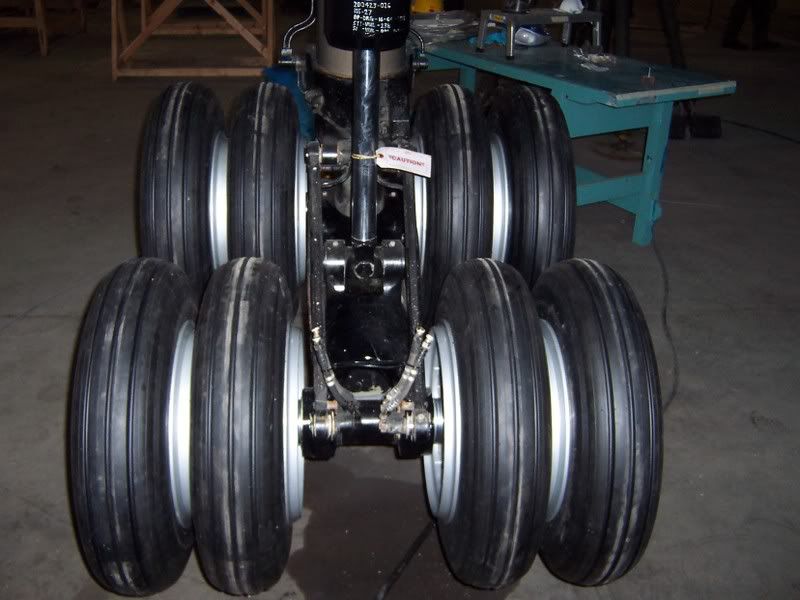
Hope that helps a bit.
Flipflopman
FlipflopmanJust going back a bit to post number 43. and the photo’s taken of the old dump at Valley; That nosewheel looks more like Meteor or some similar type to me and a bit lightweight for the likes of a Vulcan.
Can anyone get the size off of it and I’ll check it against my Meteor wheels and see if it’s the same?
Let’s keep on top of this thread and try and find out what’s at Valley.
I’ve heard about the stuff in the lake too namely a B17 crashing there and a Beaufighter.Anon.
I based my answer there mate, on the 2 years I spent with TVOC rebuilding XH558. Myself and others have fitted and removed those same nosewheels, with those exact same tyres more times you can shake a stick at, so felt quite sure that I recognised them.
However, if you think they’re Meteor wheels…..
Flipflopman
FlipflopmanPeter,
The data plate won’t give you the serial number unfortunately. It will give you the Mod state, and the date of manufacture, and also the manufacturers details, but sadly no serial number.
You may however, find it painted on the lower forward edge of the door, as this was common practise on Vulcans, as an ident. If there is any paint left, or metal for that matter!!
Flipflopman
FlipflopmanJet engines are certainly not designed to contain a catastrophic failure, certainly not the ones of museum vintage. Once a blade lets go in the early compressor stages, or even turbine stages, there is an enormous likelyhood of the blades penetrating the casing, and this has happened countless times, and has caused many fatalities. I myself have seen several incidents of catastrophic engine failure during my time as an aircraft Propulsion engineer, and in a fair proportion of these, there has been evidence of casing puncture, or actual blade loss through the casing.
Unless you have some idea of the history of the engine, I wouldn’t even begin to think about trying to run it up. There are so many variables, and so many dangers associated with it, that it’s not worth the risk IMHO.
Flipflopman
FlipflopmanAh, definitely some Vulcan relics there!!
Pic 1 – Vulcan Main U/C door
Pic 2 – Vulcan Main U/C door
Pic 3 – Red Steer and Hyd System pressurisation panel.
Pic 4 – Section of Radome, and radome latch.
Pic 5 – Section of Radome, and radome latch.
Pic 6 – Nosewheel
Pic 7 – Nose U/C and Nose U/C door Hyd distrubution block, with flexi hose connections
Pic 8 – Selection of Plugs, Fuel tank items, and a Fuel System Sequence timer.
How sad am I?!!?!? 😀
Flipflopman
FlipflopmanVulcan internal fuel capacity is 74,000 lbs.
30 – 40k is therefore roughly a 45 – 50% fuel load.
Flipflopman
FlipflopmanProbably won’t help all that much with identifying the actual tail number, but if you post it up, I’ll try to help with the identification.
Vulcan part numbers begin with a 26DC prefix, so that may be a start.
Cheers,
Flipflopman


 Sign In







