 JangBoGo
Pictures of the new variant of Pantsyr-S1 with new two-panel radar & IFF came online few months back during factory visit… will the new production variant be this one or is it meant for export?

JangBoGoThx for posting the pics above.
I am half and half expecting the 16-round Barak + single missile director installation from Viraat to be transferred to the spot in front and below of the main radar or similar position behind the funnel at the rear of the island. Same might happen with the pair of 30mm AK 230 and Bofors 40mm. But then again, why not a beefier self defence fit e.g. doubling the number of Barak missiles and directors and/or using AK 630 or maybe even 76mm naval guns (as will be on her newer companion ship IAC)?
Barak may be. Ak-230 and Bofors, not likely. Having more AK-630 would be good. But lack of medium to long range missile is not good.
By the 76mm naval gun do you mean to have it for naval gun fire support or for using AD shells? If at all a naval gun is needed for fire support, its better to have higher caliber and longer ranged A-192 or Ak-130. If its for AD, then a dedicated CIWS would be the best option.
I hope the IAC don’t keep that 76mm SRGM. It was all that Italian sales guys who wanted to sell as many units as possible with their carrier design. Instead I’d prefer having Barak or other AD systems getting installed on IAC.
JangBoGowhat has happened to the China’s large transport aircraft, it was earlier reported to be ready in 2012. Cancelled? Any new info?
.jpg)
http://english.peopledaily.com.cn/90001/90776/90882/7380756.html
JangBoGoAn earlier picture of the ATC during construction.
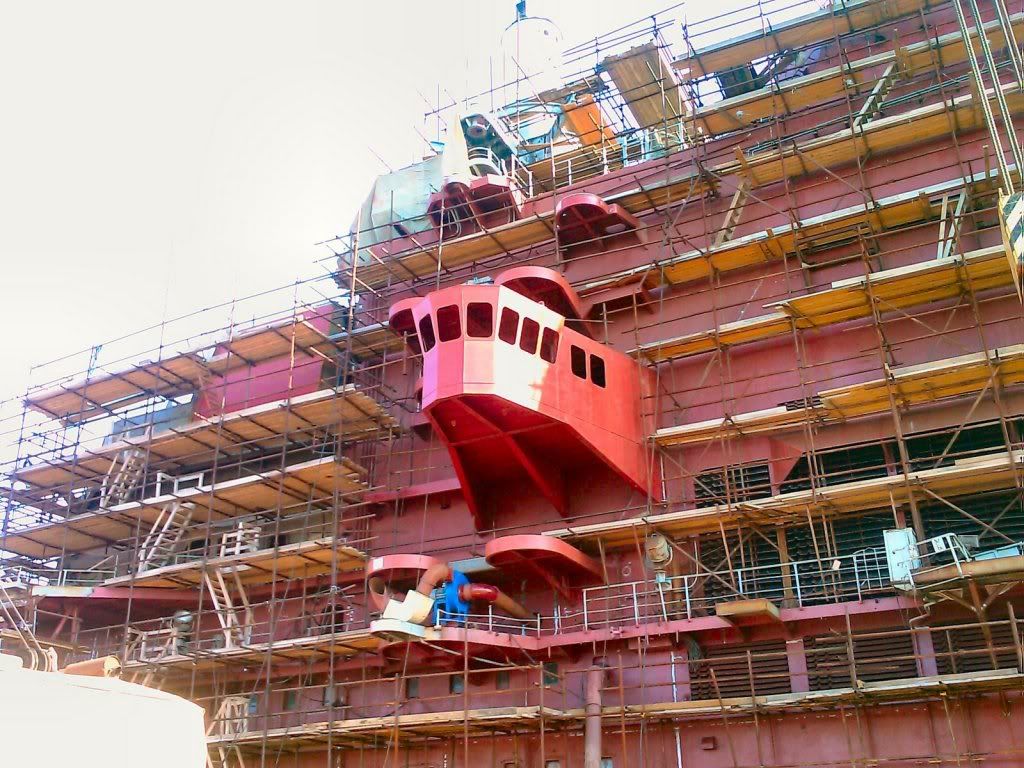
I hope hot linking it won’t create burden for Snake’s album. If yes, i’ll remove hot linking…
JangBoGois that how you think rail engines are swapped ?? 😮
that is shocking right? That how I felt when I heard from you that a locomotive engine can be changed or swapped in 10 minutes 😉
every 50 km or so there are service lines where this swapping can take place without hampering main traffic. IR has a LOT of engines for emergencies like this. I don’t think I missed the point. 😉
So strategic assets are run on the normal high traffic rail routes?
And are you claiming that the entire stretch of rail route in the country have got that 50km intersections??
congrats, you have admitted that road TEL does not offer any advantage over rail TEL. since, if you care to remember, this was your only point about the advantage of road based TEL.
you have got strange ways dear. But its ok.
I didn’t want to carry on with that engine stuff because a railway engine is more complex than a truck engine and if we carry on with that we’ll have to arrive at a very negative view on the rail launch. So i dropped it.
If you believe rail mobile is best, let it be so…who am I to change your opinion.
But A5 will have road-mobile which someone earlier pointed out and also from the above interview. But then, my problem is with having a immatured commercial trailer as the base for TEL. Its not the best solution.
you can hardly expect me to answer that isn’t it ?
let’s just say it is nothing like what you described.
Its simple. If you have seen it tell YES elze NO. End of discussion.;)
JangBoGoThis is w.r.t India’s SLBM. From the interview a figure of 10 meter have come up and I believe it is likely to be the max depth from which our SLBM will be launched.
VKS: The technologies involved in both missiles are different. An underwater missile has to deal with the pressure of a 10 metre column of water above it. Hence the configuration of the missile is different. It is heavier, the structure is different. Unlike the Agni missile, this missile carries a lot of dead weight.
The figure for Klub family is 14 meter. So wanted to know what is the max depth from which the Russian SLBMs are ejected.
JangBoGoInterview with Dr V.K Saraswat
Days after the milestone first test of India’s strategic ballistic missile Agni-V, Scientific Adviser to the Defence Minister Dr Vijay Kumar Saraswat sat down for a detailed interview with Senior Editor Sandeep Unnithan. The DRDO chief explains why the missile is a technological breakthrough and how it gives India the capability to target satellites in space.
Why is the Agni-V different from the previous Agni missiles?
VKS: Agni-V is a completely new missile system. It is a 21st-century missile because of the technologies used and a game changer because of its strategic deterrence value. The missile went from drawing board to launch pad in just over three years. The government sanctioned the Agni-V project in December 2008. We began design work on it in April 2009. The missile was on the launch pad on March 14, 2012 and launched five days later.
What are the new technologies that the DRDO has developed for this missile?
VKS: Agni-V has taken us to a new level of technological maturity. This missile is entirely different from the Agni 3 and 4. The second and third stage booster of the missile are made entirely of composites. The third stage is a new booster that we developed. It is the lowest end of the tapered cone that ends with the warhead. That itself, in terms of composites, is a breakthrough. The navigation system is highly accurate. Don’t forget that this missile travels at over Mach 20 in its terminal stage. Both the ring laser gyros (a device that measures the orientation of the missile and helps in inertial navigation) and the accelerometer (which measures the missile’s rate of acceleration) are indigenously developed as part of the indigenous ballistic missile defence (BMD) programme. We also proved redundancies of our new onboard navigation system. A backup navigation system that was less accurate but more robust was put in place. This navigation system was supported by a unique fault tolerance software that we installed in the missile. The re-entry nose cone that contains the warhead had to be completely redesigned with new material and resins. This is because when the missile re-enters the atmosphere, it is hurtling towards the ground at over 20 times the speed of sound. Friction on the nose cone causes temperatures in excess of 2000 degrees centigrade. This system had to be proved on the ground and that was a major technological development for us.
We are also working on a canister-launched system for the Agni-V. We have designed a canister that can eject the 50-tonne missile 50 metres in the air and fire the first stage. The canister will allow us to store the missile for ten years with no maintenance. The missile will be carried on railcars and on a 12×12 road-mobile truck. Carrying the missile on a road-mobile launcher is better because it is more flexible, you just need some level ground to launch it. The first launch of the A5 was from a railcar, we hope it will subsequently be fired from road-mobile launchers.
Costs and production of the Agni-V? There is a concern that you will not be able to produce more than one or two missiles a year.
VKS: The A5 costs approximately Rs.50 crore per missile. We will need two more tests before starting serial production after two years. The DRDO is working with production agencies for this. All I can tell you is that we will produce more than just 1 or 2 missiles a year.
What were the challenges posed in tracking such a long-range missile?
VKS: The Agni-V required a different range deployment. The range of over 5,000 km meant the missile would land north of Antartica. That meant the ships tracking the launch would have to sail nearly a fortnight before the launch window. We had a slight difficulty in that all our tracking systems are ship and shore-based. We don’t have airborne sensors. We needed three ships to track the launch: two near the splashdown and one to track the mid-course correction. The ships are due to return on April 30 or, 11 days after the missile test. We have a highly integrated tracking range comprising 15 sensors, seven radars and seven telemetry systems. They did an admirable job of tracking the missile flight in real time.
Does DRDO have the capability of destroying satellites in space?
VKS: Today, India has all the building blocks for an anti-satellite system in place.
We don’t want to weaponise space but the building blocks should be in place. Because you may come to a time when you may need it. Today, I can say that all the building blocks (for an ASAT weapon) are in place. A little fine tuning may be required but we will do that electronically. We will not do a physical test (actual destruction of a satellite) because of the risk of space debris affecting other satellites.
How did you develop these ASAT capabilities?
VKS: There are a few essential parameters in intercepting satellites. You should have the ability to track an orbiting satellite in space, launch a missile towards it and finally have a kill vehicle that actually homes in to physically destroy it.
We have a Long Range Tracking Radar (LRTR) used in the Ballistic Missile Defence Programme that has a range of over 600 km. We will increase the range to 1,400 km allowing us to track satellites in orbit.
It is far more difficult to intercept ballistic missiles than it is to intercept satellites. Satellites follow a predictive path. Once you track a satellite, you will know its path.
In the BMD project, we track and intercept a 0.1 square meter target over 1,000 km away. A satellite is ten times larger-over 1 meter wide.
We have the communication systems in place, again developed for the BMD project. The first-stage booster developed for the Agni-V can inject a warhead 600 km into space. We also have a kill vehicle developed for the BMD project. The kill vehicle actually homes in onto an incoming missile. We have the Infra-Red and Radar frequency seekers on the kill vehicle that accurately guide it to its target.
At what phase of development is the BMD programme?
VKS: Phase-1 of the BMD programme will be completed by 2013. In this, we will intercept Intermediate Range Ballistic Missiles with a range of 2,000 km. The second phase will be completed by 2016. In this, we will be able to intercept intercontinental Ballistic Missiles (ICBMs) with ranges over 5,000 km. Phase-1 has two missile interceptors called the PAD and the AAD. This year, we will be testing a new interceptor missile called the PDV. This missile will replace the PAD. Two missiles, the AD1 and the AD2 will be tested by the end of 2013 under Phase 2 of the BMD.
What about cruise missile defence?
VKS: That is a whole new ballgame because it calls for an entirely new set of missiles and radars. My team is presently studying CMD. We are looking at it as a possible next programme after finishing the BMD programme.
The DRDO has made breakthroughs in the K-series missiles for the nuclear submarine project. Why didn’t you use a land-based variant of this missile?
VKS: The technologies involved in both missiles are different. An underwater missile has to deal with the pressure of a 10 metre column of water above it. Hence the configuration of the missile is different. It is heavier, the structure is different. Unlike the Agni missile, this missile carries a lot of dead weight.
When will the indigenous nuclear submarine INS Arihant be commissioned?
VKS: The submarine will test all its systems this year.
Field trials of the Arjun Mark 2 ?
VKS: We have the first test of the Arjun Mark 2 in June, this year. We have given the army 80 per cent of the changes in Mark 2. There are 126 more Arjuns being built, in addition to the 126 delivered to the army. We are confident of getting another order of 350 Arjun mark 2 tanks.
What stage is the Future Main Battle Tank (FMBT) project at?
VKS: We are holding discussions with the army for this. We will finalise the specifications of the tank in six to eight months. We are looking at industrial partners for this. We want new technologies for weapons, mobility and signatures for the FMBT. We have to decide on the type of armour to use for it, whether active or passive. The FMBT will be a tank complimentary to the Arjun. It will not replace it. Each tank has its own theatre. The T-90 MBT (used by the Indian army) has its theatre, the Arjun has its own theatre.
When will the Long Range Surface-to-Air Missile (LR-SAM) be tested ?
VKS: The first successful trial of the LR-SAM was in 2010. After this we decided on a complete change of configuration. We will have another test of the modified missile in Israel in June 2012. The missile system has already been integrated into the first P15A warship (the INS Kolkata, being built at Mazagon Docks Ltd, Mumbai).
JangBoGoThe Design of first indigenous Naval aircraft imposed huge technological challenges to the Defence Research & Development Organisation (DRDO) to meet the peculiar requirements of Naval aircraft; starting from saline and humid environment of operation, restricted availability of deck run for launch and recovery and high operating load conditions. Basic design changes required to suit the carrier operations are strengthening of aircraft structure and Landing Gear, Arrester Hook, improved engine, enhanced aerodynamic performance and incorporation of special metal/material. A host of other systems like the Leading Edge Vortex Control (LEVCON) surface fitted at the front end of the aircraft wing operated by a concealed rotary actuator with aerodynamic profiling to ensure low landing speed, good controllability and better vision for the pilot. The feature of launch and recovery onboard Carrier at high sink rate of 7.1 rn/sec, flareless landing with engine to full throttle till arrested by deck cable impose five times of loading on Main Landing Gear as compared to the IAF version. Also such axial load calls for re-certification of all Line Replacement Units (LRUs), components and associated systems of naval version to ensure fail safe operation repeatedly.
http://livefist.blogspot.in/2012/04/photos-celebrations-after-lca-navy.html
Any idea on when they intend to have the definite variant of a carrier based aircraft with arrester hook?
JangBoGomy favorite shot
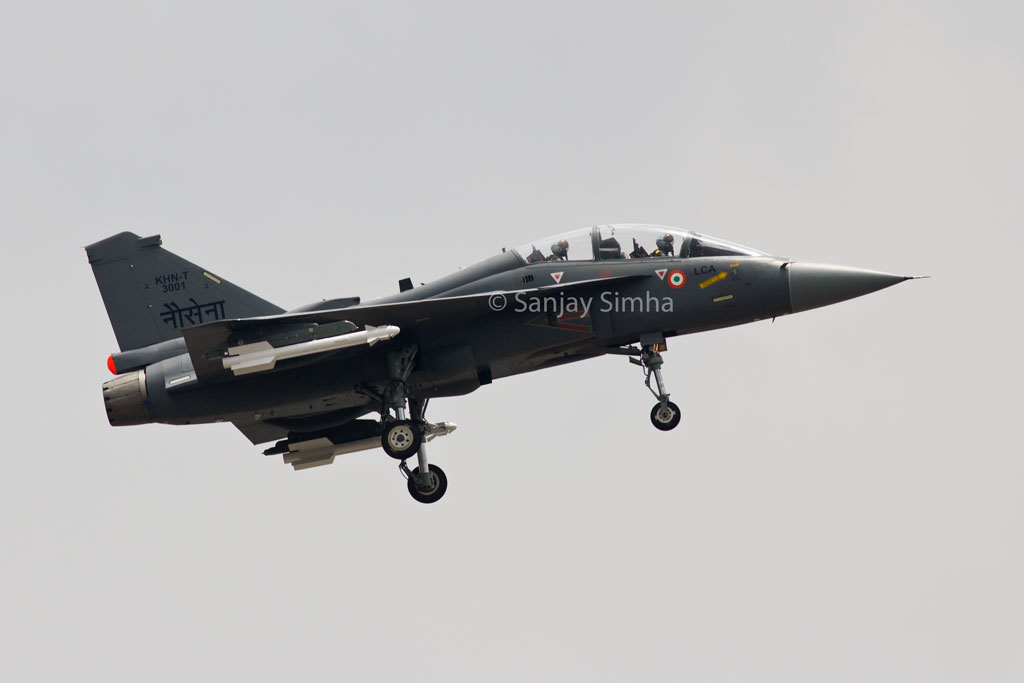
http://livefist.blogspot.in/2012/04/exclusive-photos-lca-navy-on-her-debut.html
they did not take the route of MiG-29K/M in having an underbelly point for the drag chute and arrestor hook.
JangBoGoSome more on INS Tej induction from LiveFist
The brochure released by the Navy on the occasion of INS Teg’s induction today at St Petersburg.


JangBoGoRussian-Built Frigate Joins Indian Navy
27/04/2012
KALININGRAD, April 27 (RIA Novosti)India on Friday formally commissioned a new frigate into its navy, following a handover ceremony at a shipyard in Russia’s Baltic exclave of Kaliningrad.
INS Teg is the first of three modified Krivak III class (also known as Talwar class) guided missile frigates being built at the Yantar Shipyard under a $1.6 billion deal sealed in 2006.
The other two vessels will follow in a year or so, a Yantar spokesman told RIA Novosti.
The 3,970-ton frigate incorporates stealth technologies and is armed with eight 290-km BrahMos supersonic cruise missiles.
It is also equipped with “sensors for three-dimensional warfare,” the Times of India newspaper reported.
The Indian navy already has three Russian-built Talwar class frigates.
JangBoGoWhat a half arsed analysis that!
You have to compare at battery level.Did you also forget the C&C , main. and other vehicles?
did it look like an analysis to you on a battalion or brigade level?
The main point was about the trucks and the TEL and not the missile capability as such. Basically the launcher and the reload vehicle which form the main components. That why I said 24 missiles from 12 trucks.
Iskander battalion consists of 6 types, including the TEL & the reload vehicle…. i.e 10 vehicles in total.
One Prithvi Battery has 16 missiles and the logistics include 4 TELs and 5 support vehicles which include a missile re-supply & loading vehicle, a propellant tanker , a survey vehicle and also a command post.
That comes to 16000 kg payload to 350 km in case of Prithvi III.
How many vehicles in total? and how many vehicles to carry those 16 missiles?
Prithvi support vehicles
In the above (which is for the liquid fueled) we can see the number of vehicles involved. SS350 may not need most of them. But still we can reduce the overall number if we have a better platform for TEL and re-loads.
Now , the Iskander M with a payload of 480kg for 400 km.A Iskander operational battery is expected to consist of two TELs with two reload vehicles, two command and control vehicles, two mission planning vehicles, a maintenance vehicle, and a crew accommodation vehicle.
that comes to around 8 missiles – total payload 3840 kg to 400 kms.
As mentioned earlier, Iskander battalion consists of 6 types, including the TEL & the reload vehicle…. i.e 10 vehicles in total. But the number of TEL and re-load vehicles can be increased and probably the only reason they have not done it is because they want to establish as many brigades as possible in the initial phase and once that process is complete, they might increase the missile number.
In the picture above we have 24 vehicles, which as per their current status means 3 battalion strength of 630th Brigade. (as per that photo). It is display for parade and they do not have to showcase the full compliment of the unit. If that was the case, just imagine how many will Prithvi will have to parade on Republic Day.
The Iskander-M is quoted with various figures. 400-480Km range and 700-800Kg payload. If we are taking the range as 400Km, better
increase the payload to 700-800kg. So per battalion it will be 6,400Kg to 400Km or 4,000Kg to 480Km. Whatever it suits. That is the figure from a Battalion of Iskander-M from a size of 10 vehicles.
How much will a Prithvi unit be able to deliver from a size of 10 vehicles is the question.
But again this comparison is itself dubious since Iskander is technologically one generation ahead of Prithvi which is liquid fuelled.Better would be to compare with something like the Prahaar?
I don’t know why you are so touchy….the figures I posted was not meant for actually comparing the missile capability as such. But my point was for a better platform to point out how much compact a unit gets with a good platforms. It was not for comparing Iskander with Prithvi.
btw, nice that you pointed out the Prahaar….sometime back when I mentioned that Prithvi and its role might be replaced by Prahaar eventually in the future, some had different thoughts.
Thats just your opinion.Prithvi TEL is just fine.
http://www.bemlindia.nic.in/documents/Products/Defence/Eqpt%20Spec/Prithvi%20Missile%20Launcher.pdf
When did Prithvi become a strategic missile??
did you read what I wrote correctly?
We do require a good TEL for Agni III and V though.But they going to be canisterised and most probably 16×16 Tata LPTA series.[they do have very good 6×6 , 8×8 and 12×12 vehicles as well as lps 4928 trailer]
Yes , we require a good TEL and that is what I wanted to point out with that posts. But not just for Agni-V or Agni series… Prithvi also can do better with better platforms.
It does not matter if Tata produce 12×12 or 16×16 trailers. We are not transporting shipping containers filled with sugar or grains. What we need is matured platforms like MAZ.
JangBoGoA true succesor of Akula ..a dedicated hunter-killer submarine. Was in fact mentioned by the navy brass before in 2009. But I can’t find that interview.
All I can find is this.
So we can say a new generation of pr.671 class/size of boats. But what is the status, we have not yet heard of any advancement in that project.
http://paralay.com/advanced/05.jpg
The above drawing looks out of reality. Atleast the bow. A design with a sonar section in between the torpedo room is impractical. IMHO!
No chance. Either it has to be on the lower level or on the upper level, not in between.
Also, why go to the old type after successfully having a spherical array in the bow in Yasen?
JangBoGothankfully, I am not a TEL. you should ask the question to a TEL.
and yes, for a TEL I do not see the huge advantages of being its own prime mover. if the vehicle malfunctions your critical missile is stuck on the road somewhere. while for a rail based TEL all it would take would be to swap the engine with a new one, a job that takes ten minutes.
ok. 😀
But you missed the point.
regarding the engine replacement…it is not that easy. A locomotive engine cannot be lifted from one track to another just like that. If there is no spare engine along with the unit on the same track, then it is going to take a lot more time.
But lets not talk of engine failure (locomotive or truck), it hardly happens in normal time .
do not presume to know what I have seen. 😉
‘hopefully’ ? why the angst if I have actually seen it ?
so are you claiming that you have seen the rail-mobile units?
JangBoGoI wouldn’t put too much stock in the accuracy of these plaques, IIRC Yury Dolgorukiy was depicted without a pump jet too.
If I’m not wrong Borei was displayed with a pumpjet.


 Sign In








