JangBoGo
Rocket launch and flight path

The Japs came up with their regular reaction. Last time they were damn serious in shooting down the rocket if it flew over Japan and North Korea came up with its threat of retaliation if rocket is shot down. The end result being North Korea launched the rocket, the first stage fell in the Sea of Japan and the rest flew over Japan.
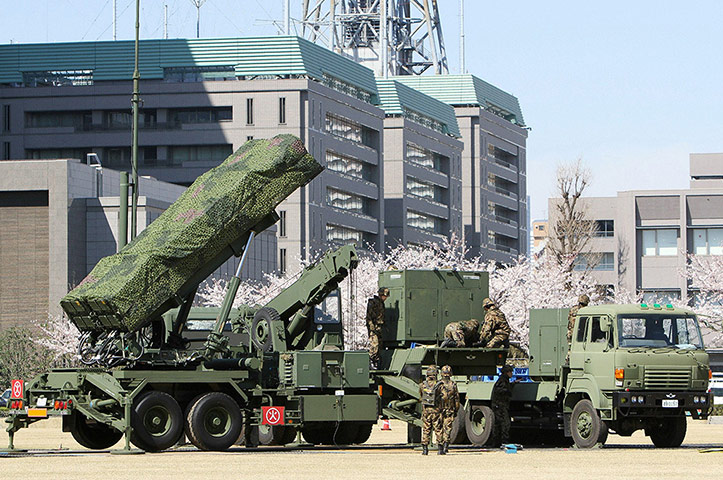
Soldiers of the Ground Self-Defence Force set Patriot missiles at the Defence Ministry in Tokyo
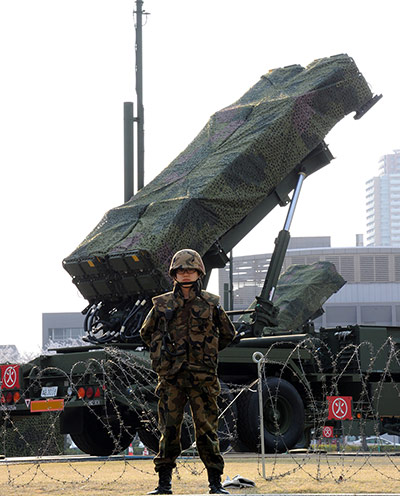
A soldier stands guard in front of a Japanese SDF set Patriot Advanced Capability-3 (PAC-3) missile launcher in Tokyo
JangBoGoNBC space expert on North Korea satellite launch: ‘It’s not a military missile … but it’s darn close’
By Ed Flanagan, NBC News Producer
When we learned that North Korea was planning on opening its tightly restricted Sohae Satellite Launching Center to foreign journalists for the first time, NBC News quickly decided we would need an expert eye to determine the accuracy and authenticity of Pyongyang’s claim that this latest rocket launch was for peaceful scientific purposes.
North Korea says it is planning to launch a weather observation satellite using a three-stage rocket during mid-April to celebrate the 100th anniversary of the birth of North Korean founder Kim Il Sung. But the United States and South Korea say it is a test of a ballistic missile.
So NBC News invited James Oberg, our “Space Consultant,” to accompany us into North Korea to view the Kwanggmyongsong-1 satellite.
With a 22-year career as a space engineer in support of NASA’s spaceflight operations, Oberg has the experience and technical expertise to determine the veracity of North Korea’s claims about this mission.
NBC sat down with Oberg after visiting the Sohae Satellite Launch Center on Sunday to get his initial impressions of the facility, the mysterious satellite and the future of North Korea’s space program.
Q. What are your first impressions from this visit to Sohae?
A: It was just amazing to be there, and the impression was that someone in the North Korean government made a very courageous decision to let us in.
Q. Going into this, you said you had a couple of standards you were looking for in this satellite that would in your mind, settle whether it was real. What were they?
A: I expected the satellite to be in a clean room; a clean environment free of dust, smudges and things. I expected the satellite to probably be already mounted on the third stage [hardware that connects to the booster] and ready to move out to the launch pad. I expected the satellite to have a reasonable design; it should follow standard designs, like power and solar panels and so forth. I was really surprised by what we saw.
Q. So did this satellite pass muster?
A: The satellite did not meet the expectations I had. I have to ask myself whether these expectations may have been too narrow, but at the same time it raised questions in my mind as to how real what we were being shown was. We asked whether this was a mock-up; in fact, we kept on asking them again and again because they insisted this was a real satellite.
The problem is the North Koreans didn’t just let us in [to the same room as the satellite], they let us get much too close. I could’ve walked three steps and poked it with my finger. But I didn’t want to put grease and smudges on the outside because it could lead the device to overheat in space or it could change a lot of things about the electro-static environment. So you need to protect the satellite from contamination – from touching, from people breathing on it, sneezing on it. And we were all coming in covered in dust after a long road trip. They didn’t protect the satellite from any of that.
Maybe the satellite is built to be rugged; maybe they don’t care. We’ll find out if they launch it, if it works or not.
Q. Talk about your first impressions of the satellite. Was there anything surprising about the satellite to you?
A: I thought at first it was a model. I thought it was a symbolic representation. I couldn’t believe it was flight hardware. I couldn’t believe it was the one being launched in a few days.
It’s certainly not a design I’ve seen much before. Right now, I’m curious about how the satellite was designed. I think perhaps they were worried we would be interested because until today they had not released a photograph or even a drawing of it. They kept its configurations a secret. Maybe it’s because they realized it was going to puzzle people.
Q. Talk about the significance of this launch. Why is it important?
A: This is a very significant launch because of the publicity on it. It’s going to be much harder to fake it if something does go wrong. But we should be prepared to accept a launch abort or a mission failure in a mature way, because that’s what happens to space powers when they start their program.
The significance of the launch, of course, is the booster itself. The booster is bigger than it has to be. It’s based on Han missiles. It’s not a military missile … but it’s darn close. Like we’ve said on TV, this rocket is not a weapon, but it’s maybe 98 percent of one.
It can be converted all too easily and all too frighteningly into a weapon, and they don’t need it. They don’t need a booster of this size, of this cost, to launch a satellite they say they want to. They seem to be overdoing it, and that can hurt a country, not help it.
For example, the Russians were seriously involved in building similar projects like their own Buran space shuttle just to compete and show off to the West. And they contributed significantly to bankrupting their own intellectual potential and real budgets in the 1980s as [the Soviet Union] was grinding to a halt.
They didn’t go bankrupt because of the Buran project, but it did symbolize the wasteful spending that they were doing based on merely show-off projects. Those lessons should be taken to heart in a rational — hypothetically rational — North Korean regime.
Q: In your opinion, what are some of the problems the North Koreans face in launching this satellite?
A: The North Koreans face scheduling pressures as they have stated publicly already that they will launch it in time for a national holiday, and not just any holiday, one of the most profound national holidays in the country’s history [the 100th birthday of North Korea’s founding leader, Kim Il Sung]. That kind of pressure has frequently led to disaster in other countries’ programs.
So I think the odds of them actually successfully launching is a real toss-up. I wouldn’t want to put a number on it, but in my opinion it’s significantly in doubt that they’ll get this thing into orbit. And then, once it’s in orbit, I think it’s significantly in doubt that they can make it work. But they’re going to try, and they’ve chosen to do it in the full glare of publicity.
But I think they need to be rewarded for making that decision. It doesn’t mean that we have to believe everything they have said, but we should at least pay some attention to it. It is a very dynamic situation because of the North Koreans’ unprecedented openness. If we don’t want them to slam the door shut, we probably need to find some way of making it pay off for them.
Q. We only had limited access to the North Koreans’ launch control room, but can you give us your impressions of the area and its team?
A: As I’ve observed the control team, they were obviously set up in staged positions. The main thing I was impressed with was the familiarity of it from my own experience on our mission control. It really struck me as too elaborate and too authentic to be a fake. It felt real to me. The director’s presentation and answers felt real. They resonated with my own experiences, and so I have no doubt that they’re showing a genuine launch control center. To see this team there, it was a remarkable feeling of familiarity, even though I couldn’t understand them except through the interpreters.
Q. If the launch is successful and the satellite deploys and accomplishes its mission, would that be a step toward North Korea becoming an equal partner in space?
A: It’s a sign they’ve put a lot of money on show-off projects because the actual services they expect to get from this [weather] satellite can be obtained tomorrow with a credit card. There are a number of providers who already supply the information this satellite is supposed to provide like taking orbital pictures, providing weather data, etc. For a country of approximately 24 million in the economic state it’s in now, it basically can’t afford a rocket of this size. They are spending far too much money for a service they can easily obtain elsewhere. So the reasons for the launch must lie elsewhere. They probably want to sell these rockets to other countries. These other countries probably don’t want them for peaceful purposes either.
JangBoGoIndia isn’t being considered by Japan as a possible partner for co-operative weapons development, from what’s been published so far. India isn’t a NATO member, & isn’t Australia.
Japanese policy is still extremely restrictive.
Japan may not be thinking about it and they might be restrictive as well. But they too need funds and India have got the pocket to sink into the AMCA project.
Things might be changing as Japan have already made the move into the amphibian aircraft requirement for the IN. It may not be a high-end stuff but still a move have been made by Japan…. But it would be better for India not to waste much time and money on these amphibians and pocket the Japanese on a joint-development for India’s AMCA.
Japan have made a good step with their ATD-X and the timeline of 2014 is very good (even if it get delay 2 yrs from there). The earlier India can make some headway to combine ATD-X and AMCA, the better. JMT
In a first, Japan offers to sell aircraft to India
In a sign of increasingly closer defence ties, Japan has for the first time offered to sell military equipment to India. While Tokyo has traditionally been wary of exporting military equipment to any part of the world, it has for the first time offered to sell multi-role amphibious aircraft that the Indian Navy needs for a variety of roles, including electronic warfare.
Sources said the matter was discussed during Defence Minister A K Antony’s visit to Japan last month and Tokyo expressed its keenness to share high-end military technology with India and even explore the possibility of joint development.
http://www.indianexpress.com/news/in-a-first-japan-offers-to-sell-aircraft-to-india/876950/0
JangBoGoOfcourse , provided the Chakra is capable of tracking these 4th gen subs of USN , Chakra also lacks the SOKS sensors and MG-74 countermeasures
so tracking of these subs will all depend on the quality of the Indian passive sonars.
Btw, as expected Russian Navy personal was there onboard and according to reports they numbed 8 when INS Chakra came to India. Any details on the period they will be onboard the submarine and if those 8 personel are a permanent posting in terms with the clause of the lease?
JangBoGoSevmash press release on INS Vikramaditya sea trial.
Important stage works
April 9, 2012
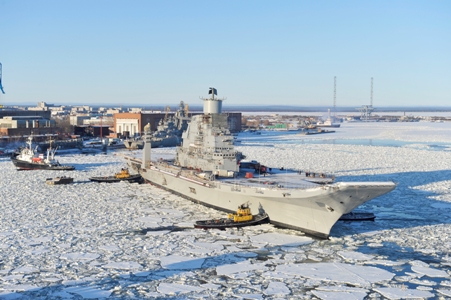
Started the next stage in the works to repair and modernize the aircraft carrier ins Vikramaditya. In weekend ship otšvartovalsâ from the wall dostroečnoj Quay and was moved to the station of degaussing.
During 20 days will be measuring the magnetic field of an aircraft carrier. This procedure is obligatory for all warships and to protect it from mine-torpedo weapons that reacts to the magnetic field of a ship. “The most important thing for us is that the aircraft carrier was totally self-dependent, are all internal systems and mechanisms, its own power plant, galley, water-tells the responsible deliverer flight Igor Leonov. -On board loaded with nutrients for 30 days, there is a Russian aircraft carrier crew. ” Permutation operation itself, according to Igor Èduardoviča, succeeded, though not without difficulty – Estate Lake plant is covered with ice.
Work on the aircraft carrier is available 24 hours a day. At the same time on the ship is up to 1100 workers who delivered tugs. The next important step is to krenovanie: on board the ship are goods weighing 360 tons, which over time are moved from the Board to Board. On the ship’s roll Centre is its mass, it is very important for evaluation of stability. After all the activities at the factory the aircraft carrier will test at sea. Output is scheduled for 25 May.
Anastasia Nikitinskaâ, head of the press service
Photo by Maxim Vorkunkovahttp://www.sevmash.ru/rus/news/1071-2012-04-09-14-44-56.html
JangBoGowhats the helicopter on that Russian model? doesn’t look like anything from Russia.
from the general looks of that twin-engined helo (except the tail rotor part), it looks like they meant Ka-60.
JangBoGohas there been any known encounter between Akula and USN Seawolf/Virginia class SSN and how did things go between them ?
it is possible that such an “interaction” has already taken place or will be on-going shortly in the Indian Ocean with the American subs based in the IOR.
Next time joint exercise goes on, there will most probably be a silent killer on India’s side to monitor the whole thing and to keep watch on the “uninvited underwater guests” that some usually send to the exercise scene.
JangBoGoSevmash press release
Train Indian sailors
March 29, 2012
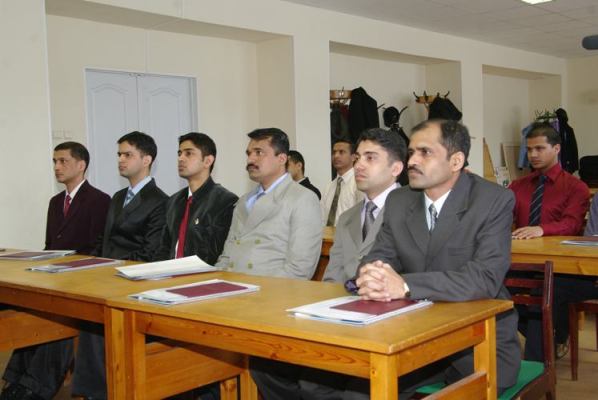
-Completed learning the second thread of Indian seafarers to crew the aircraft carrier ins Vikramaditya.
On Wednesday, the latest 7-th group were solemnly handed over the evidence. Under the terms of the contract on the renovation and refurbishment of the ship, the Russian side has to train Indian crew, which then will serve on the aircraft carrier.
The first thread of 152 persons received training in Russia from 14 March to November 4, 2011 second thread (112) began classes on September 1. 4 month Indian sailors lived in Pushkin near St. Petersburg, studying theory based VUNC NAVY “Naval Academy and 1 January arrived in severodvinsk. Yesterday, the last group of sailors electromechanical warhead has received a certificate of completion of training.
Congratulations graduates have monitoring team leader Mr. Srinivas, head of training center «-» Victor Pustovalov, head of education production PTS Nikolai Zhirkov, leading specialist of State Corporation rostekhnologii Stanislav Klimanov. All wanted the Indian mutineers of the happy return home, but said that very soon they will once again arrive in Russia to undergo Navy practice.
The Indian sailors packs suitcases, transporting the memory of Severodvinsk winter clothing and chocolate, are preparing to develop learning theory, the last 3, but the large stream. 405 soldiers in late April, will arrive in St. Petersburg.
Anastasia Nikitinskaâ, head of the press service
Photo By Alexander Tretiakov
JangBoGoSevmash press release. Shes looking very beautiful…anyone got bigger picture?
Important stage works
April 9, 2012
Started the next stage in the works to repair and modernize the aircraft carrier ins Vikramaditya. In weekend ship otšvartovalsâ from the wall dostroečnoj Quay and was moved to the station of degaussing.
During 20 days will be measuring the magnetic field of an aircraft carrier. This procedure is obligatory for all warships and to protect it from mine-torpedo weapons that reacts to the magnetic field of a ship. “The most important thing for us is that the aircraft carrier was totally self-dependent, are all internal systems and mechanisms, its own power plant, galley, water-tells the responsible deliverer flight Igor Leonov. -On board loaded with nutrients for 30 days, there is a Russian aircraft carrier crew. ” Permutation operation itself, according to Igor Èduardoviča, succeeded, though not without difficulty – Estate Lake plant is covered with ice.
Work on the aircraft carrier is available 24 hours a day. At the same time on the ship is up to 1100 workers who delivered tugs. The next important step is to krenovanie: on board the ship are goods weighing 360 tons, which over time are moved from the Board to Board. On the ship’s roll Centre is its mass, it is very important for evaluation of stability. After all the activities at the factory the aircraft carrier will test at sea. Output is scheduled for 25 May.
Anastasia Nikitinskaâ, head of the press service
Photo by Maxim Vorkunkova
JangBoGo^^ Actually, they might be building the NOPV (which seems to be based on the P28).
Prasun Chorgupta is not a very reliable source to put it lightly…
regarding Prasun, i prefer approaching it without any pre-set mindset.
He got it from DefExpo and probably he might have asked the representatives from Pipavav? But we have heard that Pipavav have some sort of tie up with foreign partners and one of them is SDB. So it is possible as Pipavav does not have any design capablity (AFAIK). So the design has to come from someone else.
btw, what chance do you see for a PSU shipyard giving away their new bread-n-butter P-28 design to a competitor from the Private sector?
BTW, there was apparently an explosion in the engine room on Vikramaditya a few days ago.
Thats what happens when you buy an old ship which has not been maintained. The refit/refurb process only goes so far.
I wonder how many more explosions there will be in future.
AFAIK, INS Vikramaditya’s main power plant is not diesel engines. The screws are powered by the steam turbines and the required steam is generated by the 8 boiler units running on diesel fuel. The diesel engines on the carrier are mainly for generating electrical power for the ship.
Even in the translation it is said the exhaust pipe burst. But still not clear which and where that bursting happened and how severe it is. Bursting of exhaust pipe due to increased pressure can happen when there is lack of exit…and a cause can be due to the pipe getting clogged.
JangBoGoSomeone, I believe Mr. Wand wanted a recent pic of MiG-31 with full load:
http://farm8.staticflickr.com/7265/7060445235_e53592f615_b.jpg
thatz real good!
JangBoGohttp://img-fotki.yandex.ru/get/6205/119078089.2/0_74249_ebc71fa9_orig
The beast in dock.
has she completed the testing?
JangBoGohaopilot,
Great photos. I loved those Gepard photos….any other shots available?
Got any good photos of Vietnamese Svetlyak class?
JangBoGoFrom trishul blog…..
Posted below is the first available artist’s conception of the naval AOPV that is now being built by Pipavav Shipyards for the Indian navy. This AOPV was designed by Russia’s Severnoye Design Bureau.
http://2.bp.blogspot.com/-D8ukiT4-eIs/T3tKltDWM5I/AAAAAAAABIw/XIEudhqJvE8/s1600/DSC00509.JPG
Any idea on which design it is based on…Project-22160??
JangBoGoSarov’s mission is still secret of course- but there was quite a photographic coup:
http://militaryrussia.ru/blog/topic-216.html
Can’t wait to see Vik out at see. Radar looks monstrous.
Thanks for the link….I was not even getting its name and project number.
Yes, the radar is huge. But I would have loved to see the 4-panel radar on the structure retained in the form of new units.


 Sign In