 Srbin
Srbin16 FC-1s is not much, they should order at least 30. I mean they wouldn’t cost much and the K-8s cost about 3-4mn each.
Srbinfrom here
http://topgun.rin.ru/cgi-bin/units.pl?field=3&unit=2052&lng=eng
it’s this Russian site.
Damn I just realized how damn big those Flankers are 😛
Srbin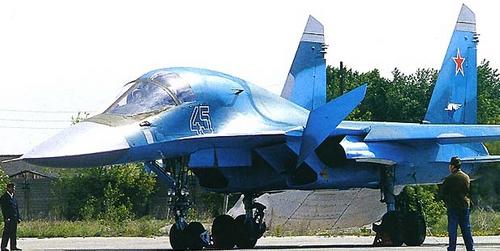
Srbinlet me gather some more info
Su-34 (Su-27IB – Istrebitel-Bombardirovshchik) is a two seat (“arm-to-arm”) strike variant that first flew in 1990. It features frontal wings and a large flattened nose with sharp edges (like the SR-71) reduce radar cross-section. This new ship-borne fighter is fitted with two AL-31FP engines with vectored thrust. Using them allows either the take-off distance or maximum take-off weight (MTOW) of the aircraft to be increased by 10-15 per cent. In the nose is a new multi-mode phased-array radar with terrain-following and terrain-avoidance for low-level attack. The aircraft has a distinctive large “sting” in the rear which contains the NO-14 radiolocation system, a radioelectronic countermeasures system, and a fuel tank. The NIIP NO-12 rearward radar that monitors enemy fighter activity behind the aircraft, and as needed, direct R-73 short-range and R-77 medium-range AAMs at the targets. The Su-32 and Su-34 have been developed and are in serial production in Novosibirsk for the Russian Ministry of Defence. The Su-34 fighter-bomber is intended to replace Russian Su-17, Su-24, and the MiG-27. A reconnaissance variant will replace the Su-24MR in the tactical reconnaissance and EW role.
The first aircraft was a Su-27UB, which featured a frontal section with new radar, bigger and widened nose. The new variant was called Su-27IB initially (Istrebityel-bombardirovshchik – fighter aircraft). The new section of the nose had a side by side cockpit. The leading edges were extended until the root of the cabin and had canards. The first prototype was not equipped with fire control systems and was used for aerodynamic tests and arrangement of cockpit. It had an improvement in the maneuverability and characteristics of landing and take-off. The air inlet lost variable geometry, since high speed at great altitude was not as important, as the bomber works most of the time at cruise speed or at low altitude.
The Su-27IB (T-10v for the Sukhoi) flew for the first time on 13 April 1990, piloted by Anatoly Ivanov and as the prototype, already called Su-34, it flew on 18 December of 1993. At this time, the development was transferred to the manufacturer in Novosibirsk in Siberia for the base of tests of the Russian Air Force in Zhukovsky. The development was decelerated in 1997 for the Sukhoi to concentrate itself in the development of the Indian Su-30 and the Su-27 acquired by China. The Su-34 was successfully tested in the Chech?nia according to Russian authorities, and also it participated of exercises of combat in the military field of Ashuluk in 1999.
It will be the new Russian theater strike aircraft, substituting initially for the Su-24 Fencer (the Russian equivalent of the F-111). The Russian Air Force has a total of 445 Fencer in Russia, being 365 in the version, B, C, and D and 80 Su-24MR and MP for reconnaisance and Electronic War. Later it will substitute the Su-17 and the Mig-27 in the tactical attack aviation. Also it is planned to be the new Russian naval bomber with coastal base, substituting the naval versions of the 95 Fencer Su-24MF (70 Su-24/Su-24M and 25 Su-24MR/MP) and of the naval Su-17 Fitters and later Tu-22 in attack antiship and Tu-142 in anti-submarine war.
The two members of the crew sit down side by side in a large cabin, with the pilot-commander to the left and navigator/operator of weapons to the right in a jettisonable Zvezda K-36dm seat [that has an inlaid system of massage]. The advantage of the side by side cockpit is not to need to duplicate instruments and controls of flight, which improves efficiency and comfort. As long missions require comfort, it has pressurization that it allows to operate up to 10,000 meters without oxygen masks, which are available for emergencies and combat situations. The members of the crew can leave the seats and be in vertical position and relax. The space between the seats allows that they can lie down in the corridor, if necessary.
A long-range surveillance radar, passive detection systems, system of communication for tactical and strategical voice and data in a single platform with long-range capacity with flight refuelling, transform it into a way of monitoring and recognition in real time and platform of command and control, forming a complete battle management system.
I can understand it can replace the Su-24, Su-17, Mig-27 and others easily in the attack role and can also act as a interceptor for it’s secondary role but the thing is how would it do in the anti shipping role?
First could it carry teh Yakhnot-M which is Russia sopposidely best anti shipping missile and also could it make use of it’s extremely long range by engaging ships at those large distances? Is it’s radar good enough?
I think this thing could be good to replace the Tu-22M only if it’s anti ship capabilites were good enough and if Russia acquires more Il-78M tankers.
SrbinWell what is sure that PAK-FA
-will be a twin engined multirole fighter to replace Mig-29s and Su-27s in Russian AF
-will be lighter than Su-27 and probably smaller and will be bigger than Mig-29
-it’s avionics and engines are unknown, it will not use AL-41F of the mig 1.44 but totally new engines as announced by Sukhoi
-it will not be as stealthy as F-22 nor is it being attempted to be because it would radically raise costs and Sukhoi doesn’t want this, they want it to be cheaper, they say 35mn but thats very unlikely
Russia has the expertise to build a 5th gen fighter, the only thing they would have problems with is stealth, but otherwise, avionics and engine wise they could do it and have proved it with Mig 1.44. However I am not sure about AESA radar and who knows but so far they have not developed it.
SrbinWhy would Egypt want the FC-1? I mean what roles would it fill? Aren’t their F-16s and M2K’s enough? I mean they should be saving money to replace those in the future. I don’t see how FC-1 could make EAF better.
Also those K-8s are vg, they are very cheap, something like 3-4mn per plane, it’s ridicilous that they are cheaper than turbo prop trainers, but probably more expensive to run.
Srbinwhen is the winner sopposed to be announced?
Srbinyahh thats true, by the time this new light weight fighter might come out the market would be crowded with the Eurocanards, PAK-FA, JSF and J-12 and other Flankers and who knows whatelse. Besides MiG could build it, something very small, smaller range, advanced and they could squeeze it in pretty quickly if they have the right funds. They should also try going for something cheap but I am not sure whats going to happen, and even if they make it I am not even sure RuAF would buy it.
SrbinHow about that MiG fighter? Is that sopposed to be a replacement for all the Mig-29s out there and other Mig-21s and etc? MiG might have the experience but there isn’t a big market out there, this isn’t the cold war and I doubt the MiG has the money.
SrbinI am not really sure about either of them for some reason.
-JSF is a great plane no matter what you say and it will probably replace all the F-16s around the World but JSF will cost as much as EF2000 probably, I can bet anyone with that, JSF is getting fatter right now which in my eyes is not a big problem but it’s cost is going to jump heavily, the 28mn projected cost for F-35A is ridicilous, I would expect it to cost anywhere from 50mn to 100mn. -Now as for Typhoon, well it probably has a much better chance of being sold than Rafale since it’s similar in performance but will be ordered in twice the bigger numbers. EF2000 is also pretty expensive and I am not really sure about it, it costs a lot too.
-In the future PAK-FA should have similar/better performance to JSF and EF2000 and will cost the least but countries will be saying it’s still Russian and it won’t have much chance in European markets, will have in many others
-J-12, I think it will be even cheaper than PAK-FA but I am still not sure about it
-MCA, forget it, India’s committment to it is shaky and who knows how long it will take to make
-F-22, forget it I doubt anyone will buy it, even potential viewed customers like Israel and Japan will not probably buy it but rather stick with F-35
-Rafale, it’s very similar to Typhoon, similar in cost and performance but will be bought in twice the less numbers and I don’t see it bought by anyone else besides France and possibly few others.
So there you have it, I really think F-35 has the best chance in the future, and EF2000 and PAK-FA the second best in world markets in teh future.
SrbinTURKMENISTAN AIR FORCE
Air Defense (Modern)
MiG-29/U Fulcrum 22/2
Air Defense (Old)
MiG-23M/U Flogger 220
MiG-25PD/U Foxbat 24
Strike
Su-17M/UM-Fitter 36
CAS
Su-25 Frogfoot 46
Trainers
L-39 Albatros 2
Transports
An-12 Cub 3
An-24 Coke 1
Attack Helicopter
Mi-24 Hind 10
Transport Helicopters
Mi-8 Hip 10
AAM
R-27R
R-40
R-23R
R-73
R-60
KAZAKHSTAN AIR FORCE
Air Superiority
Su-27S/UB Flanker 16
Air Defense (Modern)
MiG-29A/UB Fulcrum 36
MiG-31 Foxhound 20
Air Defense (Old)
MiG25PD/U Foxbat 15
MiG-23ML/U Flogger 100
Strike
Su-24M Fencer 40
Trainer
Transports
An-12 Cub 5
An-24 Coke 1
An-26 Curl 14
Attack Helicopters
Mi-24 Hind 35
Transport Helicopters
Mi-8 Hip 60
Mi-6 Hook 6
Mi-26 halo 24
BELARUSSIAN AIR FORCE
Air Superiority
Su-27S/UB Flanker 25
Air Defense (Modern)
MiG-29S/UB Fulcrum 55
Air Defense (Old)
MiG-23MLD/UB Flogger 37
Strike
Su-24M Fencer 30
CAS
Su-25/UB Frogfoot 97
Recce
12 Su-24MR Fencer
Transports
II-22 Coot 1
An-12 Cub 7
An-26 Curl 9
II-76MD Candid 32
An-24 Coke 1
Attack Helicopters
Mi-24D Hind 76
Transport Helicopters
Mi-8 Hip 140
Mi-6 Hook 11
Mi-26 Halo 30
AAM
R-27ER/ET (Possible)
R-27R/T
R-23R
R-73
R-60
Kazakhstan looks the best with Mig-31 and Su-27, I don’t think Uzbekistan or Turkemistan can cope with that even if they are very active.
Srbinanyways heres some more news
Brazil Close To Awarding $778M Military Contract-Sources
Anthony Dovkants and Adriana Brasileiro
Rogerio Jelmayer contributed to this article
26 March São Paulo (Dow Jones)–Brazil’s government is in the final stages of awarding a $778 million contract to buy 12 new fighter jets, several people close to the bidding process told Dow Jones Newswires Thursday.
An advisory committee, which is made up of members from a number of ministries, recommended a winner Wednesday, the same sources added. Their report is now expected to be approved by a committee made up of cabinet ministers, congressional leaders and President Luiz Inacio Lula da Silva in the coming weeks.
The victor will take an important slice of a $3.4 billion overhaul of Brazil’s air defense system, and a critical position in a region dominated by the U.S. The Ministry of Defense declined to name the winner.
“It’s been decided, but the name of the winner is being kept very secret at the moment,” said a well-placed source among the bidders, adding the process going forward would largely be of a bureaucratic nature.
Brazilian giant Empresa Brasileira de Aeronautica SA, or Embraer, and French partner Dassault Aviation SA have long been tipped to win. Lockheed Martin is considered to be out of the running, while Rosoboronexport’s Russian Sukhoi jet and Gripen International – a unit of BAE Systems PLC and Saab AB – are making a last-minute push.
So much so that they’re unsettling the favorite Embraer, whose president Mauricio Botelho engaged in a war of words last week during a fourth-quarter earnings call, defending Dassault’s Mirage 2000-5 Mk2 jets.
“They say the Gripen plane is faster than ours,” said Botelho. “But the truth is we can fly just as fast with more cargo. We can also fly further. Their plane is…worse,” he added. Gripen International declined to comment, saying it avoided public shouting matches.
Talking about the Sukhoi SU-35 jet, Botelho said the Russians “have always been great aerospace engineers. But what they have now is an industrial program…Their plane is a disaster. The Russians have delayed deliveries by three years, and when the Sukhoi was finally delivered, their parts were rusted and corroded.”
Responding to Botelho’s comments, Felipe Salles, marketing manager for consultancy CSE – Camargo Sistemas and Engenharia, which represents Rosoboronexport, said there were issues in 2000, referring to problems with the Indian Air Force. “But there have been no problems in 2001, 2002, 2003, or in 2004, and India has made an order for another 140 jets. The problem is that the Sukhoi is superior to the Mirage and costs half as much, it also travels further, carries a much heavier weapons payload than the other planes, and has two engines as a safety feature.”
The executive said Russian government agency Rosoboronexport had never been more confident about winning. Rosoboronexport – which has teamed up with Avibras Aeroespacial, Latin America’s biggest arms provider – has offered to set up a new assembly line and maintenance center in Brazil, creating 1,000 new high-paying jobs here.
To do this, Rosoboronexport wants to bring Embraer into the picture to assemble the fighters. As part of its offset, Russia would be prepared to buy the Brazilian company’s commercial jets. Salles said the acquisition of 100 regional planes was possible in a deal that would be worth several billion dollars.
The Russians are also prepared to open up new business ventures such as projects involving new liquid fuel satellite launching technologies. Such know-how would be key to helping Brazil get its own space program off the ground.
Rosoboronexport would set up a local air-to-air missle production plant for Brazil and its neighbors, and the Russian agency said its government would be ready to increase trade ties with Brazil, and open the door to buying more than $3 billion worth of goods over seven years.
“No other competitor has even attempted to come close to such a comprehensive agreement as ours,” said Salles.
That may be true, but if you ask Gripen International, it believes it has the best deal on the table.
Owe Wagermark, communications director for Gripen International and former deputy chief of the Swedish Air Force, said Gripen was the only bidder trying to sell a fourth-generation fighter.
“The JAS-39 is the most modern plane on offer, it’s replacing third-generation jets like the F-16 and the Mig-29. It’s a multi-role jet, it can do air defense, air to ground, air to sea, training, true reconnaissance and all at a flip of a switch,” said Wagermark.
Still, the JAS-39 has been criticized within the Brazilian Air Force, or FAB, for not being able to travel as far as jets such as the SU-35. Distance matters as Brazil is larger than the continental U.S.
“The JAS-39 refuels in the same way as the current FAB jets, there is no problem refueling in the air or on the ground, and because of its smaller size, it’s designed to operate on very short runways, unlike some of the larger planes,” said Wagermark.
Regarding details of Gripen’s offset, Wagermark said there was a commercial element to the company’s offer but added FAB had asked bidders not to comment on specifics. Wagermark said Gripen was able to talk about its compensation package in more general terms.
“The most important thing is that we are willing to share our technology and work with any of Brazil’s companies,” he said.
Gripen International, which can assemble its planes in Brazil if need be, has offered to open a technology center with Brazil’s second-largest airline Varig SA to develop areas such as logistics support and the transfer of military technology. Varig has a unit that specializes in aeronautical engineering and maintenance for commercial and military aircraft.
Like Salles, Wagermark, who has flown the JAS-39 jet and says there’s a big difference between a third and fourth generation plane, says Gripen has the best offer. “The plane is new, and because of this Brazil would be able to renew its air force for many years to come,” he said.
Embraer and Dassault, meantime, are more reticent about what they have proposed in their offset.
In a statement in Thursday’s papers, Embraer said Dassault would transfer its technologies to its Brazilian partner, and the plane would be assembled here. Embraer, which is the world’s fourth-largest commercial jetmaker, declined to comment on whether there would be improved commercial ties with France.
Still, Embraer says it has the best offer.
It remains unclear, however, which company the advisory committee has picked.
According to people close to FAB, opinion has been divided. The Sukhoi and Gripen jets scored highly among pilots, while senior officers believe the Mirage should come out on top – though that may not be the case.
In the last few months, the government has repeatedly said a Brazilian company would be involved in the deal no matter what. Foreign bidders believe this means Embraer will win a slice of the contract, but they also increasingly think Dassault and its Mirage jet will be left out. Botelho thinks otherwise.
“The expectation is that we’ll win,” he said. “There are three strong proposals, but I can’t see why we wouldn’t be the winner.”
Source: http://www.defesanet.com.br
lol so thats what these competitions get like, morons from all sides say this is can carry twice the “cargo” and “our radar is 5 times better than theirs”
SrbinMalandrao, can you please summarize that quickly in what it basically says? The translation doesn’t make sense.
Srbinthat’s true, but wasn’t the former Yugoslavian defense industry all integrated with each other through out the different former Yugoslav states? I heard that after the break up..it was difficult to fully assemble parts since some components were made in one country, while the other essential part was now made in another.
Yes and no, for somethings it was but for others it wasn’t but a lot of factories for making different parts of something were scattered around the whole country(Yugoslavia) and in different provinces.
SrbinPLa check your PMs


 Sign In







