TMor
TMorOn the other hand Typhoons got their ass whipped by F-16s, F-15s and F-18 regularly. :diablo:
:confused:
Unusual comment. What are you talking about ?
TMorIt’s not over. They criticize, ok, but we have to see how the Snecma will react.
TMorI heard that the Eurofighter has a 7.5G rated supersonic cup holder, totally surpassing the subsonic one the Rafale has.
I complained about the fact that some of us dared talking about Rafale in a TyphoonVSsuperbug thread, and i have to do the same here.
There’s no point in posting such a comment, in addition, you know nothing about what the Rafale can do. :rolleyes: (i’m not pretending that it’s better than XYZ).
If the purpose was to learn what the Rafale is capable of, then, the only thing i can tell you (and you have to trust me) is that a video on TV showed a Rafale HUD at M1.6 pulling 8G (not sustained of course).
TMorIn fact, the thread is not about Rafale at all.
Typhoon / SH only, and in my point of view, we should not discuss about Rafale here. It’s just off topic.
TMorwhere he could find 60% difference? he knows and see stuffs you’ll never, so he knows what he talk about, and you no!
that’s why he’s dassault boss and you a whiny parot spiner…
Thank you sir.
I have yet to find a single figure i could compare with what HE could get about Typhoon : there is not a single credible source except Edelstenne about Typhoon costs. Strange, isn’t it ?
TMorIn the moroccan deal, we saw how the Rafale was 50 millions per unit….3.300 million dollars for 18 right?
50 millions is the fly away price.
But you know that a deal is about a lot more than production costs.
He is speaking in front of the french parliament which will check the precision of the speech thanks of the defense committe composed of MP from differents political parties. So it would be unwise for him to lie…Especially knowing that a certain political press would love to dig up such things…And this is simply democratic regulation…
I’m afraid that you’re too optimistic. I still do not understand where he could find a 60% difference for example.
In addition, they always mix costs with VAT and costs without VAT. I’m really skeptic about their figures.
I think Rob is true here, Edelstenne says whatever he wants, I would like to see his data.
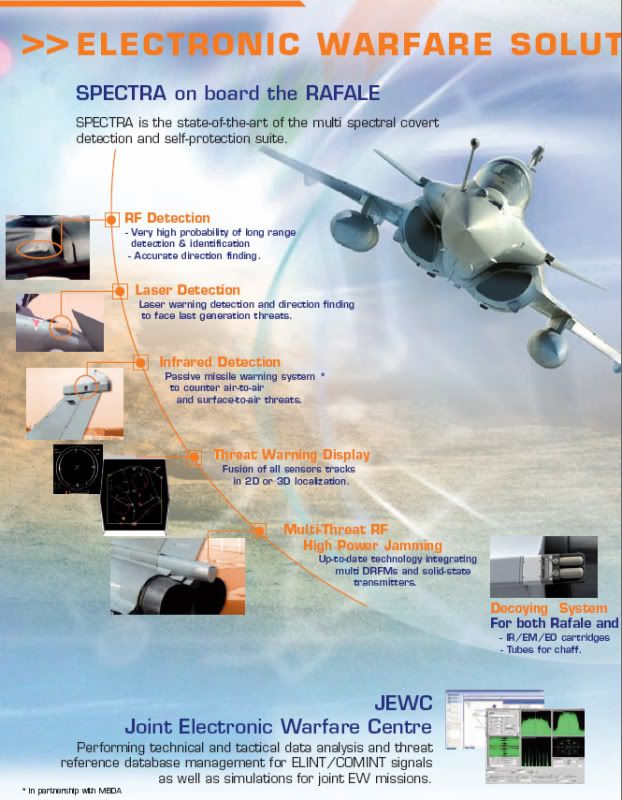
TMorJust under the LWR in the fairing at the top of the fin.

Of cource, what i wanted to circle for the LWR was the black rectangular part just above the RWR.
😉
TMorI know that the document is wrong on the LWR position in the front. But I thought that the sensors on the sides of the fin tip pod are the LWR, but they seem to be the MAW. Is the rearward facing ECM antenna located in the fin root, where the RWR antenna is?
Just under the LWR in the fairing at the top of the fin.
TMorSeems like there are no rearward facing LWR sensors:confused:
Actually, the document is wrong. The thing they labelled “laser detection” is in fact a jammer (the same as between the engines at the root of the fin).
LWR are :
1-one on the rear face of the fairing on top of the fin.
2-one on each side of the nose (look for small black squares) (above the yellow arrow).
http://upload.wikimedia.org/wikipedia/commons/f/ff/Rafale_ag1.jpg
TMor😀 Interesting laser warning detection sensor.
TMorover-g
thales and dassault are also working on plasma stealth and even plasma jamming. There was a detailed article in A&C about that. (perhaps another french poster can find a link). But it seems that those technologies are not mature enough to be implemented operationaly.
In his book “Rafale : la véritable histoire”, Germain Chambost also talks about research in the plasma field. The goal is to hide compressor blades. But we have no details.:rolleyes:
I expect this kind of toys to be ready only for 2020+.
TMorNow I can read it thanks. This probabley goes hand in hand with the integration of a SATCOM into Rafale. Are there any news/infos available about SATCOM in the Rafale? Read about plans for it long ago, but nothing has been reported since. Might be a feature of F3+?
SATCOM for 2015, according to T&A (Technologie et Armement).
TMorhttp://www.zinio.com/express3?issue=315864767
See page 31 about the AASM, it’s really interesting :
One weapon with unique advantages for CAS is the AASM (armement air-sol modulaire) from Sagem Defense Systems, newly operational with the French air force. AASM combines a standard bomb body with wings, a small rocket booster and one of four guidance heads: INS/GPS alone, or combined with scene-matching IR, laser or millimeter-wave radar (the latter not yet in service). The weapon also has a data link receiver.
AASM, Sagem claims, is more agile than an unpowered bomb, with the result that an aircraft needs less time to reposition before releasing the weapon into a laser-guidance basket. It is also programmed to seek the shortest flight time to the target and designed to perform a vertical terminal dive, reducing the risk of collateral damage in urban areas. As a last resort, it is designed so the fuze can be inhibited in flight, rendering the bomb a dud if it goes off course or a day-care bus blunders into the target area.
TMorThales Reaches Another Key Milestone In Its Phased Array RBE2 Radar Programme
(Source: Thales; issued Nov. 3, 2008)
NEUILLY-SUR-SEINE, France — Thales, European leader in electronic combat systems, today announced that its Active Electronically Scanned Array (AESA) RBE2 radar has reached a significant new milestone with the end of its hardware development phase.
This announcement signals the beginning of the first AESA product delivery phase and the validation of the new software functions, which will further enhance the radar’s capacities.This milestone is the last in a long line of key events that Thales has seen with the development of its state-of-the-art radar – AESA flight tests first began in 2003; the radar’s concepts were validated in 2005; the industrialisation phase was launched in 2006; and this final phase sees the end of the development period and the beginning of production of the hardware model. Final validation of software functions is expected to end in the 1st quarter of 2010 with the delivery of AESA radars to Dassault.
Earlier this year, the company saw the successful completion of a series of flight tests on the Rafale itself, giving further positive results of the radar’s performance in an operational configuration.
Pierre-Yves Chaltiel, Senior Vice President in charge of Thales’ aerospace solutions for government sector, comments, “Thales’ AESA radar is the furthest advanced radar of its kind in Europe. With several years advance on competitor solutions, Thales’ technology is unrivalled and we are extremely proud to be launching the production phase of this cutting-edge radar.”
In 2006, the French defence procurement agency agreed to a Roadmap that will deliver Rafale fighter aircraft with a new generation of sensors including the AESA RBE2 radar to the French Air Force and Navy by 2012.
Full integration of the AESA RBE2 positions the Rafale as the only combat aircraft of its category equipped with active arrays for both its radar and electronic warfare suite. This outstanding system that allows a 360-degree smart antenna array coverage, is a real technological breakthrough on-board the aircraft.
Customer evaluation of the Rafale combat aircraft is now carried out with these high technology systems on-board, offering the Rafale an unrivalled advantage in current worldwide competitions.
Thales has been developing its own European advanced AESA radar technology since the 1990s. With its long experience in radar technology for combat aircraft and in Passive Antenna Electronic Scanning functions qualified for the Rafale’ RBE2 radar, Thales has developed AESA radar prototypes and tested them on both Rafale and Hack (Mirage 2000 test bed) aircraft since 2003.
Thales is a leading international electronics and systems group, addressing defence, aerospace and security markets worldwide. Thales’ leading-edge technology is supported by 22,000 R&D engineers who offer a capability unmatched in Europe to develop and deploy field-proven mission-critical information systems. Thales employs 68,000 people in 50 countries with 2007 revenues of EUR 12.3 billion.
I think it’s quite clear now. The Swiss must have appreciated the show :
End of evaluation.
39 flights, 60 flight hours.
TMorShall i answer ? 😀
but there are some people here with good insight into programs
I know, don’t worry. Everything is ok for me (this time) 😀


 Sign In