 garryA
Which one runs cooler ?
Obviouslt the high bypass one. It is also more fuel economical
garryAAnd which might those be ? I was under impression PESA(non hybrid) could do everything that AESA does.
In AESA design ,the low noise amplifier is put near the receiver before the lossy components, thus AESA radar can achieve better signal to noise ratio compared to PESA (better signal to noise ratio will improve radar detection range). AESA design is approximately 2.79 dB better than PESA design in that aspect ( or about 47% better )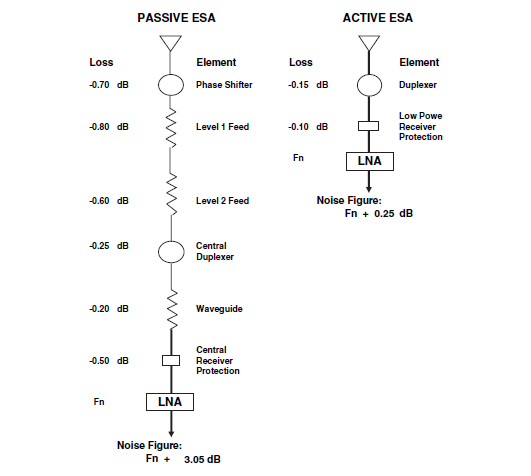
Furthermore , since individuals T/R modules on AESA do not rely on a single high power amplifier, they can transmit signal at different frequencies at the same time. As a result, an AESA can form several independent beams at different frequencies simultaneously by dividing the array into a few smaller sub-array, that improves its multitasking capabilities.
garryABut————–using common sense and logic, a fighter should be a fighter. It should NOT be encumbered and slowed down by pylons to carry bombs. If you want to bomb, use an attack bomber like the A-4 or a medium bomber.
Using common sense and logic , most country cant affrod an adequate seperate fleet of fighter and bomber
garryAMost pilots survive when their aircraft are shot down so they could be reused on another plane quickly. And if a pilot ejects, his JHMCS is likely not to be damaged.
Survival rate of ejection seat is around 80–97% so there is a big chance that you could die . Moreover, there is a significant chance of injury as well
garryAIn the 1970s, the AV-8B Harrier used VIFF (vectoring in forward flight) to jump rather than slide into new flight paths which prevented sophisticated homing missiles and their guidance radars from locking onto them. “In combat simulations using VIFF techniques, the AV-8B outfought the Navy’s F-14 Tomcat in 6 out of 16 encounters, fought it to a draw in another 7, and lost only 3” (Arsenal of Democracy II, 1981, by Tom Gervasi). I’m assuming that those computer processors weren’t fast enough to track such an instantaneous “jump”. If that is correct, can today’s faster processors overcome such tactics?
As far as i know , VIFF is used in close combat , not for BVR. The momentary stationary reduce the Doppler shift ,thus potentially can break radar lock. However, that require alot of luck also and after a VIFF you became an easy target due to the vast amount of kinetic energy that you wasted
Again from Gervasi’s excellent book: “… The most sophisticated stealth technique, of course, is that of destructive interference which reflects part of the radar wave from the aircraft’s surface coating and part from the material beneath it in such a way that the 2 sets of reflected waves will be out-of-phase. When this happens, the 2 sets of waves cancel each other out and no signal returns at all. The problem has been that a given coating applied to a surface material could only combine with it to defeat one specific band of radar frequencies (like the SR-71 Blackbird)
That is wrong , some RAM have very wide frequency coverage (eventhough they may work best at a specific range of frequency)
This problem has been overcome by developing plastic and resin coating materials laced with electrical which heat them and cause them to expand. Controlled by a computer that is part of the aircraft’s ECM power management system, the filaments automatically heat and expand the coatings to a predetermined setting which ensures that the radar waves used at any given time to detect the aircraft and whose frequency has already been analyzed by the aircraft’s radar receiver will be out-of-phase. … …”
No stealth aircraft in production use that method.
Can modern stealth overcome monopulse (frequency agile) radar?
Monopulse has nothing to do with frequency agility. It is a method to improve radar angular accuracy to a degree narrower than its own beamwidth by using more than 1 main lobe
garryAI archived a lengthy essay on this topic by defenseissues.net at http://www.stealthskater.com/Documents/Weapons_01.doc (or .pdf). The author’s conclusion was that Quantity beats Quality every day in the real world (while not so in paper and computer simulations). He also took into account the lengthy maintenance required before a high-tech plane can return to combat.
Picard (owner of defenseissues) has a long history of making up number without source and doesnot understand basic physics so you should take any article he wrote with loads of salts
(Note how a “kill” is defined. It is not the Hollywood version where a target is blown up. If a missile can prevent an aircraft from achieving its mission [e.g., inflict serious damage] and the plane has to return to its base, that’s counted as a “kill”. One time a missile lost its lock on a target plane and locked on instead to a weapon that was released from the attacking plane. It destroyed that weapon. That was also counted [erroneously in my opinion] as a “kill”.)
For military acronym, there are various different kind of kill
Mission kill : stop enemy from continues the mission
Mobility kill : stop enemy from moving
Catastrophic kill : complete destruction of enemy assets
In http://www.stealthskater.com/Documents/Missile_01.doc (or .pdf), the same defenseissues.net author maintains that the Pk (kill probability) of any radar-guided anti-aircraft missile is woefully small and the IR-guided missiles are not much better. It has to do with the missile flying at high terminal velocities. Even their 25- or 50-g turn rates didn’t help these missiles score a kill the vast majority of the time WHEN the pilot knew where they were and employed evasive maneuvers.
I see now where they are adding thrust vectoring to some of these SAMs and AAMs to improve their performance. I think that a variable throttle missile (like in a liquid-fueled one) would be better. It could rapidly catch the plane and then slow down to match the plane’s evasive maneuvers. Someone would win a Nobel prize if he/she could discover how to make a solid-fueled engine be variably thrusted
AFAIK , most of his statistic and assumption are wrong.
Along the same lines, a antiair missile’s warhead has explosives wrapped around a metal rod. When it detonates, the rod decomposes to hundreds of high-velocity fragments (flak). Problem is that it more-or-less goes in a spherical pattern, thus wasting a good percentage of the shrapnel. Could they invent a “directional” radar proximity fuze to confine the blast in a conical direction?
Not all air to air missiles use continues rod warhead, the new one like aim-120 use blast fragmentation instead. The future one even have ability to focus their blast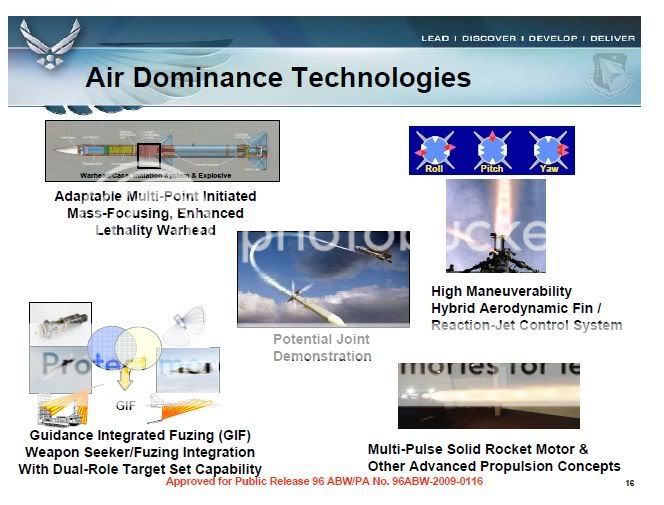

The same defenseissues.net author also posted another essay (http://www.stealthskater.com/Documents/Missile_02.doc (or .pdf) on how pilots are trained to avoid missiles. In computer simulations, SAMs and AAMs always high kill probabilities. But in actual combat, the Pks were very low. The key is knowing where the attacking missile is so that you can “time the overshoot” (assuming youhad the training). So much for the “no-escape zone” myth. If all this is true (and it apparently is), won’t BVR and WVR revert back to the days of dogfighting with guns since AAMs and SAMs are so unreliable when facing a well-trained pilot?
Missiles do not try to match the exact turn of plane , they intercept the point they flying to instead.While it may not be so hard to dodge a single missiles, dodge several missiles is very hard and will deplete your energy quickly especially at high altitude
garryAin a maneuvering fight f-35 lose
Not necessary. It got very good subsonic acceleration and ITR
garryAThe III was MUCH faster
It is slightly faster by 0.2 Mach. Regardless , those top speed rarely achieved in real combat
and a MUCH better dog fighter
That debatable F-8 may have better turn rate than the hard wing F-4J of US navy , but against the slatted wing F-4E or F-4EJ ? probably not
garryAyes, read the part you highlighted in bold a few times, and contemplate what air to air configuration really mean
What does internally mean ? internal configuration for F-35 has always been with internal fuel and weapon.
another thing to contemplate is all other sources put F-35 internal fuel in 5XX-6XX nm radius,
only one, the norwegian, puts it at 7XX, -> with 2 DT because F-35 cant use 3
Nope , this one put it at over 700 nm for both AA and AG configuration
This one put the combat radius at 751 nm for air to air configuration with engine at the end of its life where fuel consumption increased by 5%
This one put combat radius at 732 nm for air to surface configuration
This one put combat radius at 760 nm for air to air configuration
Norwegian put combat radius at 610 nm , however the condition is entirely different including medium altitude cruise and combat at low altitude
This talk about 700 nm combat radius for internal configuration
garryAthat didnt state internal fuel, it stated internal A2A configuration, as in 4 aam.
israel is working on DT for F-35, when combining all info on internal fuel range,
internal + external as in norway, (728 nautical miles using external tanks)
i conclude 760 nm range is with israeli 2 DT back and forth at optimal cruise height
That is utter nonsense . There is no external fuel tank for F-35 in existence and the development already been dropped. Nor is there any configuration where it carry 4AAM inside and DT externally. The picture clearly specified INTERNAL AIR TO AIR CONFIGURATION. I dare you to find where it define internal air to air configuration as having 2 EFT
garryAcan you point out that thanks ?
http://www.fisher.org.il/2016/Adir%20Powepoint/GaryNorth.pdf
10g isnt the max, even gripen C was pulling 12g during certification of darter
Really does not say much , F-15 done 12G before
garryAthat didnt stop them from calculating max range, omitting to mention the two drop tanks carried by F-35,
but mention 3 DT on the others
They specific said that Su-30 and F-35 did not carry any DT
garryAWhat exactly is extreme fighter agility here ?
maybe SAAB set the bar as low as just besting an ole F-16D ?
AFAIK , according to value published by SAAB , gripen then has lower STR than F-16. Moreover given that it didnot beat F-18A/C in Swiss evaluation , it may not be able to beat F-16D
but according to test pilot frederich mohler, gripen E could easily be touted as a 10g fighter,
since it could pull those g without effort
Maximum G limit doesnot say much. F-14 has lower G limit than F-16 yet it got higher ITR. Moreover, F-35 has been tested to 9.9 G AFAIK
guessing they weigh all bands more equally than L.M
So Gripen look better than F-35 in that graph simply because it is equally bad in all band?
i dont know how you derived at a single bomb from that info,
but what i do know is a bomb does not have the finesse as an aam,
a bomb load will incur both weight and drag penalty over a few aam,
and that is going to be felt particularly on a light fighter
They said maximum combat radius so that must mean optimum profile and lowest possible load, iam quite certain that Gripen didnot carry 2 storm shadow for its max combat radius. While i agrees that bombs has less fitness , the drag of small bomb isn’t that high. According to F-16 flight manual AIM-120 drag index is 5 while GBU-12 drag index is 10, so we can think of 2 GBU-12 is equally draggy as 4 AIM-120 at subsonic speed
garryAfrom LM presentation to Norway:
https://norway.usembassy.gov/root/pdfs/volume-1—executive-summary—part-1_dista.pdf
from that link:
” The F-35 has a radius of 673 nautical miles on internal fuel alone and 728 nautical miles using external tanks. “
The F-35 mission profile for Norway included combat time at low altitude and ingress/egress at high subsonic speed. AFAIK , combat time include the use of high rating afterburner which consume a large amount of fuel
By contrast, if mission profile included high altitude cruise the range will be much better
that’s 8% increase in range while adding external tanks and way under the range SAAB claims for the Gripen, even with drop tanks. Given how poor increase it is compared to the quantity of fuel added, it’s quite pityful, and no wonder they always talk about range on “internal fuel only… good way to avoid showing the poor result of adding drop tanks and that allows o claim that they are somehow “better” in the same time
AFAIK , there is no external tank for F-35 at the moment and due to its very high fuel fraction the combat radius increase wont be high with external fuel tank.
garryA1] here is the 250 nm SC pic
47753666-DutchAirForceAssociation-Gripen-2009.pdf
So i got a look at your link http://www.jsfnieuws.nl/wp-content/DutchAirForceAssociation_Gripen_2009.pdf
Seem like a full on attack at F-35 instead of a normal advertising IMHO. Regardless, there are some rather questionable charts:
What exactly is extreme fighter agility here ? why there is no value for sustained or instantaneous turn rate ? , AFAIK the original Gripen was considered inferior to F-18 according to Swiss evaluation 
How come Gripen is considered LO at VHF , L band while F-35 isn’t ? ( Gripen may be smaller but the shaping of F-35 will reduce specular reflection regardless of frequency , obviously travelling wave return may be larger when frequency going down but that doesnot explan how do they concluded that Gripen will have lower RCS )
Iam quite sure that F-35 can do more role than just the part where they circle 
A closer look at their newer advertised brochures here http://saab.com/globalassets/commercial/air/gripen-fighter-system/gripen-ng/technical-brochure-gripen-ng-english-ver.2-jan-2015_low.pdf shows even more questionable points :
The new Gripen NG turn out to be about 2000 lbs heavier than expected 
Moreover , i found this very important detail Something does not add up here , so carry a single bomb or a few SDB will reduce loitering time from 30 minutes to 0 minutes ? 


 Sign In







