 garryA
1] the photo is from the norwegian competition i think
Can you give the link to original source
2] F-35 can not load 6 aam internally, its not even planned, its notional, look up notional on google
Technically speaking then SDB II ,JSM and JSOW are also notional .Regardless there is no reason to not atleast give it 4 AAM since that the load out at the moment
3] sneaky SAAB made the requirement mach 1.1, had it been EADS they would have set the requirement mach 1.4
had it been L.M they would have set requirement mach 0.9, this is an obvious PR to go about
Another sneaky aspect is the load out of only 2 AAM for F-35 and no mentioned of CAP time
4] F-35 is cited as needing a bit of a/b to go supersonic, -hence its not supercruise capable,
every last source state F-35 can not achieve supercruise by definition, just give up already
Assuming that true , the no mentioned of CAP time for F-35 seem very dodgy , could be simply that F-35 would still be able to stay on the air longer than Gripen NG despite using afterburner since it is only internal fuel that we talking about here
4]
5] dont bother with T/W on supercruise, its T/D and you know it
There is lift induced drag as well, so higher weight mean more drag though not as much as parasitic drag or friction drag
garryASAAB do have an example on a time critical mission.
as one F-35 pilot would have it, it doesnt really matter how you achieve supersonic cruise as long as you achieve it,
for a meaningful time, (and on the face of it, he does have a good point)
so its still a huge advantage if you can make it on dry thrust.
also notice this SC profile include a remarkable 50 min. on station,
altho this being time critical it would perhaps have been more appropriate
to make a wild guess how long it would fight on station
Where does that photo came from ??????
similar to the previous table , there are many questionable “data point “
garryABeing none to fond of F-35, but this article is ridiculous.
Many of those whom work on SH, may find work at F-35 or F-15 prod line, etc.
Being a long time member , i thought you would have noiticed blackadam has a habit of posting awful article as long as those articles support his nationalist agenda.
garryAyes, probably SAAB info,
wake me up when L.M officially state F-35 make 800 nm combat radius + 30 min on station CAP,
not counting pilot rambling here but a statement on official L.M website.
its a whole lot more relevant than what you feel you are pretty sure about
AFAIK Brazil test shown otherwise , Gripen NG has shorter range compared to super hornet
garryAF-35 combat radius is low compared to gripen
Pretty sure , it out range the gripen significantly even on internal fuel
subsonic acceleration is nice if you operate from a ski jump carrier
but apparently gripen subsonic acceleration is sufficient for operating from 600-800 meter improvised air fields
Not just that , subsonic acceleration is important for dogfight
guessing they are evenly squared on sensor fusion.
That chart is unbelievably biased
Not only that they repeat the same thing over and over again to turn it in Gripen Ng favor , but it also contain many false information.For example : the fact that raven aperture can be reposition is repeated 4 times under different criterias : “Repositioned” , “scan area” , “side looking ” , “very high FoV “. Then there is some nonsense criterias like ” IRST air to air enhanced ” and ” Embeded air to air IRST enhanced” , what the heck do they even mean ?. Moreover , where is the evidence that Skyward is superior to EOTS in that aspect ?. Then there are many others criterias that they got wrong such as ” active RF decoy ” where they listed F-35 as ” NO” but it actually does has one ( ALE-70). Or “user app” criterias where most people who follow F-35 program would know that Israrel for example has their own app for F-35I. Last but not least , whoever made the chart also very sneakily play down some of F-35 advantages such as bigger radar aperture ( 1600 T/R modules vs 1000 T/R modules ) , or more effective ECM ( because jamming power and burn through range scale proportionally with radar cross section )
garryAYep, have never seen any evidence that the F-35 outperforms its rivals here.. Have you?
Yes
This isn’t utter nonsense, this is Swedish daily routine.. I have not said untrained, BTW.. and operated does not mean flown..
How to you “operate” a fighter if not flown it ?
What exactly is the Swedish daily routine we talking about here ?
garryAI have never seen any actual evidence that the F-35 has an advantage in anything, for that matter..
How about RCS ? , combat radius ? , radar aperture ? , subsonic acceleration ? , sensor fusion ?
But Gripen can be operated by relatively untrained conscripts
This is utter nonsense, no fighter can be operated by untrained individual , unless they are willing to sacrifice a large number of them to crash in take off , landing , dogfight.
garryAFacepalm!
Mad RAT : you are mismatching TWO different things, one is the search radar, whose function is to scan a large portion of air space and the SARH terminal guidance for missiles
On fighter the search/track/targeting radar is the same one , but operating in different mode usually differ in PRF and beam width.
In case of semiactive one missile have a forward receive only antenna that point the missile itself toward a target being illuminated by a CW radio source This is usually done utilizing a separate device called track radar as it need to use a narrow CW beam instead of a wide pulsating one like in the case of the search radar.
On ship search radar is the one with fan shaped beam such as AN/SPS-67
track/fire control radar is the very high power/ narrow beam width one such as SPY-1 ( and it can took on volume search role as well due to very high scan rate)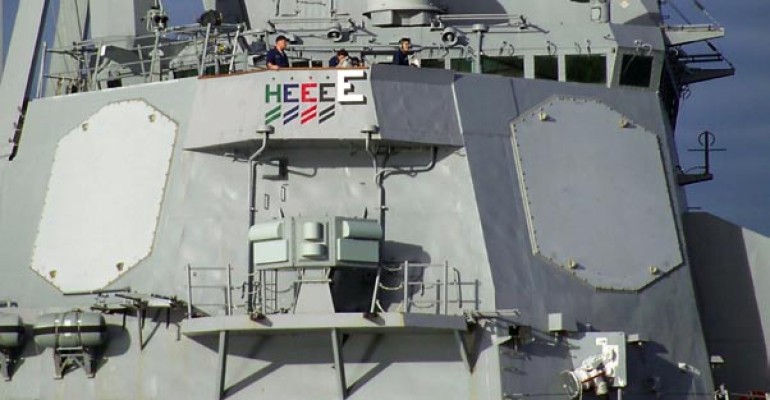
The CW illuminator is another seperate one such as AN/SPG-62 they have even narrower beamwidth than the main fire control radar but their power is much lower
The track radar and the CW illuminator are not the same one..
garryALet me say you seriously underestimate how it was difficult to track such targets until recently: they would had to be detected by the 2D surface scan radar (not the 3D AD one) as soon as the entered in the radar horizont
The only reason the fan beam (2D) radar was used for early warning instead of fire control radar was because its wide beam width will cover the volume at quicker rate , but that does not mean target have to be detected by search radar before FCR. Moreover, it was very hard to steer a high gain FCR at high rate because they need to have big aperture, however with the invention of electronic scanned array that has been solved.
To just recognize and track it you would have needed several radar scans
Which is done very quick at short range with any ESA
begin CW illumination and wait until the missile you launched reach it to detonate charge
That is without ICWI , but with that technology , SPY-1 can provide mid course update
all of this in the heaviest clutter environment possible, as sea surface reflect radio waves
Sea surface reflect radar wave but they are relatively stationary , missiles moving quite fast so the Doppler shift will be very different
garryAAbout Mirage 2000 (early M 53-5)
[ATTACH=CONFIG]250141[/ATTACH]
Dunno where that chart comes from, so pinch of salt thingy…
F-16A and F-16C in same condition
garryAIt would probably detected at such a distance, tracking would require some second and some other would be needed for the missile to be launched and reach the target
PRF setting at close engagement like that would be ridiculously high so i dont think it takes more than micro seconds to change from detection to tracking.Moreover, once missiles is launched the engagement already started.
garryAIf the ship -like Arleigh Burke- has 3 illuminators, and enemy has fired a barrage of 4 missiles within half second of each other, “time sharing” would not be valid, as counter-launched missiles would have their terminal phases right at the same time
Angular accuracy of SPY-1 probably been enough for short distance terminal guide without illuminator. Given its aperture size the resolution cell would be quite small already.
And if those missiles are M2,0+ supersonic and detected/tracked/engaged at 10km range, defending ship will have 14 seconds to shoot them down
I dont see how a missile moving at Mach 2 is only detected from 10 km. A more realistic distance would be around 25 – 30 km for sea skimming supersonic missiles if we assume the destroyer have no air cover
garryABut why do the F-35 fans always point to the LPI modes of the radar then? The F-22 has EA capability
Because fighters radar are very helpful against most targets.However, VLO targets in jamming condition is not one of them
and could have whatever capability the F-35 has with proper funding
With infinite money , you can do whatever you want. But obviously funding is limited, hence the reason F-22 doesnot even have IRST or HMD eventhough these are technically flexible
Dedicated IRST work in precise wavelength for maximum performance
Hmmm, take for example OLS-35, FSO work in 3-5 microns wavelength , exactly the same as EOTS ( ofcourse EOTS also have extra CCD and SWIR sensor)
Pirate , AAS-42 works in 8-10 microns wavelength , which is similar to DAS. So i dont see much different there either
They are also optimized for fast scanning
This doesnot make sense. There is no real reason why a “pure” IRST ( AAS-42 , OLS-35 , or FSO ..etc) should be able to scan faster than a “not pure” IRST like EOTS. In fact ,many “pure” IRST such as AAS-42 or Tiger eye or OLS-35 are scanning array , which mean they would definitely search the FoV at much slower rate compared to staring array like on DAS or EOTS.
Moreover, if some IRST actually scan faster than EOTS , then how much faster are they ? 1% ? 2 % or 10% ?.
The Advanced EOTS may approach the capabilities of a pure IRST, but probably not equate them. The regular EOTS is probably significantly inferior
IMHO there is literally zero evidence to support that assessment.I can easily say a pure IRST is significantly inferior to regular EOTS and there would be equal chance of my assessment to be correct
The F-35 can stay subsonic, but that gives the F-22 a better ability to escape if it flies in supersonic. I don’t think it would need to fly at mach 1.7 either. Launching in supersonic would also give its AIM-9Xs a better BVR range
You can’t really escape from something you can’t see.Moreover going faster generate more IR signature as well, not always a good thing
Sticking with reality is accepting the fact that the F-35 has cost 20 billion more than it should have, thus severly reducing the funding that could have been allocated to upgrading other aircraft, right?
May be it is , but that is not the question of the thread
garryAIn BVR the F-22 is likely to detect the F-35 first thanks to its larger radar and the fact that the F-35 carries external WVR missiles
Fighter radar would be pretty much irrelevance if you were to face off against target with radar cross section of that size. Especially when F-35 has jamming as well.
Also, the F-22’s IRST ( assuming a small part of the F-35’s cost overrun had been spent on F-22 upgrades ) would detect the F-35 first thanks to the fact that it is a pure IRST
TBH , until now , no one can provide any figure to prove that a “pure” IRST ( such as OLS-35 , FSO ..etc ) would offer advantage in detection range over FLIR/IRST ( such as EOTS ) . And if F-22 was to have an IRST , it would likely be variation of EOTS
and also that the F-35 has to use its reheat to maintain supersonic speed. The F-22 probably wouldn’t need to fly very fast to have the first shot with its AIM-120D so that would reduce its IR sig.Also the F-35 won’t have the 120D before 2020-2022 or something like that, giving the F-22 a substantial advantage until then
Why would F-35 use afterburner if the fight is likely to be short range ( VLO vs VLO assets ) ?. Moreover, if we go with reality then there isn’t any plan to put IRST on F-22 in near future either.
garryASensitivity translated in range and very low RCS tracking. source? Christian Venot, program head, 3AF conference, Oct 12th 2016, Le Haillan. Of course, you can believe me-or not- (i guess you won’t, but i was there, not you)
TBH , argument like this is rather pointless.If you dont have video or documents of the conference what the point ?. Imagine if someone here claim to come to Boeing conference and they said F-18 SH radar is better than Rafale radar, would that be a valid argument?. I would think not.
RBE2-AA is nearly a decade newer, it would be reasonable to assume the UMS T/R modules offer some improvements in sensitivity than those in the APG-79.
That sound fair, but would it enough to overwhelm the physical size though ?


 Sign In







