 garryA
By design constraint, the back-end elements of a radar, especially the signal generator are frequency limited.
Tomorrow, frequency hopping will be a necessary condition for any sustainable radar use. Photonics technologies allow a radar to operate at broad wide frequency without major complexification (hence cheaper and more reliably).Also, compactness and light weight made this technology very suitable for radar, planar radar or embedded radar panels.
Everything is on the links.
Fair point , but i dont see how that related to other alleged capabilities of photonic radar such as super high resolution at long distance or immune to stealth
garryAFor first question : To generate their radar signal, Ghelfi and company used software to select two optical resonant frequencies (modes) in a mode-locked laser and fired it at a photodiode sensor. The electrical output from the sensor is an RF signal that can reach up to 40 GHz without upconversion; because the laser is mode-locked, there is very little noise. Return signals are altered in amplitude in a way that is easy to accurately digitize.
It is an excerpt from this article:http://spectrum.ieee.org/tech-talk/aerospace/aviation/laser-makes-more-accurate-radar-system.
it can also explain how the frequency range is determined no more by hardware i.e. RW transmitter.For all the rest, here the article in Nature:http://www.nature.com/nature/journal/v507/n7492/full/nature13078.html
Here a diagram: http://www.nature.com/nature/journal/v507/n7492/fig_tab/nature13078_F2.html
According to what said in the article ,in photonic radar you can reduce internal noise of the system by 10 times ( 10 dB ) because analog hardware components such as mixers, amplifiers are replaced by two optical resonant mode-locked laser and a photodiode sensor. But that would only affect internal noise of the system ,while 10 dB reduction is good i dont see how it is related to able to have image like resolution at long distance like you claim . Moreover ,background noise will still present , talking about noise reduction , AESA radar also have their amplifier in front of lossy components to reduce effect of internal noise ( that give it about 50% or 3 dB noise reduction over PESA )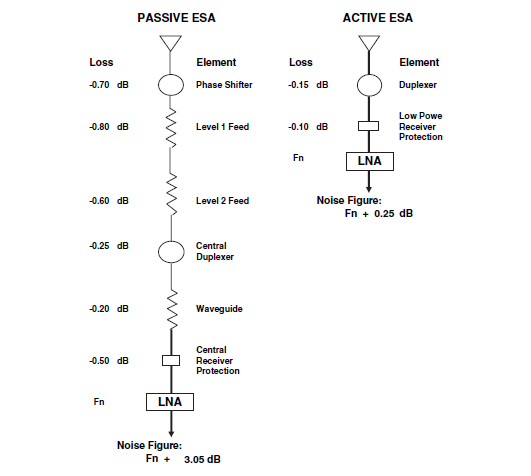
In ant ase there is not more a radiator and an emitter so all the fisical limitation associated to them you refer to are gone.
hence, no need to differentiate Photonic radar in active or passive one.
Actually according to the article and the graph this seem to deal with feed and signal convention so you still need a antenna, which mean all the physicals limitation like side lobes , beam width , background noise are still relevance ( no different if i understand it correctly ). And for electronic beam steering ( in case of electronic scanned array) you will still need many elements , to be able to generate several beams (in case of AESA )each elements still need their own signal generator, so i dont see how Photonics radar would erase the different between PESA and AESA
a photonic radar doesn’t need to have them as it can tailor cut the emitter surface in the desired radio wave dimension until it reach the dimensional limits of the antenna, that in this case would act as it were just a single emitter.
what do you mean ?
garryAPhotonic radar is when insead to product radio waves using a klinstron or a TWT a laser is used to produce photons and they are converted into them once they reach the radiating elements.
How do you convert photons to high frequency radio wave though ?
Something they used the acronim PhAESA photonic active elecronically scanned array but they tend now to drop the active as radio waves are not generated directly.
I dont think the “active” in AESA represent that radiowave is generated directly, in PESA radar radio still being generated directly and they dont use the word “active”
First of all it is Software definited: A,C, L, X or K band emission all from the same radar.
Technically, you already have very wide band transmitted such as LPDA, but they just have lower efficiency. Would photonics radar have same efficiency at all frequency? how about directivity?
Add an extremely crisp signal also a great distances, with an image like resolution and a complete elimination of the ambient noise.
How exactly do they do it?
From what i know SAR technology allow high resolution long distance too but it also have massive disadvantages such as long integration time, blurry moving target. I doubt that photonics radar can achieve everything without any drawbacks
Several thousand of signals emitted in a tenth of second, so to gain both doppler beam sharpening and LPI at the same time.
I dont really see the point, so basically it like a radar operate in high PRF? or FMCW radar?
garryAFrom that angle the whole airframe is much bigger than the intake face. Moreover, YF-23 is said to have better all aspects RCS because it doesn’t have horizontal stabilator, has nothing to do with engine intake. So stop with that example or you became a second JSR
garryAno. US uses DSI on the f-35 because the F-35 is first and foremost a strike aircraft, with a very good a2a capability second.
china uses DSI simply because the US does it. that is why they put it on everything.
if Northrop or Boeing decides one day to use 3 engined fighters, you can be sure China will do the same thing and put it on everything.
DSI is used because it is light and have good signature characteristic
garryAI still dont understand , bandwidth = upper frequency -> lower frequency , frequency is revolution per second so why would a shorter transmitter pulse have wider frequency ? if i understand it correctly , wouldnt frequency is the same whether the pulse long or short ? Or bandwidth here have different meaning ?
From a physics perspective, the fundamental reason for this is something called the bandwidth theorem (and also the Fourier limit, bandwidth limit, and even the Heisenberg uncertainty principle). In essence, it says that the bandwidth ΔωΔω of a pulse of signal and its duration ΔtΔt are related:
A signal with a limited time duration needs more than one frequency to be realizable. (Conversely, you need infinite time to confirm that a signal really is monochromatic.) The bandwidth theorem, which can be proved rigorously for reasonable definitions of the bandwidth and the duration, means that the smaller the time duration is, the larger the bandwidth it requires. It is a direct consequence of a basic fact of Fourier transforms, which is that shorter pulses will have broader support in frequency space.
(This last statement is easy to see. If you have a signal f(t)f(t) and you make it longer by a factor a>1a>1, so your new signal is g(t)=f(t/a)g(t)=f(t/a), the new signal’s transform is now:
and this now scales the other way, so it’s narrower in frequency space.)
More intuitively, the theorem says that it’s impossible to have a very short note with a clearly defined pitch. If you try to play a central A, at 440 Hz, for less than, say, 10 milliseconds, then you won’t have enough periods to really lock in on the frequency, and what you hear is a broader range of notes.
garryAbut the number of patterns is not infinite. These patterns will be recorded by DRFM .
Yes, the job of DRFM is to record , everyone know that. But assuming that each compressed pulse consist of only 5 different sub pulses, even if you can only produce 20 different kind of sub-pulse ( at different frequency) , that already make 3.200.000 different possible combinations ( 20 to the power of 5). In a modern radar the number of sub pulse in a compressed pulse and the number of possible sub pulse are much higher.
garryAI am not sure what you are trying to convey here.
I mean a compressed pulse consist of several different frequencies (wide bandwidth) , which mean the radar receiver will have to listence in wider frequency range ( bandwidth ), so more percentage of jamming power will get into radar receiver and increase J/S ratio. For example : if radar can operate between 8-12 Ghz , 4 Ghz total bandwidth , assuming jammer distributed energy over the whole range, for a normal pulse with bandwidth of only 1 Mhz ,then only 0.025% of jamming power will get into radar receiver. For a compressed pulse with 1 Ghz bandwidth ,about 25% of jamming power will get into radar receiver. That a significant different IMHO.
garryANo contest
garryAYoure insane, the F-14 was an aerodynamically perfect aircraft with even its fuselage acting as a lifting body.
Many others aircraft have lifting body design ex Su-27, F-16 and they all look so much better than F-14, i mean look at this
garryAHere is the duct closed:
[ATTACH=CONFIG]249139[/ATTACH][ATTACH=CONFIG]249140[/ATTACH][ATTACH=CONFIG]249141[/ATTACH][ATTACH=CONFIG]249142[/ATTACH]
How do they even closed the duct ?
garryA
garryAIt could simply be the wing shape.
Can you elaborate ?
garryAIf you don’t think so, then provide evidence that counters this.
You choose a photo looking from a specific angle upward not from frontal aspect, so obviously YF-23 engine will look exposed , but from frontal the engine is covered pretty good.And as said before , the alleged better all aspect stealth of YF-23 is because the lack of tail fin and has nothing to do with intake , it may even have worse frontal RCS compare to YF-22
garryAStealth – The YF-23 had better all aspect stealth qualities which ..
YF-23 is commonly thought( we dont have their scattering graph to compare ) to have better all around stealth quality because it doesn’t have horizontal stabilizer , so that 2 fewer conner reflectors. And TBH , YF-23 doesnt have more exposed engine fan than PAK-FA


 Sign In








