 garryA
That in 10 years, Chinese J-20s will eat you for breakfast is your least problem..
.
And how can you be so sure that J-20 will out perform F-35? we dont have any figure related to its kinematics performance yet
garryA.
here’s the immediate response upon hearing the news F-35 couldnt even meet the mediocre threshold
“What an embarrassment, and there will be obvious tactical implications. Having a maximum sustained turn performance of less than 5g is the equivalent of an [McDonnell Douglas] F-4 or an [Northrop] F-5,” another highly experienced fighter pilot says. “[It’s] certainly not anywhere near the performance of most fourth and fifth-generation aircraft.”
The sustain g limit of F-16 block 50 with 100% fuel, 2 aim-120, 2 empty wing pylon ( DI21) , at mach 0.8, and 15. 000 feet is 4.6G, that is actually similar to 4.6G value of F-35A and inferior to 5G value of F-35C. I don’t see how that illustrate F-35 as a bad fighter.
garryAi wont be arsed with pilots subjective feelings/parroting instructions, i will trust DoD if they up F-35 performance parameters,
like this in reverse
https://www.flightglobal.com/news/articles/reduced-f-35-performance-specifications-may-have-significant-operational-381683/now if DoD comes out and say a few control law tweaks has made it possible to raise the standard to
-increased sustained performance to 6.0, and acceleration cut down by 8 sec,
-i’ll buy it and conclude its every bit as good as the ole F-16
F-16C Block 50
Equipped with 2 AIM-120s and 2 empty pylons to match F-35:
2xAIM-120s + 2xLAU-129 on stations 1 and 9 instead of 16S210 included in basic aircraft weight, 2xLAU-129 on stations 2 and 8 for previously spent A-A missiles, + 8 racks of chaff-flare + gun ammo; weigh 599kg in total.
Drag index = 21; (+1 for each LAU-129 at wingtips, +6 for each LAU-127 at stations 2 and 8, and +7 for F-16C basic airframe drag index)
Altittude = 15000 feet, Speed = M0,8:
With take off weight = 22000lbs aka 218 kg fuel (6% of total internal fuel capacity) => sustain turn rate = 6.3Gs With Drag index = 0.
With take off weight = 26000lbs aka 2032 kg fuel (63%) => sustain turn rate = 5.3Gs with DI=0, 5.1Gs with DI=50, 5.2Gs with Drag index = 21.
With take off weight = 28500lbs aka 3227 kg fuel (100%) => sustain turn rate = 4.8Gs with DI =0, 4.4Gs with DI=50, 4.6Gs with Drag index = 21.
We dont know the exact configuration of F-35KPP but logically:
1- It will definately include at minimum two AAMs (as B variant has no gun, there is no point in giving it a “key performance figure” unarmed. Quite possibly, it will include 4 AAMs.
2- Logically, KPP of F-35 will at least involve 50% fuel, and judging how other KPP is given to other aircraft, it is quite possibly 60%, to include reserve fuel into equation.
( and we know that F-35 with around 50-60% fuel have similar combat radius with an F-16 fully loaded with internal fuel
3-This comparison favor F-16 because you cannot guarantee that an F-16 will enter BFM with 2 AAMs and only 2 empty pylons; typically, it would almost certainly carry 2 additional LAU-129s at 3 and 7, plus MAYBE additional missiles on those pylons, non-jetisson fuel tank pylons on 4 and 6, centerline pylon on 5.
garryAExactly and because the F-35 fuselage is wide, a good part of the 42.7 m2 wing area is not wing area but fuselage.
The same thing can be said about Su-27, PAK-FA, F-15, Rafale, F-14.. etc, how is it a problem?
Yes, so?
So it isn’t a big deal
Not sure whats the point here. But there is no aircraft without body lift.
Even a tube will generate lift at positive AoA, but some design is more optimum in produce lift than the others
Sure, but the F-35 is also huge compared to the F-16. Relative to weight, the stabs are actually pretty much the same size (compared to an 8500 kg F-16C). F-16C is not unstable anymore though.
kinda hard to compare here without specific figures, ” pretty much” is not accurate enough.
garryAIn any case, great achievement for a plane that made its first flight in 2006 to be comparable to (an excellent) one that entered service in 1978.
The one used in the test was a F-16D block 42, right?
F-35 is comparable to F-16 only in certain aspect, here is sustained turn rate, in others aspects such as sensor, payload,combat radius, RCS, it far superior. Now you can complain that how come a new aircraft isn’t superior to the old one in all aspects, well here the new flash, every single fighter we have nowadays be it F-22 or PAK-FA or Typhoon, none can surpass the altitude, speed performance of Mig-25 and SR-71 that made their first flight in 1964, none can surpass the payload or combat radius of F-111, none have better armour than P-47 that made first flight in mid WW II… etc, does that mean new fighters all suck? obviously not, time go by, doctrine change and new key parameters is needed
garryAwhere are you getting that from ?
From the guy who involved in flight testing and development of F-16, but you could also find various sources regarding negative stability and CG of aircraft.
TBH, I don’t quite understand what you are trying to say with the paragraph you quoted
“This is the very first part he referring to”
no, he swapped later on from the latter part taken out of context in the middle of the report
I didn’t pay attention to the exact words either of you said but it clearly say at the start of the report what the test is about. Regarding losing energy part, it kinda obvious that the one at making high AoA yaw will always lose more energy than the once doing some rolling maneuverable
garryAyes, i will remind you again, here is what you wrote:
notice how you write “VERY FIRST sentence” in capital letters
…then scroll down the document to roughly the middle and you find the “VERY FIRST” you are referring to,
….in the middle of the high AoA blended region chapter 😮ed: i just saw you swapped the selective copy, whatever
This is the very first part he referring to
This is the middle part you referring to
garryAIf you use the reference wing area. Due to the wide F-35 body, the percentage of the 42.7 m2 wing area that is actually part of the fuselage is pretty high. The actual F-35 wing area is only ~25% larger for more than a 50% weight increase. Also, later model F-16s are not known for their low wing loading. Then again, even 10 tons empty weight seems to work fine with the F-16 wing (F model), but an air superiority fighter it is not.
[ATTACH=CONFIG]248047[/ATTACH]
References wing area always included the part within the fuselage
The F-15 also has a huge part of its fuselage includes in reference wing area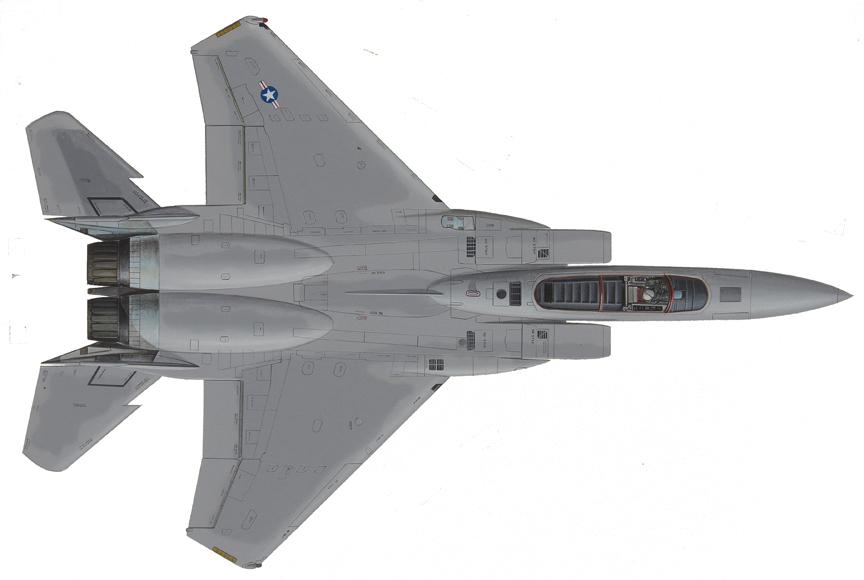
But that not what body lift mean. Even for aircraft without any body lift, if you have to measure lift at certain AoA, the part within fuselage is still included in references wing area when you use the lift equation, the only part that would change is the lift coefficient.
Moreover, both F-16 and F-35 are negative stability design, which mean their horizontal stabilator actually contributed to total lift instead of reducing it, and the tail fin of F-35 is actually huge compared to F-16
garryAMy position as a technician that has worked on machines all my life is the fact that ANY machine that is supposed to be a do all, end all, all things to all people, ends up doing all those jobs rather poorly. This would include the F-35
Reading some of your old post you dont sound like a technician at all TBH, and all fighters today are designed to operate multi role, we don’t have money for single role aircraft anymore
Ya, well don’t blame me for LM design choices. They did enlarge the F-35C wings, and frankly i can’t see other option. Krueger flaps and longer leading edge flaps was not enough, so they went for larger wing when Navy OP.
Do you understand why do they have to enlarge the wing for carrier operation?
If bigger wing is always better then why dont they put a bigger wing on F-35A also?
That however does not translate into a larger wing gives bad cruising fuel consumption and sustained turn rate. The Flanker has allready proven that decades ago.
I didn’t said an aircraft with big wing will have worse range or worse sustained turn rate than one with small wing. I said if everything else the same, then a bigger wing will result in more drag, simply because it have more wetted area, and the drag will generally bad for fuel consumption ( you can counter that by having more fuel or high bypass engine), The drag will also be bad for sustained turn, but because generally bigger wing can generate more lift, it can also be good for turning, so whether it benefit to have bigger wing for certain platforms have to be decided by wind tunnel test. You can’t just lookat them and say, well bigger wing is better or vice versa
garryALarger wings help reduce wing loading so is very good for A2A fighter.
An higher wing loading however give plane stability, so usually is accepted if not sought in A2G oriented plane, so not a surprise to found it in F-35.
It is not that direct, if the wing is bigger, you get more wetted area, hence more drag at the same AoA. And talking about wingloading is irrelevant without knowing their lift coefficients
Drag depend however more by the profile of wing that to their overall dimension, .
Both drag and lift depending on both the wing shape and its area. If you want more lift, you will also get more drag. There is no free lunch. You cant have a wing that provides more lift than the others at the same speed, same AoA but some how get less drag
garryAIf you don’t increase the wing areal when you get a larger and heavier airframe, well eighter you go for the Pure interceptor design(aka Mig-31) goal, or you are basicly making a very bad Choice(like craming three different design and role into one airframe)..
That the PakFa has much larger wing areal vs F-35 is totaly legit, I would flip it around and say if we could stretch the F-35 and put larger wings on it, then all for the better..
Everything else the same, then bigger wing will cause more drag ( bad for cruising fuel consumption and sustain turn rate) , and more lift ( generally good for intanneous turn rate) , whether the increase in lift is worth the increase in drag will be up to wind tunnel test.
garryAIt is difficult to communicate through the Google translator. Download the table and look at the formula in the cells.
https://yadi.sk/i/yV-T2cUHujyX8[ATTACH=CONFIG]247992[/ATTACH] [ATTACH=CONFIG]247993[/ATTACH]
So your evidence/source for your calculation is from a table that is also made by you????
Moreover ihmo, you cant ignore others factors like wing area, wing thickness, wetted area when measuring drag
garryAA T-50 did not sit down after every 500 km to check off and landing :p
Guys, everything is easier, F-35 guzzles fuel like a behemoth
Fly over the ocean is ways more dangerous than fly over land, if you run out of fuel or cant refuel when you need to, you basically lose the aircraft, you wont be able to recover the aircraft when every where is water so the safety fuel percentage requirement will be much higher. Moreover, we dont know if the II-78 was used to refuel the PAK-FA either.
garryA. .
If KPF cannot handle that truth, then I need them less .
@LEG : Keypublishing members are not dumb, we will not believe a poster just because he spams military acronyms in his posts. Especially, when these posts are full of amateur misconception and errors
garryAit clear that JSR is wrong
When has JSR ever been right?


 Sign In







