 garryA
Sorry, I have to reduce your interesting post to just a pair of question in order of not getting stuck there forever, I have a way more beautiful business to care about as now.
Look, I have not talked at all about kinematics of missiles, re-read my post please.
Point was instead that while employng a SaRh or TVM missile you would absolutely need a very precise location of the incoming menace in order to point your fire control radar and illuminate them with , all ARh missiles, from Phoenix onward act autonomously, they are guided in the vicinity of the target usually with a mid corse guidance systems , when they are close enough they justactivate their own seeker and do all the engagement sequence all from themselves with not any actual imput from the launcher.
This was originally introduced to allow them to engage several targets in the same moment while the conteporary SaRH missiles ccound instead be used only against a single target.
Now, such a capacity of a completely autonomous engage sequence come actually extremely useful to counteract the main limitation of low frequency radar engaging a stealth, that several there have justly mentioned: such radar can spot them at an useful distance and can track them also but with a low refresh rate and without a precise location.
They instead just provide a sort of probably “box”, larger or smaller according to their own power and distance of target, in which the plane is.
Now while such a box is waay too big to allow for a SaRh targeting, it is at the contrariy well under the range in which an Arh seeker would activate themselves and perform their own, better reiterate it, completely autonomous engage sequence, not dependent at all by the original distance between Ad radar and the target.
Certainly, neither I expect tem to have the same kill probability than against a conventional target but still something that would work the same.
I understand your point , my point is that the box may be enough again legacy aircraft , it wouldnt be enough again stealth aircraft , because the seeker range will be degraded greatly
garryAseeker range may in many cases out-range engine
(ASTRA) At sea level the range is expected to be 13 miles.
Active homing range will be nearly 16 miles.
http://forum.keypublishing.com/showthread.php?113735-missile-flight-theory&p=1835045#post1835045
I mean seeker range again stealth target , especially in case of jamming, and the beam width (not the same as FoV ) of missiles seeker is only a few degrees so a big resolution cell is a big problem.
garryA. Also the F-22/F-35 cannot get sufficiently precise coordinates for a GPS weapon at that kind of range. .
they can , SAR mode for airborne radar is very common nowadays
garryABecause everyone his talking about L band (decimetric) there?
I was talking about metric band radar i.e. C band working eventually in close connection with other L and X band radar.
To negate the shaping of VLO aircraft , The operating wavelength of your radar need to be in Mie region in respect to the dimention of the aircraft , because at that region we start to have creeping wave return
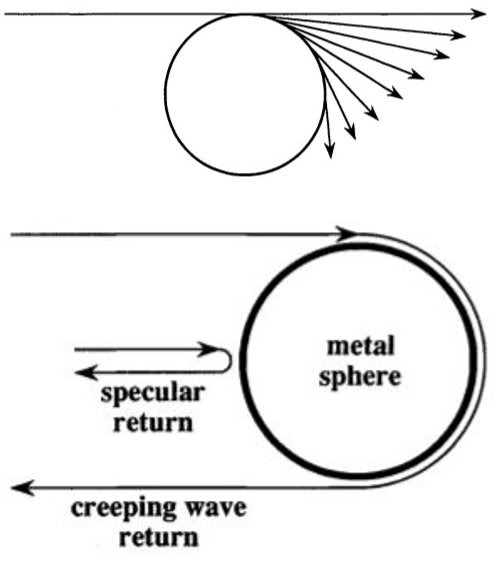
Mie region is where 1 < 2πa/λ < 10 , C band frequency (4-8 Ghz ) has wavelength between 3.75 and 7.5 cm ,F-35 length is around 15 meters (or 1500 cm )
1500/7.5 = 200 > 10 , so if you are using C band you wont be able to exploit the vulnerable of stealth aircraft at low frequency. And even though low frequency work better again VLO Platform , it doesnot mean you will suddently able to detect stealth aircraft from 300-400 km with low frequency radar ,for example : no AWACs use X band radar , all either use L band or C band AESA array , but they still have problem detect stealth aircraft as demonstrated in many exercrises
Still the AESA IS VALID ONLY IF AIRBORNE thing???
No , but AESA isnot some magical technology , AESA aperture have better efficiency than normal dish type antenna , but they still follow gain equation , so if you want longer wavelength ( low frequency ) then you would need bigger aperture or the gain value will decrease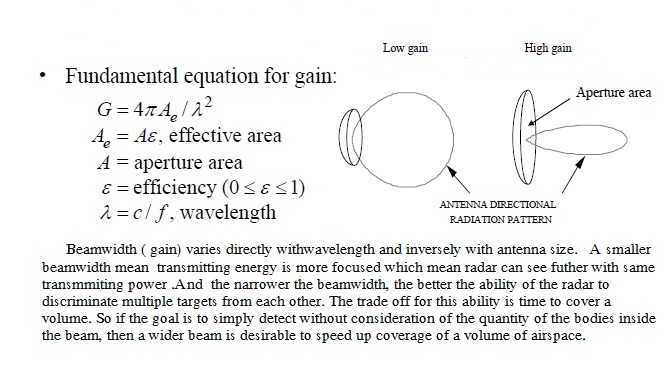
For the rest I have gave just a look at the performances of such (the latest ones) radars and the “boxes” they are able to obtain are well inside the engagement range of even a standard airborne ARh missile, let’s imagine with a S-400 (or a SM-6) size one.
kinematics range of missiles isnot important , what important is their seeker range , what is the range of their tiny seeker again a stealth platform with some jamming.
Still, they won’t operate alone, standard procedure would be one in which C bands would gave not only early warning but also a initial location and tracking of the target while decimetrical and centrimetical AD radars would instead used not to scan all the horizon but to look with a spot on mode into the “boxes” individuated by the former so to refine track
If the centrimetric radar cannot detect the stealth platform in the first place then how can it help refine track ? , I understand that VHF radar will cued them to look at a certain direction , but if the centrimetric cannot see the stealth aircraft themselves then pointing them in that direction wont help much.
For the rest also USN has introduced a similar way of operating (called cooperative engagement) for their own E-2D and AEGIS. So, if you things those are vain efforts, let’s complain with them also about wasting tax payer money, please.
.
the cooperating engagement link between E-2D and Aegis is to reduce the problem of radar horizon , a radar at higher altitude will have longer horizon
garryAIt is from almost from a decade ago that was ascertained that any stealth plane are easier not just to be detected but also located and tracked that was it originarly thought possible by developers and military programmers that worked on design of such time (i.e. just american)VLO. So it seems me that NI is quite retarded on such a matter.
Detection and route tracing are actually possible at quite significant distance using metric and decimetric wavelenght radars, what is still difficult to achieve is a sufficently precise and continuative position of the plane enough to engage it with actual standard AD system based on SARh and TVM guidance.
That is one of the main reasons because new generation missiles using ARh guidance are being introducted lately in a sort of frenzyby every one around: also having a greatly imprecise initial position i.e. a sort of large probability box in which the stealth plane could be won’t avoid such missile to be directed against it using mid-course update and complete engagement using its own sensor.
Certainly such an modus operandi would not allow the same high success ratio than one permitted by actual systems against conventional aircrafts crazy enought to dare into without a very heavy jamming cover but still enought to be quite effective.
Most troubling thing of the above mentioned new engagement procedure is that it is not significantly affected by the distance between the launcher and the target as the previous one, a train right on the face on the initial argument that was actually used to “sell” the risky and absolutely expensive F-35 program to USAF and most of the western air forces i.e. the ability of sneak across enemy air defences and reach target all alone without any further support..
Low frequency radar can perform better again stealth fighter than their high frequency counterpart , but that doesnot mean you can suddenly detect stealth fighters from hundred km aways just by changing frequency from X band to L band. The main problem is when you reduce operating frequency of radar , the gain value will go down along with it ( doesnt matter if the antenna is PESA or AESA ) , so power will be alot less concentrated .
Lower gain ( bigger beam width ) will also reduce accuracy significantly , especially at long distance , ARH missiles can help at short range but at long distance , the size of the resolution cell can easily surpass the seekers range of ARH missiles.
Radar frequency and resolution
And why a modern Ad sistem would need a dedicated fire control radar if they have ARh missiles?
Because , low frequency radar mean long pulse width and wide beam width , both are terrible for long range engagement ( even with ARH missiles )
garryA1. The overall point is that the jamming will be detected and tracked.
3. Your not going to be able to jam the APG-81 with a late eightes designed pesa radar.
1) Jamming will always be spotted on RWR , but to get firing solution is a different thing
3) Every radar no matter what kind , SPY-1 , Big Bird or APG-81 ..etc can be jammed (even if they are so sophisticated that they cannot be jammed by deceptive techniques , they can still be jammed by noise techniques ), what important is at what distances they can burn through the jamming signal.
Same with RCS, sometimes it seems that someone (not referring to you) think than detection range would be reduced in direct proportion with it.
So a radar able to detect a 10 sqmtrs plane at 400km would have a 40km range against a 1 sqmtrs one and a 4km range against a 0,1 VLO plane?
I think you are refering to me ( sorry if iam wrong )
I donot think radar detection range will be reduced directly proportional to RCS reduction , radar detection range varied with the forth root of RCS ( signal travel 2 ways ), so a radar that can detect an aircraft with RCS of 10 m2 from 400 km , would have 224 km range again aircrafts with RCS = 1m2
But it is a different story if you factor in jamming (one way signal ) , jamming power required will varied directly proportional to RCS reduction , and burn-through distance will varied with square root of RCS

garryAMaybe it was that, so allow me to correct it for more clarity:
Let’s make a comparison: A strike package offour F-35 with only internal A2G load against a strike packagefour Su-34, three with the standard A2Gload and one with escort jammer package and A2A weapons.
Who would deliver a greater punch? What change of survival? What cost?You can also put four F/A-18 and a Growler instead of Su-34 so not to have national preferences interfere with theoriginal i choosed Su-34 because i consider it the most extreme application of the area jamming concept: a plane so big that can carry a specialized ECM suite together with a great load without any relevant effect on its own performances.
Su-34 option is probably cheaper but F-35 option is a better choice if adversary have good air defense.The size of Su-34 should allow it to carry bigger , more powerful ECM pod than the jammer that F-35 has , but the much smaller radar cross section of F-35 will compensate for that easily , Su-34 would need to carry jammer that is 100 -1000 times more powerful than the one on F-35 ( be it APG-81, ALE-70 , MALD-J or whatever ) just to achieve same effect.
get firing solutions using passive means. .
Not as easy as it sound
https://basicsaboutaerodynamicsandavionics.wordpress.com/2016/03/02/rwresm-and-passive-geolocation/
garryAAnd that assumption is based on what?
in air to air role, i dont see Su-34 has any advantage again F-35 TBH
garryAthere a high chance this actually happened, IFF problems and all that
garryA– Shot down aircraft inside your country is a really big deal , it not like a video game where you do whatever the f you want , if you are the pilot who shot these planes down then you will single handedly kill hundreds of people, most people dont want to do that
-Unlike video game , planes do not disappeared completely after missiles hit them , they will fall down ,and in popuated area , you risked killing many more innocent people too
-Radar can easy detect these airliner , but with air space like below it really hard to know which one was taken by terrorists and which one wasnt and even with the immediate landing command , the number of aiport is limited and plane cant just teleport to the airport to land so you have many many aircraft on sky
garryAWhere do you take into account that the AESA emits like a beam? The energy receive might be 100 or 10000 times larger, hard to say given the fact that we don’t know how narrow the beam is.
Gain describe how narrow a radar beam is
Radar Basic
garryAWell, it seem that the thread has grown some good wings now and that we actually agree, the more the less, on many points.
Just a precisation for GarryA, maybe its just a different way to call things but i’ve checked : passive radar is actually used for multistatic radar also and it was actually those ones I was referring about.
I think it just the language barrier , however in my opinion calling a multi static radar system a passive radar is rather misleading
If you read Radar technology encyclopedia.. you’ll see that Passive radar is basically a radiometer. Neither ESM nor RWR.
The passive radar terminology we see today is widely misused and misleading. The best one to describe a radar which is not having receiver and transmitter in same space would be Bi-static Or a multistatic radar. We can further divide the class of this bi/multi-static radar based on whether they have cooperative transmitter or in opportunity. Those who have cooperative transmitter can be considered a Bi-static radar while those without cooperative transmitter is PCL (Passive Coherent Location or Locator maybe)
So far only newest version of VERA are capable of PCL Operations.
honestly I dont see much different between a passive radar like Kolkhuga , LERA and a modern RWR/ESM system like ALR-94 , ASQ-213
both consist of multiple receivers , both dont have transmitting component , they both analyse the radio echo received , whether they can determine target location or not depend alot on the software and the specific characteristic of that target
garryAGarryA, it is EXACTLy the same thing I have written in the post you have cited! ESM is not a viable counter stealth system as it is not work in a continuative way and does not give any reliable spatial reference.
Passive or better said not-cooperative multistatic radars however are much more effective and several of them are already operative, OTH radars works, metric band radars are a well consolidate reality.
As I have repeated ad nauseam in several threads and repeated also in the post you have cited not one of them would render VLO technologies useless but thinking that situation is the same of thirty years ago is also a wishful thinking and far greater that the one Falcondude impute to BlackAdam.
Passive radar is just another name for RWR , and OTH radar are very inaccurate , have huge blind area ( blind area of sky wave radars can be from 500-1000 km in radius in front of them ) , in my opinion the best kind of radar that can be used again stealth platforms are multi static radars ( transmitter and receivers are not at the same location ).
But i agree with you that the combination of different systems does help alot again VLO assets , what i critise about these articles is that they only consider one side of the equation.
for exmple :
” other ground-based radars might have collected intelligence data needed to “characterize” the F-22’s signature at specific wavelengths.”
what if the F-22 carry luneberg lens ?
”Kolchuga Radar, the system is not really a radar, but an ESM system comprising three or four receivers, deployed tens of kilometres apart, which detect and track aircraft by triangulation and multilateration of their RF emissions”
what if stealth aircrafts using directional datalink and high gain radars ?
” Low frequency OTH radar can detect stealth aircraft as easy as normal platform ”
but these OTH radars have massives size and practically stationary so how about threat from long range cruise missiles ?
and so on ,but i think you get my point : both sides will use suitable tactics to achieve advantages,another point people forget is that one of the most important characteristics of air assets in general are their mobility , with air assets you can concentrate all of your forces in one location and move on to the next one in mater of hours , while ground forces have to be evenly distributed
garryAThis thing is very hard to believe. What kind of EM Radiation emitted from exhaust trail and in what frequency. Plus Electromagnetic interference from engine.. well Is this some sort of JEM (Jet Engine Modulation) ? It would work for radar (real active radar) But for ESM ? from where it can get the emission source for bouncing inside the engine duct. And there almost no possibility for Kolchuga to actually in the “right angle” to view the JEM.
Given the links is wikipedia , i suppose the writer simply lack knowledge about electromagnetic field hence he made that ridiculous statement .
No, it’s not wishful thinking, several countermeasures against Stealth have been developed in the decades passed from when F-117 entered service.
Some, like Kolchuga itself were very partial or not worth the cost, other work just fine.
All of them are the more or less partial: no one cover the engagement sequence from the beginning to the end all by itself but the sum of several of them combined with all the probability will.
For the rest, we can’t have a definitive proof of it until there would be real operative missions made by stealth planes against an up-to-date multilayer and multisensor AD system, something that actually just an handful of nations have…
Better said just Russia and China for sure.
While there are counters against stealth fighters and they have existed for decades, it not as one sided as being potrayed in these articles, a ground RWR system ( Kolchuga) doesnt eliminate targeting problems again modern VLO assets
garryAAll of this sounds like wishful thinking!
I have the feeling that OP either really bad at English or really bad at critical thinking, his articles are always super duper one-sided


 Sign In







