The only thing better than a “fat lady” carnival scam, is one where you don’t actually have to produce the lady.
Well obviously we should give them all our money.
powerandpassion — PM sent.
Thanks,
Dave
Bump. Useful discussion I need to refer someone to.
Rats. I thought this was going to be about the Vultee Valiant.
It certainly has a wing that leaks. A friend of mine is de-fueling after each flight these days.
The Battle was one of the first aircraft to rack-up hours on the new, early-mark Merlin engine. Unfortunately, those early engines were not all that great. Failure rate was high in comparison to some more established engine types.
This rather disturbed R-R, and they undertook an in-depth and expensive rectification program, where they took engines off the line at random, and then test-cell ran them until they failed. This worked well, identifying weaknesses.
And this was no Air Ministry initiative — the people at R-R could see the war-clouds gathering, could practically hear the goose-stepping, and wanted the best engine in the industry to support whatever was coming.
Of course it became profitable too, but at the early stage there was great concern. This engine had started out as a private venture, the PV-12, and it was a bit of a gamble. (Not all their gambles paid off — the Peregrine for example, or the Vulture.)
Good thing they did it — by late summer of 1940 the pilots had to worry about tactics and endurance, but seldom about their engines.
There were 2 survey companies from Canada at the time, Spartan and Kenting. My father flew B-17s for Kenting 1960-62, high-altitude photo-survey.
He mentions that the Mosquitos were considered by the company pilots as a bit suspect by then — no one wanted to find out the hard way which glues had been used to put them together.
One particular P-38 was extremely successful — it mapped pretty much the whole Andes.

And thanks to all for the kind remarks!
Dave
It is!
I flew 2 airshows last summer in the P-51. It’s a very straightforward machine. Being a “second generation” WWII fighter, they’d sorted a lot of things out, and opted for simplicity from the point of view of the pilot. It’s one big gotcha is getting slow in the circuit.
I don’t have much time in it at all, but the evolution from the P-40 (in which I do have some time), to the P-51, is very striking during the checkout.
There was also the threat looming across the channel — nasty nazi bombers looking for aircraft factories to flatten.
Better to have lots and lots of facilities turning out something useful, than few.
As referred-to above, Spitfire production was dangerously slow at the start. Castle Bromwich did not get properly going until after Churchill was PM, and he tasked Beaverbrook with making-it-happen. From wiki:
In spite of promises the factory would be producing 60 per week starting in April, by May 1940 Castle Bromwich had not yet built its first Spitfire.[33] On 17 May, Minister of Aircraft Production Lord Beaverbrook telephoned Lord Nuffield and manoeuvred him into handing over control of the Castle Bromwich plant to his Ministry.[35] Beaverbrook immediately sent in experienced management staff and workers from Supermarine and gave control of the factory to Vickers-Armstrong. Although it would take some time to resolve the problems, in June 1940, 10 Mk IIs were built; 23 rolled out in July, 37 in August, and 56 in September.[36] By the time production ended at Castle Bromwich in June 1945, a total of 12,129 Spitfires (921 Mk IIs,[37] 4,489 Mk Vs, 5,665 Mk IXs,[38] and 1,054 Mk XVIs[37]) had been built. CBAF went on to become the largest and most successful plant of its type during the 1939–45 conflict. As the largest Spitfire factory in the UK, by producing a maximum of 320 aircraft per month, it built 12,000 aircraft of this type, before its closure in 1945.[39]

Maybe this thread is too old to dig up, but in case anyone is interested, I wrote an article about flying it (as one of many “barnstorming” days in 2016) that was published in EAA Warbirds, and later online here http://www.vintagewings.ca/VintageNews/Stories/tabid/116/articleType/ArticleView/articleId/605/Big-Silver-Kite.aspx
Or a passenger, or some piece of gear, interfering with the controls.
Or a failure of control linkages.
Moving the rudder farther back also helps on the ground, reducing the likelihood of ground-loops, which the Harvard is known for.
This was one of the reasons it was done on the P-40 as well.
Nope. That whole scenario was quite unlikely.
The one thing you as a pilot do not want to have happen during a forced-landing is to nose-over, and be trapped upside-down in the fuselage. In sand. On a beach. With a rising tide. And the enemy across the street.
And that is far more likely if you attempt a gear-down landing. So, the advice was, and is, belly it in.
We’ve all seen flights operating from packed sand. Just north of where I’m typing this now a DH84 took off from Wasaga Beach in 1934 and made it to London. But it requires prior knowledge. You need someone to evaluate it and tell you the conditions, or you need to look down and see heavy vehicles driving on it. If that’s happening, then sure, put the gear down.
But otherwise, gear-up.
Mind you, that Spitfire appeared to glide for 10 minutes, and shot down half the Luftwaffe while doing so. I’m surprised it didn’t soar over to Manston. And sink the Scharnhorst along the way 😉
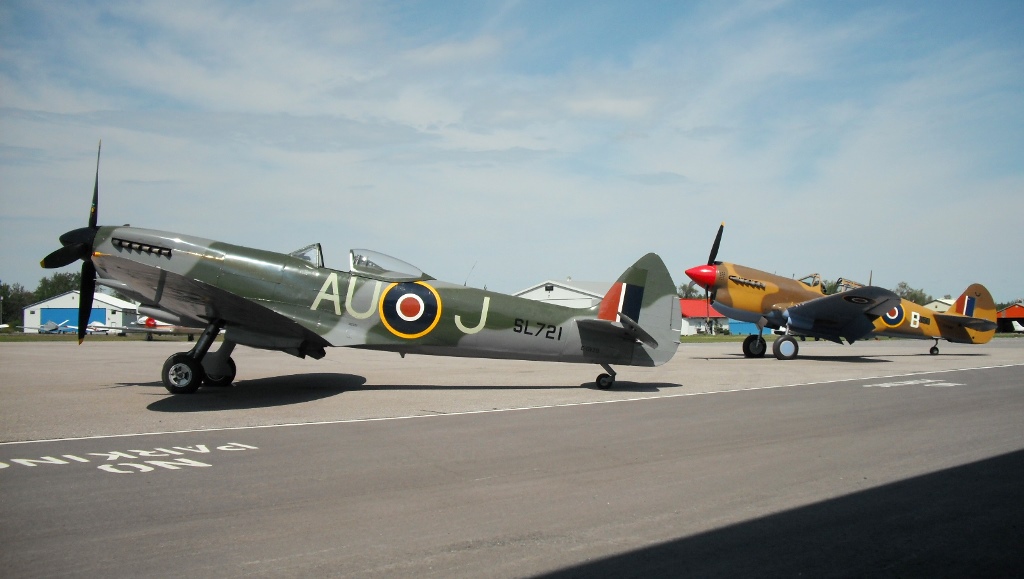
Oh there were lots of stops, of course. SL721 still has the original fuel tank and that’s all.
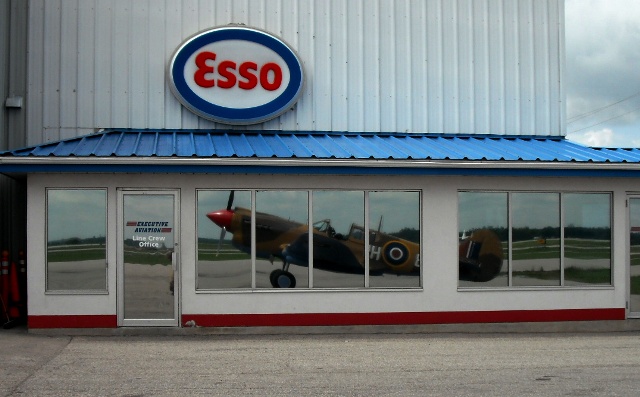
It’s kind of fun: to land unannounced at a little “Washington County” airport in a Spitfire and P-40, pull up to the pumps, shut down in unison, jump out, and say, “Do you mind if we park these here for a few minutes? Gotta make a phone call.”