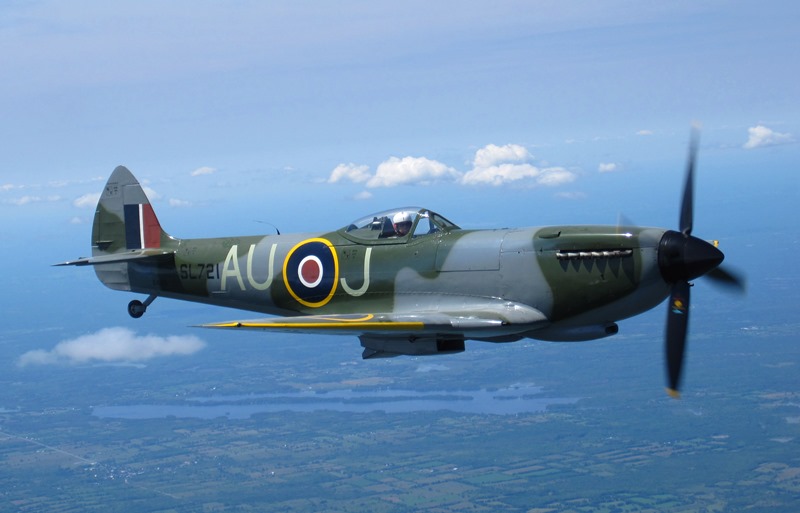
It is indeed. We were able to do a Merlin swap, and match them up, when we were juggling requirements for the P-51, the Spit XVI, and the Spit IX under construction. It all worked out.
Here’s a photo of SL721 from 2009. We were flying back from OSH. The radio crapped-out in the Spitfire, so we flew formation for the 5 hours all the way back to Gatineau. Not the sort of thing you usually see when you’re driving and you glance back over-your-shoulder…

Be a pleasant, dependable person.
Get a pilot’s license.
Be a pleasant, dependable person.
Put in couple of hundred hours of tailwheel time.
Be a pleasant, dependable person.
Upgrade to a Commercial license.
Be a pleasant, dependable person.
Join an outfit that flies Spitfires — and sweep floors, take tickets, flip burgers, give talks at schools, talk people through the fence, fund-raise, do paperwork, lead projects, wipe oil off the aeroplanes, wipe oil off the floor, manage passengers, flip props, shovel snow, cut grass, and so on.
Be a pleasant, dependable person.
And then offer to fly anything, anywhere, anytime — and don’t damage it.
Be a pleasant, dependable person.

I’ve flown beside it many times. It’s a shame to see it go, but we have a new Mk IX, and the hangar is jammed.
Here’s a video of it, taken by my GIB one day…
This is the aircraft that truly launched the VWoC Collection. When Michael Potter bought the Spitfire, and started flying it to various places and events around Ottawa, he was overwhelmed by the response. Crowds of people magically appearing, reporters, airport staff, old men tugging their great-grandchildren and then getting all misty-eyed as the years rolled away…
After which of course he built a magnificent hangar and then filled it.
Dave
The throttles worked the wrong way.
Very disconcerting, that.
Lots of research.
When you get the thing built, we’ve got the world’s best Hucks Starter at Vintage Wings. Bring it there and we’ll crank it.
Dave
BTW — not exactly a warbird — although Vietnam counts of course — but here is a brand-new addition to the Collection.

It was previously owned by the Irving family of New Brunswick (yes, that Irving family!).
Dave
Nope. An accident makes no difference to value.
I does focus the next pilot’s attention, though.
Still, it would be fun to play with an O-49 for comparison.
KW flies his here… https://www.youtube.com/watch?v=QU1Vy096LJU
What is a Meteor Piston?
A quick search leads only to chain saws.
The ownership of a single seat Spitfire does not always fall into the “making money” bracket. For some it is the pleasure of custodianship of a piece of history and of fulfilling a dream.
Of course. We have 2, a XVI and a IX (which will have a First Flight this summer). Both are single-seaters, and reflect the passion of Mr. Michael Potter, who owns the collection.
But it would also be nice if they could pay their own way. That is happening big-time in the UK now since the CAA re-wrote the rules.
Also, there is the point of view that if a flight operation is commercially viable, it connects people in a way that they will NEVER forget, particularly those who are not aeroplane-crazy, when they go for a ride.
Before such a ride most people just view the whole things as dry old history. (Not the people on forums like these. They are the Choir.) But after a flight in a fighter, an Understanding takes place. History is no longer old and dry. It sounds and smells like a Merlin.
Unforgettable.
And that change happened because a Ride took place. And that was possible because it was commercially viable. And that happened because of CAA rule-changing, plus airframe conversion to 2-seaters.
Dave
The demand in the UK for Spitfires these days is for 2-seaters.
Now that the CAA have changed the rules, giving rides is going full-blast, both at Duxford and at Biggin Hill. It’s quite profitable.
A single-seat with a Griffon engine does not fall within that demand.
Dave, that’s me near cnc3. I have Reid’s Playboy. Should do a photo shoot with your 24W some time. I will contact Cam re the belts. Interested to learn more about the short section of webbing with the green tag annotated “Hurricane Belt” and “#11 AID Aug.6/43”.
Regards
John
John, Glad to connect with you, and I’m glad Reid’s Playboy stayed close. Sure, we should do a photo flight sometime and send the result to his daughter. I keep a thread going about the F-24W on wix, http://www.warbirdinformationexchange.org/phpBB3/viewtopic.php?f=16&t=24344&start=690
Cheers,
Dave
Are you NW of Brampton, near Caledon?
Those harnesses are interesting. I think I recognize #4. I flew a restored-to-original DH-82C tiger Moth that had that. It was NOT a good harness because it did not hold you down in the seat.
But you appear to have some terrific time-capsules there. The fabric should probably not be used, but the hardware should be all right.
Do you know Cam Harrod? He’s a specialist in this sort of thing.
Dave
Sure. That’s all true. The Storch and the Cub-type aircraft are better at short-field. But essentially they are single-purpose aircraft. They go slow, don’t travel far, don’t carry much, and land short. That’s it.
The Lysander can do more. And back in the day it would get to central France and back in one night. You can’t do that mission in a Storch, even if you could carry enough petrol. Not enough load-carrying capability and too few hours of darkness.
I flew the Lysander this summer in several situations where the short-field capability was very handy. I only used a few hundred feet. It’s handy now, like it was handy then.
This photo I took at Mountainview, which is a WWII relief field for CFB Trenton. We were taking Air Cadets on Famil flights, but Trenton has no Avgas so we had to divert 15 nm to MV (where the Cadet glider operation is based) whenever we needed fuel.

I landed on the grass of the infield (just to the left of the picture), not on the runway, using about 500ft, because this allowed me to get to the pumps without having to taxi on pavement across a strong wind. (Lysander brakes now are not much better than they were then.) (And taxying a Lysander if it’s windy is usually of more concern than landing it.)
Anyway, during the summer, I used its short-field capability a number of times. But I also ferried from Ottawa to Edenvale without a stop, 250 sm into the prevailing west wind, with only internal fuel. And that is an fair indication of the aircraft’s utility.
Dave
Most of the tasks the Lysander ended up completing involved flying fast enough to GET somewhere, like Air/Sea Rescue, and target-towing, and delivering mail and parts and people long-distances in North Africa, and delivering spies to and from France.
None of those jobs are practical in the 80 kt Storch.