 JSR
JSRI don’t see how one effects the other. As it’s not like they are coming from the same production line.
As long as we are discussing it. It’s interesting that half the Super Hornet Fleet will be Growlers?
Australia budget is geared towards F-18 while its promised subcontractors need JSF work.(it is questionable whether thos subcontractors will be in business waiting for JSF orders)
so there is simply no money for JSF and the induction rate is not so high. it is reasonably presumed that JSF is not coming to Australia anytime soon.
when you put so much money into upgrading electronic warefare and create plane of gaint external pods. your basically dismissing all rcs reducing features of airframe and make the plane even more heavier.
practically the same thing is going to happen to Canada whose economics are not in great shape.
JSRYet, one F-35 is more capable (survivable) than several Super Hornets. Regardless, I personally don’t trust the numbers. I remember when it was said the Super Hornet had vastly better numbers than the F-14. Yet, that turned out to include the whole Tomcat Fleet. Yet, the F-14D (last model) was much closer to the Super Hornet. (funny how they left that out)
As always it’s not what they tell you but “what they don’t”
F-14D will not be closer to F-18E as F-14D is much heavier plan by weight so alot of fuel penalty.
JSRNot to split hairs yet Australia made a previous order of 24 Super Hornets (F/A-18F’s) Which, will now be supplemented by another 12 Super Hornets (F/A-18F’s) and 12 Growlers* (E/A-18G’s)
*12 of the first batch of Super Hornets were wired. So, they could be upgraded to E/A-18G Growler Standards.
Also, you bring up a good point. It’s not just purchasing the aircraft but the work share.
hmm should I cancel the F-35 which will bring me work for the next 20-30 years (maybe more) or purchase another 4.5 Generation Fighter. That may bring me some work over the next 10 years!:eek:
My point is Australia ordered 24 F-18E/F. and 12 of them will be upgraded to EA-18G at cost of $1.6b to $1.8b depend on exchange rate. and this will be done by around 2018. the second 24 is i think not signed yet.
so getting another 24 plane before that date is tall order. what i am saying is that total 48 F-18E/G will be in Australia by 2020 if everything goes according to plan. so chance of Australi getting JSF before 2020 diminishes. this already very slow rate of induction.
JSRBoeing can provide more offsets and reliable figure for operations.
According to the GAO, the Super Hornet actually costs the U.S. Navy $15,346 an hour to fly. It sounds like a lot — until you see that the U.S. Air Force’s official “target” for operating the F-35 is $31,900 an hour. The GAO says it’s a little more — closer to $32,500.
CBC also asked Lockheed Martin to say if it had any quarrel with these numbers — and it did not.
In a written response, a Lockheed spokesman declined to offer any different figures, but insisted the F-35’s operating costs would be “comparable to or lower than” the “legacy platforms” — meaning, older jets — that it will replace. Those do not include the Super Hornets, which Boeing says are 25 per cent cheaper to run than Canada’s “legacy” CF-18s.
But it’s Boeing’s entry that will grab most attention. It’s the only American competitor for the F-35, and being “interoperable” with the U.S. is a big deal for Canada. Boeing is also offering to meet or beat the amount of contracts — known as “industrial benefits” — that Lockheed Martin would steer to Canadian companies.
JSRYou do realise that Australia is doing well thanks to Chicom-influenced mining boom? There’s been some slow down but the economy is still reasonably robust.
Australia is now in same category as Norway/Saudi/Kazakhistan as mininig boom has failed to tranform into a industrial/scientific power. and this is impacting its ability to support modern weopons. It could only afford 24 F-18E untill this point. and may induct another 24 in next 10 years. this is so slow induction that F-18 line will unprofitable after USN is done with F-18E.
Practically same thing is happening to Canada. Canada still has some pocket of aerospace left. when there is no domestic aerospace left it is hard to get contracts as supplier to F-35. and without those offsets budget cannot afford it.
This is same issue in India.
http://www.ainonline.com/aviation-news/ain-defense-perspective/2012-12-14/manufacturing-details-stall-franco-indian-mmcra-negotiations
Manufacturing Details Stall Franco-Indian MMCRA Negotiations
What has happened to the fighter market since 1990? A 90% collapse in sales.
Or are you saying the global economy has been in ruins since 1990?
90% collapse is more due to aircrafts being pricer with more capability. so that many are not needed.
JSRThere is no such thing as rcs advantage in this context
There are countries that are spending far more on F-15s than on EF.(Rafale contempory)
Australlia convert half of order of F-18E into a version that will carry big pods outside. no concern with RCS. It was done at such price that they could have added additional 18 F-18E.
Threre are hundreds of chinese heavy jets.
Even the latest order 42 MKI by India came with large price increase. no concern with spending money on aircraft with no rcs reduction feature.
by now India will know rcs level of Rafale to large extent as they trialed it.
Most of the above aircrafts are way heavier and need two pilots. so alot expensive to operate.
Su-35 has taken certain measures for reducing rcs but it is not objective to make it slow.

JSRRafale is not the only a/c with such capabilities:
Anyway, sensor fusion is important, and RWR is not the only sensors; I am sure that just like Gripen, Rafale will use it’s antenna to listen to emissions from e.g. the Su-35.
These days, sensitivity and quality of sensors, image processing, sensor fusion, and networking are more important than ever.
Most likely the SU-35 will operate it’s radar in LPI mode.
Since Western fighters (including Rafale) still has a lead in several areas when it comes to electronics, signal processing, sensor fusion, Rafale has several advantages over the SU-35. If those advantages are used in a tactically useful manner, Rafale would in most cases come out on top.
from where this lead comes from?. Most advanced semi conductor fabs are in Asia. and it was Russian that developed image processing capability almost a decade ago for Samsung. and they are still looking for Russians.
http://job.samsung.ru/MainPage/Vacations/Senior-Software-Engineer-for-Image-Processing—Co.aspx
see Korea spending per year in 2012 to 2013. Every year EU based spending is going down and most of equipment is practically obsolete. and with Lack of highest level software skills. there is highly unlikely that any thing in Gripen/Rafale will come close to Su-35.
http://www.semi.org/en/node/41961
Regions planning to spend the most on fab equipment in 2012 are: Korea (over $11 billion), Taiwan ($8.5 billion), the Americas ($8.3 billion), Japan ($3.8 billion), and Europe/Middle East ($3.5 billion).
In 2013, the largest spending is expected again in Korea (over $12.5 billion), the Americas (over $11.5 billion), Taiwan (over $8 billion), Japan (over $4.5 billion), and China ($3.6 billion).
JSRRough field capability? Shorter take-off roll? Logistics commonality? Have to remember that Russia designs for real war, not NATO-style white collar 9-5 ‘war’. :p
strong airframe to carry heavy weight antenna. The Antenna on IAF A-50EI is biggest i think for this size of aircraft. you dont want too long aircraft that create hinderance in war time airbase. no need for extensive aerodynamic testing on new plane.
Common cockpit design with IL-476 transport. so much larger pool of pilots and more reduce maintainance cost. It is spacious aircraft without being slow.
JSRAh yes, the good old make a ridiculous claim and then demand others disprove it approach…
Not ridculous claim. Tornado ADV specification performance is higher or you think only Dassualt Specifications are right.
Again, spec-sheet top speeds are very misleading. No 4th generation aircraft actually operates near its maximum speed. Additionally, while it is true that going higher and faster is advantageous for BVR shots, that really only matters if you are comparing similar missiles.
I didnot said that aircrafts operate at top speeds with weopons. Rafale top speed is lower. so it is more likely that its weopon carrying speed will be lower.
A Meteor is a far longer ranged and more energetic missile than is available on any threat aircraft, meaning that the Rafale would have a substantial advantage even if it were operating slightly lower or slower.
You certainly dont have comparable data of other missile that proclaiming Meteor is far longer range than any other. why doesnot India/UAE integrate into there Mirages?. there could be other customers if it provide any advantage.
:rolleyes:
This would be pretty comical if I didn’t suspect you were serious. The Su-35 has bigger engines, therefor you think it can carry more pods and be a better standoff jammer? 😀
Sure it is fighter to compete with 5G types. More aerodynamic with rcs treated canopy than any other flanker.
You don’t seem to know what point you are making.
The Growler supports all US aircraft, from the F-22 and B-2 to the B-52. It is a dedicated support asset and it works with all aircraft across all the services.
Su-34/Su-35 does not support all Ruaf?. both wingtip and centreline pod is tested. Su-34 have even a big tail. I would say every Su-34/Su-35 is potential Growler.
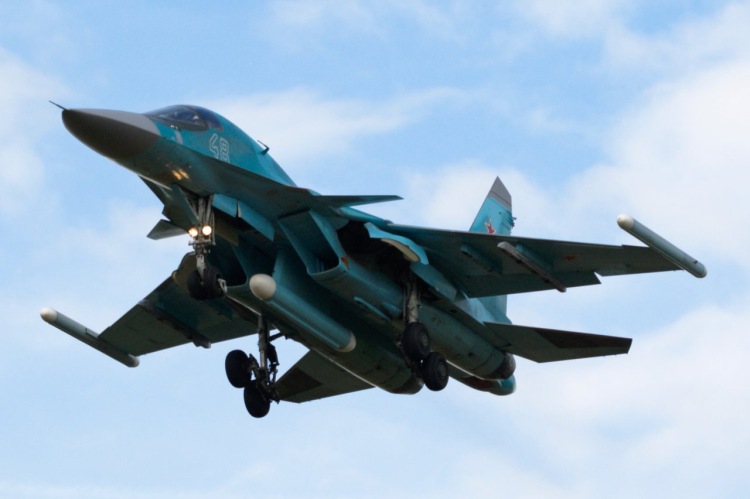
The existence of the Growler doesn’t say a thing about the RCS of the baseline Super Hornet or any other aircraft.
Growler is to degrade radar/communications. If rcs measures alone are effective there is no point for this aircraft.
JSR:rolleyes:
Great, now I have to go the other way. This is pure foolishness.
Tornado comparable? Weak engine power? Not provide acceleration for BVR shot?
Come on now…
so prove it that Rafale can have higher altitude/speed for BVR shot than Tornado ADV?
You would have to be nuts to say the Rafale is anything less than an extremely deadly adversary in an air to air engagement, particularly once it receives Meteor.
Rafale is certainly more agile aircraft than Tornado but it does not mean Tornado top end is slower than Rafale or less capable radar in Tornado.
There also really isn’t any comparison between an Su-35 and the EA-18G. The EA-18G is essentially in a class of its own. The Growler is a specialized aircraft with substantial permanently mounted modifications and multiple large pods.
Certainly an Su-35 with the appropriate pods could provide some of the same types of support as a Growler, but not nearly to the same extent. Besides, by the time the Su-35 is in real operational service the Next Generation Jammer will be arriving.
Su-35 engine power is way more than Growler. so certainly more powerful and heavier pods to higher altitude/speed it can carry.
The point i am making is that F-18E despite reduced RCS measures need this super expensive version with all external pods. so slighlty reduced rcs of Rafale is certainly not an advantage.
JSRModerm EW suites can give good range estimation (good enough to compute BVR firing solution) and also share data through data link to consolidate passive tracks.
What is extremly simplistic is ignoring the fact that a EW system will detect your radar emission 2 times further away than your radar effective range, so you’d better use it with caution, especially when your RCS is something like 20 times higher than your oponent’s.
India has a good insight on the last generation of su-3x, yet they were convinced that ordering 126 + Rafale is a good idea
First we dont know what criteria India use to select planes. it could be similar criteria of Agusta-Westland deal. and Those IAF Rafales are not arriving any time soon.
EW cannot replace Radar. Rafale is essentially Tornado comparable. Not much higher speed/altitude. and with weak engine power it willl certainly not provide acceleration for BVR shot and power requirements to same extent as wingtip pods on Su-35. not much impact on aerodynamic. External pods are more easily upgradeable than some thing internal.
see these wing tip and centerline pods. the wing tip pod is bigger than R-77.
It will increases effectivness more than EA-18G. you dont need centerline pod for every aircraft. one aircraft in group will do the work for rest. and rest could still have wing tip pods. if these external pods are not important so why Aussies has to spend $2b over the top of F-18E to create EA-18G.

JSRDo you have a source for the weight figures? The MSIP I Eagle is around 13 tons. What would increase the weight by 1 ton?
Those 31700 pounds as stated on the af.mil factsheet seem to be correct – for the original F-15E without CFTs.Btw, mission time of 1 hour without ext. fuel is realistic for an air/air mission including combat.
31,700 is weight for F-15C.
F-15 does not bring much more than F-16. that why IDF chose numerous F-16I rather than F-15I. Alot of countries that have budget for F-15 chose F-16 for strike like Japanese F-2, Turkish F-16, UAE F-16E etc.
JSRNot according to this website :
http://www.af.mil/information/factsheets/factsheet.asp?fsID=102F-15E ; Weight: 37,500 pounds ( 17,010 kilograms)
Thrust: 25,000 – 29,000 pounds each engine (13182kg)http://www.af.mil/information/factsheets/factsheet.asp?fsID=101
F-15C ; Weight: 31,700 pounds ( 14,409 kilograms)
Thrust: (C/D models) 23,450 pounds each engine (10659kg)Empty F-15 will not fly – you need to add some fuel and missiles – then you can compare both T/W.
Those weights are for non AESA models. F-15SA with twin pilots will be quite bit heavier and draggier.
JSRCost is a relative term. As it’s not just the price out the door but the total cost of ownership over the life time of the ship. (50 years!) The CVF is brand new and the Ex-Gorshkov/Vikramaditya is an old rebuilt warship. Which, has already had a long list of problems. Which, India maybe not be able to count on in a time of crisis……..
You don’t see many people trying to rebuild there old car instead of buying a new one. Because in the long-term it never pays off.
your assuming there will be no problems and time slippage to operationalize british carriers?
I think engines for Vikramadityia are new. and also upto 1500 India worker and sailors got trained. Viki is overall valuable deal for India thats why India is not abandoning it yet. (India Navy pilots already trained for MIG-29K/Ka-31 AEW). India may also take option of K-52K from the same carrier.
I would think Russian Navy will take that carrier incase India want to sell it.
Total cost of ownership will be way higher incase India try to purchase this size of ship from UK. just funding 45 Rafale or 45 F-18E will cost $15b. Ship construction alone will take 15 years to meet complex India requirements and participation . your looking at overall cost of $30b.
JSRi think Canada will only afford Gripen with coming budget cuts


 Sign In







