 GoldenDragon
Good point…but regardless most of the route would be “safe” anyway as it can be flown over water from the US…even to Berlin! 😀
Well, it’s the last tenth of the trip that’s a potential political hassle. I mean, even if the airspace above Paris was deemed available by EUCOM it would solve only a small section of the itinerary through a very crowded part of Europe.
GoldenDragonThere are probably many other starving artists out there doing the same. So it remains a hobby …
GoldenDragonDepending on whom the USAF is gonna bomb the crap out of, you could designate a “safe” route. There probably isn’t one for some places, like if the US wanna bomb Berlin again.
GoldenDragonWith the rapidly rising price of oil?
It’s prepositioning with subs or carriers …
OR
reviving the NB-36 nuclear-powered bomber program.
Yup, no need to even bother with mid-air refueling.
This little baby 51-5712 carried an air cooled nuclear reactor. It didn’t power the props though. The reactor was on so they could its effect on instruments.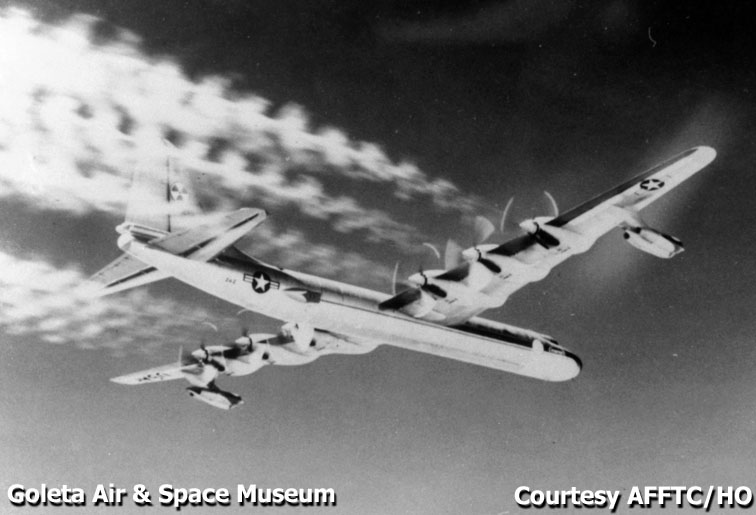
GoldenDragonAnd the connection between the FC-1 and the MiG-33 is there, even if it isn’t obvious in the hardware stage. The Mikoyan designers of the MiG-33 reportedly assisted Chengdu in some of the preliminary work on the new aircraft after the Super-7 project died. Does that mean that the FC-1 is a Mikoyan design or a MiG-33 evolution? No it doesn’t. But the two programs are in a way linked, even if the FC-1 turns out to be 100% indigenous (save the engine).
“Reportedly” yes but factually? So far, no.
I haven’t found any connection.
There simply isn’t any news of an assistance deal with MiG which you see on other Chinese projects like the Y8F600 program (with Antonov.) (1)
The FC-1 is an open project intended to gain market shares. Being connected to well-established firms like MiG actually helps in its marketing.
There would be no reason to hide it if it were so.
—————————————-
(1) http://www.shanfei.com/English_2/products/aircraft.htm
“SAC signed a contract with Antonov Designing Bureau, Ukraine for researching and developing Y8F600 aircraft at Chinese Aviation and Spaceflight Exposition held in Zhuhai.”
GoldenDragonVery nice pictures, A2A!
Say how much does it cost to fly a MiG21UM? And how long is each flight?
GoldenDragonAny upcoming launches?
Post them when they happen. It would nice to see a list by the end of the year.
GoldenDragonAnd finally a model of an unknown :confused: fighter – looks a bit like an early J-10 study …. but also a bit like this strange J-13 version !
Any comments ????
O.k. … lets give me just some time and I present You all my own first J-13 drawing ….
Deino :p
A very interesting picture, the square belly intake is identical to the one on the J-10. No other Chinese design has this.
But no canards I could see and wingtip rails which the J-10 doesn’t have.
The nose and cockpit extends out on a “swan’s neck” with a slight droop which is a design philosophy that began with the F-16, F-18, MiG-29 and Su-27 in the 1970s and 80s. So it is probably a later design than the J-11 and J-13.
GoldenDragonNot bad, which rocket class?
GoldenDragonThat last one looks like Lockheeds original F-22 design…
And yes, there is a connection between the FC-1 and the Mikoyan MiG-33 design.
Highly unlikely.
The original Super 7 was a collaboration project between China and the US.
Negotiations with Pakistan began the FC-1 phase of the project. And Pakistan wants something along the lines of their F-16s not a MiG.
Save for the powerplant, the RD-93, there is hardly any connection with MiG.
GoldenDragonAnother interesting point is that the launch was put forward a day to avoid bad weather. Most rocket shots are delayed when there’s changed, not kicked off early.
A Chinese idiosyncracy to do things ahead of schedule 😀
http://www.spaceref.com/news/viewpr.html?pid=14686
Success for Early Double Star Launch
A rare event in the history of space exploration took place yesterday (25 July) when the second European-Chinese Double Star spacecraft lifted off a day early from Taiyuan spaceport, west of Beijing, on a Long March 2C rocket.
The launch of the spacecraft, officially called Tan Ce 2 (Explorer 2), was brought forward one day to avoid bad weather. Lift off occurred at 08:05:18 BST (07:05:18 GMT or 15.05:18 local time).
Preliminary analysis of spacecraft data indicate that the spacecraft has been successfully inserted into a polar orbit ranging from 681 km to 38,278 km above the Earth, and that its experiment booms have deployed correctly.
Tan Ce 2 is the second spacecraft to be built for the Double Star programme, a unique collaboration between Chinese and European scientists. Its predecessor, Tan Ce 1 (Explorer 1), was successfully launched on a similar rocket from a launch site in Xichang on 29 December 2003 and is now returning a rich stream of data.
Eagerly awaited by UK scientists, who have played a major role in the Double Star missions, Tan Ce 2 will complete a six spacecraft Sino-European constellation designed to solve a 30 year-old space mystery: what happens when magnetic storms are generated above the Earth?
“We are delighted that everything seems to be going according to plan,” said Andrew Fazakerley (MSSL-ICL), one of the UK principal investigators for both Double Star and Cluster.
UK EXPERIMENTS UK teams play major roles in both Double Star and Cluster, through provision of instruments and involvement in science operations.
Seven of the eight European instruments on the pair of Double Star spacecraft (including five led by the UK) are copies of instruments on Cluster.
The Plasma Electron and Current Experiment (PEACE) on TC-1 and TC-2 was provided by the Cluster team at Mullard Space Science Laboratory, led by Andrew Fazakerley. This measures the speed, direction and population of electrons around the spacecraft.
Principal Investigator for the Fluxgate Magnetometer (FGM) experiments on TC-1 and lead Co-Investigator for the TC-2 FGM is Chris Carr from the Cluster team at Imperial College London. These instruments can measure a magnetic field in space 1,000 times weaker than the field at the Earth’s surface.
An experiment on TC-1 that measures waves (rapid variations in the magnetic field) includes the Digital Wave Processor (DWP) instrument, developed by the Cluster team at the University of Sheffield, under the leadership of Hugo Alleyne.
In addition, Double Star will draw on science operations expertise at the Rutherford Appleton Laboratory (RAL). RAL has been running the Cluster Joint Science Operations Centre (JSOC) since the beginning of 2001 and has adapted this to provide a similar service for Double Star. This European Payload Operations Service (EPOS) works with the European instrument teams on Double Star to co-ordinate the commanding of their instruments and delivers the finalised commanding to the Double Star Science Application System in Beijing.
RAL is also providing the Double Star Data Management System that will exchange key data products generated by the instrument teams between national data centres in Austria, France and the UK, and enable scientists and the general public to browse and retrieve those products.
Mike Hapgood, lead scientist for both the Cluster JSOC and Double Star EPOS, says, “This is a great opportunity to advance our understanding of the large-scale behaviour of the Earth’s magnetosphere.”
NOTES FOR EDITORS
Double Star is the first major collaboration between Europe and China on a scientific space mission. A major challenge has been to compare the methods used to develop space missions in Europe and China and to develop efficient ways of working together.
Each Double Star spacecraft is a spinning cylinder about 2 metres across and 1 metre high.
Tan Ce 1 (TC-1) is flying in a highly elliptical equatorial orbit of 570 x 78,850 km altitude (354 x 48,997 miles), inclined at 28.5 degrees to the equator. Over a lifetime of at least 18 months, it will sample key regions on the day and night sides of the Earth where the process of magnetic reconnection occurs. These reconnection processes dominate the dynamics of the magnetosphere.
The 343 kg drum-shaped Tan Ce 2 (TC-2) will observe the Earth’s changing magnetosphere from a highly elliptical polar orbit. Over a period of at least one year, it will sample the polar cap and cusps – the main regions where energy from the Sun flows into the magnetosphere. Those energy flows are largely controlled by the reconnection processes to be studied by TC-1.
European institutes contribute eight of the 16 Double Star scientific instruments and part of the network of data systems on the ground. These instruments are almost identical to some of those that have been flying on the Cluster quartet since the summer of 2000.
The four identical Cluster spacecraft — Rumba, Salsa, Samba and Tango — pirouette around the Earth in close formation, carrying out unique multi-scale, 3-D observations of the electrically charged particles in the solar wind and their battle with the magnetosphere.
In order to allow the combined observations by six spacecraft, the lifetime of ESA’s Cluster mission has been extended three years until the end of 2005. If all goes well, the lifetime of all the spacecraft may be further extended to increase the scientific return of this unique constellation.
The turbulent interaction between the supersonic solar wind and Earth’s protective magnetic shield is revealed in various ways. The arrival of huge clouds of magnetised particles (known as coronal mass ejections) at the Earth gives rise to the beautiful aurorae — the Northern and Southern Lights — but it can also produce magnetic storms that may have serious consequences for human activities, from power cuts to damaged satellites and communication breakdowns.
GoldenDragonLauncher is the Long March 2C.
GoldenDragonImportant because it is part of a major China/European collaboration effort.
http://www.physorg.com/news522.html
Second Double Star satellite successfully launched
July 27, 2004
Yesterday, 25 July at 09:05 CEST (15:05 local time) the Chinese National Space Administration successfully launched Tan Ce 2, the second of the Double Star science satellites. This marks the latest important milestone in the scientific collaboration between China and the European Space Agency.
Tan Ce (“Explorer”) 2 was launched from the Taiyuan spaceport west of Beijing (Zhangye province) using a Long March 2C rocket. The launch, initially scheduled for today 26 July, took place one day earlier in order to avoid adverse weather conditions expected in the days to come. The spacecraft will join Tan Ce 1, which was launched on 29 December 2003, to complete the Double Star configuration.
About 8 hours after launch the two solid booms holding the magnetometers were successfully deployed. In the next few weeks, all spacecraft sub-systems will be checked out and the commissioning of the on-board scientific instrument will follow.
Double Star will operate alongside ESA’s quartet of Cluster satellites to closely study the interaction between the solar wind and the Earth’s magnetic field. Together, these missions will provide the most detailed view to date. TC-1 is already returning a wealth of scientific data. Back in January, both missions tracked a coronal mass ejection from the Sun and gathered valuable data about the Earth’s bow shock.
Tan Ce 2 reached its nominal orbit, with perigee at 682 km, apogee at 38279 km and inclination of 90.1 deg. The positions and orbit of the Double Star satellites have been carefully defined to enable exploration of the magnetosphere on a larger scale than is possible with Cluster alone. One example of this coordinated activity is the study of the substorms that produce aurorae.
The exact region where these emissions of brightness form is still unclear, but the simultaneous high-resolution measurements combined under these two missions are expected to provide an answer.
ESA is contributing eight scientific instruments to the mission, seven of which are Cluster-derived units.
These are the first ever European experiments to fly on a Chinese satellite. ESA will also be providing ground segment support, four hours each day, via its Villafranca satellite tracking station in Spain.
Scientific cooperation between China and ESA goes back quite a long way. A first Agreement signed back in 1980 facilitated the exchange of scientific information. Thirteen years later, the collaboration focused on a specific mission, Cluster, to study the Earth’s magnetosphere.
Then, in 1997, came a big step forward. The CNSA invited ESA to participate in the Double Star dual-satellite mission to study the Earth’s magnetic field, from a perspective different but complementary to Cluster’s. The Agreement to carry out this joint mission was signed on 9 July 2001 by ESA’s then Director General Antonio Rodotà and CNSA Administrator Luan Enjie.
For Professor David Southwood, ESA’s Science Programme Director: “Today’s successful launch marks the culmination of these joint efforts and a further important step forward in this historic collaboration between China and Europe.”
More about Double Star:
The Double Star position and orbits have been defined in relation to Cluster, which are located far away at about a third of the distance from the Moon. The duo are much closer to Earth. TC-1 in elliptical orbit (550 x 63 780 km) will operate for 18 months. TC-2 in polar orbit (700 x 39 000 km) will operate for 12 months. This allows an overlap period, the quartet’s lifetime having been extended by three years to end-2005.
ESA is also contributing 8 million euros of funding to the programme. This covers the refurbishment, rebuilding and pre-integration of the European instruments, four hours per day data acquisition and the coordination of scientific operations.
More about Cluster
This ESA mission comprises a quartet of satellites launched on two Russian rockets during summer 2000, now flying in formation around the Earth. They are relaying the most detailed ever information in 3D about the impact on Earth of the solar wind, that perpetual stream of subatomic particles given out by the Sun which can damage communication satellites and disrupt power supplies. Operations have been extended to end-2005.
GoldenDragonYes Arthur, the landing gear bulge is also present on the 2nd flying prototype 03.
GoldenDragonThe weather J’s were a real joke. They were in place without the proper avionics kit and a big unknown, if the fancy composite props would break up if you drove it through large hail. What a joke.
Well Elp, you and Albert and other members of our forum are mentioning things that are showing up in stories following up the report.
Audit says military is buying deficient planes
Among a few of the problems:
# Propellers that require repair or replacement after exposure to severe weather conditions
# Malfunctioning radar and data-transmission systems
# A lack of certification to conduct air-drop operations — one of the aircraft’s primary missions
I don’t understand why there has been almost no reports of such major problems until now.
By most accounts until recently, the C-130J was compared favorably to the much delayed A400M and An-70 projects.
The C-130J certainly has a lot of export interests. Even France is/was evaluating it.
A few days before the scandal story broke:
http://biz.yahoo.com/prnews/040721/daw066_1.html
“Lockheed Martin Receives Request for Additional Super Hercules and Celebrates Historic 50th Year for the C-130
Wednesday July 21, 4:59 pm ET
FARNBOROUGH, England, July 21 /PRNewswire-FirstCall/ — Lockheed Martin (NYSE: LMT – News) has been notified by the Royal Danish Air Force (RDAF) that Denmark will exercise the option for an additional C-130J Super Hercules. Denmark has already taken delivery of three of the advanced airlifters since placing its first order on Dec. 1, 2000.”
Good luck to the Danes.


 Sign In







