 SpudmanWP
IRST detection of a head-on target is for a plane, not a missile. A plane is a MUCH larger target and heats up more due to friction.
SpudmanWPThose larger than 5km numbers are for AAMs with the motors burning. An AMRAAM launched at BVR ranges is likely well beyond that detection range.
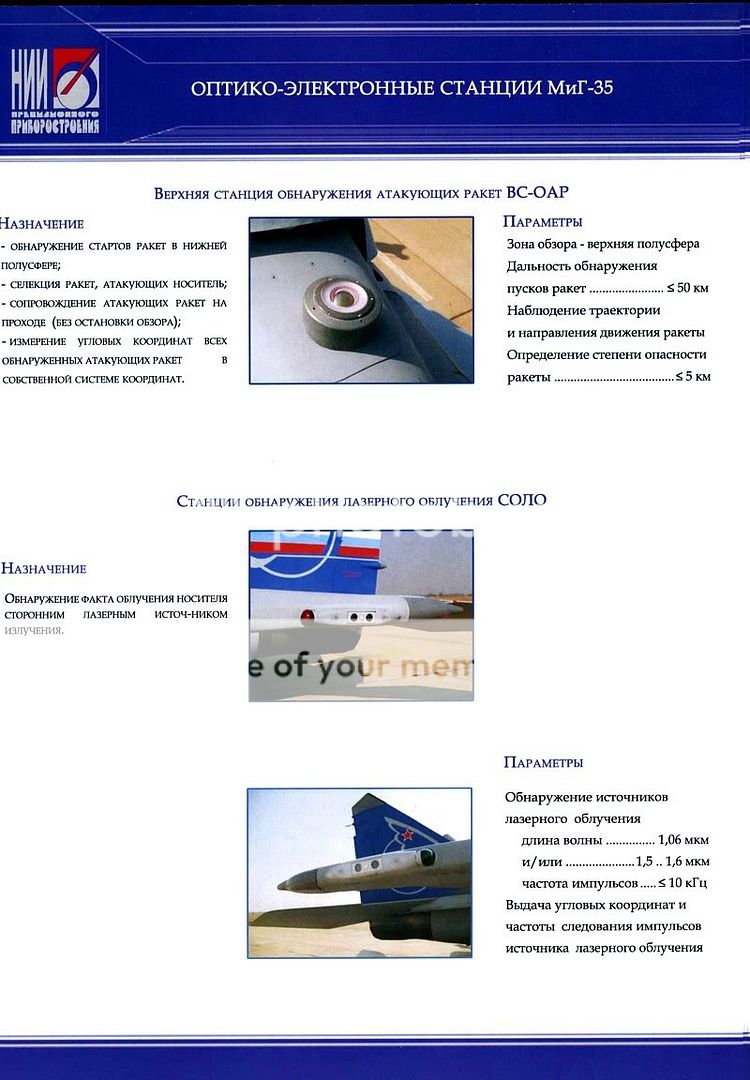
I copied the pics from the linked site.

SpudmanWPPrecisely the “E”? Anti ship.
The “K” is a diferent story.
The “E” is the lead developmental airframe for UAI. As such it can carry the JSOW, JASSM, and any future ASMs that gets UAI. All the E’s have been updated with Blk1 UAI functionality.
SpudmanWPRussia claims a SOAR detection range of “< 5km” for a non-burning (read coasting) inbound AAM.
I was being generous with 5-10km.
http://www.secretprojects.co.uk/forum/index.php?topic=1728.0 (see the attached photos at the bottom of the linked page)
SpudmanWPShow me where it (IRST) is operationally used as an MLD first.
SpudmanWPSpud – If the USMC is at IOC by 2015 (the date is not publicly disclosed any more) they will be flying Block 2B aircraft limited to Mach 1.2, 40000 feet and 5.5 g, and with no multi-ship fusion.
None of which keep the USMC from taking it to Red Flag by 2015.
The AIM-120D is not due to complete OT until FY14 so the chance of IOC within the year is small (DOT&E report).
Read my post again. I said that it would be C7.
The obvious flip-side of the GPS and high-arching profile is that the missile needs to keep getting radar updates from the launch aircraft for a longer period after launch – on the upward trajectory the target may not even be in the seeker FOV, and the high-arch takes longer to cover the distance.
So the shooter (1) is using more radar emissions and (2) has to keep the target in its radar FOV, closing the range. Neither is an ideal stealth-type engagement.
Updates to the 120D could come from the APG-81, ESM, or EOTS from ANY F-35 in the area, not just from the shooter.
And I tend to concur with ff1987 that IRST or indeed MAWS will detect launch flare at a greater range than 5-10 km. Indeed, IRST should see the upward-trajectory flare of a long ballistic profile pretty easily against a cold sky.
To see the launch the IRST would have to be looking at that point in the sky at the right time. Don’t bet on it.
SpudmanWPA MAWS might get you a 5-10km heads-up to an inbound AAM coming in on a high-arching attack.
Not much time to do much.
At 10km, a descending AAM going m2 will hit you in 15 seconds.
SpudmanWPMost engagements will be head-on so I used that scenario in my example.
SpudmanWPOn the RedFlag issue, I was speaking of the F-35B, not the A. Here ar a few reasons why I think it will happen by 2015.
–The USMC’s first Operational Sqdn just stood up next door at Yuma. They will have all their F-35Bs by the end of the year.
–The USMC is eager to get the F-35B to IOC and demonstrate it’s capabilities (makes it a smaller target for budget cutters).
–The USMC’s center for developing F-35B combat tactics is also in Yuma.
–The JPO has used surrogate aircraft (BAC1-11, CATB, Falcon, etc) at several joint exercises (Red Flag, Bold Alligator, etc) and would jump at the chance to fully utilize the networked capabilities of multiple F-35Bs.
On the question of the Aim-120D
–In the Red Flag plan above, they will likely be Aim-120C7
–The Aim-120D will be IOC within the year. Not known if the Aim-120D will make it into Blk3 or Blk4.
–ATK is on contract (Sep 2009) to deliver technologies related to a new AMRAAM motor in 2013. Range improvements, lighter weight, more energetic propellents, multi-pulse motor, etc were part of the plan.
–IMHO the above motor will form the basis of the Aim-120D+ (next block of D)
–The key benefits of the 120D that allow for a greater range and NEZ are it’s high, arching flight profile. The 120D has a GPS assisted INS. This allows the 120D to know precisely where the target is as long as the datalink is active and to know precisely where it is. This allows for better target & interception prediction leading to a more efficient arching flight profile. Also, because of the better target prediction & interception it can go active much later than previous AMRAAMs. This would allow the 120D to use more power for it’s seeker (if it has this capability to vary the power) while using the same battery size. Going active later in the intercept (vs previous AMRAAM versions) gives the target less time to deploy countermeasures. The two-way datalink will allow the AMRAAM to communicate it’s status ensuring a better intercept. Lastly, an arching profile is better because it can use gravity to recover maneuver energy and because the target will present a larger RCS when viewed from above rather than head-on.
SpudmanWPbut whomever thought F-35 will best 4.5 gen a/c in A2A will have to revise their calculation even regardless of cost effectiveness.
Time will tell, specifically 2014/2015 Red = Flag 🙂
That is, unless a much superior BVR missile comes into being.
Aim-120D/D+
SpudmanWPThanks ob, my bad.
SpudmanWP@Pistonrob, there are a total of 2 motors, not 4. The layout is the same as on the British Lightning (one on top and one on the bottom).
The biggest problem I see is the top scoop. It will have air separation problems in high-g maneuvers.
As far as TV, it might be better to merge the two exhausts into a single F-22 style nozzle or a single 3D nozzle. The problem with the current layout is that the lower nozzle cannot assist in pulling Gs since it cannot deflect upwards.
On the landing gear issue, the F-35’s mains are rear of the cg so I do not see this as an issue.
SpudmanWPPostpone =/= Cancel
ANKARA — Turkey said Jan. 11 it has postponed an order to purchase its first two U.S.-made F-35 fighter jets due to technical problems and rising costs, but said it still intends to buy 100 more in the long run.
“Due to the current state of the JSF (Joint Strike Fighter) … and the rising cost … it was decided to postpone the order placed on Jan 5, 2012, for the two aircraft,” the Undersecretariat for Defence Industry (SSM) said in a statement.
The SSM, the public body responsible for Turkey’s arms purchases, said the decision was taken because the technical capabilities of the aircraft were ”not at the desired level yet.”
After the initial purchase of the two jets, Turkey plans to order 100 units of the stealth fighter to replace its current fleet consisting mainly of F-4 Phantoms and F-16 Falcons, according to the statement.
Looks like they want their initial planes at Blk3F (IOC), not Blk2 as they would be if ordered now.
IIRC Turkey is not part of the IOT&E program so they would not need Blk2B jets.
SpudmanWPSince there is no explosive, what goes “kaboom”?
It would have to hit a munition, a plane that is fueled, etc. Otherwise it’s a neat entry hole and a slightly larger exit hole with a loud “woosh” in-between. Yes there will be some shrapnel, but not much.
How good is the seeker? Does it have target ID with point targeting (Does it know what a CVN is and where to aim for or does it aim for center mass)?
SpudmanWPIn order for kinetic energy to be effective it has to be transferred.
Is it sea skimming with a level penetration or a dive?
If it goes through a carrier, from left to right, it may just **** off the tech in the hanger and not do much damage. No necessarily even a mission kill. 😉


 Sign In







