SABR and RACR weigh LESS than the MSA in the F-16
Wouldn’t cooling the array be an even bigger issue in most cases?
NG’s SABR and Raytheon’s RACR are “drop in” replacements for F-16s and are specifically made to fit within the power and cooling requirements.
Yes, BF-06 is from LRIP2.
Good thing that did not happen at sea 😉
Where do you land when the carrier closes?
How is Japan only getting a 20% offset (spread over less than 10 years) better than partner nations getting upwards of 75% or more (spread over the life of the program)?
I think they looked at what the Typhoon offered and decided it did not outweigh the loss of American relations over the sale. I think if the roles were reversed (eg if the Eurofighter was of F-35’s caliber and all the US put forth was the F-15/18), then Japan could have easily gone the other way.
I too would have loved to see the F-35 in a knock down, drag out competition.
How is the F-35 a bad choice for Air-defense/Air-interception? It goes above m1.6 with 4 internal AMRAAMs (the F-18 cannot do that), it has an IRST, has stealthy data links, EODAS, and its radar and RwR are linked to act as a single unit, and has a radar that even the APA says is second to only the F-22’s APG-77.
What about the F-35C makes it a better choice than the F-35 for this mission? It only has a range benefit of less than 100nm but gives up 1.5g of maneuverability, costs about $20 million more than the F-35A, has no internal gun, and does not carry any more AAMs than the F-35A.
—edit–
The only way to realistically lighten the C is to change the landing gear which will not give you much of a benefit. If you try and lighten the structure you will lose more g loading ability and have to retest the airframe (basically making a F-35D).

Given that the F-35 is a 9g airframe, (which the F-18 is not even close to with a 7.6g limit) and the F-35 is faster than the F-18 with weapons, I think it’s pretty accurate.
The proportion of F-35s body lift vs. total lift is more than that of most other fighters, even twin engine ones like the Eurofighter, Rafale, F-18, etc and is much greater than skinny single engine fighters like the F-16, Gripen, etc.
Obviously large spaced twin engined fighters like the SU series and the F-15 have a great amount of body lift that was proven quite convincingly when the Israeli F-15 landed with most of it’s right wing missing (remember that this was without the benefit of fbw).
F-35
# Wing loading: 91.4 lb/ft² (446 kg/m²)
That does not take into account the lift generated by the lifting body design of the fuselage.
I was a little off, it’s slightly under m1.6 at a very small altitude margin.

@Geoff: The F-35 has been flown in testing with dummy internal weapons (there are plenty of pics of this). Even after this series of tests the KPP of M1.6 with 2 AMRAAMS and 2 2k JDAMS has held.
@Sintra: The Nikkei weekly is not just a journal, heard of the Nikkei Index much? As to “Operability/Maneuverability”, that pretty much means flight performance (remember we are talking armed, no clean airshow performance).
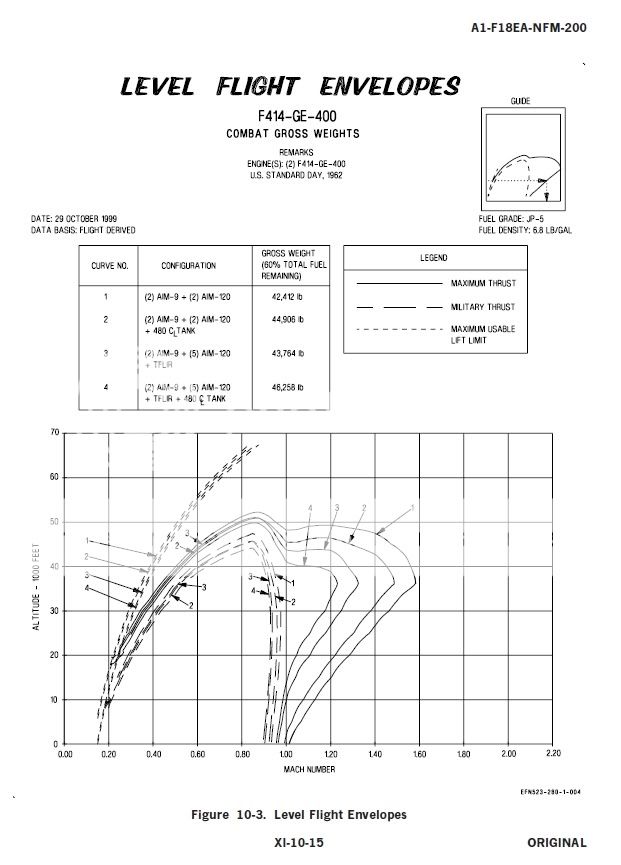
Claims backed up by actual test data, as in turn rate, max speed, etc. For example, the max speed of the F-35 is given at M1.6 (with weapons). If you look at the performance charts of the F-18E, it can only do ~m1.4 when loaded with 4 missiles.
That was Slowman’s translation. As he hates the F-35 and thinks that it will be the “destruction” of Japan’s parts industry, I do not think he would have erred on the side of the F-35.
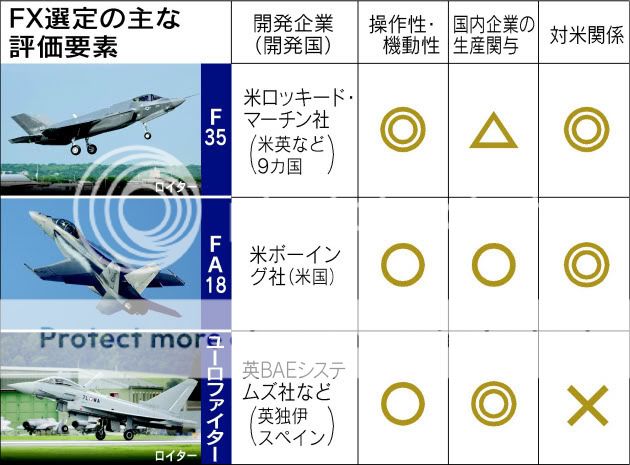
Here is a graphic from the above Nikkei article (thanks Slowman for providing).
The first category is “Operability/Maneuverability”, the second category is “Industrial Participation”, the third category is “Relations with the US”.
Biggest surprise for F-35 haters is that it placed the F-35 above the F-18 and Typhoon in “Operability/Maneuverability”