 SpudmanWP
Funny thing.. This IRST is not what the USAF F-15’s are being upgraded with.
SpudmanWPPeter,
The original doc was part of a Military Avionics 2008 conference by Rick Rosa (MS Architecture Lead).
Here is the original site
The original is a flash presentation with audio.
There is another nice presentation by Mike Bossert (F-35 Air System Archatect), again with audio.
Both of the DefenceIQ sites require registration to view, but it is free. I have split the presentations into MP3s and PDFs. I am currently uploading them to Google Docs. I will add the links when available.
Unfortunately, Blk 0.5 was as far as the presentation went. As to when EOTS gets in, this slide from a Sep ’08 presentation shows it as part of Blk1 (LRIP3).

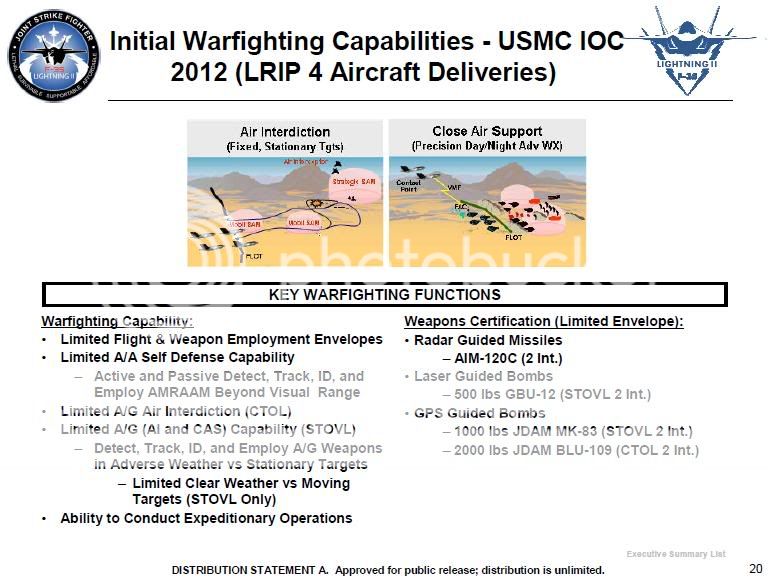
From the same presentation is Blk2 (LRIP4)
——Update
Here are the Google Docs links to the files:
Rick Rosa MP3
http://docs.google.com/leaf?id=0B2Wxyon_-A1fZTE5YjBkOGUtYTJiZC00YTE2LTliMDItOWYwYTA2MmNlNmY2&hl=en
Rick Rosa PDF
http://docs.google.com/fileview?id=0B2Wxyon_-A1fNTdiNTgxY2ItOTVmYi00NTg0LTlhMzUtM2VlYWRjY2VmODAy&hl=en
Mike Bossert MP3
http://docs.google.com/leaf?id=0B2Wxyon_-A1fOTJlNzk1MTEtMmUwMy00OGExLWFlZDQtYjc3YWUyOTk5ZTYy&hl=en
Mike Bossert PDF
http://docs.google.com/fileview?id=0B2Wxyon_-A1fNDg1MjgyMDgtZDE1Ny00MDY4LTk0MTctYTUxZjI3OGFkMjgx&hl=en
SpudmanWPQuick question; why are AESA radars slanted upwards? Doesn’t that require greater steared angle to deflect downwards for air to surface modes? why not simply have it facing flat?
Basic RCS reduction measures.
In a head to head engagement the oncoming radar sweep will reflect up and away from the transmitting AC.
SpudmanWPHere is a list of BF-4’s Block 0.5 MS functionality.

SpudmanWPUpdated BF-4 info:
April 7, 2010 (by Bjørnar Bolsøy) – The first mission systems-equipped Lockheed Martin F-35 Lightning II stealth fighter flew for the first time today, ushering in what will be the most powerful and comprehensive sensor package ever to fly in a fighter.
During the flight, F-35 Test Pilot David Nelson climbed to 15,500 feet (4,700 meters), verified engine response at varying throttle settings, performed a series of flight-qualities maneuvers and checked the operation of the aircraft’s mission systems. The flight out of Lockheed Martin’s Fort Worth plant began at 10:04 a.m. CDT and concluded at 10:59 a.m.
“Today’s flight initiates a level of avionics capability that no fighter has ever achieved,” said Eric Branyan, Lockheed Martin F-35 deputy program manager. “The F-35’s next-generation sensor suite enables a new capability for multi role aircraft, collecting vast amounts of data and fusing the information into a single, highly comprehensible display that will enable the pilot to make faster and more effective tactical decisions.”
The F-35’s avionics, or mission systems, also process and apply data from a wide array of off-board sensors based on the land, in the air or at sea, enabling the jet to perform command-and-control functions while providing unprecedented situational awareness to air and surface forces.
F-35 BF-4, a short takeoff/vertical landing (STOVL) variant, will begin testing with the AESA radar, EW, ICNI, ICP, GPS, INS and HMDS, then integrate the remaining sensors as flight testing progresses. F-35C Carrier variant and F-35A conventional takeoff and landing variant test aircraft will be similarly mission systems-equipped, with mission systems commonality among the three variants near 100 percent. High avionics commonality is an enabler of rapid training, interoperability, and lower production and support costs.
F-35 avionics already have undergone more than 100,000 hours of laboratory testing, including sensor-fusion testing in the program’s Cooperative Avionics Test Bed, a highly modified 737 airliner incorporating the entire F-35 mission systems suite, including an F-35 cockpit. F-35 software has demonstrated remarkable stability, and sensors have met or exceeded performance predictions.
BF-4 is scheduled to fly to Naval Air Station Patuxent River, Md., where it will join three other F-35Bs currently undergoing flight testing. BF-4’s general test objectives include providing data for mission systems Block 0.5 functionality in the F-35 flight environment to evaluate hardware and software implementation and integration, and providing data to support mission systems component development.
The Block 0.5 software incorporates important capabilities, including air-to-air search and synthetic aperture radar modes, identification friend/foe transponder, integrated UHF/VHF radios, electronic warfare radar warning receiver, and navigation functions. Information is presented to the pilot through state-of-the-art cockpit and helmet displays.
The F-35’s full mission systems suite includes:
● Northrop Grumman AN/APG-81 Active Electronically Scanned Array radar [Long-range, multiple simultaneous air-to-air and air-to-ground targeting; SAR mapping]
● Lockheed Martin Electro-Optical Targeting System (EOTS) [Long-range, passive infrared search and track, air-to-air and air-to-ground targeting capabilities]
● Northrop Grumman Electro-Optical Distributed Aperture System (EO-DAS) [Passive, spherical, long-range threat detection; source of infrared video and night-vision projection onto pilot’s helmet visor for spherical view around aircraft]
● BAE Systems Electronic Warfare (EW) system [Simultaneous geo-location of multiple threats and targets]
● VSI Helmet Mounted Display System (HMDS) [Helmet with integrated, virtual head-up display, targeting information, look-shoot capability and video/night vision projected onto the helmet visor]
● Northrop Grumman Integrated Communication, Navigation & Identification (ICNI) [Friend-or-foe identification; automatic acquisition of fly-to points; secure multi-wave, multiband, multimode wireless communications and data links]
● Lockheed Martin Integrated Core Processor (ICP) [Supports radar, EOTS and DAS sensor processing, navigation, stores management fire control and fusion of sensor and off-board information]
● Honeywell Inertial Navigation System [Raytheon Global Positioning System]
http://www.f-16.net/news_article4053.html
SpudmanWPBF-4 just took off 🙂
This is the first mission systems-equipped Lockheed Martin F-35 stealth fighter.

SpudmanWPStarting at the 1:02 mark in this video is the same sequence, but this time with voice. He clearly says there are “23 targets within 100 miles (assume nmi)”.
SpudmanWPThe same way the F-35 would find the T-50.
And how will that happen considering the US’s huge advantage in radar, RCS, IRST, EODAS, RWR, datalinks, and general avionics tech?
Will the Russians magically not only catch up, but surpass US tech in a single step?
I think not.
SpudmanWPYikes… I was not being arrogant, just making an observation that i did not understand.
My bad for typing “in” instead of “of”, it was not intentional.
SpudmanWPHas there been actual cofirmation that EODAS is limited to the WVR arena? Surely the sensor tech used in EODAS can exceed WVR distances?
It is not likely and trust me, I am a huge F-35 fan and would love to tout BVR fighter tracking ability for the EODAS if it was possible. The main problem is zoom. Because the EODAS has to cover a 360 sphere, it cannot zoom (optically) because that would mean that it would loose track of other things in that area as it zooms in.
If you meant BVR ranges for the MLD functions of the EODAS it’s highly likely that it will be able to detect & track missile launches well into the BVR arena due to the high levels of heat involved.
SpudmanWPEurofighter is offered with the PIMAWS passive infrared system for MAWS, but I don’t know if anyone has bought it yet. Hopefully someone picks it up for the reasons you mentioned.
Also, that new DDM NG thing looks amazing- apparently they’re going to add DIRCM at some point. Looking ahead to the Rafale of 2015-2018, we have:
AESA
DDM NG with DIRCM
Active Stealth
9t engine
More SPECTRA modes
METEOR
OSF-IR
Helmet Mounted Display (?)
and who knows what else. I hope it will give the F-35 a nice bit of competition.
They has better add some more of those DDM NG sensors if they want to cover all angles of the AC. If both (they said two sensors) are on the tail, what covers MANPAD launches from below?
SpudmanWPI have no doubt that the hardware of the AN/AAR-56 (F-22’s MLD) can handle the job. Here are two video’s showing what the MLD can pick up. It’s only a matter of writing the software to interpret the information and integrate it into the F-22 battle computer.
However, just as EODAS in only WVR, so is the MLD. There is still a need of a real IRST for long range detection and ID of targets.
SpudmanWPThe F-22 will pick up on any Link-16 activity.. unless the sneaker is only receiving Link-16 data.
A deployed AIM-9M (same seeker as the 9L) can not see more of an area as the APG-77, so there is no benefit to coverage area. However, the RCS and range of the F-22 will be seriously compromised having those bays open (all the time too).
A better option would be to bring the tech of the EODAS into the F-22’s MLD, as LM is planning. It would also provide a better detection range into the MLD than even the 9X could provide. Let’s hope they get this into the Incr 3.3 timeline.
SpudmanWPI sugesst the seven years old thesis
“Signal Processing for Airborne Bistatic Radar” from Kian Pin Ong!
and how self synchronisation at DSSS works.
I found that here:
http://citeseerx.ist.psu.edu/viewdoc/download?doi=10.1.1.107.177&rep=rep1&type=pdf
and my head is still hurting from the levels of mathematics involved 😉
The funniest thing I saw was on the title page:
A thesis submitted for the degree of Doctor of Philosophy
Why is someone getting a Doctorate in Philosophy writing a paper dealing with high levels of Mathematics and Engineering.
SpudmanWPLockheed released a 2009 Year in Review F-35 vid.
I had to split this in two pieces due to Youtube’s 10 minute limit.
Part 1 of 2:
http://www.youtube.com/watch?v=sFpnkiDgeCQ
Part 2 of 2:
http://www.youtube.com/watch?v=Vl0n8Wm8XRg


 Sign In







