 SpudmanWP
Your assuming many things that wont happen.
1. The PAK FA knowing where the F-35s are and the direction they are coming from. How does this happen?
2. The PAK FA will not be detected by ground radars from the sides and rear. Since the PAK FA’s RCS reduction is clearly forward sector only, detection from the side and rear is a no-brainer.
3. If you can see the F-35s, you are within the range of an AMRAAM (the AIM-120D/D+ btw), especially in a head-on engagement.
SpudmanWPThis is why LM has until May 1st, 2010 to come back with a plan as to how they will use the LRIP transfer F-35s.
SpudmanWPAccording to his latest memo, Undersecretary Carter wants 4 additional F-35s (1 new build F-35C and 3 LRIP transfers) for the SDD program. They will transfer back to the IOT&E program when SDD is done.
SpudmanWPIn the spirit of openness, here is the original report from the “Inside the Air Force” newsletter:
Inside the Air Force – 2/26/2010
Fraser: Focus on capability not a date
Air Force To Slip F-35 Joint Strike Fighter Initial Deployment Date To 2015
The Air Force will delay the initial deployment date of the F-35 Joint Strike Fighter more than two years in response to Defense Secretary Robert Gates’ decision to extend aircraft development and slow production, service Secretary Michael Donley told lawmakers this week.
The revelation came just days after Air Combat Command chief Gen. William Fraser said he would not deploy the fifth-generation fighters until they have a minimum number of essential capabilities. As recently as this month, Air Force officials had called for the F-35 to reach its initial operational capability by mid-2013.
“For the Air Force . . . that will be late in calendar year 2015,” Donley said during a February 23 House Armed Services committee hearing when asked by Rep. Larry Kissell (D-NC) when the service would have “deployable, meaningful numbers of planes in the air.”
The potential slip in IOC is the result of a Pentagon decision to extend F-35 system development and demonstration, Fraser told reporters during a February 19 briefing at an Air Force Association-sponsored conference in Orlando, FL.
“My focus is on combat capability. It is not on a date,” Fraser said noting he is “still very confident in the program and the restructuring that¹s gone on.”
The fighter must have Block-3 software and a certain number of spare parts and trained crews to meet IOC requirements, according to Fraser. The Marine Corps plans to declare IOC for its JSFs with an earlier block of software.
“Whenever there’s any adjustments in any program, you have to go back and take a look at are all the requirements still going to be met by time frame X or Y,” he said.
ACC is working with the Air Force Operational Test and Evaluation Center and other organizations throughout the service to see how the Pentagon-directed changes will impact its JSF IOC schedule, Fraser said. “The aircraft are going to deliver at a different rate now . . . so that’s why I have to go back and take a look at am I going to have sufficient air crews trained, sufficient number of aircraft, parts and spares and all that when SDD is already moved slightly to the right?”
Although the F-35 will likely reach the battlefield later than expected, the Air Force does not anticipate any major changes to its current legacy fighter programs, other than already planned modifications and upgrades. “We’re going to continue with the program of record that we have for our legacy aircraft to add capabilities to them [and] to perform some service life extension programs,” Fraser said.
Still, the service is performing structural evaluation tests on its F-16s to see if they can fly longer than planned. “We’re using the fleet viability board process to understand where these airframes are and how long can you continue to fly them,” he said. “All of that together . . . is how we will mitigate any potential gap,” Fraser said.
At the same time, Lockheed Martin plans to invest hundreds of millions of dollars to improve JSF, a fix company officials claim will help right the lagging program.
Lockheed is already investing funds to establish a new software mission systems test line and assign more people to generate the new software “to catch up,” according to Steve O’Bryan, Lockheed Martin vice president of F-35 business development and customer engagement. We need to put money to catch up or maintain the flight test schedule,” he said during a Feb. 19 briefing with reporters, also in Orlando.
The new software is expected to field in 2012 — around the time low-rate initial production Lot-4 aircraft begin rolling off the production line.
The price tag of the new software is in the “hundreds-of-millions of dollars” range, O’Bryan said, noting the company is putting “management reserve” behind the software.
The company is also contemplating the addition of another test aircraft that “will allow more throughput in the flight test [and] alleviate the stress on other assets and move it to this one.”
Word of the potential IOC slippage came one day after Air Force Chief of Staff Gen. Norton Schwartz said the program might soon breach Nunn-McCurdy spending limits (Inside the Air Force, Feb. 19, p1).
Earlier this month, the Pentagon announced it would slow F-35 system, design and development and invest billions of dollars in an attempt to right the program. While Lockheed is six months late in rolling out SDD aircraft, company officials claim LRIP-3 aircraft are expected to roll off the production line on time.
“We are focused on affordability,” O’Bryan said. “We are focused on execution. What we need to do is concentrate on delivering the jets, rebuilding confidence in the program and getting jets in flight tests to the operators. Until we do that all else really pales in comparison.”
However, Lockheed officials were mum on the price tag of the F-35. “We’re still looking at the numbers” in the budget, O’Bryan said.
On February 1, Air Force deputy budget chief Marilyn Thomas said the service projects that F-35s will cost $141 million per copy.
“The contracts for LRIP-1, LRIP-2 and LRIP-3 . . . I can tell you that we’re confident the LRIP-4 contract as well will sign below the [Selected Acquisition Report] value”, O’Bryan said.
In all honesty, I am a F-35 supporter and a naturally optimistic person. With that in mind, here is what I see as possibly happening:
I do not see the IOC, as it has been defined in the past, being delayed till 2015.
There are a couple of reasons for this. First, let’s look at what the USAF has been using as IOC in the F-35 program.
Here is the original schedule as it was when the SDD contract was signed:

The two year SWAT-delay, from an IOC of 2010 (USMC) to 2012 (USMC), is obvious here. Also note that the USAF planned an IOC while still in Block 3 DT&E. This is before ITO&E. This does not jive with the above quote:
The revelation came just days after Air Combat Command chief Gen. William Fraser said he would not deploy the fifth-generation fighters until they have a minimum number of essential capabilities. As recently as this month, Air Force officials had called for the F-35 to reach its initial operational capability by mid-2013.
“For the Air Force . . . that will be late in calendar year 2015,” Donley said during a February 23 House Armed Services committee hearing when asked by Rep. Larry Kissell (D-NC) when the service would have “deployable, meaningful numbers of planes in the air.”
…”My focus is on combat capability. It is not on a date,” Fraser said noting he is “still very confident in the program and the restructuring that¹s gone on.”The fighter must have Block-3 software and a certain number of spare parts and trained crews to meet IOC requirements, according to Fraser. The Marine Corps plans to declare IOC for its JSFs with an earlier block of software.
Clearly DT&E F-35s are not deployable, maybe ITO&E. So it looks like he is speaking of a different kind of IOC then they have historically used in the F-35 program. I think his comments were meant to light a well-deserved fire under LM’s a$$ to get the program back on track.
Point two, LM and the JPO have not been sitting on their hands and are planning steps to get the program somewhat back on track.
At the same time, Lockheed Martin plans to invest hundreds of millions of dollars to improve JSF, a fix company officials claim will help right the lagging program.
Lockheed is already investing funds to establish a new software mission systems test line and assign more people to generate the new software “to catch up,” according to Steve O’Bryan, Lockheed Martin vice president of F-35 business development and customer engagement. We need to put money to catch up or maintain the flight test schedule,” he said during a Feb. 19 briefing with reporters, also in Orlando.
The new software is expected to field in 2012 — around the time low-rate initial production Lot-4 aircraft begin rolling off the production line.
The price tag of the new software is in the “hundreds-of-millions of dollars” range, O’Bryan said, noting the company is putting “management reserve” behind the software.
[b]The company is also contemplating the addition of another test aircraft that “will allow more throughput in the flight test [and] alleviate the stress on other assets and move it to this one.”[/b]
Well, the additional test aircraft is a no-brainer. It is good to see LM already adding software test assets.
With all that being said, 2010 will be a very critical year for the F-35 program.
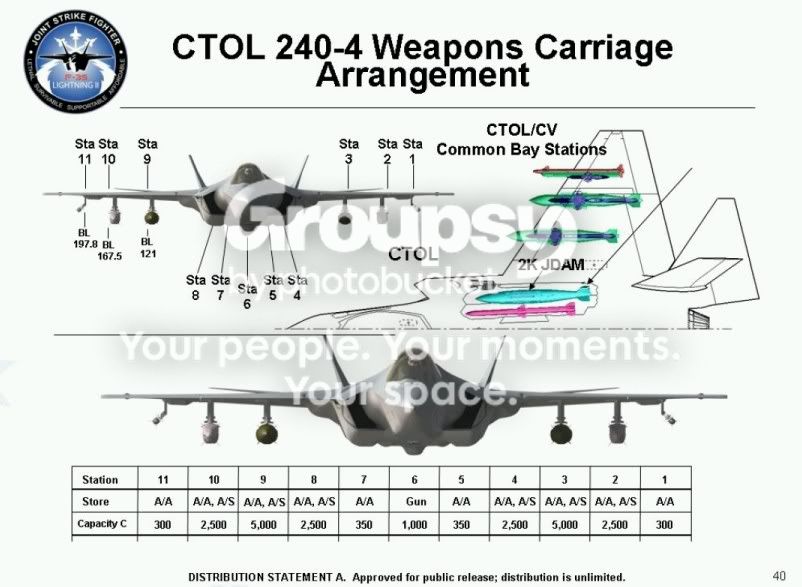
SpudmanWPInternally (stations 4,5,7, & 8) can carry one AMRAAM each. After Blk 5, stations 4 & 8 will likely hold 2 each.
Stations 2,3,9 & 10 can hold two AMRAAMs each with an MER.
Stations 1 & 11 can hold 1 AIM-9x each.
That’s 4-6 AAMs internal and 10 AAMs external.
.
.
RE: A2A weapon load of the F-35
The F-35 will be able carry 4 missiles on internal stations and up to 10 additional missiles on external stations. To look at potential future increases in internal carriage capability, studies have been done to explore the use of advances in launcher technology, however, current mission analysis does not necessitate further exploration of these capabilities at this time.
Thanks,
CherylCheryl Limrick
F-35 Lightning II Program Office
Assistant Public Affairs Officer
200 12th S, Suite 600
Arlington,VA 22202
(o) 703-601-5503
(c) 703-608-8965
[email]cheryl.limrick@jsf.mil[/email]
SpudmanWPNo, but in response the EF has to give up fuel to carry a large number of AAMs, the F-35 does not.
SpudmanWPWell, the F-35 will be able to carry 14-16 AAMs. How many can the EF carry and at what range?
SpudmanWPI’ve seen that thumbnail, but missed the AMRAAMs 🙂
SpudmanWPCheers brother! AIM-120B it is then.
Any idea of the date or source of the image?
Nope, I found it on another fighter board.
I will see what I can find.
SpudmanWPA few clarifications on the X-49.
1. The phase one tests were only cleared for the existing flight envelope of the H-60.
2. It still achieved a top speed of 165 kts in level flight and 177kts in a slight decent. This is above the top listed speed of the blackhawk (159kts).
3. The wing was from an existing Aerostar FJ-100 business jet. A purpose built wing (and new ring hopefully from carbon fiber) will be much lighter.
4. The existing benefit is more about range than top speed.
SpudmanWPLike this?

SpudmanWPNo need to complaint — the real news is worse than you would expect:
IOC delayed to 2015… pcfem and Spudmanwp where are you?
Sweetman says: “naysayers 1 JSF program 0”. Irritating, isn’t it?
I’ll wait to comment when I see confirmation.
SpudmanWPHere is the solution, the best of both worlds. Piasecki Homepage
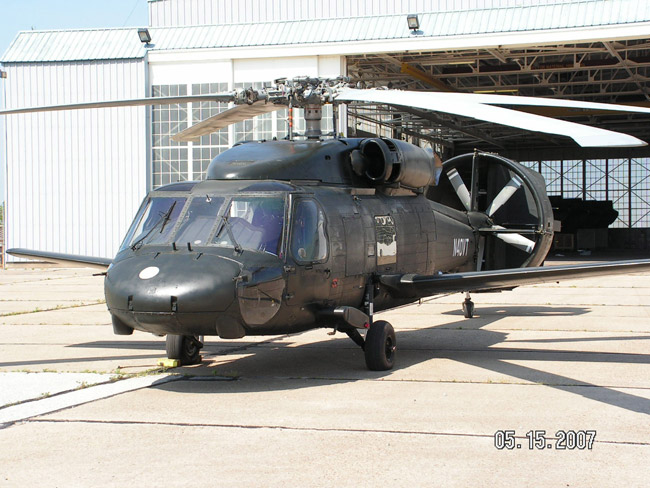
According to this site:
Weight added to the X-49A YSH-60F will be about 1,600 lb (725 kg). It will have an unrefuelled combat radius of 1,411km following a rolling take-off, and 963km after a vertical take-off, [u]representing a three-fold increase over the standard H-60[/u].
SpudmanWPthing is, rafale has all its sensors internally
So are the sensors in the DEWS system.
SpudmanWPis the super tucano the only in production trainer that has been modified for a2g combat? how about the potential for the texan or pc-21, orlick?
there is talk the British wants to use the super tucano for Afghan ops. Is it good enough? how is its high altitude capabilities?
Yes, the Texan has been converted and is the AT-6B:
http://www.hawkerbeechcraft.com/military_and_special_mission/light_attack.aspx


 Sign In







