Abhimanyu
See and try to think what implies each word in the clause[B]Apex fences are highly swept, upper surface spoiler-like surfaces hinged at the leading-edge of the delta-wing
I disagree, as the abstract is not ambivalent. Leading edge is the portion shown in red colour in the latest diagram posted by you, and where the Tejas 3 leading edge slats are located.
What is shown by you may be ‘fences’, but they are not descriptive of the abstract i.e. “hinged on the leading edge”, unlike slats. As per this article, Tejas’ slats are located on the leading edge, and are independently actuated i.e deflectable or hinged. The article describes their function to increase pitch-moment at high AoA — which is exactly the same described in the abstract.
Besides, here it must be mentioned that the term ‘spoiler’ is a generic term used for any device on the wing that kills lift and/or brakes. The abstract posted by you earlier also terms slats as spoiler-like surfaces.
AbhimanyuNo, Shukla said that the 10.5 ton clean-config meant a full load of fuel and 7 pylons attached, but with missiles only on the two outboard most ones.
21Ankush, I agree with the above, as earlier I misread Col. Shukla’s statement “quickly”. However, 10.5 tons cannot be achieved with only 2 missiles attached along with all 7 pylons, because it is unlikely that they weigh as high as 1.5 tons.
AbhimanyuYou have misunderstood the concep of wing fences, number one these are upper wing surfaces, you first have to prove the LCA has them, not claim a thing without a single shred of evidence, number two the wing has not a real horizontal view, so perspective is a fact you forget, on your picture the LCA has very visible the trailing edges so you can not see if the wing is really cranked or not since it is inclined.
The above is inaccurate. The technical paper of Vigyan Inc. posted by you earlier unambiguously mentions that, and I quote, “Apex fences are highly swept, upper surface spoiler-like surfaces hinged at the leading-edge of the delta-wing“, end quote.
The 6 slats of Tejas (3 on each wing) are also hinged on the leading edges of each wing. They can deflect above or below to generate vortices at all AoA regimes. Photos, schematics and official technical documents pertaining to the same have been posted earlier.
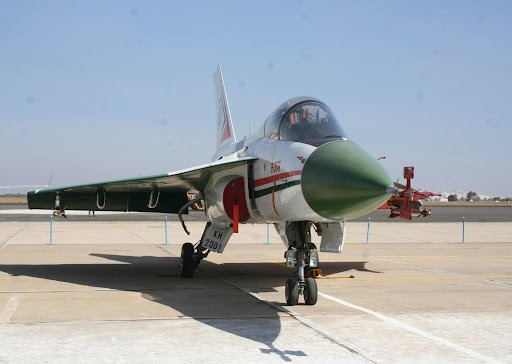
From this picture is evident your famous crank might be just an optical illusion since the wing of the LCA thickens abruptly just after the notch
The above is inaccurate. The location of the notch in the disassembled wing panel is shown in this photo.
As mentioned earlier the ‘notch’ seen in front-view (and also in the above photo) is not only due to the “abrupt” change in angle of sweep of the leading-edge but also partly because the lower-swept portion slopes upward as it goes aft (the reason why the wing’s cross-section is thick in your photo). This slope creates a low-pressure region over the wing as was shewn in this photo posted earlier.
Note that the notch as seen from the front-view, is NOT seen in any other fighter including Viggen, Draken or F-16.
AbhimanyuFROM FORCE
‘I perceive is that we will have Two Variants of the (Fifth Generation Fighter) Aircraft’
Given that the Russians have already started work on the Fifth Generation Fighter Aircraft (FGFA), what kind of a role is HAL seeking with the agreement on co-development, especially when we will be contributing 50 per cent to the total investment? How do we make this truly a joint venture?
By the time we signed the agreement, Russia had already done considerable amount of work on the air frame. The design configuration has been frozen and they have started manufacturing components. But this is only in relation to the air frame. The systems in it are by and large similar to those in Su-30. Now they want to switch over to better systems. They would like to go in for the composite structure (unlike Su-30, which is all metal). We want a twin-seater aircraft, which the Russians did not envisage. With a twin-seater, the entire fuselage, wing structure and indeed the design will change. It needs to be understood that air frame configuration freeze and manufacture of first prototype is only a small portion of the whole work. After this, a whole lot of testing and integration of components need to be done. During these tests, there will be a number of necessary modifications that will have to be made. There will be considerable learning during this testing stage. For this reason, I am hopeful that we can take on 50 per cent of the work, provided we join the project as soon as possible.
From the above, Mr. Fakruddin has established that the design has been frozen and production of the PAK-FA has already begun.
In my view, it may be extremely regrettable that as per Mr. Fakruddin, India’s work-share in the PAK-FA may be relegated to only testing, integration and only modifications to the airframe to make it into twin-seater. The latter part of ‘modification’ is verified by the earlier report from Reuters, as per which India shall have rights to modify only, “ostensibly” because the design has already been frozen and released into production.
As regards India’s interest in only modification for converting PAK-FA into a twin-seater only, in my view, though Mr. Fakruddin may be right about this activity entailing significant modifications to the “entire fuselage” and “wing structure” of PAK-FA, however other twin-seaters have not had to undergo such “drastic” changes.
For example, the twin-seater variant of Su-27 viz. the Su-30 or the trainer version of Tejas do NOT have any major structural difference from their single-seat versions.
Lastly, it may be unfortunate that Mr. Fakruddin is only “hoping” that India may possibly get 50% of the work-share, whereas up till now, as per the media and official announcements by defence ministry, India would definitely have gotten 50% work share. This uncertainty itself is unjustified, given that India will contribute exactly 50% of the costs.
Finally, Mr. Fakruddin has expressed concern over the passing delay in negotiations, because it leads to lessening of India’s work-share. In my view, this “clamouring” for uncertain work-share itself is a bad prospect in it’s very sight and there will be discrepancy to what India may be ‘promised’ and what it may actually obtain from this contract.
The sense that one gets is that the Russians believe that they will contribute
almost 90 per cent to the project. With such a mindset, how is an equal partnership possible?The question that we need to ask is whether we have one or two variants. The Russians would like to go ahead with their air frame, engine and systems, whereas we may not like to have the same engine or navigation system. What I perceive is that we will have two variants of the aircraft. In the final product, there may be an aircraft which is 90 per cent Russian and there can be another aircraft which is 50 per cent Russian.
From the above, it is clear that at the most India may customize the navigation systems only, whereas the airframe design will remain solely Russian. Changing the engine may be highly unlikely, besides in any case it would be foreign only.
Thus, it is increasingly clear that the PAK-FA agreement is practically a purchase agreement with licence manufacturing only. In my view, instead of PAK-FA, the HAL must commit itself to the indigenous MCA as it would help in furthering India’s indigenous aircraft industry. The “cold-war” era of licence manufacturing and the 1990s era of local customization must be done away with, after conclusion of Tejas and later with the MCA.
AbhimanyuOk, but let me say I did not realise that the new empty weight was actually confirmed by Dr. Subramanyam. It was only a few weeks back when we were talking about the confusion surrounding this issue, and while we did discuss the possibilities of new avionics/IFR etc raising the empty weight, we also contemplated other possibilities such as a typographical error, i.e. 6,500 instead of 5,600.
Note that the issue of weight vis-a-vis Dr. Subramanyam’s interview was also discussed earlier.
As per Colonel Ajai Shukla’s blog, and I quote, “The LCA’s designers say that the removal of telemetry instrumentation, which is essential during flight testing, will bring the Tejas’ weight down by as much as 300-400 kilos. Re-engineering some of the displays and sub-systems within the cockpit will lop off another 300 kilos; the weight reduction of 600-700 kilos is expected to allow the carriage of more weapons.“
Thus from the above, the removal of test-equipment, and streamlining the functionality of LRUs into fewer systems will reduce the empty-weight by 600-700 kilos, which shall be ~5,800 kgs only.
Im not sure about this. Although I might be wrong, but I was under the impression that clean would normally mean plus internal fuel whereas normal takeoff would constitue missiles.
As hypothesized earlier and now collated from the article by Col. Ajai Shukla, the clean-config as defined by various manufacturers is varied. As per his article, Tejas’ clean-config at 10.5 tons is reached upon full internal fuel, and ALL 7 pylons loaded with weapons, pods and/or fuel-tanks.
This may be contrasted with the definition of clean config. of the T-50, which is defined as being without external load and full internal fuel, or that of the JF-17, which is defined as being with full internal fuel and 500 kgs of weapons. The weights for both are 9000kgs and 9,072 kgs respectively.
Hence, in case of Tejas upon being loaded with full-internal fuel and 500 kgs of weapons (JF-17’s definition) it’s weight would be ~9,500 kgs only, which is in agreement with other fighters globally, that have similar empty weights notably, Gripen C, T-50 and JF-17.
Thus, there is nothing “amiss” in Tejas’ weight in clean-config being upto ~10 tons as it is in agreement with similar fighters.
Reference :-
AbhimanyuJust read something in another thread that might be of interest to you guys.
Canards are now being considered for Tejas as additional control surfaces.
Even though this in not finalized, it does point to the fact that this is something they have identified as an area of improvement.
Kaduna2003, as per the articles posted earlier, canards were tested on scale-models of naval variant of Tejas. ADA rejected them and will install LEVCONs instead, as experiments showed that they did not result in increase of lift, stability or manoueverability.
As per the article quoted by you, there is no unanimity over the addition of an auxillary control wing which may not necessarily be canards, but similar to the small and immobile canards of Su-30 MKI.
Man you are dreaming and without even any aerodynamic real proof.
The reality is compounded wings are called double delta, the Draken and Concord have compounded double delta wings, the same we can say about the F-16XL and Su-27 see the geometry, however these last two aircraft can be considered a different type by some basic technical reasons
I disagree that no “aerodynamic proof” was provided by me. As per similar “aerodynamic proof” with supporting photos that was furnished repeatedly earlier, the Tejas has compounded AND a cranked wing structure, whereas Draken, Gripen are ONLY compounded and NOT cranked.
As demonstrated by photographs and technical papers from NASA, the cranked-arrow F-16XL has a different definition of ‘crank’, which seen from the top-view is the “abrupt” change of the wing’s angle of sweep. But as per the diagram of another research paper posted earlier, the crank is defined as the dihedra of the wing seen from front-view. The Tejas’ crank component of the wing, corresponds to the latter definition and not the definition of F-16XL.
This crank is formed by the slope over the Tejas’ lower-swept wing part (as demonstrated in a labeled photo posted earlier). It assists in vortex generation over the wing to achieve lift effectively performing the action of a canard to quite an extent.
The following photo demarcates the point location of the crank of Tejas’ wing, as seen from front-view.

This point is the confluence of the lower and higher swept leading edges. As noted earlier (again with supporting photos), as Tejas wing base is plain, this crank is apparently visible due to the combined effect of the compound and the slope over the lower-swept part.
See that in this article they say fluid mechanics of interaction between the strake and wing vortices of a generic 76°/40° double-delta wing leading to vortex breakdown, check the angles 76 deg is a high swept and 40 deg is low swept like the wing of a MiG-29 or an F-16XL not an AJ-37 or LCA
I disagree with the above. The abstract of the research paper has only taken 76/40 combination as a subject of the test, and neither does it conclude nor aims to conclude that this particular combination of sweep is superior to a wing of lesser sweep. It only tries to study the effects of vortex breakdown on an example 76/40 wing.
Here, I may personally advise you to comprehend the abstract and conclusions of formal research papers.
The LCA and Viggen have delta wings with a notch, some people might call them conpound since the leading edge has two sweep angles but by definition the real conpounded wing is the one seen on the Concord or Drakken
The above is inaccurate. The Tejas’ wing is outward compounded also. The Draken’s wing is inward compounded, whereas the Concorde does not have a “sharp” compound, but a smooth curve known as ‘ogee’.
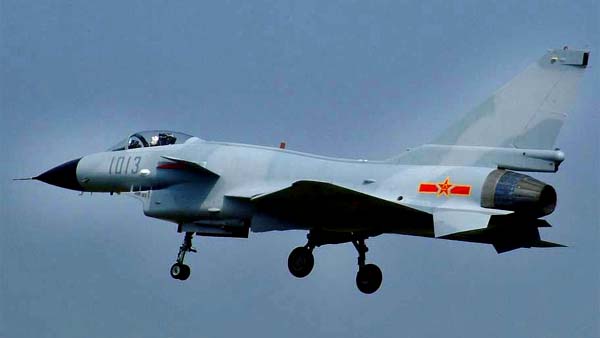
Now all this talk by yours that the elevons are smaller in a delta canard configuration has no aerodynamic real base and the reason is in an aircraft like the J-10 it has number one two centers of lift since it has two wings and both have positive lift, flap deployment is less restrited but also the need for triming is reduced.
I disagree with the above. As per the detailed labeled diagrams of the Gripen’s cutout schematic and schematic of Rafale posted earlier, it can be observed that the actuator assemblies of these 2 planes are much smaller in comparison to Tejas’ elevon actuators. Thus, the elevons of these planes are expected to trim lesser than Tejas’ elevons in part because the canard is the primary pitch authority, and also in part because being subjected to ‘wash’, they anyway cannot “harness” their complete trim potential.
In contrast, the Tejas compensates for the lack of canards by elevons that deflect far much more than elevons of Rafale or Gripen.
Trimming will be relatd to stability, the tailess delta wing usually is neutrally stable to reduce the amount of pitching moment
The above is inaccurate. As per the official website of ADA, Tejas is highly unstable in the pitch axis, wherein it’s CG shifts in the sub-sonic and transonic regimes. It’s flight control is configured to bring back the Tejas to stable configuration every 12 milliseconds.
The value of the static margin, sm, should be large enough to provide acceptable handling qualities at the most aft center of gravity position. This may require an analysis of the aircraft dynamics at various flight conditions. Since the destabilizing effect of the fuselage is not included explicitly here the value of sm used in the above expressions should be increased appropriately
With this i am sure you will adduce the canard disadvantages but in reality you disregard the stability problems a tailess delta wing will have.
Note that Tejas’ handling during numerous flight-conditions has been tested in I disagree with the above. The Tejas has negative static stability, which is handled adequately by the flight-control computers that bring it’s frame back to stability every 12 milliseconds.
Though there is no auxilary wing to provide a moment to the most aft center of the CG, how the Tejas overcomes this disadvantage is enunciated below, using your own research paper.
Read this article about how the tailess delta wing has all the properties i have said before such as low drag but lack the trimming capacity of the tailed configuration
http://www.aiaa.org/content.cfm?pageid=406&gTable=mtgpaper&gID=45836
http://pdf.aiaa.org/preview/1986/PV1986_1838.pdfand how it limits flap and leading edge deflection and if the LCA has larger flaps and elevons is simply to reduce the deflection of these devices, the J-10 or Gripen have relatively smaller elevons because trimming is also done by the canards
The above is inaccurate. The above papers mention how the tailless delta has low pitch-down authority when the CG is shifted aft at supersonic regimes. This results in instability.
Hence the paper suggests the addition of ‘fences’ on the leading edge of the wing that can trim to provide a counter-moment to the aft shifted CG. This is exactly the approach used by Tejas, in which 6 slats (3 on each leading-edge) are placed that trim to provide moment from the front, besides vortex generation.
Once again, I may kindly advise you to properly ascertain and comprehend abstracts like the above, for I think the above contradicts your core point of view that Tejas’ delta is disadvantage, whereas the paper details an approach that Tejas has in fact embodied itself. Another interesting point to note is that the paper is from an Indian research institute of the based in the US, and one author is Indian.
[B]Abstract : … The analysis is based on four canard geometries varying in planform from a 60-degree delta to a 25-degree swept wing, high aspect ratio canard. The canards were tested at several positions and deflected from -10 to +10 degrees. In addition, configurations consisting of a horizontal tail and a canard with horizontal tails are analyzed. [color=”blue”]Results of the analysis indicate that the canard is effective in increasing lift and decreasing drag at Mach numbers from subsonic to high transonic speeds by delaying wing separation. The effectiveness of the canard is, however, decreased with increasing Mach number. At supersonic speeds the canard has little or no favorable effects on lift or drag. It is further shown that the horizontal tail is a superior trimming device than the close- coupled canard at low-to-moderate angles of attack and that a configuration consisting of canard, wing, and horizontal tail is superior in performance, to either canard or horizontal tail at high angles of attack.[/blue]
The above abstract only summarizes that canards are ineffective at supersonic speeds, maybe even detrimental. The horizontal tail is shown to be superior to the canard design at low to moderate AoA. The paper neither mentions tailless delta devices, nor compares them with Su-35.
And at least i post articles published by NASA no speculation, you are posting your opinions without any base upon NASA or reknown french institutes, but you only post your opinions without any real aerodynamic base.
I disagree with the above. 2 NASA papers from 1959 and 1996 have been posted and analysed earlier, as per whom the wing cranks are shown to be effective for stability and lift. A research paper that diagramatically shows the wing crank of an experiment, also arrived at a similar conclusion. Supporting photos of Tejas’ slope above the lower-swept part have been posted a few times earlier.
Detailed comparisons with detailed labeled schematics of Rafale and Gripen have also been done.
AbhimanyuAbhimanyu
Please do not fantasize any more, let us go by parts.
A) the Viggen, F-16, MiG-29, Drakken and Su-27 as many other fighters have compounded wings . The LCA is not the first aircraft having a compounded wing, the Concord has a compounded wing too, even the F-14 and MiG-23 have compounded wings when they have their wings at minimal and medium sweeps.
The above is inaccurate. Please note that earlier it was mentioned that Tejas has compounded and cranked wing, the combination of which is NOT present in any of the fighters mentioned by you, including Mirage-2000.
The Tejas has a crank which apparent as a dihedral, is seen in the photo of Tejas from the front-view that you had posted earlier. However, the dihedral is an “illusion” only because as seen in this photo, the lower portion of Tejas’ wing is flat and so indicates no cranking.
This crank is visually apparent due to the slope of the lower-swept portion that is parallel to the boundary of the glass cockpit (seen in the same photo). As per the article, “Radiance of the Tejas”, this crank is used for vortex generation thus performing the function of canards to quite an extent. This shape of the wing is not seen in other fighters including Draken, Viggen or Mirage-2000.
Now any canard deflection will change pitch, yes it is true a canard deflection always changes pitch and also can change the center of lift position, for this reason the Su-35 has canards, they are also pitch authority controls but they are working in conjuction with tailplanes, consider the Su-35 still have very complex LERXes with canards, this combination of LERXes and canards uses the canards as pitch devices and as a more complex control of the vortices generated by the LERX
Now do not misunderstand me i am not belittling the LCA, the aircraft is fine if it is as good as the Mirage 2000 and even if it is better well that is a great achievement, but i do not think it is as good as the Rafale or Eurofighter
It must be noted that it is true, as you said above, that as canards work in tandem with tailplanes a greater moment about the lift-point can be achived (this was noted by crobato earlier). However, note that Tejas’ elevon actuators are far larger than those shown earlier on diagram of Gripen, or Rafale. Thus, Tejas’ deflection angles are likely to be much more to compensate for the lack of canards.
It may also explain why the actuator fairings for ‘elevons’ on canard planes are either small (as in Gripen) or partially absent (as in J-10). It is because being subjected to ‘wash’ from canards, they cannot achieve the fullest desired output on a given AoA, and consequently further power to deflect them may not be necessary.
Thus, it is highly likely that Tejas can match the J-10 or any so-termed ‘Eurocanard’ in manoeuverability and agility.
Again, for a given manouever, the degrees of AoA required for delta-planes are likely to be lesser than those of tailed or canard delta-planes, as a delta design has “natural” tendency to respond well to pitch (especially at high speeds), albeit at the cost of “bleeding” forward thrust.
AbhimanyuJust a quick question people.
Empty weight for LCA (originally) was meant to be around 5,500 kg, though this seems to have gone up a notch as a result of newer requirements from IAF and the new figure floating around somewhere near 6,500 kg.
I disagree with your view that the figure of 6.5 tons is “floating around”, for it has been well documented by Dr. Subramanyam’s latest interview, not to mention ADA’s placards at S’pore ’08 (also posted earlier). Thus, it is not a ‘rumour’ as your statement may imply, but an officially confirmed fact.
Recently this topic was discussed in another thread, and if I remember correctly the general consensus was that this increase in empty weight has come from things like addition of IFR, avionics, strengthning of airframe for R-73 etc.
The above is accurate. Earlier, there was another case of placards at ILA Berlin and DefExpo ’08, which showed Tejas’ empty weight as 5,680 kgs. It may only be concluded that this figure is without the avionic additions mentioned by you above. In addition to these, there are onboard oxygen generators also.
Now in his blog Ajai Shukla mentions that IAF’s demands for extra combat punch added two tons to the LCA’s original weight of 8 tons. Indeed, LCA’s (normal or clean?) takeoff weight was meant to be 8 ton originally (with empty weight of 5.5 tons), though this should have gone up by a ton only as a result nearly a ton increase in empty weight (or perhaps slight more cos it could perhaps carry slightly more fuel and heavier WVR missiles?). Or am I missing something here?
As discussed in another thread, the definition of clean config is defined differently by PAC Kamra and Korean Aircraft Industries. As per the latter, it constitutes only internal fuel, whereas the former describes it as carriage of internal fuel with 2 missiles.
In my view, the clean config weight of Tejas (internal fuel + 2 air missiles) must be 9.5 to 10 tons only, because internal fuel capacity of Tejas is 2,400 kgs and weight of 2 missiles taken is 400-500 kgs.
Now as shown earlier, other fighters in the same weight category as the Tejas, like Gripen, T-50 and even JF-17 all have weights with 2 missiles in the same range i.e. between 9.5 to 10 tons only. Thus, Tejas is not an exception and there is no “alarm”.
As regards the weight of 10.5 tons claimed by Mr. Shukla, it may be that ADA may have yet another definition of clean config, than KAI or PAC Kamra. I think that it may mean the ‘fighter’ config. in which internal fuel, and at least 4 missiles/bombs are carried.
AbhimanyuIt is generally accepted that Tejas has 2 control surfaces i.e. rudder and one pair of elevons. However in my view, as both the elevons are mutually independent surfaces, they must be counted as 2 individual surfaces and not counted together as one surface.
As discussed earlier, Tejas can perform all manouevers with equal agility as any fighter plane. In the video posted by 21Ankush, it is seen performing various manoeuvers including simultaneous pitch and roll.
I agree that European and Chinese aircraft companies found canards to be advantageous, however definite determination of manoueverability comparison can now only be done by visual comparison, instead of theoretical speculation. Canards are advantageous, especially if they are able to utilize the elevons in a double-moment about the lift point. But I don’t think conventional tailed or tailless delta designs will be “abandoned” soon.
Other points to be mentioned may be that Su-30 MKI’s canards are NOT under the pilot’s control and are not the lift authority at all (tail is the lift authority). They are automatically deflected for small vortices only.
Another point is that Tejas is NOT a simple delta like Mirage-2000, but a compounded and cranked delta.
Can the Mirage 2000 and LCA emulate the same manuevres the Su-30MKI can perform?
See, Su-30 MKI is advantaged with TVC which Mirage and Tejas do not have.
AbhimanyuOhh ….now the 70% composite by weight??? so better than F-22 AND JSF 35:D
The mantra propagated here was 90% by surface and 40% by weight!
Color me Skeptical :diablo:
The above is inaccurate, because as per Dr. Subramanyam’s latest interview, I quote, “For example, in the area of composite structures, 90 per cent of the surface area of the LCA is made of composites, which is the highest in the world.”, end quote.
Your assumption that the tabloid from which you quoted is correct and Dr. Subramanyam is “lying” does not hold any ground, as Dr. Subramanyam is the apex authority on Tejas currently.
In fact, at the risk of “reprimand” by admin, I may say that despite repeatedly posting official interviews, official sources, and many other news reports that contradict your claims, you ‘conveniently’ choose to ignore them and post the same inaccurate sources again (notably from the Indian Express). This is tantamount to malafide intent.
AbhimanyuHuh.. Well I guess I will leave you to your alternate world of Fantasy and make believe…….. or read the interview again
Please note your points against the statements by Dr. Subramanyam from the interview itself. The points which you raised 1-2 months back on the basis of media reports have been proven false already :
Going through the Subramanya interview , we can summarise the following;
LCA* is clocked less than 500 hrs till date with flight no more than 30-35 Minutes each.
Dr. Subramanyam’s interview :- The recent flights that we have undertaken have been as long as 90 minutes.
Even with GE 404IN20 the performance fall short well below the AIF ASR
Dr. Subramanyam :- However, this falls a little short of IAF’s ASR.
LCA*’s AoA is still less than 20 and the ASR is not the claimed 26 by the fanbase, but mere 22.
“In this respect, we have already validated all the parameters except the angle of attack. We are presently, at 20 when the required is 22.”
Note that it has never been claimed that the ASR has been 26 degrees. As per the technical document, “High AoA testing of Tejas LCA”, the flight regime has to be tested upto 26 degrees to test rudder authority only.
LCA* is still struggling at 6G even after 900+ flight, and the ASR requirement is watered down to 8G
Note that it is not mentioned in the interview if the IAF’s ASR is reduced to 8G, since it is the first time that they have been declared publicly. The figure of 9G may remain a goal of ADA only, similar to the goal of 26 degrees AoA to test only rudder authority.
Dr. Subramanyam : “I would say that our design has performed. The engine is designed to perform against the drag parameters that it has done. However, this falls a little short of IAF’s ASR. It will only be possible to meet the ASR if we go in for a new engine.”
Here is the original design intended LCA parameters:
Flight Envelope:
AoA: 35 deg.
Roll-rate : 290-300 deg/sec
Sustained load G-limit : 9/-3.5g
I request you to post the source of the above. The above AoA is inaccurate, because as per the technical documents, news reports and interviews (including this one) posted earlier, the AoA mentioned is 22 degrees only. Thus, the above source is inaccurate.
Read this also which corroborates what is being not said by subramanyam;
LCA needs new engine to be worthy of combat
Express news service
The Indian Express is once again being incorrect as the IAF has already placed an order for 20 Tejas units as per this news report and this report. Earlier, the Indian Express has proven to be inaccurate as with the figure of 17 deg. AoA reach thus far.
Hence, this newspaper must not be relied upon for correct updates on Tejas.
AbhimanyuGoing through the Subramanya interview , we can summarise the following;
[LIST]
[*]LCA* is clocked less than 500 hrs till date with flight no more than 30-35 Minutes each.
The above is inaccurate as it has flown for 1.5 hours since last year, and this year (especially in the flight from Bangalore to Nagpur). As per the interview, the 500 hours test-time besides being an estimate, is irrelevant as test-points have to be validated in as few test-flights as possible. For this purpose of accelerated flights, consultancy by Boeing is sought, as posted earlier.
[*]Even with GE 404IN20 the performance fall short well below the AIF ASR
The above is again inaccurate, as in his own words, it was only “little short” of ASRs. As per the interview, the design parameters and drag performance has been validated fully, which refutes all earlier media reports that claimed otherwise. The issue remains the engine only.
[*]LCA* is still struggling at 6G even after 900+ flight, and the ASR requirement is watered down to 8G
The Tejas has ‘comfortably’ clocked upto 6G limit in trials. He does not explicitly mention that only new engines alone will meet 8G or 9G. Tests with the new IN20 engines will continue with further LSP units, and these may also witness higher G limits.
Again it is an inaccurate conclusion that the 8G requirement has been ‘truncated’ or was the same since the ASR was first formulated by IAF in the 1980s, because this is the first time that IAF’s expectation has been declared publicly. The ADA’s webpage maintains that the goal of G limit is 9G.
As per the interview, the number of test-points reached are the milestones, instead of the number of test-flights per se. For example, the JF-17 reached all it’s intended test-points in just 2.8 years of testing (500 flights as per a Chinese source).
[*]LCA*’s AoA is still less than 20 and the ASR is not the claimed 26 by the fanbase, but mere 22.
The above is inaccurate again, as the Tejas has already reached 20 degrees AoA as per Dr. Subramanyam, and not 17 degrees as erroneously claimed by the media. As per the technical document posted earlier, for purposes of stability high AoA trials have to be limited to 24 degrees and upto 26 degrees if rudder control assists. This does not imply that the ASR is 26 degrees AoA, but the regime that Tejas has to be ultimately tested in.
The rudder authority is present upto 30 degrees AoA.
Hence, the ASRs mention 22 degrees AoA (touched), and 8G which is different from design goals as mentioned
[*]No Boeing still for taking through the motion of flight testing., so be prepared for more delay.
The above is not mentioned in the interview. As per news reports, ADA has accepted Boeing’s proposal in contractual negotiations. The contract will be signed following Boeing’s pending clearance from the US government.
[*]No the LCA* is 6.5 Ton!!, from the claimed 5 ton
The above has already been declared by placards of ADA at recent Singapore Air Show 2008 as per which empty weight is 6.5 tons (photos of the placard has been posted in other threads). As per the placards at ILA Berlin show, the Tejas’ empty weight is again displayed at 5.6 tons, which is what is known as ’empty unequipped’ weight and most likely the design goal after LRU reduction.
Abhimanyuainspiron, thanks for posting the informative interviews of Dr. Subramanyam and Mr. M Fakruddin.
Dr. Subramanyam’s interview will “lay to rest” the incorrect ”propaganda” of the Indian media, that Tejas project began in 1983, etc. Tejas is 2 tons overweight, and that Tejas has reached only 17 deg AoA etc. etc. Although all this was known from other public sources earlier too, the Indian media ignored it.
However the most important “vindication” was Dr. Subramanyam’s confirmation that Tejas’ design is sound, and that only the engine is under-performing. This is again contrary to inaccurate media speculation that there are “design problems”.
Regarding Kaveri engine, it will meet ASRs once it is completed. But earlier there were expectations that IN20 itself would meet ASRs and that the newer engine may be for more enhanced ASRs. It is unclear from the interview whether an attempt will be made to expand the flight-envelop further with the recent IN20 engines, or has the limit with IN20 also been reached.
AbhimanyuBut nonetheless, the Europeans did and the Israelis also went with it. The Japanese also had canard-delta concepts of their own. As for the Russians, MIG did seriously propose its MiG 1.44 and Sukhoi did implement canards on its Flankers. The US also implemented canards on its B-1B. Are you familiar with the X-31 super maneuverability study?
crobato, please note that that current US and Russian planes have not implemented either the canard or pure delta designs. As mentioned earlier, atleast delta planes were brought into service by US and France, however none of the canard-delta planes have ever been introduced into service by US and Russia.
I stand corrected that the US and Russia have indeed experimented at least on the canard-delta designs. I was aware of X-31, however while typing the post it escaped my recall.
Nonetheless it showed DRDO pretty much alone in this one, against an opinion that is made up of Dassault, SAAB, IAE, Eurofighter consortium (BAE, Messerschmitt, etc,.) and MiG.
I disagree with the above. Note that up to only 8 months earlier, the Mirage-2000 also had active production; however it’s production was halted after the “wake” of Rafale. As late as 2006, France offered this plane to the IAF, and before the MRCA proposal was mooted, the Mirage-2000 was the IAF’s main choice for 126 planes.
Besides, it may also be noted as per the research paper posted by MiG-23 MLD (and various others available) that the experimental delta F-16 XL was concluded to be superior to the F-15 that was in service; however, the “momentum” with the F-15 was begun and so commitment towards it was not changed.
An elevon part times as an aileron and as an elevator. But unlike canard-deltas and tailed planes, an elevon cannot function in one moment of a time, as both aileron and elevator, because aileron and elevator is functionally an “or” proposition.
As discussed earlier, the Tejas’ elevons are independent of each other. A simultaneous pitch in the process of executing one roll can be performed by deflecting one elevon more than the other, in the same direction. A “pure” roll is performed by elevons equally opposing each other, while a “pure” pitch is performed by elevons equally assisting each other.
A delta plane can thus perform ALL the manouevers performable by a conventional tailed plane, as well as canard-delta plane.
That does not constitute a droop. No plane can change any wing position from anhedral to dihedral or vice versa, unless you can flap wings like a bird. Note the elevons are down while the canards are pointed up just as I described.
I disagree with the above. In the frontal photo of J-10 while taxiing, the canards only appear “upturned” as their aft portion is hinged upwards (note that the aft is wider). However, as in the photo posted by me earlier in this photo, they are clearly oriented down at the wing, and in this photo they are clearly flat.
Actually presently canards in all planes are hinged (unlike Viggen’s canards, which were fixed and that had “elevon” like structures at aft). As I am unable to view the photo from CDF, you may please post it on this thread.
Wrong. Canards don’t need to because they have a fresh air stream in front of them, unlike control surfaces tied to the main wing that have to deal with the wake from the wings’ front edge as well as the boundary layer that forms around the wing. You simply cannot ignore even the late fifties studies about why all moving control surfaces are better. In fact one of the reasons why canards are generally smaller than tail planes is that they can generate the same amount of control authority for less size and deflection.
I disagree because as seen in this photo of Tejas ( photo courtesy : Colonel Ajai Shukla), it may be subjectively observed that the elevons are “huge” in size and so command a significant leeway over the incoming airflow. So they may not always be at “mercy” of wing wake, turbulence etc. Tejas’ elevons may also be seen in this photo also (magnifiable).
However, during flight, they are not seen trimming as much as shown in the photos because small trims suffice to achieve the manouevers. In contrast, smaller control surfaces have to trim more to achieve the same effect if they are the primary pitch authority; if assisted by elevons even if ‘washed’, the trim may not be as much.
To illustrate the importance of sheer size as a counter example, one may ‘imagine’ had the elevons on Tejas been 50% of their area (same as a canard’s size on the J-10). By this basic flight manouevers may have been impossible.
And even if they are turned to pitch, canards generate lift even for the drag they produce. Control surfaces on the trailing edge of the wings however, have to push the aircraft down on its tail to move the nose up, and hence they create negative lift while exerting drag at the same time.
The above may be possible, however the rate of pitch will be the same regardless of positive or negative lift. Again the loss (or gain) of lift may be negligible of the order of not more than few feet. Also, the gain by canards will be negated by the elevons at opposite end, that will effort to lose lift.
I think the debate may not be continued further, as it is increasingly descriptive and speculative now. In my view, the J-10 and Tejas are likely to have equal agility.
AbhimanyuI would like to know from members whether the canards on the Eurofighter are the primary pitch authority, or are they supportive with pitch authority being provided by the elevons. Actually, from my personal visible point of view, the canards appear “too small” compared to the wings to be the primary pitch authority.
Thus I would like to know if they are only augmentative surfaces similar to the small canards on Su-30 MKI as seen in this photo
Reference :-


 Sign In