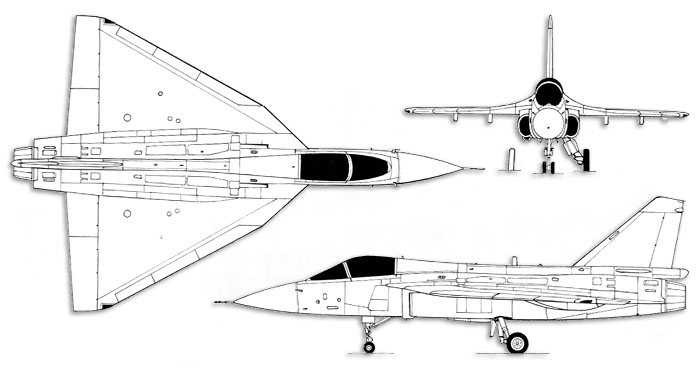
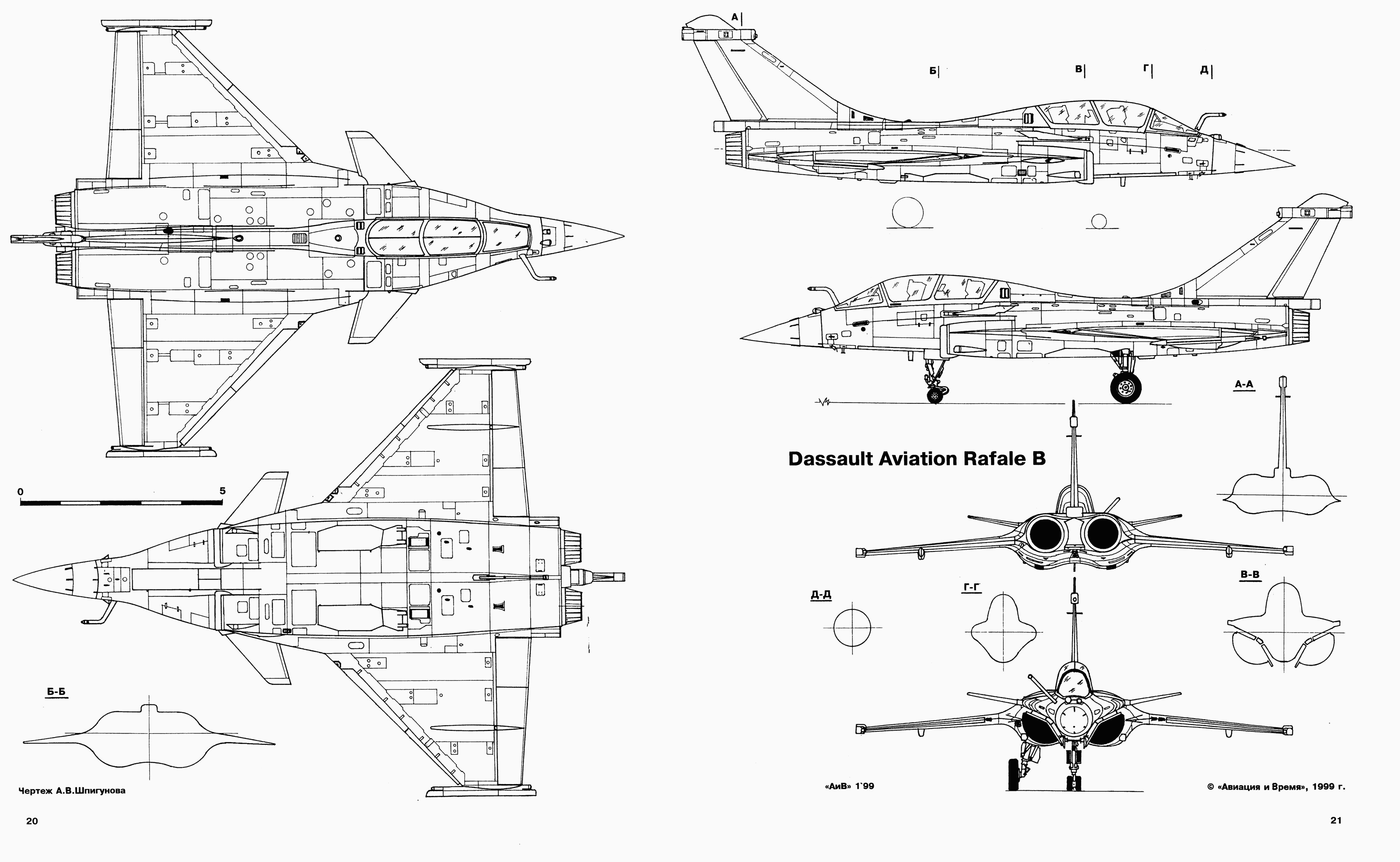
Abhimanyu
MiG-23 MLD, thanks for posting the above article, as it is informative.
The canard is detrimental to both lift and static longitudinal stability. …. it is observed that for small vertical separations between the surfaces the forward portion of the wing is ineffective in producing lift.
From the above, I think it is referring to ‘wash’ over the wing, that leaves a low-pressure over the wing. So the wing gets “starved” of air to actually deflect it and create lift.
Note that this happens when the canards are deflected slightly, i.e. “for small vertical separations”, as described in the article.
It is demonstrated that the canard can directly affect the pressure distribution on the wing and application of this configuration to direct lift control and control configured aircraft are noted.
This above is the main function of the canard i.e. creating a low-pressure above the main wing to generate lift. However, the same property is detrimental to flaps and elevons of the wing which have to trim extra efforts at higher AoA to generate lift. I think this is ‘upwash’ (as downwash is high-pressure airflow).
Canard designs suffer large penalties in drag with low aspect ratio canard surfaces.
The above is the primary disadvantage of canards. The canards in J-10, Gripen, etc. are high-aspect ratio but which still provide 2-3% more drag than tailed designs, and further still than tail-less desings.
The canard also is the configuration with the highest drag, however since canards are usually smaller than tailplanes are still prefered by some companies than tailplanes, however the US and Russians used LERXes as canards substitutes on aft tailed designs.
To the above I may opine that like US and Russia, India also did not adopt canards for the Tejas. However, instead of LERXs, it added an andedral crank over the lower-swept portion of the wing, and which slopes upwards as it proceeds aft.
AbhimanyuThe following is another photo of Tejas’ frontal view.
Photo courtesy : Livefist, by Mr. Shiv Aroor.

AbhimanyuI think crobato asked for the short take off. Not landing.
The same mechanism is also used for take-off also, as seen in this video of Gripen, in which it is shown taking off and landing over a civilian highway. Note that just at the instant before take-off, the canards deflect significantly and the same occurs at the point of touch-down. At touch-down, they further incline to be fully vertical to act as air-brakes.
AbhimanyuThe following is a photo of Tejas (LSP-2). Photo courtesy : Colonel Ajai Shukla, from his blog, Broadsword

AbhimanyuAnd yet Saab and Dassault had the opposite conclusion.
See, ADA concluded that for Tejas only, and likewise Dassault, SAAB, Chengdu etc. concluded otherwise for their own respective airplanes. It must also be noted that no American or Russian company has implemented either deltas or canard-delta planes.
Thus, it may show that various design houses have varying opinions based on their own test-data. It may not be said that one design is superior to the other.
No. The elevons would have acted as ailerons in the initial phase as the plane banks. But once the plane has fully banked, they could act in concert with the canards to increase pitch angle.
Elevons means the surfaces can act both as ailerons or elevators in different times.
Actually, here there may now appear to be difference in canard planes. As rightly noted by you, the ‘elevon’ on each wing too is further segmented into 2 parts.
Now, as mentioned earlier, the Rafale has actuator fairings visible for the outboard segment only (as shown in the schematic of top and bottom view), whereas none are visible for the inward segment. Thus, it apparently has airelons only. However, you may be right that elevons are present on some canard-delta planes as Gripen has elevons.
In this labeled diagram of Gripen, labels 94 and 96 clearly mention that they are actuators for the inboard and outboard elevons respectively (i.e. for the 2 segments of one wing). Similarly, labels 67 and 68 are also outward and inward elevons for the other wing.
I now agree with you that elevons on Gripen atleast can be used in conjunction with the canards for pitching moment. As discussed earlier, the Tejas can perform a simultaneous bank and pitch manouever by deflecting one elevon more than the other, albeit both upwards : the same action can be used in the Gripen. So the pitch-up as well as roll components of the elevon motion can be provided without conflict.
However, whether this property of Gripen i.e. 2 moments being provided about the lift fulcrum, results in higher pitch rates than Tejas may be a matter of experimental observation only. For, as noted earlier, canards subject the wing to a ‘wash’, which forces an increase in the wing’s AoA to achieve the same pitch effect. Canards as seen here and here are also smaller than Tejas’ larger elevons, which is not subject to any ‘wash’.
Again, it is doubtful whether Rafale or J-10, which do not appear to have elevons are any less manoeverable than Gripen that has them. Thus, many other extraneous aerodynamic factors may be there which we may be unaware about. Or it may also be that Gripen’s inboard ‘elevons’ may be only flaps on the trailing edge, and the outboard ones may only be airelons.
The Eurofighter had a different system; by moving the canards as far away from the wing as possible, it reduces canard wash. By putting them in the front it also increases the control authority leverage. The Eurofighter has anhedral canards; the J-10/Lavi/Rafale/Gripen has dihedral canards.
I never seen the J-10 droop its canards like you claim. It would not have been mechanically possible.
See, the J-10’s characterictic frontal photo shows upright canards (I “morphed” the photo to remove them and posted the same on another thread). That is seen when the J-10 is taxiing only, but during flight they do “droop” as seen in this photo.
The Russians have long concluded—back in the late fifties, starting with the MiG-19 in fact—that all moving control surfaces are the best way to maintain control at supersonic speeds, not control surfaces attached to a wing and which is subject to the trailing wave drag produced by the wing’s front edge and the boundary layer flowing across the wing’s surface. The US also came to the same conclusion in the sixties (although pioneers like Northrop knew that well ahead) though not after the Delta Dart, Starfighter, Phantom, etc,. had been designed and made.
In fact, the Soviet Union, Western Europe, and the US have all abandoned the pure delta form for one reason or another. Are you saying that the DRDO is smarter than all these countries collectively?
See, to the above it may also be brought to notice that US and France atleast brought delta fighters into service, whereas none of the US and Russian companies “ventured” to canard-delta designs. Leave aside bringing into service, canard-delta planes were not even experimented with by these 2 nations.
Canard-delta designs are the particular domain of 3 particular European companies only, and so cannot be taken as an industrial benchmark. As mentioned a few times earlier, the F-teens, Flanker and MiG series do not feature canard-deltas and are not wanting of performance.
In fact, I disagree that the delta has been “abandoned” by US and Russia, because the F-22 and F-35 can be reasonably termed as tailed delta planes. But there are no indications or plans of canards being added in their current or future projects.
Large control surfaces do have increased drag.
The above is true, however the advantage is a lesser trim effort needed. Small control surfaces like canards, have reduced drag at the expense of a larger trim effort needed to achieve the same objective.
How does that explain the short take off of the Gripen from highways then?
As mentioned in a latter post, the Gripen orients its canards to a near vertical position while landing on civilian highways (photo posted earlier). Maskirovka rightly said that it effectively acts as an air-brake. This enables low landing distance by it.
Abhimanyu*Gripen has an AOA of 50 deg. as a practice limit. That seems high compared to LCAs goal of 21. In the 1996 flight tests however the Gripen could do 110 deg. alpha. and still retain controllability. How is that possible, should´nt the aircraft be leaning backwards then?
Do you know the AOA numbers of other fighter aircrafts?
Maskirovka, I disagree with the above. AoA limits that lie in the ‘extreme’ regime of 50 degrees are tested either in computer simulated environments, or in scale model CFD tests only. They are not conducted on actual flight tests.
As per page 7 of the technical document posted earlier, the Tejas has achieved 55 to 87 degrees AoA under scale model tests. The model was 1:15 the size of the actual and it was tested in a vertical tunnel. However, as per the same document the Tejas has been flight-tested to 20 degrees AoA, with 22 degrees never having been exceeded. Thus, it is in conformance with the global ‘norm’ of AoA i.e. between 20 to 25 degrees only.
As per the canit.se link posted by you, the Gripen too has a preliminary alpha limit of 20 degrees (equal to Tejas’ limit), exceeding which, the flight-control instantly tries to bring it down to 20 degrees or lesser (similar to how 22 degrees has been touched by Tejas). The 55 degrees limit as mentioned was the software limitation only, and it is unlikely that the airplane will actually touch that limit in tests. The article mentions that the computer will limit the alpha to angles that are sustainable keeping in view the loading, speed, altitude etc.
BTW, a couple of sweet Viggen pics that clearly shows the cranked delta. The first one is from 1967 testflights and the 2nd one is wallpaper material 🙂
I disagree with the above. The above are not cranks, but in fact compound of the wings. If the leading edge of the wing is further separated into 2 edges of different sweeps, then it is said to be compounded.
The Tejas also has a compound wing. However, this is often referred to as the ‘crank arrow’ wing in NASA research papers posted earlier, and which was the reason of “confusion” between MiG-23 MLD and me as to what actually constituted the crank on Tejas. The F-16 XL, is specifically termed as the ‘crank arrow’ wing. However, that is called as the compounded delta by Tejas’ designers and which is explicitly referred in this research paper as the ‘cranked arrow’.
Hence, it may be reasonably concluded that in western academia, the compound delta is referred as the crank or ‘cranked arrow’. However, in the article, “Radiance of Tejas”, the Tejas’ compounded wing nature is acknowledged distinctly from the crank. Hence, the crank in Tejas’ context is not the compound of the wing.
Now, earlier MiG-23 MLD referred to a sharp anhedral ‘notch’ of the wing as the crank, and which was also the definition as per another technical paper posted by me earlier. Seen from the side view, the lower-swept edge of Tejas’ leading edge has a slope. Seen from the front-view, it appears as a dihedral. This may be viewed as an ‘”upward notch”, which is likely to be the crank.
Thus, the crank on the Tejas is the ‘slope’ or anhedral notch on the lower-swept part of the leading edge.
This crank generates a low-pressure over the wing, assisting lift. It is beneficial in low altitude stability and manoueverability also. It must also be noted that such a feature is NOT found on any fighter plane developed since 1970s to date, be it Viggen, F-teens, Russian planes, or the present Eurocanards.
AbhimanyuEarlier I mentioned that landing distance of Gripen on civilian highways is short as it may use parachutes and flaps. However, flaps themselves are subject to “wash”. To offset it, canards are used in a near vertical position as shown in this photo of Gripen while it is taxiing.
MiG-23 MLD, in this “era” avionics may not matter much, as even JF-17 is scheduled to be installed with an AESA radar and state-of-the-art European avionics suite. Thus avionics are like “plug-ins”, and the platform in which they are installed — whether JF-17 or Typhoon — may be immaterial.
However, it can be safely mentioned that structurally and aerodynamically, Tejas is at par with the Typhoon as it is an unstable design, it is controlled by a flight-control system (that also controls the slats on each wing’s leading edge), and a high percentage of composites. As shown in the video posted by 21Ankush, Tejas can perform the entire range of manouevers with agility and speed.
Now regarding the Su-30 MKI, it has small canards that are fixed, and which are not in the pilot’s control. They trim automatically according to the receipt of airflow. The pitch authority remains on the rear tails. I think Su-30 MKI is the only plane to have canards as well as tails.
AbhimanyuFirstly, it may be reiterated that as per the links posted by 21Ankush and myself earlier, it has been reported that canards were added, but later cancelled on the Naval Tejas as CFD flight-tests did not indicate enhancement in lift, stability or manoueverability.
In the J-10, there are actually four control surfaces, two on each wing, on the trailing edge. How would you know the difference between an elevon and an aileron? From a visual standpoint they look the same.
crobato, every delta plane has such a bifurcation of the elevon of each wing including the Tejas (Tejas schematic. However, they are not 4 independent surfaces, but only 2 as the 2 parts on each wing act together in tandem. Now, in case of Rafale, the bottom view shows the actuator assembly for only the outward divisions of each wing.
Another explanation may be that suppose Rafale or J-10 needs to bank while executing a pitch. Thus, the canards will be deployed for pitch and the airelons for thr bank; had they been elevons acting in concert with canards, this manouever may not be possible.
This is compensated, and why its not an issue, with the Gripen, J-10, Lavi and Rafale, because the canards are dihedral meaning the wing tips point upward so the wings appear like a V, while the main wings are anhedral, meaning the wing tips point downward or at a lower height compared to the wing root. This makes the planes look like a rough flattened “X” if viewed head on. Thus the canard wash is thrown over the plane and not on the wings.
See, the above may be a measure to reduce the effect, however it may not have eliminated completely.
In this photo of Eurofighter, the canards are “drooped” as in ‘A’ and not in ‘V’ (the ‘V’ orientation is usually seen when J-10 is taxiing). In the photos off J-10 while in flight, the canards are not necessarily seen to be “upright”. To generate lift, they have to “droop”, which in turn may increase ‘wash’ over the wing.
Elevons are not efficient control surfaces because they can only deflect the air stream that is already flowing downstream from the past the main wing. They are also subject to the turbulence and bursts from the vortices produced in the leading edge of the delta. An elevator whether its in the tail or in the canard, is a completely independent and separate form on its own, which means it takes on a fresh air stream, and best yet on the canard because it does not have the after effects of the main wing.
I agree with you that elevons are subjected to turbulence of the main wing and canards are subjected to ‘unhindered’ air first. However it must be noted that tails too are also subject to the “wash” of the main wing. But elevons are not subject to wash as they are part of the wing itself.
It must be noted that elevons are also significantly “bigger” than canards as they span a larger width as seen in this video posted by 21Ankush. Thus, their effect on lift cannot be much lower than canards.
As regards the landing distance of Gripen, it is true that it is configured to land on civilian highways also, which indicates a short-takeoff and landing capability. However, it may also be assisted due to parachutes, large flaps, etc.
AbhimanyuIn my view, the single biggest disadvantage of canards is that they increase forward drag by providing air resistance. Hence, many of it’s advantages are negated by this. In contrast, the Tejas faces far lesser drag due to the absence of canards or any such fixture that resists airflow.
Again, as per wikipedia’s article on canards, the wings NEVER operate at their full potential, as they are subjected to the canards’ “wash”. Thus, the elevons in such planes (if they exist at all), have to make extra efforts to assist the canards in the lifting moment about the fulcrum. This is probably why Rafale and J-10 do not possess elevons, but airelons only.
With this in mind, you can start to understand why some tailed configurations like the F-22, try to extend the tail planes as far away from the plane’s fulcrum. You want the least amount of control authority to exert the same force to turn the aircraft on the same degree, or the same amount of control authority to turn the aircraft on a higher degree. Being efficient on this is a major factor in maneuverability. This is the reason why tailed configurations have an inherent advantage on maneuverability. The Soviets knew this early and hence why they junked the pure delta configuration early and went to the tailed delta. Note the way the MiG-21’s tailplanes extend backward, and it isn’t just for sweeping.
crobato, I fully agree with the above. It is indeed interesting to note that none of the Russian & American aircraft houses ever adopted deltas or canard-delta configurations for their planes. They may have experimented only, as in case of the F-104 dart.
It must be noticed from this photo of F-22, that there are significant mechanical extensions involved to extend and hold the tails far beyond the end of the engine exhaust. While this may not lead to a significant weight increase in the F-22, for the lightest smallest combat jet like Tejas, such additions may disturb it’s weight profile completely.
The added weight of all this extra assembly would also shift the CG backward, thus defeating the very purpose of keeping the fulcrum far from the control authority.
AbhimanyuA pure delta config has its elevons closer to the center of gravity or better yet the fulcrum point of the plane. If you understand the mechanics of lever action, the closer you are to the fulcrum point, the greater the effort or in this case, control authority exerted to lift the other side of the lever, which in this case, is the nose to pitch.
crobato, I disagree with the above. As per a labeled diagram on page 2 of the technical document released by ADA on the AoA testing of Tejas, the CG of Tejas lies “fairly” in the center of the frame. Hence, the elevons do not have to “strain” during the pitching effort.
Anyway, the actual center of lift is not necessarily the CG, but it varies at points that lie in front or behind the CG, at subsonic and supersonic regimes respectively. This aspect is due to the unstable design of the Tejas’ airframe which assists flight stability.
The airframe is constantly brought back to stability every 12 ms by the flight-control computer, else the plane may go out of control.
If the control surfaces is more efficient producing the same amount of authority thanks to lever action, the control surfaces can trim less to produce the same amount of authority and turn. That means less drag, and less drag means better sustained rates. That’s one reason pure deltas don’t have good sustained rates and have a high energy bleed on turns.
Actually as already mentioned above, Tejas’ elevons do not have to exert greater authority than tail-planes (in conventional planes like F-16), as the CG of Tejas is also centrally located. The drag induced during turn is due to the large wing area of Tejas which leads to larger obstruction of wind while turning. In contrast, tailed planes have a significant gap between the tail and main wing, which allows for unobstructed flow and hence lesser drag.
Thus, conventional planes have higher sustained turn rates than deltas.
To partially overcome this low sustained turn rate, Tejas has a slope over the lower-swept part of it’s leading edge in order to maintain a vortex over the wing, to assist lift. Computer controlled leading-edge slats also help in vortex generation.
Canards offer a variation to the control authority issue by providing a second lifting force on the other side of the lever which complements the downward force from the elevons on the other side. So you have two forces acting simultaneously. And because of this too, the required trim for all four surfaces amounts to a lower degree than if you have two large control surfaces as the elevons. This produces less drag on the sustained turn.
I disagree with the above. Elevons are not present on all canard-delta planes. As an example, as per the schematic diagram of Rafale, from the top-view and bottom-view, the trailing edge of the wing has visible airelons only. In case of J-10, lower flaps are present throughout the trailing-edge of the wing, however, on the upper part of the same edge, only airelons are visible.
Again, even if assuming that canards assist the wings in lift by providing more moment about the lift-point, it must be remembered that the lift due to the wings is restricted by the constant subjection to low pressure vortex generated by canards, also called as “downwash”. The downwash is also the reason for longer take-off distance.
References :-
AbhimanyuIn my view, expensive fighter planes like F-teens, ‘Eurocanards’, etc. may not find a market among developing nations in Africa and S. America. The acceptable market for such planes may only be in “rich” middle-east nations, and NATO allies like Japan, S. Korea, Finland, etc.
Developing nations in Africa may have a market for cheaper fighter planes like JF-17, Russian fighters like MiG-29, Su-30 and Chinese planes like J-8. These developing nations do not have the requirement, skill, finance or threat to operate F-teens or ‘Eurocanards’.
Hence, these planes are unlikely to find a “toehold” in the global fighter plane market.
AbhimanyuSee, canards are forward tail-planes only. There is no other function. As a secondary effect, canards generate a vortex above the main wing, a function which is already performed by Tejas’ sloping lower-swept part of the wing.
Again, canards are used for pitching moments only, whereas for rolling the delta-wing’s airelons are used (canards cannot oppose each other like airelons).
There is also a misconception that delta-winged planes like Tejas or Mirage-2000 are less manoueverable because they have only 2 control surfaces, whereas planes like F-16, MiG-29 or Gripen, EF etc. are more manoueverable because they have 3 control surfaces. It must be remembered that the Tejas and Mirage-2000 can also perform all the 3 movements i.e. pitch, yaw and roll. Combinations of these movements is also possible.
We may consider the airelons and elevators of the F-16 or Su-30. The airelons ALWAYS oppose each other, whereas the elevators ALWAYS support each other. In a delta like the Tejas, the 2 elevons (elevator + airelon) can oppose as well as support each other, thus performing the actions of elevators and airelons as and when needed.
Assume that an F-16 is executing a roll while simultaneously pitching up. The Tejas can also execute this manouever simply by deflecting one elevon lower than the other. Now assume that an F-16 is pitching up and banking. The Tejas can execute it in again the same manner.
It is known that pure delta configs have higher instantaneous turn rates than canard-delta configs. High sustained rates may also be achieved by lowering the AoA and by the vortex generation of the sloped lower-swept wing.
AbhimanyuSee, wherever the crank is located on the Tejas’ wing, we do know that it is aerodynamically very advantageous. This is as per the conclusions of various NASA research projects, including F-16 XL, as discussed earlier.
Thus, without further debate to “hunt” for the crank, I may once again mention to what I was referring to on the Tejas earlier, that generates vortices.
As per the photo posted by me earlier, the lower-swept part is shown in red and the higher swept part is demarcated in blue. Now, seen from the side-view (as shown in the photo), it may be observed that it ‘slopes’ downward at an angle.
Firstly, we may at least agree that one can see a sloping lower-swept wing part of the leading-edge from the side-view.
One may visually converge upon the said portion in this manner :-
Wing –> leading edge –> lower-swept portion –> slope over it.
This slope generates the vortex above the wing, thus performing the function of a canard. It is not seen on the Viggen.
AbhimanyuMiG-23MLD, I now agree that there may be uncertainties over the constitution of the ‘crank’ on the wing of an aeroplane.
As per a diagram shown in a page of Aerospaceweb.org, the crank is defined to be the upward curvature of the wing away from the dihedral, i.e. going upwards. It is exactly the same as described as a “notch” by you, on the photo of the green coloured WW2 plane posted by you previously.
However, in a research paper on the “Cranked arrow wing” of the F-16 XL, the crank on it is defined (as seen from top-view) as the junction between the lower-swept component and the higher-swept components of the wing’s leading edge : in this case, the lower-swept portion is away from the fuselage and the higher-swept wing is joint to the fuselage — opposite of the Tejas.
The diagram from the webpage of Aerospaceweb’ that labels the crank, is shown below :-
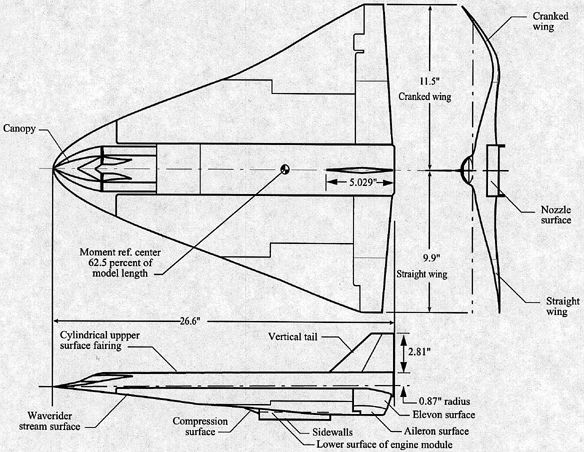
The diagram below is that of the F-16 XL, which was the subject of NASA’s research project titled, “Cranked-Arrow Wing Aerodynamics Project” :-

Link of schematic of the F-16XL from NASA’s website :-
http://www.dfrc.nasa.gov/Gallery/Graphics/F-16XL1/Medium/EG-0035-01.gif
As per the above mentioned technical research paper of NASA, “Cranked-Arrow Wing Aerodynamics project”, or CAWAP, the crank is that part of the blue portion of the wing, where the wing abruptly changes angle. In addition to this, a declassified NASA research paper dated to October 1959, has also specifically investigated the “Effects of wing-crank, leading edge cord extensions, and horizontal tail-height”. It concludes that such a design leads to improved statical longitudinal stability.
Hence, from the above as yet incompletely comprehended technical papers, the conclusion is the same i.e. cranked-wings provide for superior wing-stability, superior lift and better lateral directional stability (the last one from Aerospaceweb, investigating these on hypersonic vehicles).
References :-
2) NASA Langley Research Center Review of Cranked Arrow wing project
AbhimanyuMiG-23MLD, I’m afraid you are once again mistaking the “notch” in the wings of Viggen or Tejas to be the crank. This notch is discernible in both the aircraft from the top-view only.
However, the crank is the lower-swept leading edge, that is “hammered down”. It is visible from the side-view. A hypothetical 90 degree “hammering” will make it perpendicular to the rest of the wing — however, in Tejas’ case it is done to the limit of 5 degrees only.
This is the portion of the wing, which generates the vortex above the wing. It is absent on the Viggen.
Reference :-


 Sign In