 talltower
Does JHMCS and aim9x negate super maneuverability; canards and tvc? Does JHMCS and aim9x put American teen series on par with euro-canards in wvr?
It may limit, but not completely negate supermaneuverability.
Remember, not even 5th Gen AAMs have 100% PK.
Although none of the U.S. 4th and 4.5th Gen teen series fighters may have canards, they wisely chose to be equipped with their helmet mounted display to compensate for lack of supermaneuverability, which it can do so to a certain extent.
Putting an AIM-9X or Python 5 and JHMCS or DASH on say, an F-22, that’d be a lethal combination.

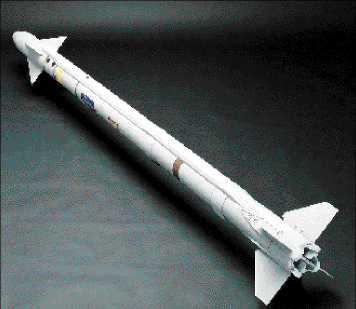


talltowerNot in relation to an aircraft heading directly towards the other. The T-50’s compressor blades are visible from the front of the aircraft, and that would show up on radar. The F-22’s, OTOH, are not visible from the front of the aircraft. So if the two aircraft are moving towards each other, the F-22 will likely detect the T-50 before the T-50 detects the F-22, because of this.
The only way for the pilot of the T-50 to prevent being spotted would be to maneuver in a heading that would prevent a head-on merge. But then this would still put the F-22 at an advantage because, like all stealth aircraft, the T-50 is most stealthy from the front, rather than the sides or rear. The F-22 would also likely have the speed advantage.
I see the T-50 as a compromise to the F-22. It has decent stealth, but not as good.
Yeah, that may be true.
At least the T-50 has a similar degree of stealth to that of the F-35, when coated with RAM.
Oh, well, it’s Russia’s best attempt at creating a genuine 5th gen stealth fighter.
talltowerZambian K-8

talltowerI was thinking…
…why not the Boeing F-15SE Silent Eagle as a possible alternative?
It’s the final evolution of the venerable F-15 Eagle family, two seats, twin engines and configurable CFTs.

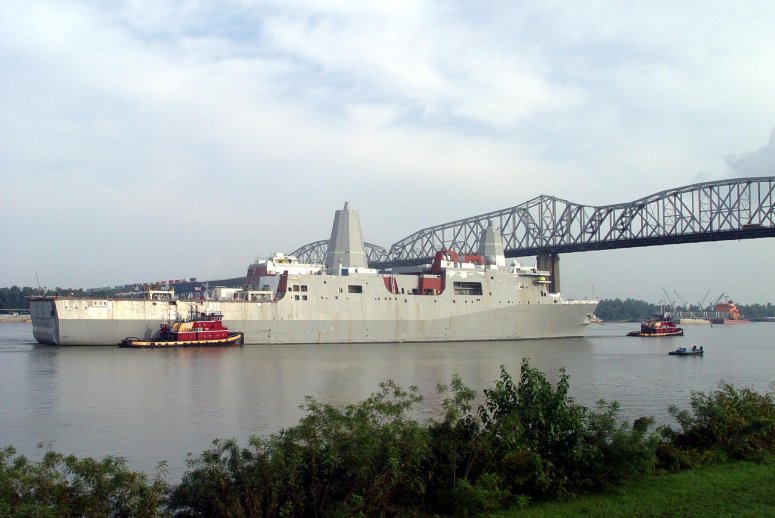
talltowerLPD-17 Reliability Issues Surface Again
Article excerpt from Defense Industry Daily
LPD-17 Reliability Issues Surface Again
It’s 2010, and Navy reports continue to be very negative. (June 30/10)
Problems with USS New York [LPD 21] reportedly have the US Navy scrutinizing every ship built in the class’ 2 shipyards. Unfortunately, it’s just the latest installment in a long string of basic workmanship issues. In March 2005, “Cost Overruns, Budget Uncertainties Hurting USN and Contractors” noted:
“With the help of a $50 million grant from the state of Louisiana, Northrop Grumman has modernized production at Avondale, and the company is now projecting completion of future amphibious ships at a much faster pace than in the past. Nevertheless, scathing Navy inspector general reviews that detailed shoddy construction and basic workmanship problems at Avondale are cause for legitimate concern in areas that will not be fixed by modernization alone.”
While some teething problems are not uncommon for first ships of a new class, The new San Antonio Class stands out for their number and severity. All in a ship whose costs rose from about $700 million when the program was sold, to over $1.7 billion – then stayed at that drastically elevated level through subsequent vessels…
Source: http://www.defenseindustrydaily.com/lpd17-reliability-issues-surface-again-03235/#more-3235
talltowerPutin boasts new jet fighter better than U.S. plane
Article from Reuters
Putin boasts new jet fighter better than U.S. plane
Putin watched a test flight of a “fifth-generation” stealth fighter, dubbed the T-50 and billed as Russia’s first all-new warplane since the collapse of the Soviet Union in 1991.
“This machine will be superior to our main competitor, the F-22, in terms of maneuverability, weaponry and range,” Putin told the pilot after the flight, according to an account on the government website.
Putin said the plane would cost up to three times less than similar aircraft in the West and could remain in service for 30 to 35 years with upgrades, according to the report.
Successful development of the fighter, built by Sukhoi, is crucial to showing Russia can challenge U.S. technology and modernize its military after a period of post-Soviet decay.
Russia also plans to manufacture T-50s jointly with India.
The F-22 raptor stealth fighter first flew in 1997 and is the only fifth-generation fighter in service. Fifth-generation aircraft have advanced flight and weapons control systems and can cruise at supersonic speeds.
According to the government website, the test pilot told Putin the controls of the T-50 allowed the pilot to operate most of the plane’s systems without taking his hands off the joystick, which he said would be very useful under high forces of gravity.
“I know, I’ve flown,” Putin replied. Sukhoi has said the plane should be ready for use in 2015.
talltowerSuper Hornet Fighter Family MYP-III: 2010-2013 Contracts
Article excerpt from Defense Industry Daily
Super Hornet Fighter Family MYP-III: 2010-2013 Contracts
The US Navy flies the F/A-18 E/F Super Hornet fighters, and has begun operating the EA-18G Growler electronic warfare & strike aircraft. Many of these buys have been managed out of common multi-year procurement (MYP) contracts, which aim to reduce overall costs by offering longer-term production commitments, which allow contractors to negotiate better deals with their suppliers.
The MYP-II contract ran from 2005-2009, and was not renewed because the Pentagon intended to focus on the F-35 fighter program. When it became clear that the F-35 program was going to be late, and had serious program and budgetary issues, pressure built to abandon year-by-year contracting, and negotiate another multi-year deal for the current Super Hornet family. That deal is now in the works. We will be using this entry to cover the Super Hornet MYP-III program’s budgets, and this article has been updated to include all announced contracts and events likely to be connected with MYP-III. It will remain free-to-view, until the MYP contract is finalized.

Source: http://www.defenseindustrydaily.com/Super-Hornet-Fighter-Family-MYP-III-2010-2013-Contracts-06392/
talltowerGajillion-Dollar Stealth Fighter, Now Easier to Shoot Down
Article from Wired
Gajillion-Dollar Stealth Fighter, Now Easier to Shoot Down
The jet that’s supposed to make up more than 90 percent of America’s combat aviation fleet may have become a lot easier to shoot down.
Lockheed Martin, makers of the Joint Strike Fighter, has been under huge pressure to stabilize the jet’s skyrocketing costs. Production prices have nearly doubled on what was supposed to be an “affordable” fighter. R&D money is up another 40 percent. Some analysts predict the program could run as much as $388 billion for 2,400 jets.
So Lockheed decided “to trim 11 pounds and $1.4 million from each aircraft by removing shutoff valves for engine coolant and hydraulic lines and five of six dry bay fire-suppression systems,” according to InsideDefense.com.
But those cuts made it much harder for the Joint Strike Fighter to withstand a hit from an anti-aircraft weapon. “When you have something full of fuel under high pressure, some of it very hot, flowing close to hot metal parts and 270 VDC electrical components, your shutoff and check valves and fire suppression in the dry bays (places fuel will spray into) are your only defense,” a knowledgeable observer notes.
Michael Gilmore, the Defense Department’s chief weapons tester, recommended in a letter to Congress last month “that these features be reinstated.” The amount saved by trimming these components, he noted, would be more than made up, if just two aircraft were lost. “Live-fire ballistic testing has demonstrated that the JSF is vulnerable.” [CORRECTED: The second half of the quote was originally attributed to Lt. Gen. George Trautman, who favors the change.]
Now, one of the JSF’s now selling points was that it wouldn’t have to worry to much about taking on anti-aircraft fire; the jet would be so stealthy that the ground-to-air guns would never find it. But according to a report published by Air Power Australia, the plane is easier to spot than originally advertised. In fact, it is “demonstrably not a true stealth aircraft.”
Locheed says a recent “technological breakthrough” has fixed all that: a fiber mat that can blend stealthy qualities right into the composite skin of the aircraft.
And in an e-mail to Danger Room, Lockheed spokesman John Kent basically said the Pentagon tester was all wrong about the plane’s vulnerability.
“Rigorous combat analysis revealed that the survivability improvements afforded by the engine fuses and fire extinguishing features were very small,” Kent wrote. “These changes were thoroughly reviewed by the F-35 Operational Advisory Group and approved through the joint JSF Executive Steering Board, which includes membership from all nine JSF partner counties. All agreed that the weight saved by the elimination of these components would be better utilized in maintaining the performance capabilities of the aircraft. The present design meets the JSFPO’s expectations for vulnerability.”
Well, yeah. That’s true. “With the exception of a 30mm high-explosive incendiary round typically associated with light anti-aircraft artillery,” wrote Lt. Gen. George Trautman, the Marines’ deputy commandant for aviation, who favored the trim. Like the kind Russia has, and sells all around the world.

Source: http://www.wired.com/dangerroom/2010/06/stealth-fighter-mods-make-it-more-likely-to-get-shot-down/
Looks like survivability in the F-35 has gone downhill, making the stealth multirole fighter vulnerable even to small arms fire.
Think of the Japanese A6M Zero of WWII; it was papier mache compared to the P-47 Thunderbolt, which was a flying tank.
Similar thing applies to the F-35; it would be papier mache compared to the A-10 Thunderbolt II, which is a flying tank killer.
talltowerRussian military to buy 50 fifth-generation fighters after 2016
Article from RIA Novosti
Russian military to buy 50 fifth-generation fighters after 2016
Russia’s Defense Ministry will order at least 50 fifth-generation fighters from 2016, a senior official said on Thursday.
“At the first stage, there will be dozens of planes, more than 50,” said Vladimir Popovkin, deputy defense minister for arms procurement.
He was on hand as Russian Prime Minister Vladimir Putin observed the test flight of a prototype fighter and later talked to the pilot, Sergei Bogdan, who said it was the fighter’s 16th test flight and more would follow shortly.
Popovkin said that based on the outcome of initial tests, the Defense Ministry would purchase the first six to 10 aircraft after 2012.
He said the fighter will be superior to U.S. analogs.
“The requirements we are setting on this plane are well above those for the U.S. fifth-generation aircraft,” he said.
Putin said the Russian fighter will be about three times as cheap as its foreign analogs.
The prime minister said 30 billion rubles (around $1 billion) had already been spent on the project and another 30 billion would be required to complete it, after which the engine, weaponry and other components would be upgraded.
He said, factoring in modernization and upgrades, the fighter will have a service life of 30-35 years.
As Putin climbed into the cockpit of the plane, Bogdan began telling him about the aircraft’s unique features, in particular the yoke that was very convenient, especially during overloads.
“
I know, I have some flying experience,” Putin said.
In 2000, then acting president Putin co-piloted a Sukhoi-27 Flanker fighter jet from Krasnodar to Chechnya’s capital of Grozny ahead of presidential elections.
Russia’s only known fifth-generation project is Sukhoi’s PAK FA and the current prototype is the T-50. It is designed to compete with the U.S. F-22 Raptor, so far the world’s only fifth-generation fighter, and the F-35 Lightning II.
Russia has been developing its newest fighter since the 1990s. The country’s top military officials have said the stealth fighter jet with a range of up to 5,500 km should enter service with the Air Force in 2015.
The PAK FA is to be armed with next-generation air-to-air, air-to-surface, and air-to-ship missiles, and has two 30-mm cannons.

http://en.rian.ru/russia/20100617/159464671.html
50 T-50 PAK FAs; that’s enough for only two VVS fighter regiments.
talltowerFortunate for people on the ground. Was this an ambulance flight?
Yes, it was. It was a flight for the pick-up of a sick patient. Unfortunately, the plane had to turn around due to engine failure but it lost altitude and crashed.
Several people were injured, but fortunately, no people on the ground were killed.
talltowerNew Zealand Selects NH90, A109 Helicopters as its new Fleet
Article excerpt from Defense Industry Daily
New Zealand Selects NH90, A109 Helicopters as its new Fleet
In 2005, NH Industries’ NH90 helicopter was selected to replace the Royal New Zealand Air Force’s aging UH-1 Iroquois, which would remain in service until 2009. A firm deal was finalized in July 2006, and New Zealand will buy 9 TTH variant helicopters; Australia’s initial 12-aircraft NH90 buy may offer some points of comparison.
Delays would eventually push New Zealand’s NH90 project back to 2011-2012, but making the decision also allowed New Zealand’s Labour Party government to move ahead with a second helicopter replacement…

Source: http://www.defenseindustrydaily.com/new-zealand-selects-nh90-helicopter-0466/
talltowerRussia did not refuse to sell su-33 to China. China wanted to purchase a small number and Russia wanted to sell more because it would otherwise be unprofitable to reopen the production line.
That imitation part doesn’t even make sense. J-10 and FC-1 aren’t related to the Russians. J-11 isn’t getting export at all. There is no evidence for it other than some paranoid sukhoi officials.
Russia planned to sell the Su-33 to the PLAN, enough to equip two naval fighter regiments, but soon backed off because of the J-11B being manufactured without the benefit of a license (retrofitted with Chinese avionics).
http://www.strategypage.com/htmw/htnavai/articles/20100607.aspx
http://english.pravda.ru/world/asia/04-06-2010/113664-china_pirate-0
An Su-33 prototype was imported from the Ukraine to kick start the J-15 Flying Shark development, fulfilling the PLAN’s requirement for a naval air superiority fighter.

J-15 wireframe
talltowerDead Aim, Or Dead End? The USA’s DDG-1000 Zumwalt Class Program
Article excerpt from Defense Industry Daily
Dead Aim, Or Dead End? The USA’s DDG-1000 Zumwalt Class Program
Program continues, but radar goes from dual-band to single-band; Bow sonar dome delivered. (June 2/10)
The prime missions of the new DDG-1000 Zumwalt Class destroyer are to provide naval gunfire support and next-generation air defense in near-shore areas where other large ships hesitate to tread, possibly even as the anchor for an action group of stealthy Littoral Combat Ships and submarines. The estimated 14,500t (cruiser sized) Zumwalt Class will be fully multi-role, however, with undersea warfare, anti-ship, and long-range surface attack roles.
That makes the DDG-1000 suitable or another role – as a “hidden ace card,” using its overall stealth to create uncertainty for enemy forces. At over $3 billion per ship for construction alone, however, the program faced significant obstacles if it wanted to avoid fulfilling former Secretary of the Navy Donald Winter’s fears for the fleet.
DID’s FOCUS Article for the DDG-1000 program covers the new ships’ capabilities and technologies, key controversies, associated contracts and costs, and related background resources. From the outset, DID has noted that the Zumwalt Class might face the same fate as the ultra-sophisticated, ultra-expensive SSN-21 Seawolf Class submarines. That appears to have come true, with news of the program’s truncation to just 3 ships. Meanwhile, production continues.

talltowerCanada’s CH-148 Cyclones: Better Late Than Never?
Article excerpt from Defense Industry Daily
Canada’s CH-148 Cyclones: Better Late Than Never?
Canada’s Maritime Helicopter Replacement Program has been a textbook military procurement program over its long history. Unfortunately, it has been a textbook example of what not to do. While Canada’s Sea King helicopter fleet aged and deteriorated to potentially dangerous levels, political pettiness and lack of concern turned a straightforward off-the-shelf buy into a 25+ year long odyssey of cancellations, lawsuits, rebids, and more. Eventually, the Canadian military settled on Sikorsky’s H-92 Superhawk as the basis of its new CH-148 Cyclone Maritime Helicopter, which will serve from the decks of Canada’s naval ships and bases.
The civilian S-92 has gone on to some commercial success. To date, however, Canada has been the H-92’s only military customer – with all of the associated issues one might expect around systems integration and conversion for naval operations. There are also deeper questions being raised concerning both the machine’s fitness, and DND’s conduct of the program as a whole. This article covers developments in Canada’s Maritime Helicopter Program…

http://www.defenseindustrydaily.com/Canadas-CH-148-Cyclones-Better-Late-Than-Never-05223/
talltowerThe Right to Bear Arms: Gunship Kits for America’s C-130s
Article excerpt from Defense Industry Daily
The Right to Bear Arms: Gunship Kits for America’s C-130s
Special Operations Command’s AC-130H/U gunships can lay down withering hails of accurate fire, up to and including 105mm howitzer shells, in order to support ground troops.
The Marines also wanted heavy aircraft that could support their Leathernecks on the ground. The bad news was that the Corps could field about 45 KC-130J aerial tankers for the price of a 12-plane AC-130J squadron, and lighter options like the AC-27J “Stinger II” would probably tally similar costs once R&D dollars were factored in. Could the Marines change tack, and offer a modular weapon package that would let them arm their existing tankers as needed? Could armed KC-130Js offer limited fire support, while loitering over the battlefield and using their unique speed range to refuel helicopters and fast jets alike? The Harvest Hawk program aims to do just that. It would give the USMC a far less capable convertible gunship option for Afghanistan, at a cost that’s about 2 orders of magnitude below a dedicated gunship fleet. Unsurprisingly, the next service to show interest in this concept was SOCOM itself…
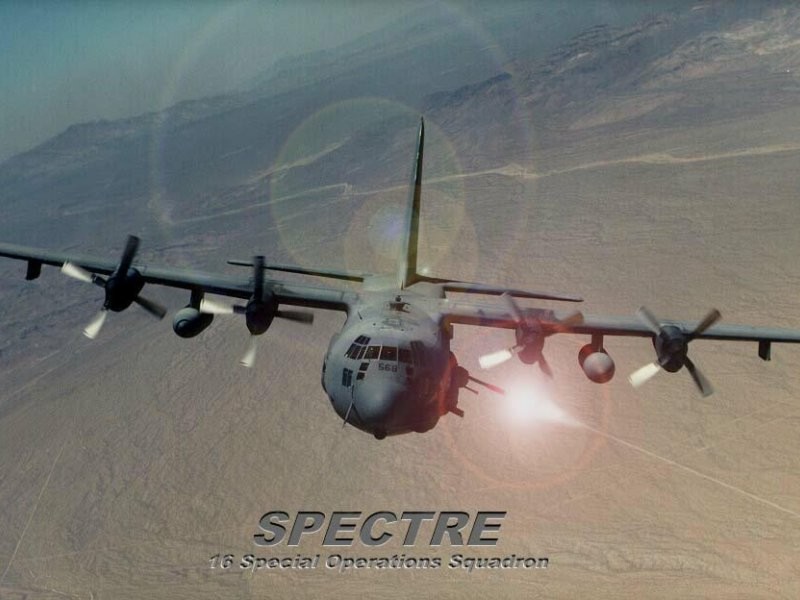
AC-130H Spectre of the 16th SOS, 27th SOW @ Cannon AFB, NM.
Source: http://www.defenseindustrydaily.com/Harvest-Hawk-Aims-to-Arm-USMCs-KC-130J-Aerial-Tankers-05409/


 Sign In







