 talltower
Two-seaters often has some less fuel to accomodate a 2nd crewmember, but is concidered worth it in specialized a/c like EW/SEAD/DEAD to mess with and pinpoint radars.
It will be far and away worth it, in fact a requirement to have a 2nd crewmember if it is to control UAV’s.
Historically the F-4 Phantom is one of the most prolific two-seater aircraft, which meant two sets of eyes and ears i.e. better situational awareness and division of pilot workload.
Another one is the F-15E Strike Eagle series.

talltowerPoland Seeks Advanced Jet Trainers
Article excerpt from Defense Industry Daily
Poland Seeks Advanced Jet Trainers
Poland is looking for 16 Lead-in Fighter Trainer (LIFT) aircraft to replace its aged fleet of over 100 PZL Mielec TS-11 Iskra trainer jets. The Iskras were initially going to be retired by 2009, but in June 2010, Poland’s Ministry of Defense said that a tender was still a few months away. The new trainer jets aren’t expected until at least 2013.
Right now, Polish pilots mostly train in the USA on supersonic T-38 Talons and USAF F-16s, but that contract expires in 2015…
Poland’s air force flies 35 upgraded Russian MiG-29 fighters, which are expected to remain in service until 2025, and 48 F-16 C/D Block 52 fighters, which were purchased in 2003. Another 45 Sukhoi SU-22M strike aircraft are scheduled for retirement in 2016. That makes them irrelevant to the future trainer competition, but does create a smaller air force unless their numbers and capabilities are replaced.
The LIFT jets would be the bridge to Poland’s front-line fighters, after pilots train on its 28 modernized PZL-130 Orlik TC-II basic and intermediate turboprop trainers. They new jets could also receive secondary duties like air policing or light attack.

http://www.defenseindustrydaily.com/Poland-Seeks-Advanced-Jet-Trainers-06423/
talltowerThe USA’s New Littoral Combat Ships (LCS)
Article excerpt from Defense Industry Daily
The USA’s New Littoral Combat Ships (LCS)
Exploit simplicity, numbers, the pace of technology development in electronics and robotics, and fast reconfiguration. That was the US Navy’s idea for the low-end backbone of its future surface combatant fleet. Inspired by successful experiments like Denmark’s Standard Flex ships, the US Navy’s $30+ billion “Littoral Combat Ship” program was intended to create a new generation of affordable surface combatants that could operate in dangerous shallow and near-shore environments, while remaining affordable and capable throughout their lifetimes.
It hasn’t worked that way. In practice, what the Navy wanted, the capabilities needed to perform primary naval missions, and what could be delivered for the sums available, have proven nearly irreconcilable. The LCS program has changed its fundamental acquisition plan several times since 2005, and canceled contracts with both competing teams, without escaping any of its fundamental issues. This public-access FOCUS article offer a wealth of research material, alongside looks at the LCS program’s designs, industry teams procurement plans, military controversies, and contracts.

http://www.defenseindustrydaily.com/the-usas-new-littoral-combat-ships-updated-01343/#more-1343
talltowerJust because it is obsolete doesn’t mean it can’t kill you. If their skill levels are significantly reduced by the lack of flying time then 3:1 may not be a large enough margin to ensure the North’s winning in the air, assuming tha the South’s pilots are well up to speed.
The KPAF and ROKAF have two different strategic philosophies in mind.
The KPAF goes for brute strength and numbers, while the ROKAF goes for tactics and technology, akin to using a pickax or a scalpel.
talltowerRussia to Order French Mistral LHDs?
Article excerpt from Defense Industry Daily
Russia to Order French Mistral LHDs?
In August 2009, Russian media reported that their country was planning to take a radical step, and buy a French Mistral class amphibious assault ship (LHD) by the end of 2009. The outlet quoted the Chief of the Russian General Staff, Gen. Nikolai Makarov, who said that: “We are negotiating the purchase of one ship at present, and later planning to acquire 3-4 ships [of the same class] to be jointly built in Russia.” A Russian order would represent a sea change on several fronts – and also the extension of some trends.
France currently operates 2 Mistral class LHDs, and recently ordered a 3rd using economic stimulus funds. Unlike some other LHD designs, the Mistral class cannot operate fixed wing aircraft. Even so, it’s an important tool of power projection. Mistral class ships can carry and deploy up to 16 helicopters, including attack helicopters like France’s Tiger or Russia’s Ka-50/52. Its main punch revolves around its 4 landing barges or 2 medium hovercraft, however, which deliver armored vehicles, tanks, and soldiers to shore. The vessel is equipped with a 69-bed hospital, and could be used as an amphibious command ship…

http://www.defenseindustrydaily.com/Russia-to-Order-French-Mistral-LHDs-05749/#more-5749
talltowerits all depends on sensors, PAK-FA seems to have a big upper hand.
Also a bigger class fighter.
True.
The Indian FGFA will have literally every advantage, though marginal, in the bulk of the parameters such as performance, maneuverability and weapons systems, though both the J-10B and FGFA would be acquired in limited numbers, i.e. no more than two combat squadrons.
talltowerCaged Tiger: Germany’s Troubled Helicopter Purchase
Article excerpt from Defense Industry Daily
Caged Tiger: Germany’s Troubled Helicopter Purchase
Germany’s EC665 Tiger UHT/HAC scout and attack helicopters have traveled a long road since the initial 1984 requirement that launched the program. They were originally slated for service in 1992, but technical delays have dogged the project. Schedule slips and funding shortfalls meant that the EUR 3 billion for 80 helicopters wasn’t placed until 1998. Deliveries from Eurocopter began in 2003, but instead of having 67 helicopters in service by the end of 2009, Germany had just 11 – none of which are considered fit for operations, or even for training.
That issue came to a head in May 2010, as the German government moves to suspend the contract until these technical issues are fixed…

talltowerAnd keeping the aircraft (minus spare parts availability) as ‘compensation’ for the Iran-Iraq war.
talltowerAustralia’s Submarine Program In the Dock
Article excerpt from Defense Industry Daily
Australia’s Submarine Program In the Dock
The January 2010 failure of a generator aboard HMAS Farncomb is just the latest problem faced by its fleet of 6 Collins Class diesel-electric submarines – which are now reduced to just 1 operational vessel. That readiness issue presents an immediate financial headache for Australia’s government, and adds a longer-term challenge to the centerpiece of Australia’s future naval force.
With just 6 submarines in its fleet, Australia’s current deployment set-up leaves little room for error. Even a normal setup of 2 in maintenance, 2 for training but available if needed, and 2 on operations makes for a thin line, given Australia’s long coastline and sea lanes. Instead, Australia currently has 3 submarines in “deep maintenance” and completely unavailable (HMAS Deschaineux, Sheean, and Rankin), 1 submarine back in port and facing indeterminate maintenance (HMAS Farncomb), 1 “limited availability” submarine fit for training (HMAS Collins), and 1 operational boat (HMAS Waller) that was in port for major battery repairs as recently as May 2009. When crewing problems are added to the mechanical issues, Australia’s 2009 White Paper plan to build 12 diesel-electric fast attack submarines as the centerpiece of the 2030 Australian Navy is attracting questions…
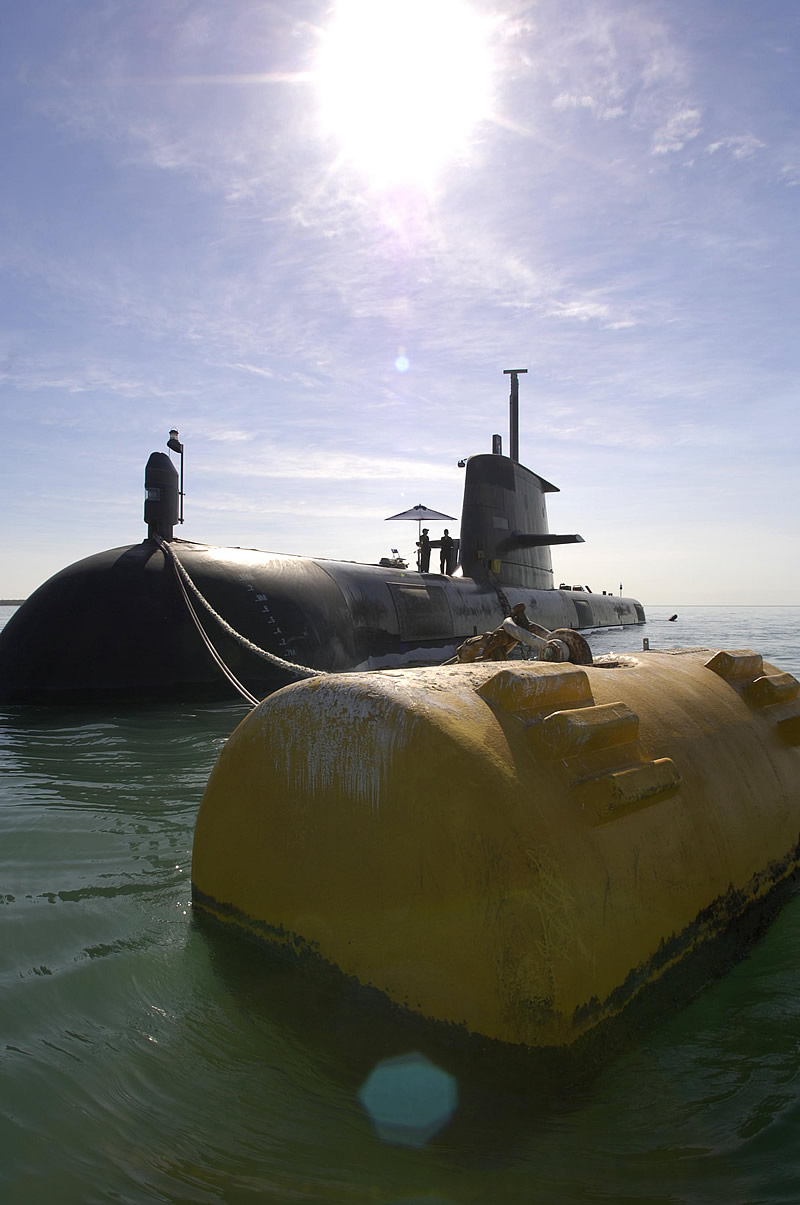
Source: http://www.defenseindustrydaily.com/Australias-Submarine-Program-In-the-Dock-06127/
talltowerBut in Vietnam, it was a whole lot different. The AIM-4D Falcon was incapable of downing VPAF MiGs, and wholly unreliable.
http://www.youtube.com/watch?v=qUcloQwXZ54
http://www.youtube.com/watch?v=D2y_B_uFTNw
talltowerTo compare an island to a Carrier totally misses the point, that you cant target a Carrier like that, it’s constantly on the move.
A runway on an island is as stationary as a runway on main land, they are equal.
But earth is much more stronger than a steel island.
A flattop can take a certain number of bombs, torpedos and ASCMs, but an island can take dozens of nukes.
talltowerEgypt to Add AH-64D Block II Attack Helicopters
Article from Defense Industry Daily
Egypt to Add AH-64D Block II Attack Helicopters
May 22/09: The US Defense Security Cooperation Agency announces [PDF] Egypt’s formal request for 12 AH-64D Block II Apache Longbow attack helicopters, 27 T700-GE-701D engines, 36 “Arrowhead” Modernized TADS/PVNS sensors, 28 M299 Hellfire Longbow missile launchers, 14 AN/ALQ-144v3 “disco ball” infrared jammers, and 14 AN/APR-39Bv2 radar signal detecting sets. Egypt will also buy composite horizontal stabilizers, Integrated Helmet and Display Sight Systems (IHADSS), helicopter repair and return, transportation, depot maintenance, spare and repair parts, and other related support items and services.
These helicopters would join 35-42 AH-64s already operated by the Egyptian Air Force, which have been upgraded to AH-64D Block I status. The estimated cost for this order is $820 million, but a DSCA request is not the same thing as a formal contract. The exact details are a matter for negotiation, unless Congress blocks the sale within 30 days.
The prime contractors would be Boeing in Mesa, AZ and St. Louis, MO (AH-64); GE in Lynn, MA (engines); and Lockheed Martin Missiles and Fire Control in Orlando, FL (Arrowhead, M299). Note that the APR-39B is a Northrop Grumman product, BAE Systems makes the “disco ball”, and IHADDS is a Honeywell product – but they are not prime contractors. Implementation will require the assignment of a U.S. Government representative to Egypt for a period of 6 years to provide intensive coordination, monitoring, and technical assistance, as well as 6 Contractor Field Service Representatives for a period of 5-10 years.
Source: http://www.defenseindustrydaily.com/Egypt-Aims-to-Add-AH-64D-Block-II-Attack-Helicopters-05458/

talltowerQuite true. More white elephant high-tech ships instead of more numerous current tech counterparts.
Under FDR, he emphasized a large fleet of escort carriers, built in larger numbers.
talltowerFrance hopes to sell Rafale to UAE in 2010
Article excerpt from UPI
France hopes to sell Rafale to UAE in 2010
PARIS, May 6 (UPI) — Negotiations between France and the United Arab Emirates on Dassault Aviation’s Rafale fighter jet are taking longer than expected but Paris hopes to strike an agreement by the end of this year.
A French official familiar with the negotiations told Defensenews.com that an agreement struck this year would mean that next-generation Rafale jets could be delivered by 2014.
This so-called F4 standard of the multirole Rafale would be a true “fifth-generation” aircraft, the official told Defensenews.com. The United Arab Emirates is mulling the purchase of up to 60 planes, experts say.
talltower
Wonder what St. Louis has to offer the military aviation industry…


 Sign In







