 talltower
Powerful Past, Promising Future Mark 1000th F414 Engine Milestone
Article from GE Aviation
Powerful Past, Promising Future Mark 1000th F414 Engine Milestone
May 05, 2010 — LYNN, Mass — The F414 Turbofan Program celebrated delivery of its 1,000th production engine today, capping a decade of providing power to a growing range of applications and demonstrating critical technologies that deliver significant increases in mission capability.
“We look at this milestone as a tribute to the past ten-plus years, as well as a springboard for future technical innovation,” said Tony Mathis, vice president and general manager of the Lynn Turbofan Department. “We are pleased with the track record we have compiled to date, and we look forward to continuing to produce one of the most versatile and reliable powerplants in military aviation history.”
The F414-400 engine (22,000 lb/fn) has achieved an outstanding record of performance to date. With more than 1 million engine flight-hours of experience in Boeing F/A-18E/F Super Hornet and E/A-18G Growler aircraft, the F414 continues to exceed United States Navy (USN) goals for reliability and time on wing. The USN plans to purchase more than 1,200 engines, including spares, to power 594 twin-engine F/A-18 E/F and EA-18G aircraft. Individual F414 high-time production engines have accumulated 3,800 EFH.
In addition to operation with the USN, the F414-400 engine is now operational with the Royal Australian Air Force (RAAF). The first five F/A-18E/F Super Hornets arrived in Australia on March 26 with 19 additional aircraft planned for delivery through 2011.
The F414G, a single-engine variant of the F414-GE-400, delivers 20 percent more thrust for the Gripen Next Generation aircraft than previous powerplants. The NG Demonstrator first flew in May 2008 and has completed more than 100 flights, exhibiting excellent operability and performance in both subsonic and supersonic operation.
In anticipation of evolving and more demanding requirements, the F414 family is continuing on an ambitious growth path to increase thrust, improve durability and satisfy environmental considerations. The Enhanced Durability Engine (EDE) is focused primarily on durability improvement and life-cycle cost savings for the USN customer, while the Enhanced Performance Engine (EPE) – with increased thrust – is targeted for potential international customers.
The EDE incorporates an advanced high pressure turbine (HPT) and six-stage high pressure compressor (HPC) that offers a 2-3X hot-section durability gain and reduced fuel consumption, which could equate to a $1-2 billion savings over the life of the USN fleet. The EPE includes EDE improvements plus a new fan for greater airflow, resulting in a 20 percent thrust improvement and greater operational flexibility.
Demonstrator versions of both the EDE and EPE have been successfully run, laying the groundwork for a USN-funded specific fuel consumption (SFC) reduction effort. This initiative, geared toward developing near- and long-term energy strategies, is aimed at showing a 3 percent SFC gain compared with the current F414-GE-400 configuration. An F414-powered Super Hornet operating on a biofuel blend successfully flew in April 2010 — the first tactical USN aircraft to use a biofuel blend.
GE is also working with the USN to develop a retrofittable noise reduction kit for the F414 that features chevron exhaust nozzle technology. These nozzles have serrated edges where each “lobe” penetrates into or out of the primary flow and generates a secondary flow, significantly reducing jet noise. To date, results show a 2-3-decibel noise reduction — or about half the sound energy. The USN has identified funding for a program to further test and mature the technology to prepare it for incorporation in the USN F414 fleet, with work scheduled to continue through 2011.
GE Aviation, an operating unit of GE (NYSE: GE), is a world-leading provider of jet engines, components and integrated systems for commercial and military aircraft. GE Aviation has a global service network to support these offerings.
Source: http://www.geae.com/aboutgeae/presscenter/military/military_20100505.html

talltowerAll garbage.
10 billion of R&D for any new jet would be better off buying 100 more PAK-FA @ $100 million a piece, if that were their price.
And one-engine not the Russian way of doing things.
Well, they haven’t built a single engined jet since the MiG-23 Flogger and Su-17/20/22 Fitter.
talltowerInflection Point: How Much Is That (F-35) Fighter in the Window?
Article excerpt from Defense Industry Daily
Inflection Point: How Much Is That (F-35) Fighter in the Window?
The Battle over the F-35 fighter’s costs is quickly becoming a strategic issue for Lockheed Martin. The firm is worried that the rising Pentagon cost estimates per fighter will spook both domestic and foreign buyers, right in the crucial period between FY 20100-2015, when it is supposed to move to full-rate production. If that happens, it could create a vicious spiral of slower cost drop-offs, followed by more cutbacks, followed by rising costs and delays. On the other hand, if concerns are allayed, and then the pessimistic estimates turn out to be right, a number of countries and government will find the future of their air forces hung out to dry, via unaffordable contracts. The problem is, Lockheed Martin and the US government disagree sharply over what the F-35’s cost is. That’s why so much is riding on who is eventually right, and on who is perceived to be right, right now.
Bill Sweetman is arguably aviation’s most respected journalist. “JSF – Talking Real Money” helps explain why, as it dissects the 2 colliding viewpoints of the fighter’s future costs. Here’s the core of the debate…

talltowerYou mean the MiG LFI, aka MiG-39, Russia’s equivalent of the F-35?

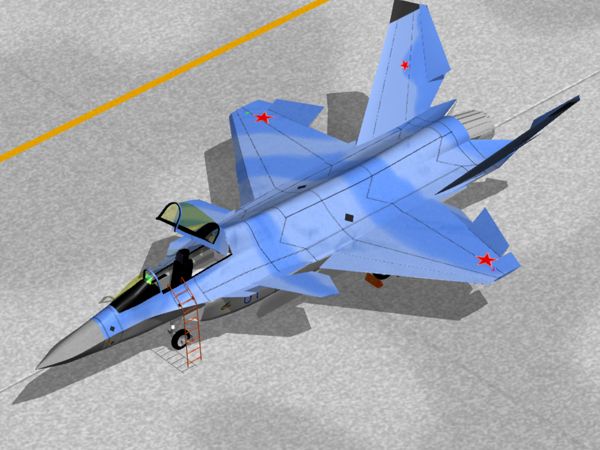
Certainly it’d comprise the low-end of the prospective Russian 5th Gen fighters.
talltowerBut still no sign of side weapons bays?
I don’t see them.
talltower
Can’t be smoke and mirrors, can it?
talltowerT/A-50 Golden Eagles for Iraq?
Article excerpt from Defense Industry Daily
T/A-50 Golden Eagles for Iraq?
Full competition under way. (April 29/10)
Iraq may be on track to become the first export customer for South Korea’s T-50 Golden Eagle family of supersonic jet trainers and lightweight fighters. But the KAI/Lockheed Martin plane will have to work for it, against a familiar set of international competitors.
DJ Elliott of the Long War Journal says that the A-50 was suggested in fall 2007 to the Iraqi Ministry of Defense, by MNSTC-I’s Coalition Air Force Transition Team. Iraq’s underway basic trainer purchase is Hawker Beechcraft’s T-6 Texan II, but a jet trainer is required as an interim step between the T-6 and more advanced planes like the F-16s that Iraq is seeking. Depending on their installed equipment, TA-50s could also serve as F-16 supplements. Other contenders can also be equipped as light attack jets, albeit without the same loaded supersonic capabilities…

Source: http://www.defenseindustrydaily.com/TA-50-Golden-Eagles-for-Iraq-05255/#more-5255
talltowerIt’s more like a cross of both smoke and mirrors and actual design work.
I know the PLAAF is wanting a 5th Gen fighter to compete on equal terms with the Raptor, but built in limited numbers due to its high development and operating costs and assigned to a couple of elite fighter regiments, while the J-10 and J-11 remain their workhorses.
Avionics are OK and airframe designs look radically unorthodox.
What’s critically missing is the turbofan engines. If the Chinese engineers want a proven supercruise-capable turbofan developed in a fraction of the time, they can reverse engineer the AL-41F and call it the WS-17.
talltowerIndia to induct 5th-gen fighter jets by 2018
Article from Domain-B
India to induct 5th-gen fighter jets by 2018
24 April 2010
As part of India’s efforts to effectively meet the emerging threats in its immediate geographical environment the Russo-Indian fifth generation fighter aircraft programme (FGFA) will result in state-of-the art stealth fighters being inducted into the Indian Air Force by 2018.
According to Indian Air Force chief, Air Marshal PV Naik, “The fifth generation aircraft would possess technologies which would provide it (India) the edge over adversaries in future air warfare,”
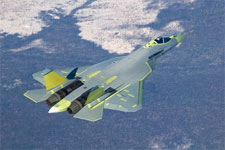
PAK-FA in debut flight
“China is rapidly modernising its air force,” he said. “On our part, the IAF is reviewing its tactics regularly to increase its combat potential.”
The Russo-Indian PAK-FA fifth-generation fighters, slated to match and outperform the US F-22 Raptor, can evade sophisticated radars and operate from short airstrips. It also has longer endurance than the current lot of fighters, being able to stay in the air for a longer period of time, air force officials said.
India plans to procure at least 200 of the 5th-gen PAK-FA fighters, each valued at $100 million. India will spend at least $32 billion over the next five years to modernise its largely Soviet-era weapons systems.
Though government-level agreements are already in place for the PAK-FA programme, the two companies India’s Hindustan Aeronautics Ltd (HAL) and the Russian designer and manufacturer, the Sukhoi design bureau, are yet to work out the details.
But this, officials say, is a mere formality and will be locked in some time this year.
State-run Hindustan Aeronautics Ltd is expected to build the mission computer, cockpit displays and other navigation systems for the aircraft as also design and construct the two-seater variation of the aircraft. While the IAF will be opting for the two-seat variant of the fighter the Russians are opting for the single seat-variant. Both sides, though, will be inducting small quantities of both variants.
India is also in the market for 126 multi-role, medium range fighters and a short list of finalists for the $11 billion contract is expected to be declared by June-July of this year.
Apart from inducting state-of-the art aircraft into its force and upgrading existing aircraft to suit the modern fighting environment, India also plans to upgrade more than 50 airbases along the Chinese and Pakistan border, air marshal Naik said.
Source: http://www.domain-b.com/defence/air_space/iaf/20100424_fighter_jets_oneView.html
talltowerU.S. Air Force to Test X-37B Orbital Test Vehicle
Article excerpt from Defense-Update

U.S. Air Force to Test X-37B Orbital Test Vehicle
The U.S. Air Force launched the newest and most advanced unmanned re-entry spacecraft today, April 22nd, 2010 at 7:52PM from Cape Canaveral Air Station, Fla. The spacecraft was launched on an Atlas V expendable launch vehicle, the 8.9 meter long, five ton X-37B Orbital Test Vehicle (OTV) is a ‘risk reduction’ vehicle designed for space experimentation that explores concepts of operation for a long-duration, reusable space vehicle. According to Mr. Gary Payton, Air Force Deputy Under Secretary for Space Programs, the first mission of the X-37B OTV will evaluate new concepts of operation employing a reusable autonomous, unmanned spacecraft. Experimentation will be performed on the mission in space and on the ground, upon its return, assessing the cost and complexity of the turnaround cycle – repairing the vehicle after the flight and preparing it for a new mission in a timely and cost effective manner. Following a series of in-orbit experiments, the vehicle will be commanded to autonomously perform the reentry maneuver to land at the Vandenberg Air Force Base in California, gliding through the atmosphere, on its 4.5 m’ span wings.
Source: http://www.defense-update.com/features/2010/april/x37b_21042010.html
talltowerThink of the upgraded F-15C as a chaperon of sorts to the F-22A.
You know, like mother and daughter (the Eagle is a generation older than the Raptor).
Like the analogy?
talltowerIranian Displays Advanced Ballistic Missiles, Air Defense Systems & Anti-Ship Missile
Article from Defense-Update

Above: the Iranians displayed the Ghadr-I Ballistic missile at the Army Day Parade 2010. This missile is capable of hitting targets at a range of 2000 km. The Iranians displayed an earlier version of the Ghadr in 2007. This missile is about four meter longer than the Shahab-3B/M versions, adding 35 seconds burn time. Photo: Ali Rafiei, Fars
Iranian Displays Advanced Ballistic Missiles, Air Defense Systems & Anti-Ship Missiles on Army Day Parade
Iran’s S-300 ‘look-alike’ – Hoax or Reality?
Iran has unveiled several new missiles and UAVs at the 2010 Army Day Parade, highlighting long-range ballistic missiles of the solid-propelled Safir and liquid propelled Shahab family. Iran also hints on the existence of a new missile in its arsenal, an S-300 ‘look-alike’. The vehicle displayed on the parade carries four cylindrical canisters measuring roughly as the S-300 container-launcher, but the Iranian vehicle does not show any erection apparatus. If these vehicles are part of a real system, they could be vehicles carrying reload missiles. The system is definitely not the Russian S-300, but could be a derivative of the Chinese HQ-9.

Iranian S-300 ‘look alike’ missile carriers shown on the Army Day Paradein Tehran, April 18, 2010. These vehicles seem to be carrying mock-ups representing a future missile being developed by Iran. The design looks similar to the Russian S-300 or Chinese HQ-9, but is too simplistic to represent an operational SAM unit. Photo: Ali Rafiei, Fars
Yet, the likelihood of this vehicle being a true missile is questionable, according to Aviation Week reporter Dave Fulghum, that considers the Iranian display a hoax. Iran has claimed for several months now that it has developed an indigenous air-defense missile comparable to the S-300 it has ordered from Russia. Iran is also modernizing its Hawk missiles, into the locally modified Hawk (Shahin) to improve its air defense capability. Iran has also introduced the Mersad (Ambush) – a further improved version of the Hawk. Iran’s Defense Minister Ahmad Vahidi said recently that Iran’s defense industries began full scale production of the Mersad surface-to-air missile, considered to be superior to the missile Iran received from the USA during the 1970s. The range of the Mersad is claimed exceed 40 km. The system introduces modern radar signal processing technology, an advanced launcher, and improved guidance and target acquisition systems.
The parade included mostly locally developed and produced systems, and, therefore has not displayed the latest air defense system in Iran’s arsenal – the SA-15 Tor delivered by Russia few years ago. These point defense missiles being used to defend many of its nuclear sites.
The Iranians are also planning to introduce locally developed radars to replace a series of aging Russian-made systems currently deployed in the Persian Gulf. “The systems will be designed and installed chiefly for defense purposes,” said Vice President for Science and Technology, Nasrin Soltankhah. She added that the new radar systems will also feature capabilities to provide meteorological data for weather forecasting and analysis.
Iran’s Defense Minister Ahmad Vahidi said recently that Iran’s defense industries began full scale production of the Mersad surface-to-air missile, considered to be superior to the US-made Hawk missile Iran received from the USA during the 1970s. The Mersad introduces modern radar signal processing technology, an advanced launcher, and improved guidance and target acquisition systems.
The Iranians are also planning to introduce locally developed radars to replace a series of aging Russian-made systems currently deployed in the Persian Gulf. “The systems will be designed and installed chiefly for defense purposes,” said Vice President for Science and Technology, Nasrin Soltankhah. She added that the new radar systems will also feature capabilities to provide meteorological data for weather forecasting and analysis.

An Iranian fast boat launching the Nasr-1 anti-ship missile. Photo: MEHR
Anti-Ship Missiles on Display
Two classes of antiship missiles participated in the parade. The Ra’ad (Thunder), is the first indinenously produced anti-ship missile from Iran. Based on the Chinese HY-2 Silkworm, the Ra’ad and its Silkworm launcher were matched to a tracked platform to provide an all-terrain weapon system that can be deployed along the coastal plains of the Persian Gulf. The missile has a maximum range of 360 km. Iran is also producing three types of anti-ship missiles designed for operation from surface vessels or land vehicles.
These include the Chinese C-802, the land-based configuration carries three missiles, capable of attacking surface targets at distances of 120-180 km. The missile has an autonomous (self-targeting) range of 40 km. The Kosar is a smaller, short-range version of the Chinese C-701, This missile can be guided using radar or TV guidance.
The newly developed Nasr 1 is larger than the Kosar missile – based on the Chinese C-704 design. Longer and heavier than the C-701, the new missile has a heavier warhead, capable of destroying larger ships, with displacement of up to 3,000 tons. The Iranians designate the weapon a ‘cruise missile’, but it seems it is more likely a short-to-medium range anti-ship missile. According to Jane’s Air-Launched Weapons, the range of the C-704 is 170 km (106 miles) and its warhead weighs about 109 kg (240 pounds). There are probably two versions of the missile – one using radar guidance and another, operating a TV seeker. Future enhancement of the missile could also include air-launched versions. A longer range version of the Nasr could also be in development – most probably a long-range naval attack weapon based on the Chinese turbojet-powered C-705 cruise.
Iran is also fielding enhanced versions of the Noor (Chinese C-802), converted into an air-launched version that can be carried by Mi-17 helicopters and strike fighter jet aircraft.
Latest Ballistic Missiles on Parade
Among the ballistic missiles displayed on the parade were two Shahab 3 missiles and the solid-propelled Sejjil 2. All missiles were seemingly of operational capability, carried on erector-launchers, by commercial trucks.

Above: Sejjil-2 long range ballistic missile. Photo: Ali Rafiei, Fars

Above: An Iranian Shahab-3B ballistic missile. This variant has a larger warhead, compared to both the Shahab-3 and the Shahab-3M. Photo: Ali Rafiei, Fars

Fateh 110 short range guided missile is believed to be based on the unguided Zelzal-1 rocket is probably the Iranian first attempt to develop an advanced ballistic missile having trajectory shaping, terminal maneuvering and precision attack capability. From the images have been released sofar it seems that the missile seems to be in development. Photo: Ali Rafiei, Fars
Source: http://www.defense-update.com/features/2010/april/iranian_missiles_20042010.html
talltowerMalaysia publicly agrees to buy 12 EC725s, also wants attack helicopters
Article from Flight Global
Malaysia publicly agrees to buy 12 EC725s, also wants attack helicopters
By Leithen Francis
Malaysia has publicly agreed to buy 12 Eurocopter EC725 combat search and rescue helicopters and is in the early stages of looking for attack helicopters.
At this week’s Defence Services Asia (DSA) show in Kuala Lumpur, the country’s defence minister Ahmad Zahid Hamidi signed a letter-of-acceptance for the EC725s, which will be delivered in 2012 and 2013.
He told local news media that the plan is to sign a final contract when prime minister Najib Abdul Razak returns from overseas and the cabinet has a chance to meet and sign off on the deal.
The Royal Malaysian Air Force is also trying to have a requirement for attack helicopters included in the country’s next five-year plan, say industry sources.
At DSA, Eurocopter had a scale model of its Tiger attack helicopter on
display next to a scale model of the EC725.
Sikorsky was promoting its armed S-70 Black Hawk at the show and highlighting how the helicopter has interior kits so it can be used for multiple roles. For example, it can be re-configured to be a VIP transport, medical evacuation, reconnaissance team insertion or troop transport helicopter.
Sikorsky was also promoting its upgrade package for the S-61 Nuri helicopter that includes new rotor blades and a replacement avionics system from Rockwell Collins that includes four flat-panel digital displays.
The EC725s will replace some of the air force’s 20 Nuris, the first of which was received in 1968.
Malaysia originally planned to phase out all its S-61s, but budget constraints mean it plans to retain and upgrade at least 15 of them, say industry sources.
At DSA, Finmeccanica company Selex Galileo was pitching to get its systems included in the Nuri upgrade programme. It was also promoting its airborne tactical observation and surveillance system to meet Malaysia’s requirement for maritime patrol aircraft.
The air force is seeking to buy four maritime patrol aircraft, with Selex Galileo’s sister company Alenia Aeronautica in the running with its ATR 42MP. However, Indonesian Aerospace (IAe) is understood to be the front-runner in the competition with the CN-235.
If IAe wins the contract, Selex Galileo could still be contracted to provide the ATOS mission system, which has already been integrated with the CN-235 for customers including Ecuador.
talltowerInvestigators Focus on Tupolev 154 Jetliner
Article excerpt from The Wall Street Journal
Investigators Focus on Tupolev 154 Jetliner
Investigators seeking the cause of a plane crash that killed Polish President Lech Kaczynski, his wife and a delegation including dozens of high-level officials on Saturday are likely to focus on both the Tupolev 154 jetliner and the pilots’ actions.
The Russian-made plane, which was 20 years old, had been overhauled in December at a Russian aviation facility and had flown relatively few hours.
The Tu-154, which crashed outside Smolensk, Russia, was on its fourth attempt to land amid heavy fog. Investigators will seek to understand why the crew tried bring the plane down in such unfavorable conditions.
Russian media reported that the airplane’s pilot ignored warnings to abort his landing outside of Smolensk and land instead in Minsk or Moscow. The jet crashed about a kilometer short of the runway at the Smolensk-Severnyi military airport, shortly before 11 a.m. Moscow time.
The airport lacked modern radio-navigation systems that help guide planes in poor visibility, according to the Polish newspaper Rzeczpospolita.

Russian special services secured the area after a Polish government plane crashed near the airport in Smolensk, Russia.

Tupolev Tu-154
The airport lacked modern radio-navigation systems that help guide planes in poor visibility, according to the Polish newspaper Rzeczpospolita.
Had the airport been equipped with the latest radio-navigation systems and/or the pilot not attempted to land at Smolensk Air Base, President Lech Kaczynski, the first lady and his governmental advisers and military leaders would not have been killed in this untimely and tragic accident.
talltowerArticle excerpt from The Wall Street Journal
Polish President, Others Killed in Plane Crash
By GREGORY L. WHITE in Moscow and MARCIN SOBCZYK in Warsaw
Polish President Lech Kaczynski and dozens of others in a high-level delegation were killed Saturday when their plane crashed on landing outside the western Russian city of Smolensk, officials said.
Russian state television reported that the Tu-154 jet crashed about a kilometer short of the runway on its second attempt to land in heavy fog at the Smolensk-Severnyi military airport, shortly before 11 a.m. Moscow time.
Reports of the number killed in the crash varied. Polish officials put the figure at 88, while Russia’s Ministry of Emergency Situations said 97 had died and Russia’s Investigative Committee said the total was 132.
“We still cannot fully understand the scope of this tragedy and what it means for us in the future,” Foreign Ministry spokesman Piotr Pszkowski said. “Nothing like this has ever happened in Poland.”
Article excerpt from BBC News
Poland mourns President Lech Kaczynski after jet crash
Poland is in mourning over the deaths of President Lech Kaczynski and much of its defence establishment in a plane crash in western Russia.
All 97 people on the jet, who had been due to attend a memorial for victims of a wartime massacre, died when it crashed in fog near Smolensk air base.
Russian officials say pilots ignored warnings they were flying too low.
A week of mourning has been called in Poland where a two-minute silence will be held at noon (1000 GMT).
Russia has also declared Monday a day of mourning for the victims, whose remains have been flown to morgues in Moscow.
Source: http://news.bbc.co.uk/2/hi/europe/8613778.stm


 Sign In







