 mark_pilkington
oops -that was inexcusable – although in my defence I was corncentrayting on spelling Hangar/hanger and there/their correctly and getting the apostraphie in the right plaice and forgot about Gipsy/Gypsy
The quicker we all stop trying to speak English and simply adopt American the easier it will be to digest sitcoms, news limited and other indoctrine – smiles
regards
Mark Pilkington
mark_pilkingtonoops -that was inexcusable – although in my defence I was corncentrayting on spelling Hangar/hanger and there/their correctly and getting the apostraphie in the right plaice and forgot about Gipsy/Gypsy
The quicker we all stop trying to speak English and simply adopt American the easier it will be to digest sitcoms, news limited and other indoctrine – smiles
regards
Mark Pilkington
mark_pilkingtonSo thats an eventual total of 5?
USA
Flying Replica
UK
Original under restoration
“Original” under “reconstruction”
Replica under construction
NZ
Replica under construction
I would tend to agree with David Burke that historically significant aircraft such as Grosvenor House should be preserved and not operated due to the increased risk of loss, but of course thats an issue for the owners.
I do wonder however if the “other two” eventually go into active operation in the UK that the Trust might reconsider ongoing operation of the original, even though static airframes is not in its remit.
If its ever grounded Australia would be more than happy to receive it along the lines of NZ and the Gull smiles.
regards
Mark Pilkington
mark_pilkingtonSo thats an eventual total of 5?
USA
Flying Replica
UK
Original under restoration
“Original” under “reconstruction”
Replica under construction
NZ
Replica under construction
I would tend to agree with David Burke that historically significant aircraft such as Grosvenor House should be preserved and not operated due to the increased risk of loss, but of course thats an issue for the owners.
I do wonder however if the “other two” eventually go into active operation in the UK that the Trust might reconsider ongoing operation of the original, even though static airframes is not in its remit.
If its ever grounded Australia would be more than happy to receive it along the lines of NZ and the Gull smiles.
regards
Mark Pilkington
mark_pilkingtonIn the absence of ongoing input from the proponents of the “Peoples Mosquito” and further details of their proposal, this thread seems to be wandering off into seemingly pointless debate.
The thread is responding to a proposed reconstruction of a Mosquito in the UK, the proponents do not appear to have proposed using metal construction to a new design and the prospect of anyone doing so is pure fantasy, well beyond any feasibility to reconstruct one to the original design.
There are at least 4 Mosquito’s under active restoration to fly including the three currently progressing through the New Zealand workshops, I dont see any those projects being called to a halt over concerns of future maintenance issues?, or being given advice here to do so?
A Mosquito TIII operated successfully in the UK for many years without any apparant timber shrinkage, or any limits on its life or performance by the UK regulator?
“IF” a group of 13 people can swell to more than that, and acquire the money and parts to undertake a reconstruction, (and hopefully access the expertise in NZ) then good luck to them.
If others have had a previous fleeting look at building a Mosquito, and decided that a newly designed metal airframe is the way to go, let them acquire the money and commence that project, but place it in its own thread as its certainly not going to be a De Havilland DH98 Mosquito, and doesnt warrant ongoing debate in this thread.
Its splitting hairs to suggest a modern reconstruction, or reproduction Mosquito built to the original DH plans and methods with ply and balsa, but using modern glues is equal to a replica using new design and aluminium construction that at best only retains the aerofoil and external shape.
Let the proponents of the “Peoples Mosquito” proceed, succeed or fail on their merits, and hopefully inform us here of “their” plans and either encourage our support or suffer our scorn if need be, when or if they have got that far.
It seems reasonable for a group to make such a proposal and move forward subject to the response and support they receive, I wish them good luck.
Relegate the Tin Mossie to the bin, or a new thread, and those wishing to debate the merits can do so there, and this thread can remain on topic.
regards
Mark Pilkington
mark_pilkingtonIn the absence of ongoing input from the proponents of the “Peoples Mosquito” and further details of their proposal, this thread seems to be wandering off into seemingly pointless debate.
The thread is responding to a proposed reconstruction of a Mosquito in the UK, the proponents do not appear to have proposed using metal construction to a new design and the prospect of anyone doing so is pure fantasy, well beyond any feasibility to reconstruct one to the original design.
There are at least 4 Mosquito’s under active restoration to fly including the three currently progressing through the New Zealand workshops, I dont see any those projects being called to a halt over concerns of future maintenance issues?, or being given advice here to do so?
A Mosquito TIII operated successfully in the UK for many years without any apparant timber shrinkage, or any limits on its life or performance by the UK regulator?
“IF” a group of 13 people can swell to more than that, and acquire the money and parts to undertake a reconstruction, (and hopefully access the expertise in NZ) then good luck to them.
If others have had a previous fleeting look at building a Mosquito, and decided that a newly designed metal airframe is the way to go, let them acquire the money and commence that project, but place it in its own thread as its certainly not going to be a De Havilland DH98 Mosquito, and doesnt warrant ongoing debate in this thread.
Its splitting hairs to suggest a modern reconstruction, or reproduction Mosquito built to the original DH plans and methods with ply and balsa, but using modern glues is equal to a replica using new design and aluminium construction that at best only retains the aerofoil and external shape.
Let the proponents of the “Peoples Mosquito” proceed, succeed or fail on their merits, and hopefully inform us here of “their” plans and either encourage our support or suffer our scorn if need be, when or if they have got that far.
It seems reasonable for a group to make such a proposal and move forward subject to the response and support they receive, I wish them good luck.
Relegate the Tin Mossie to the bin, or a new thread, and those wishing to debate the merits can do so there, and this thread can remain on topic.
regards
Mark Pilkington
mark_pilkingtonThere are a number of online references to the existance of a fuselage and tail group, rumoured to have been “new in a box” but apparantly stored outside for many years.
Randy Haskin at WIX provides an excellent account of the collection during his visit in 2002, and in a 2006 post he provided some photos, some which show the P-47 fuselage (or at least its windscreen or rear fuselage) in the background where it was located near the Skyraider and Corsair FG-1D.
http://www.warbirdinformationexchange.org/phpBB3/viewtopic.php?t=7722
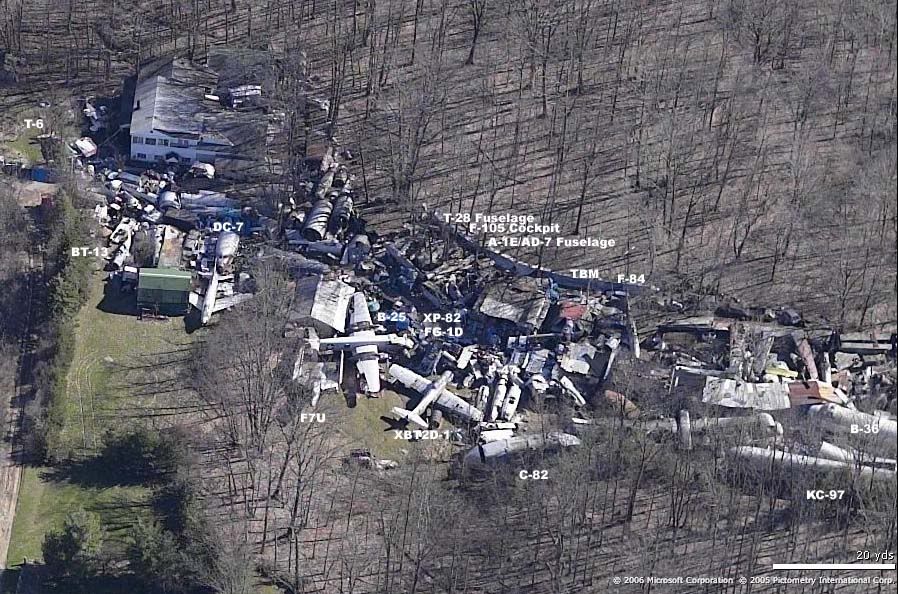



However a recent post at WIX has recent photos of the P-47 fuselage in December 2011.


http://www.warbirdinformationexchange.org/phpBB3/viewtopic.php?f=26&t=43645&start=0
The entire photo collection is here:
http://s1114.photobucket.com/albums/k527/cooper9411/
Regards
Mark Pilkington
mark_pilkingtonAnything is possible with enough effort and cash, Glynn Powell in NZ seems enough evidence of that.
Of course there is a lot of metal in the wooden wonder and any credible project would need to start with a kitset rather than simply a pile of new plywood.
And equally it would seem pointless to duplicate the moulds and expertise already amassed in NZ simply to “do it yourself” the money “saved” would be more than “wasted” in passing up access to that proven capability.
Clearly a starter kit would be the best way to access all the metal parts, and an identity, there were a couple of derelict Mosquitos gathered in the US (including the one from Mexico City that we all drooled over in 1970’s copies of Air Classics), and I understand they have passed into the hands of the Swedish Air Force Museum.
And as everyone says, the real limiting factor is Money.
If “Enough” money was available, a deal with the Swedish Air Force might be possible to deliver a static fuselage & or wing set from NZ in trade for the second aircraft parts, and with “enough” money, perhaps Glynn can be persuaded to push another static and flyer out of his production line.
So the starting point remains – getting enough money, a hard thing to achieve as the aircrews associated with these types pass into history, and out of influential or financial capabilities of assistance, leaving the need to inspire a major sponsor or sugar daddy!
I hope the project is successful, I’m not sure it will be, but you can never have too many flying Mosquitos, of course the current financial climate is not encouraging.
In regards to building one out of metal, might as well just buy the 3/4 replica recently built in France and be done with it, ie if its not going to be a full scale accurate “Wooden Wonder” why bother.
regards
Mark Pilkington
mark_pilkingtonHi all.
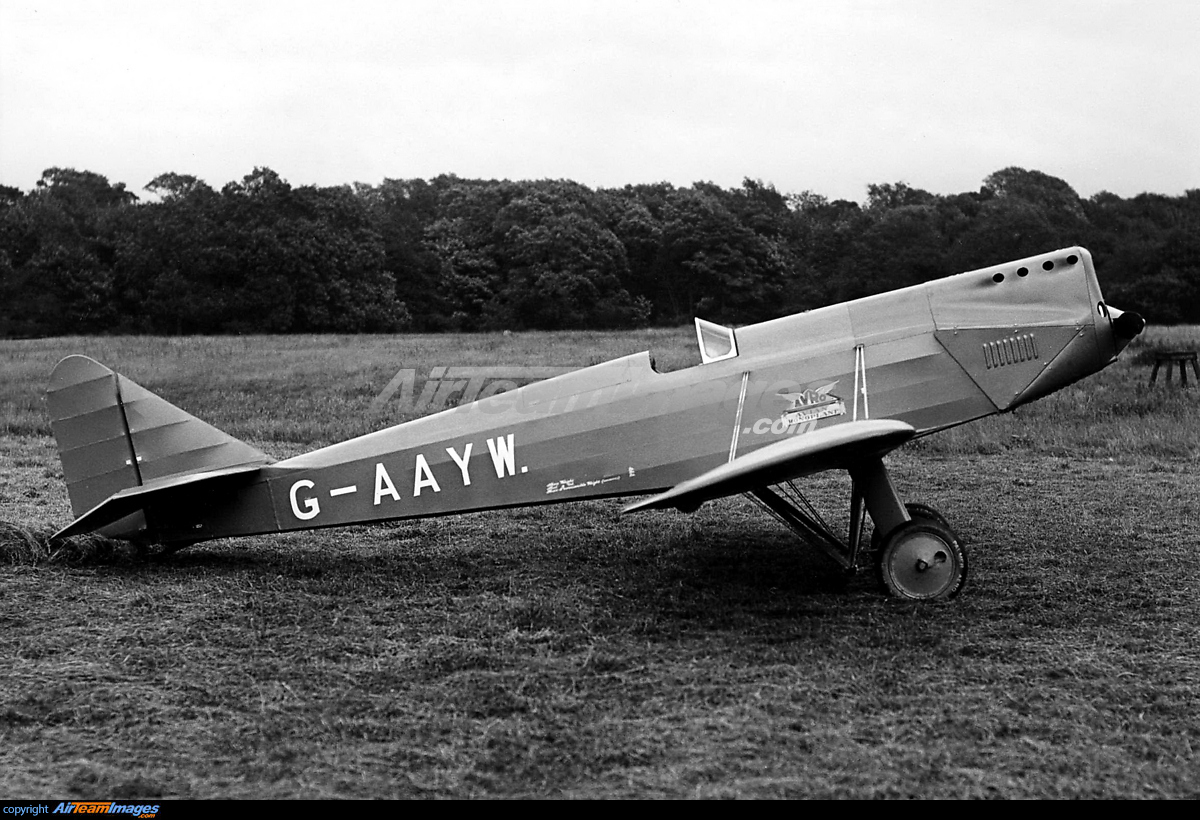
I’m researching the 625 monoplane version of the Avro Avian. Two were built, one with a Genet engine and one with a Cirrus Hermes. It’s the latter aircraft, registed G-AAYW, that I’m interested in. There doesn’t seem to be an awful lot of info on the web.
I’m looking for photos and hopefully a reasonable 3-view of G-AAYW. Apparently it was pea-green but I can’t find any documentation to back that up?
Thanks in advance!
Jon
There is brief mention of G-AAYV and G-AAYW on page 101 of “Avro – an aircraft album” by Harlin & Jenks, 1973 Ian Allen books, under the type 594 & 616 Avian (the type 581 Avian is treated seperately).
Below is a summary of the entry.
The type 625 Avian Monoplane is listed as consisting of a single seat Avian fuselage fitted with 30ft span wire braced wings and a special wide track undercarriage.
Two were build for racing, registered as G-AAYV (Genet Major I) and G-AAYW (Cirrus Hermes I), they were entered in the 1930 Kings Cup but were too serverely handicapped and the race was won by an Avian Mk III.
G-AAYV is listed as being converted into a sports Avian (ie Mk IVM) in 1931 and G-AAYW being passed into the hands of S/L RLR Atcherley of Schneider Trophy fame.
A side on photo of G-AAYV (lifting off or landing?) flown by F.Tomkins at the 1930 Kings Cup Air Race is credited from Flight International.
Perhaps Flight have photos of G-AAYW at the same event?
The photo of G-AAYV shows the same prominent fuselage stringers of the welded metal tube fuselage of the Mark IVM, the fin / rudder seems identical as does the Genet Major and townsend ring as compared to the adjacent photo of G-ABMF a racing Mk IVM with its forward seat replaced with an 18 Gal fuel tank.
As Paul suggests earlier, the main differences would therefore seem to be the wing, bracing and the unique undercarriage, although the windscreen, and cut-away cockpit differs from G-ABMF and may be derived from a Sports Avian referred in the text as being a modified version of the Mk IVM with a cut-away cockpit sides, racing windscreens and a modified undercarriage with a straight-through axle, (apparently 16 were built – mostly with Cirrus Hermes I engines).
There are close up on the ground pictures of G-AAYV (without its Townsend Ring) and G-AAYW on the Flight Archive.
The 3/4 forward view of G-AAYV provides a good view of the undercarriage while the side on view of G-AAYW shows the wing bracing, the cut-away cockpit and the Hermes installation.
There are larger format versions on the flight archive.
http://www.flightglobal.com/pdfarchive/view/1930/untitled0%20-%200769.html
Although as you mention yourself google provides many excellent images of G-AAYW in anycase.


regards
Mark Pilkington
mark_pilkingtonI have had some further success in adding to my collection of Original DH pre-war “manuals of Instruction” (thanks to Bruce & ebay smiles), but am still seeking to buy original copies of the following DH “Manual of Instructions”
DH 50
DH 61 Giant Moth
DH 80 Puss Moth
DH 83 Fox Moth
DH 85 Leopold Moth
And although not DH, an original ADC Cirrus Engine mark I or II Manual
any leads on these would be greatly appreciated (and yes, I am monitoring Brian Cocks store online)
Regards
Mark Pilkington
mark_pilkingtonYes, I would agree.

http://en.wikipedia.org/wiki/Airco_DH.6
So this pretty conclusively resolves the issue
To B.E. or Not to B.E., that was the question,
and D.H.6 seems to B.E. the answer
smiles
Mark Pilkington
mark_pilkingtonThe BE2 has seperate cockpits for each occupant, this however bears more resemblance to the combined cockpit designs of the Avro Type E – 500 series, but the curved rear fuselage decking does not appear in those designs?
regards
Mark Pilkington
mark_pilkingtonbump
Could anyone in the cockpitfest or UK preservation scene knowing Tim / Junk Collector ask him to check his forum PM’s and to please email me. (I note he hasnt posted here since late 2010)
regards
Mark Pilkington
mark_pilkingtonGuys,
Anyone on the board in touch with Peter and/or Mike and help me get in touch with them. I had been in touch a few years ago and have lost Peter’s email address.Seeking a phone number, email, snail mail – anything.
Thanks
Lee
Toronto, Canada
Mike and Peter now operate NAA P51-D VH-FST and the following contact details are available in the public domain on the CASA Aircraft Register.
http://www.casa.gov.au/scripts/nc.dll?WCMS:PWA::pc=PC_90127
VH FST
Power Driven Aeroplane with tailwheel-retractable landing gear
Single Piston engineManufacturer: NORTH AMERICAN AVIATION INC
Model: P51-D-30NT
Serial number: 45-11526
Aircraft first registered in Australia: 12 August 1999Full Registration
Registration holder as of 31 May 2006AITCHISON, Michael
17A Briant Rd
MAGILL SA 5072
AUSTRALIARegistered operator as of 31 May 2006
AITCHISON, Michael
17A Briant Rd
MAGILL SA 5072
AUSTRALIA
Regards
Mark Pilkington
mark_pilkingtonThere is only one Lincoln in the UK and that is RF398 at RAFM Cosford.
There’s also RE408/B-010 on display in Argentina, they are the only complete Lincolns, there are major parts of one for restoration in Australia.
A total of 4 survivors worldwide.
1 in the UK
RF398 at Cosford
2 in Argentina
RE408/B-010 in their Museum, B-017 Gate Guardian Villa Reynolds
“1” in Australia
Major components of RF342 in storage for future restoration.
A73-27 Cockpit section seperately survives
Regards
Mark Pilkington


 Sign In







