 mark_pilkington
Back in February this year Andy Saunders posted on the Battle of Britain Historical Society forum a letter found on a pilot washed up on a beach in November 1940.
The letter commences
Dear Helen,…….
Andy asked if anyone had any idea of who it could be. It was suggested that perhaps it was Stuart Walch of 238 Squadron who had died in August 1940. On my reading of it, internal evidence indicates that the author was NOT Stuart Walch ……
cheers, alexfax
I found this both an interesting but perplexing and frustrating thread.
The opening post quotes the introduction of the letter, and poses the identity of the author, and then discounts the identity being Stuart Walch, and subsequent posts debate if the authors real name was Stuart, or if its an adopted family name, or if the letter has been correctly transcribed? but for those of us unfamiliar with the issue, there is the missing clue of “why” Stuart is at issue in the first place
– Is the name the signature at the bottom of the rest of the letter, or mentioned in the text?, is it possible to share the full transcription of the letter here?
I went to the Battle of Britain forum looking for Andy’s original post but couldnt find it there either.
Regards
Mark Pilkington
mark_pilkingtonBack in February this year Andy Saunders posted on the Battle of Britain Historical Society forum a letter found on a pilot washed up on a beach in November 1940.
The letter commences
Dear Helen,…….
Andy asked if anyone had any idea of who it could be. It was suggested that perhaps it was Stuart Walch of 238 Squadron who had died in August 1940. On my reading of it, internal evidence indicates that the author was NOT Stuart Walch ……
cheers, alexfax
I found this both an interesting but perplexing and frustrating thread.
The opening post quotes the introduction of the letter, and poses the identity of the author, and then discounts the identity being Stuart Walch, and subsequent posts debate if the authors real name was Stuart, or if its an adopted family name, or if the letter has been correctly transcribed? but for those of us unfamiliar with the issue, there is the missing clue of “why” Stuart is at issue in the first place
– Is the name the signature at the bottom of the rest of the letter, or mentioned in the text?, is it possible to share the full transcription of the letter here?
I went to the Battle of Britain forum looking for Andy’s original post but couldnt find it there either.
Regards
Mark Pilkington
mark_pilkingtonSorry, moderation of this compared to other incidents ie bbd does not hold water at all.
Like it or no not that is pretty much a fact.
I would rather see active moderation based on good intentions to maintain and uphold some standards, than lax or no moderation and descent into a “free for all” -“no holds barred” rabble because Mods were concerned at the mob reaction, or simply non-existant due to lack of volunteers.
Peter’s reasons for the lock were explained and reasonable, there was no facts coming forward or even seperate confirmation of any incident beyond the original OP, I dont think anyone bordered on outrageous speculation but it was Peter’s call to await some confirmation.
And still no real damage done in temporarily closing the thread if he was being a bit too cautious in other peoples eyes, as can be seen, some facts came forward and the thread re-opened.
The BBD thread was discussing a confirmed and public incident, with additional independant and public information /facts being released from various sources as it unfolded so that speculation was kept as at a minimum, I’m therefore not sure there is a direct comparison to be made?
Its usually a thankless task as far as I can see, but our volunteer Moderators give up their time to help us enjoy this site under the direction of the owners /providers KP- I’m happy to abide by the Moderators judgement, and am happy to support Peters call on this issue too.
Thanks to Peter and our other Mods, keep up the good work.
regards
Mark Pilkington
mark_pilkingtonSorry, moderation of this compared to other incidents ie bbd does not hold water at all.
Like it or no not that is pretty much a fact.
I would rather see active moderation based on good intentions to maintain and uphold some standards, than lax or no moderation and descent into a “free for all” -“no holds barred” rabble because Mods were concerned at the mob reaction, or simply non-existant due to lack of volunteers.
Peter’s reasons for the lock were explained and reasonable, there was no facts coming forward or even seperate confirmation of any incident beyond the original OP, I dont think anyone bordered on outrageous speculation but it was Peter’s call to await some confirmation.
And still no real damage done in temporarily closing the thread if he was being a bit too cautious in other peoples eyes, as can be seen, some facts came forward and the thread re-opened.
The BBD thread was discussing a confirmed and public incident, with additional independant and public information /facts being released from various sources as it unfolded so that speculation was kept as at a minimum, I’m therefore not sure there is a direct comparison to be made?
Its usually a thankless task as far as I can see, but our volunteer Moderators give up their time to help us enjoy this site under the direction of the owners /providers KP- I’m happy to abide by the Moderators judgement, and am happy to support Peters call on this issue too.
Thanks to Peter and our other Mods, keep up the good work.
regards
Mark Pilkington
mark_pilkingtonBush lawyer Mark, how original.
Thanks Keith but I’m not quoting ownership of the term, or claiming copyright to it.
If one actually kept up with the law rather than reproducing slabs of legislation off the internet one would know that the Copyright Council of Australia currently considers that if there is loss loss incurred by the unauthorized use of copyright material then there is no breach of copyright.
Actually Keith thats a bit rich- its knowing and referring to “current legislation” that constitutes “keeping up with the law” not what an independent not for profit organisation might “currently consider” or more correctly what “you” might interpret them to “currently consider”?
The reason for my post was to debate the issue of a persons legal rights and access to remedy under the law, by quoting legal opinion from a credible source (The Australian Attorney Generals office), not simply ones personal opinions or interpretations, the quoting of actual references seems quite relevent to that.
Perhaps you would care to quote and reference where “you” are sourcing the Copyright Council’s “current consideration” that “no breach occurs if no loss occurs”, to evidence it and contrast it to the advice I quoted from the Australian Attorney General’s office? in the post above (or more interestingly – the Copyright Council’s own published and quoted fact sheets below?)
You are quite correct that there are many legal ways in which copyright material can be used without infringing the rights of the owner and being in breach of the law, but its not simply related to the owner suffering a financial loss, and demonstrating a loss as you have implied.
Its simply a situation of suffering an infringement and breach under the law, and demonstrating it, and then incurring the costs to pursue the matter legally to defend and enforce your copy “rights”, and seek remedies, and in that way not so different to defending against an infringement of trademark, patents and design registration via legal action, ie spend the money – and win or loose on the strength of your case.
But in anycase lets see what the Copyright Council of Australia actually have to say? as directly quoted from “their” online fact sheets, rather than just “your” interpretation?
When is copyright infringed?
The Copyright Act gives copyright owners a number of exclusive rights. These rights relate to materials such as text, artistic works, musical works, computer programs, films and sound recordings, and include the right to reproduce copyright material and, for some material, to perform or screen it in public and to publish it on the internet.Generally, copyright is infringed if copyright material, or a “substantial part” of it, is used without permission in one of the ways exclusively reserved to the copyright owner.
No mention above about a financial loss being required to occur, to limit copyright breach or to achieve a remedy under the law?, obviously I’m not reading the same part of their website that you are?
So if there is a breach, lets see what they say about remedies pursued legally through the courts?
Remedies and penalties
Civil remedies
Remedies the copyright owner may be able to obtain against a person who has infringed their copyright include “damages” or an “account of profits”. “Damages” is a sum of money intended to compensate the copyright owner for money lost, or spent, in respect of the infringement and will vary with the circumstances. An “account of profits” is the profit made by the infringer in selling the infringing copies.
Courts may also order the infringer to “deliver up” all remaining infringing copies, and may award additional damages or an injunction prohibiting the infringer from continuing to infringe copyright.Criminal penalties
In some circumstances, infringement of copyright is a criminal offence to which fines and jail terms may apply. The criminal provisions generally apply to commercial piracy, and are used particularly in relation to infringements of copyright in records, videos and computer software.
Hmm, seems to suggest that both civil AND criminal penalties can apply?
Taking out an injunction when you have not suffered a loss and assuming a court would grant one; seems like an absolute waste of money that achieves what ???? Stop Uncle Heinrich’s Fw190 pics from be plastered all over the internet. There’s a pressing issue confronting the human race.
Yes well lets first again see if the Copyright Council thinks an injunction is possible?
Interlocutory relief
Interlocutory orders are orders that are made by a court after a case has been started but before it is finalised. Interlocutory orders are about such things as preserving the status quo, obtaining evidence, or preventing further damage to the claimant.
Ex parte orders are orders made as a result of an application made by one of the parties, generally without the knowledge of the other party or parties
Final orders
Final orders are granted after the case has been heard, and put the courtʼs decision about the issues in dispute into effect. In deciding what remedies to grant where infringement takes place online, a court can take likely infringements into account as well as proved infringements if, taken
together, the infringements were on a commercial scale.A court can award a number of different types of final orders, including:
Damages
This is payment of money to compensate for the infringement. Damages are often based on the amount that the copyright owner would have been able to charge for the use of the material.
Sometimes, a court may award additional damages if the infringerʼs conduct has been “flagrant”.
An account of profits
This is payment of any profits that the infringer has made from using the work. Generally, a copyright owner asks for either damages or an account of profits because a court cannot award both.
Delivery up of the infringing articles
A court can also order the infringer to deliver (give) any infringing articles or “device” used to make the infringing articles to the copyright owner. If the infringer is not able to do this (for example, because the articles have been sold), he or she may be ordered to pay “conversion damages”.
These damages relate to the value of the infringing articles, but may be reduced by taking into account costs incurred by the infringer such as manufacturing costs.An injunction
This is a court order that usually prohibits a party from doing something. In copyright infringement cases, an injunction will usually be an order that prohibits the infringer from continuing to infringe.
So it seems the Copyright council actually indicates legal action, including an injunction, can be undertaken “without” an actual loss being incurred, and simply because an infringement or breach has incurred. (as against that purpose or level of use that is permitted under the law).
Obviously I must have missed their “considered advice” that you are referring to?, or is it possible “your” interpretation of the law, and “your” interpretation of the Copyright Councils advice on the matter – is wrong?
http://www.copyright.org.au/find-an-answer/browse-by-keywords/
see fact sheets on:
Infringement – What can do? – (G052)
Infringement – Actions, Remedies, Offences & Penalties (G056)
If you actually read my first post, I did agree that the cost of legal action may far outway the financial value someone might ascribe to protecting their rights of ownership of their “happysnaps” or even “Uncle Heinrich’s Fw190 pics” from be plastered all over the internet.
As with all legal action there can be significant costs, but sometimes people take legal action on principles alone, to protect their rights, and that is their choice, and right, regardless of any other pressing issues facing the human race.
And yes, many people continually breach and infringe copyright on the basis that the owners will not, or cannot afford to take action to stop them.
regards
Mark Pilkington
mark_pilkingtonCopyright is a confusing legal right, but not as vague and as weak as is implied by some of the comments above.
Remedy need not be financial compensation, but simply legal restraint from further use, ie further breach of copyright, the legal costs to recover compensation may far outweigh the compensation -deterring any court action, but the legal costs to enforce copyright through legal restraint is quite modest in comparison, (but still unlikely to be justifiable to simply stop use of a single “happy snap”)
Despite the opinions and bushlawyer advice of some, it is (in Australia at least) quite easy to legally enforce copyright (if your ownership claim is able to be evidenced to the satisfaction of a court) by simply applying to the courts to place an injunction on the offending person to restrain them from ongoing infringement, if that infringement is outside the usage permitted under copyright laws.
Continued infringement of the copyright is clearly then illegal against the injunction applied by the court and easily enforceable ongoing by the court itself.
Legally then, a breach or contravention of an Injunction is contempt of court, the fines and penalties of which are decided by the court and not requiring further legal action or costs by the copyright owner to enforce it, or the underlying “copy” rights it was enforcing.
The obligation then falls to the other party to overturn your injunction by evidencing their rights, or disputing your claim.
Unless the other party contests and overturns the injunction by legally disputing to the court that an copyright infringement has not occured or disputes your claim of ownership, then is no need for the copyright owner to expend additional civil costs in a court battle, as the ignoring of a court order is not a dispute between the private individuals, but now a disobediance of the court itself and therefore now becomes a dispute with the crown and society.
In addition, some legal claims may allow the plaintiff to seek a court order to prevent you from doing something (or requiring you to take a particular action) before the matter is finalised. This is court order is known as an “injunction” and it can be a very serious matter to ignore or breach an injunction
http://www.findlaw.com.au/articles/4131/being-sued—tips-for-small-business-owners-involv.aspx
The following outlines the true facts regarding remedies for copyright infringement in Australia, under Australian copyright law.
Injunctions
11.1 The owner of the copyright in a work or other subject-matter may obtain an injunction to restrain an infringement of copyright occurring or continuing.
Costs to invoke an injunction might still outway the true value to you of someone “stealing use” of your “happy snap”, and of course that is a personal financial decision, but the costs are far lower that embarking on civil action seek financial compensation, and successful restraint does not rely on demonstrating any financial loss, simply ownership of copyright.
The matter of getting compensation is a totally seperate matter and requires a loss to have been suffered, but legal compensation for commercial use can be beyond compensation and include punitive damages.
Damages
11.2 A person whose copyright is infringed is entitled to damages as compensation for infringement. In the case of a blatant infringement, or where some particular benefit has accrued to the defendant, punitive damages may be awarded to a copyright owner. In determining the amount of damages for copyright infringement, a court may consider whether the infringement involved converting hardcopy material into digital form, as well as whether a stronger penalty would deter others from committing the same infringement.Account of Profits
11.3 Alternatively, the court may order payment to the owner of copyright of the profit made by the infringer as a result of the infringement.Conversion damages
11.4 Where the infringement was deliberate, the Copyright Act also provides for the owner of the copyright in a work or other subject-matter to be in substantially the same position as if he or she owned the infringing copies of the material. Subject to the discretion of the court, there is a provision for a copyright owner to have any infringing copies of the material in the hands of the infringer (including any device used in making the copies) delivered up to him or her.
Of course the laws of other countries may vary from above, but those extracts above are from the Australian Attorney Generals office rather than bushlawyer opinion, and although they are clearly pertaining to Australian Law, I suspect similar remedies exist under most western law in other countries.
Regards
Mark Pilkington
mark_pilkingtonGuys,
thanks for that photo of T9552, thats exactly the type of shot I was looking for, I had been reminded of a photo existing & I “thought” I had seen a photo “somewhere” but couldnt recall where, hence my post, I have the book in my collection, but it wasnt one I had dragged out to look in.
MarkP
Whilst searching for something else this morning I found this original print sent to me by Pearce Dunn many many years ago. On the back is written:-
A9-143 Warbirds Museum Mildura Vic. Nov 1973.
That serial does not tie up with some of the published Beaufort Websites which claim 143 was a major crash and fatality.
Do you have the story and fate of this one?
Mark12
Mark,
For a long time this was the largest chunk of Beaufort surviving in a museum/collection anywhere in the world, other than a cockpit at the then Moorabbin Air Museum then identified incorrectly as A9-152, and a cockpit at the Harold Thomas collection A9-703.
This Beaufort still survives in Australia today and is “near” live and well, but has suffered an identity crisis over the years from its first collection and display at Pearce Dunn’s Warbirds Aviation Museum at Mildura.
For a long time it was recorded as A9-43, and later in publications such as Leslie Hunts [I]Veteran & Vintage[I] it was quoted as A9-143 and as you see it listed in this photo.
Those identities then create confusion and uncertainty to its ultimate fate and current status.
The aircraft is now correctly identified as A9-141 and is under restoration to fly with Ralph Cusack in Caboolture in Queensland.
All other major surviving examples were recovered by Monty Armstrong and Charles Darby in 1974 from Tadji PNG, (T9552/A9-13 mark V, and A9-555 mark VIII with the Bristol Aero Collection – USA, A9-557 mark VIII, at the AWM, and A9-559 mark VIII as DD931 mark II with the RAFM in the UK, other than a cockpit/fuselage/centre-section of A9-501 mark VIII that sat derelict at Gove strip in the Northern Territory that has largely been consumed by other restorations, although its cockpit is being restored for return to that site for display.
A9-501 when being recovered

The ADF-Serials.com.au website offers the following:
A9-43 Previously T9595. On display at Warbirds Museum, Mildura until it closed. Current location unknown.
A9-143 Served with 14 Sqn, 7 Sqn, 5OTU and 1OTU. Crashed 30/07/45, 4 miles from Paynesville on Waddy Island VIC. Crew;FLGOFF Melville Maxwell Castle 424966, FLGOFF Robert Meath Hammond 415870, FLTSGT Stanley Trevor Lloyd killed.
Where as it is correctly:
A9-141 Served with 14 Sqn,7 Sqn 1OTU and 5OTU. Ground looped 14/01/44 Tocumwal NSW. Currently under restoration in Brisbane QLD. Allocated VH-KTW.
http://www.beaufortrestoration.com.au/
After coming to grief in an accident in 1944, A9-141 was written off and her whereabouts were unknown.
That is. until 1982 – where the cockpit and fuselage section was spotted in the grounds of an Air Museum in Mildura, Victoria – by a self-professed Aircraft Enthusiast, Ralph Cusack. Time and the elements had been unkind to this important aircraft – years of sitting outside in the sun, wind and rain had taken their toll (a situation that was not helped by vandals, who also gave the aircraft some unwelcome attention).
Knowing that no complete surviving Beauforts existed, Ralph purchased the remains of the aircraft – with a view to restoring it to an airworthy condition.
The first stage in the process was to transport the aircraft back to Brisbane. The aircraft was loaded on to a semi-trailer and delivered to Brisbane.
Parts were sourced for the aircraft from all over the world. It is estimated that, when the aircraft is fully restored, approximately 40-50% of the parts on the aircraft will be from aircraft other than A9-141.
The pace of the restoration picked up when the aircraft was moved into its current home – in the inner Brisbane suburb of Hendra. Volunteers – a group of people with a common interest in aircraft and a desire to see the A9-141 fly again – help when they can, and the restoration progresses.
The goal is to have this important aircraft flying in time for the 90th Anniversary of the Royal Australian Air Force – in 2011. If you talk to Ralph or any of the over 40 volunteers involved in the restoration – this is an anniversary that A9-141 will be alive to enjoy..
Here are two photos of A9-141 taken from Ralph’s site, of it sitting at Mildura when acquired in 1982.


Here is a more recent photo took of A9-141 while finalising the purchase and packing of T9552/A9-13 in July of this year.
Not quite “flying” by 2011 but getting closer each day!
It was built as a DAP Beaufort mark VII, with a similar low set early turret similar to A9-13, but at some stage that fuselage section was replaced with one from a later Mark VIII – originally it carried the damaged section from A9-230, however that was replaced with a section from another mark VIII and the damaged section from A9-230 is now with the AARG at Moorabbin as part of the earlier collection of parts acquired prior to the recent purchase of A9-13.

So although the finished product will fly as the mark VII A9-141 with its cockpit and wing centre-section, visually it will present more as a mark VIII with its later dorsal turret mounting.
regards
Mark Pilkington
mark_pilkington‘Combat Codes’ by by Flintham and Thomas, the bible, lists:-
100 Sqn Vildebeeste III – c. Feb 1940/Feb 1942 K**** NK-H Far East.
100 Sqn Beaufort V – Nov 1941/Feb 1942 T9552 NK-* Far East.
Mark
Thanks Mark
can you elaborate on the entry for the Beaufort, or what references the book provides, or how it sources its information?
This is actually the aircraft I’m investigating, T9552 was the 13th production DAP Beaufort but issued to Q Flight of RAF 100 Squadron in Australia prior to the fall of Singapore and the return of all Beauforts back to the RAAF, with T9552 becoming A9-13.
T9552/A9-13 was recovered from Tadji in PNG in 1974 and in Charles Darby’s “Pacific Aircraft Wrecks” book on page 25 is shown with the remanants of B-NK still showing on the side of the fuselage.
On page 12 of Colin Kings book “Song of the Beauforts” No 100 squadron and Beaufort Bomber operations, the author covers the history of the RAF 100 squdron operations, stating “Records show that T9558 had been allocated to the squadron on 24 December and T9552 on 21 January 1942, bringing the total strength to 8 aircraft. At that time the squadron continued to wear the squadron codes “NK”, which had been the 100 squadron RAF Vilderbeeste’s code letters.”
In this wartime Australian documentary of manufacturing the Beaufort there is footage of completed aircraft flying from @ 7.30 minutes in, while all are wearing the RAF type roundel with yellow outside none are wearing squadron codes.
http://www.youtube.com/watch?v=jBfpjPCb2r8
From 9.10 minutes onwards a formation of 6 aircraft without codes are seen in the air and at 9.26 a single aircraft is seen flying with the codes B-NK, followed at 9.41 by formation of 9 aircraft, unfortunately its unclear if they are wearing squadron codes too?
I assume the early footage of 6 aircraft is perhaps of the original 6 prior to travelling to Singapore, where- as the footage of 9 might well be in the period January 1942 to 25 February after T9552 had joined the squadron but before the transfer back to the RAAF?, and it would seem that “NK-B” in the film is T9552/A9-13.
Are there any still photography in the UK of these aircraft in RAF service in Australia?
DAP Beaufort A9-13 was the 13th locally built Australian mark V Beaufort Bomber, with the first 20 being assembled from imported UK parts, but fitted with Australian built Pratt and Whitney 1830 Twin Row Wasp engines. A9-13 was originally built to an RAF order of 180 aircraft and was delivered as RAF serial number T9552 in January 1942 and was one of 20 Australian Beauforts delivered to 100 Squadron RAF at Richmond NSW.
The first 58 aircraft were constructed with British serial numbers for delivery to the RAF for use by RAF 100 Torpedo Squadron at Singapore, however only 6 aircraft ever left Australia for Singapore, with 1 crashing on the way, and the remaining 5 hurriedly returned to Australia following the Japanese invasion.
T9552 was transferred to the RAAF as A9-13 in May 1942 following the fall of Singapore, along with all other Australian RAF Beauforts and a new RAAF 100 Squadron was formed to operate Beauforts adopting the number and many aircrew from the RAF 100 Squadron attachment already in Australia along with those who escaped from Singapore. In April 1942 A9-13 was transferred to Number 1 Operational Training Unit at Bairnsdale in Victoria for use in the training of Beaufort aircrew before allocation to operational squadrons and served with 1 OTU until December 1942 when it suffered a forced landing due to engine failure
A9-13 continued to serve with 1 OTU until January 1944 when it was transferred to 1 Aircraft Deport at Laverton from where it was issued to 8 Communications Unit serve in New Guinea as a replacement for A9-79 in a communications and support role.
While serving with 8CU in New Guinea A9-13 was used to calibrate ground based airfield and early warning radar installations, as well as general communications and “milk” runs.
During a flight to deliver fruit and vegetables in May 1945 to the 100 Squadron base at Tadji airfield near Aitape in Northern PNG A9-13 suffered a forced landing and was converted to components.
Regards
Mark Pilkington
mark_pilkingtonIt looks very much to me like a modified Boeing 747 with its original fin removed, its outer engines removed and wing sections clipped, its nose modified to create a second “standard” cockpit position, and heavy panelling over the cabin area for explosive and gun fire training?
The fuselage seems short for a 747-400 etc, and seems very much like the “length” of the 747SP, but its upper deck length and “twin” window spacing seem more like a 747-300 or 400 series, as does the main fuselage window spacing, there are the 5 seperate rows along the main cabin but the final row seems short, equally the reducing top cabin height at the fin attach is not standard “747”.
Qantas had two such 747SP’s – VH-EAA retired in 2002 and returned to Qantas at Marana where it was stored? VH-EAB went via a similar route it 2001 so its neither of those.
I suspect its a 747-300 or 400 series, perhaps with a cut and past rear fuselage/tail job to shorten it, hence the fake fin and rudder?

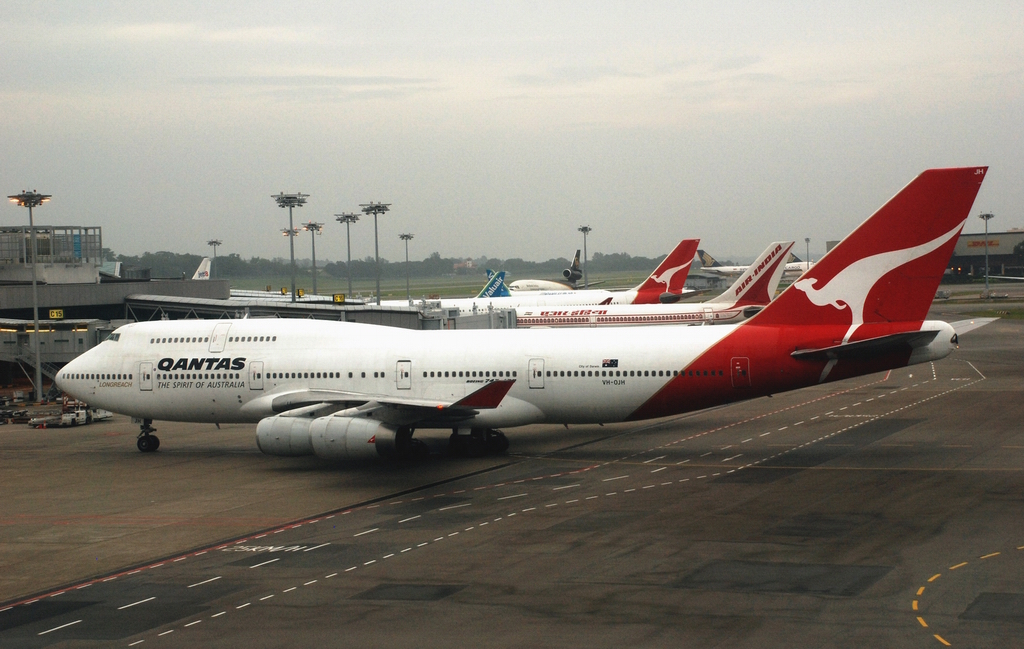

It also seems to have a beefed up lower fuselage and nose gear installation?
Qantas disposed of VH-EBU a 747-338 “Nalanji Dreaming” and it remains intact at Avalon airport but with its aboriginal paintscheme painted out, where it had been used for such training, and well as film use.
Of course a second hand 747-300/400 (or 747SP?) acquired and flown into RAAF Pearce for such a purpose need not be an ex-QANTAS aircraft in anycase.
regards
Mark Pilkington
mark_pilkingtonThe wing parts are useful but the undercarriage is not, perhaps the Hermes at Duxford can use them.
Cees
Perhaps the Hermes at Duxford is a suitable recepient of the surplus Malta Wing Centre-section and undercarriage if a second Halifax project is not identified?
regards
Mark Pilkington
mark_pilkingtonThe Nose and Tail turrets from BRF were on display at the RAAF Museum in the late 1970’s early 1980’s on loan from the Moorabbin Air Museum, the nose turret is now in the RAAFA Collection in Bull Creek WA and the tail turret is on display at Moorabbin.
Moorabbin also has a rare CAC Turret from the CA-11 Woomera, a B-24 Liberator rear turret and Bristol Turret from a Beaufort, along with a cupola from a Whitley nose turret.
Regards
Mark Pilkington
mark_pilkingtonMark – I would dearly like to see the RAFM Beaufort restored to its genuine RAAF PNG markings and I dont think people would see that as being out of place as that is exactly what it is. Aircraft such as the Beaufort were a part of the direct Empire war effort and I think people would relate to it more.
As for the CASA -I still feel that her genuine markings are what would suit her best -I am hoping that the days of museums painting aircraft in spurious markings are coming to an end – the idea that by painting her for instance in a BOB film scheme could act as a kind of half way house isnt really that worthy. The use of the machines in the film was just a tiny part of the Heinkel /CASA story. I am not a great advocate that the IWM should spend large sums of money on an aircraft of limited historical connection to the U.K. To me the real story is the Spanish use post WWII and their exploits in North Africa.
David,
I support much of what you say, and retaining aircraft in their own identities and colourschemes is a valid display strategy, particularly when the aircraft is complete and has its own unique story to tell, but balancing that is the issue of the collection purpose and the role the aircraft is to play in the collection.
There is a valid role for replicas, reproductions and FSM’s in museum displays, and we accept those being put into the colourschemes and markings of the collections subject matter, as clearly they have no identity of their own, so I still consider the same can apply to a complete aircraft being presented in “representative” markings rather than its own.
The RAFM Beaufort in one of 5 surviving in the world, with the other 3 in Australia, 1 in the USA, all ex RAAF examples.
One of those in Australia is A9-13 / T9552, a DAP mark V and the oldest surviving example of the 5, it was built in Australia and joined 100 Squadron RAF in Australia as part of 180 intended to be delivered to the RAF from Australian production, although only 6 were flown to Singapore to try and defend from Japanese attack, and the remaining 59 built including this aircraft then tranferred back to the RAAF – This would have been the ideal one for Hendon to have acquired, displayed as itself as T9552 it would have fulfilled all objectives.
The example that the RAFM does have is an ex RAAF Mark VIII, but is very similar to the Bristol Mark II that it represents, the other 3 surviving examples are identical to it with the AWM and US examples being mark VIII’s and the Flying restoration in Australia being a mark VII but fitted with the centre-fuselage of a mark VIII effectively resulting in that outcome in anycase.
All 3 in Australia will be presented as Australian built RAAF aircraft in their own identities, the US example is assumed to result in the same outcome ands from my position the 5th in the RAFM being presented as a Bristol mark II in RAF markings is not a loss of the RAAF heritage but filling a gap of an extinct type in the UK, representing a type both built and operated by Britain.
I do contrast that with the RAAF Seagull in the RAFM which is best displayed as itself given its rarity.
In the USAF Museum there is an ex RAAF Bristol Beaufighter mark IC, A19-43, its main structure was recovered intact in Australia in the 1970s and the airframe saw operational service with the RAAF in PNG, It is one of only 3 surviving ex RAAF Bristol built Beaufighters, the other two are later mark XI examples one in the UK at Duxford and the other in storage un restored in Australia, while two ex RAAF DAP Mark 21’s also survive but tell a completely different story.
It is an example of the failures of Australia’s export laws at the time, and should have instead been acquired by the AWM and retained in Australia, instead it is displayed in the USAF Museum in night fighter colours as an obsecure type the US flew in Italy. Instead it could be displayed in its own authentic operational colours as an allied aircraft that flew in support of US forces in the Pacific against the Japanese and is of the type that Americans flew as night fighters in Italy.
and yes, the RAAF Beaufort in the RAFM could be displayed in its RAAF colours on the same basis, but its not the sole survivor, and there are equivalents remaining in Australia itself.
Museums need to balance using exhibits to tell the story they acquired them to tell, as well as retaining the provenance of the object itself, but there are a number of ways that can be achieved.
The CASA as a type is irrelevent to the UK let alone the remit of the IWM, but as an FSM of a He 111 it is a perfect acquisition, if they spent money on a fibreglass FSM of a HE 111 for a display it would be happily displayed in BoB german markings, I dont see the difference with the CASA.
Regards
Mark Pilkington
mark_pilkingtonI think the arguements for and against the IWM’s justification of the Casa/1-11 are really nul and void. IF and WHEN the IWM decide to let the aircraft go, WHERE could it go under cover in the UK?
If a post war spanish built, german designed licence buit HE-111 derivitive has no place in the IWM collection and justifications or arguments for its retention and display are really “null and void” then I would extend the same view to the relevence of its display undercover anywhere else in the UK (displayed in its post war spanish authentic presentation it seems as irrelevent in the IWM as any other UK collection?) and instead argue for its offer back to the Spanish (who it is assumed would display it in post war Spanish colours), or the Germans (who would most likely happily display it in wartime German colours with or without a Jumo conversion), or perhaps the USA who would most certainly do so.
But if its not a certain case of “WHEN”! the IWM decide to let the aircraft go, and still a only case of “IF”? then the debate and justifications of it being in the IWM collection would not seem to be “null and void” and quite a valid issue to be debated?
regards
Mark Pilkington
mark_pilkingtonThe aircraft was either built on the line with Merlins or converted from Jumo. Either way back engineering is all well and fine but it didnt see service with the Luftwaffe and most likely was built when the Nazi regime had ceased to exist. What I do find interesting is that the Deuches Museum choose to restore their CASA in the silver and blue of the Spanish air force -as a machine it looks far better in that than a pseudo Luftwaffe scheme and I think the public is savvy enough through information boards to understand what they are looking at!
I’m not sure there is a need to display it as authentically as a CASA and in spanish colours to justify its pedigree, but if that was done so be it?, I suspect that might simply support arguments of no relevence?
The Deuches Museum as a German Science and Technology museum (as against a Military Service or War Museum) is displaying a German design licenced built in Spain post WW2, its relevence isnt as a mockup He 111, it has historical relevence to be there in its own right as a german design, hence presentation in its CASA and spanish colour scheme are very appropriate and relevent.
The rationale for the CASA in the IWM is assumed to be its relationship to and representation of the He-111 as a type, and that types strong significance in the wartime experiences of Britain and therefore its relevence to a War Museum, I think thats quite acceptable, but that would lean me to displaying it in the context of that relevence not its own spanish identity.
In this case we have a post war “version” of a wartime aircraft being presented in colours and an identity it never wore, and with technical differences to the actual aircraft it is trying to represent.
There are hundreds of aircraft in museums in that same situation.
Would you then also apply the same criteria to the Beaufort in the RAF Museum, its an Australian built mark VIII presented as a Bristol built mark II, it clearly never served in the RAF or Europe and therefore should be presented in its RAAF colours?
Similarly the P-40 is built up from an ex-RAAF example recovered from the Pacific, and although technically similar to those flown by the RAF never in fact did so, should it be presented in its RAAF colours.
I personally wouldnt mind those outcomes, but within the UK presentation in representative RAF colours chemes and identities are more relevent to the types significance in Europe, otherwise the UK public might question what is the relevence of Australian aircraft in a British museum?, and have difficulty in interpreting the types role in UK history due to the distraction of the RAAF colours and markings.
Equally when Hendon acquired its Hudson there wasnt any others in preservation in Australia so display in its authentic RAAF colours and identity were very appropriate and appreciated, but with the AWM and RAAFM both having RAAF examples in preservation for future display, and Temora flying theirs in RAAF colours perhaps it is time for the RAFM to be encouraged/permitted to present their Hudson in a more relevent colourscheme to UK heritage, ie an RAF Coastal Command colour scheme?
The RAAF Seagull is perhaps a special case, it is the last of breed (as against a Walrus) and so is deserving of being preserved in its authentic RAAF colourschemes despite its role in the RAFM in representing the wider family ie Walrus, and certainly it shouldnt be technically modified “into” a Walrus to “correct” any differences.
Not that I consider full conversion of the CASA is viable or necessary to justify its retention and display in the IWM collection at Duxford, but what about all the WW1 replica’s in the RAF Museum collection, even if they are technically accurate, they equally didnt ever see service with the RAF and were all built long after the period they purport to represent, yet display in no colour schemes (as they are not entitled to wear them) and signage focusing on them not being original would defeat the very purpose of them being there, to allow full size interpretation of machines from that period.
Otherwise the argument for any full size aircraft or mockups being displayed in museums dis-appears and a collection of walk around photos on a digital display and historic movie film can suffice, ie is the UK richer or poorer in terms of Bomber Command heritage and public interpretations and learnings from the Yorkshire “Halifax” display?
As I have said previously, I would not embark on a complete conversion of the CASA to a quasi He 111 its unlikely to be a complete success due to the lack of parts and would still not be an original.
I wouldnt argue with it being presented in an accurate BoB colourscheme with Merlins in place and a signboard coverage of the CASA and its spanish history.
Equally I wouldnt argue with its merlins and cowls being removed and replaced with fibreglass He-111 cowls etc to better present it, but would still retain signboard coverage of the CASA and its spanish history.
Of course my opinion is just that of an armchair enthusiast in front of a PC on the other side of the world, but also a potential visitor or “customer” to the IWM as well. (and despite the comments of some, we are all entitled to our opinions and able to debate opposing views without denigrating others)
Regards
Mark Pilkington
mark_pilkingtonThat’s just the way I roll…
Then certainly dont let any of us stop you from rolling off somewhere else.
I would certainly agree with the comments of others above, and take offence at your comments and attitude.
From what I can see you have posted @20 comments in this forum, and many appear to be rather obnoxious in one form or another, if you cant control what you type and how it reads to others, then resist the temptation in the first place.
Posting under an alias and claiming anonomity due to proffessional employment within a collection or museum to imply some type of expert opinion, does not give you any right to deride others for putting their opinions or views forward.
Simply demanding to be excused because “thats how you are” doesnt cut it for me.
regards
Mark Pilkington


 Sign In







