 mark_pilkington
.
Not relevent to this thread but something that might be of interest to Halifax enthusiasts as a bit of trivia.
While searching on google for a reference to the Halifax wing root cord (we have the Hermes wing cord listed in the thread above) I came across a site that records Fredrick Handley Pages school days when he became interested in aircraft.
Frederick Handley Page was born in 1885 in Cheltenham to Frederick Joseph Page, who owned and ran an upholstery business, and Ann Elizabeth, nee Handley. From Cheltenham Grammar School young Frederick went to London and enrolled at the Finsbury Technical College where he studied electrical engineering and became interested in aircraft.
http://myweb.tiscali.co.uk/hawkerassociation/hanewsletters/hanewsletter026nvu/handleypagesixty.html
In Australia we are just closing the Duigan Centenary of Flight commemorating the efforts of John and Reg Duigan to design, build and fly the first Australian aircraft in 1910.
John Duigan was born in 1882 in Australia but travelled to England for his tertiary education, and went to the same Finsbury Technical School as Fred, to study electrical engineering and it is understood by the Duigan family that they were apparantly at the school at the same time, although its not confirmed they were in the same year or in the same class, but clearly John Duigan also developed an interest in aircraft before his return to Australia in 1909, – the mind wonders as to “who sat next to who” in that class?
Uncle Jack left Brighton Grammar in 1900 and went to Finsbury Technical School in London. He was there for 4 years and took diplomas in both electrical and motor engineering, and then he had about 3 years experience with several firms including Weymouths and Seimens.
http://www.duigancentenaryofflight.org.au/duigan-aircraft.html?start=7
regards
Mark Pilkington
mark_pilkingtonAccording to Ian Robinson the Hastings wing also bore 57 prefix partnumbers, perhaps the strechted bits had the Hastings part numbers only. Anyone care to check?:cool:
Don’t let this thread get carried away too far by people’s own interpretations, just stick to facts that can be confirmed.
Cees
Depending on the cord of the wing centre-section (perhaps thats something to add to our measuring task?) it might be possible that the centre-section shares ribs and other structure from the Halifax with the Hastings (we know the wheel track is identical) hence the part numbers in the wing centre-section might be HP57 prefix?
But the Intemediate wing with its different sweep back, and engine position, and the outer wing, without its engine position, are looking like completely new designs to the same aerofoil shape, hence they are likely to be uniquely HP67 prefix partnumbers.
In addition the stampings of the “6” may well have lead to mis-interpretation at the time as “5” due to the overall similarities of the wing.
In anycase the Yorkshire outcome is still an excellent result.
It would seem the sections removed from Malta are cut up wing centre-section portions with the undercarriage and inner engine narcelles, and there is an intention to build new wings, so that resulting outcome may well modify the Hastings structures into quite an exact reproduction wing?
As I said above, it would be interesting to measure the cord of the Hastings and Halifax centresections?
regards
Mark Pilkington
mark_pilkingtonI personally consider a CASA 111 is better than nothing in terms of the IWM displaying representative types of the most important air battle in the history of the UK?, (perhaps one of the most important air battles of military history?) and that seems a worthy topic of IWM coverage?
“Bombing” was the key component of the German side of the battle so while the 109 is the obvious adversary to display against the Hurricane and the Spitfire, the He 111 was the real mainstay of the German offensive and a CASA 111 is better than nothing.
If reproduction/replica WW1 aircraft can be displayed in museums such as RAFM Hendon, if wood or fibreglass full scale mockups have a role, if B-25J’s can be re-worked as B-25C’s and presented in Doolittle raid colours at museums such as NMUSAF, or has already been stated above, many “trainer” or post war peacetime examples of types can be presented as more famous wartime “combat” identities, or ex RAAF Spitfires or Beaufighters can be presented in USAF colours or identities? again in the NMUSAF as are many other “foreign” aircraft presented in other “national colours” to fill local collection holes, then what is wrong with a licence built 111 being presented as a BoB He 111 – with, or without Jumo’s fitted.
Regardless of the Jumo’s being available, if the major distraction is the deep chin cowls of the merlins surely the existing engines and cowls could be removed and stored, and a set of mockup cowls could be produced over new build mounting frames designed to take the weight of the cowls and props without engines in place?, without the need to source engines and accurately replicate the full Firewall forward internally?, there is no need to try and make it authentic down to the last bolt since it still “wont” really be an authentic He 111.
Its not what it “really” is, but it can still be representative of the type, without misleading the public, nothing wrong in a museum doing that to educate and inform, and yes in this competitive world even “entertaining” the general public.
Its exactly like “data plate” spitfires, as long as the truth behind the reproduction is made known, there is nothing wrong with one being displayed in the identity of a real one, and even put on display in a museum, even in BoB or wartime colours, even though “it” never really flew in the 1940s, let along existed until 2000+!
Personally I would simply paint it in a representative BoB colour scheme but intact as a CASA 111 with its Merlins and cowls, support it with a display board that briefly tells the history of the CASA and its technical differences, and then goes on to explain the large role the He 111 played in the Battle of Britain, and in that way would consider it very relevent.
The RAF Museum has an authentic He 111, and the IWM CASA left intact provides a technical comparison to that for those of us who count rivets and wish to see the differences, but to the General public they both would represent the BoB Enemy bomber, the villan in the story, and hence part of the story to be told.
Museums are there to preserve and display collections, but also to entertain, educate and tell the story of history, that can be done with photos, scale models, diorama’s, FSMs, replicas, imposters or the real thing, but something is better than nothing, and the CASA is certainly better than nothing in my mind.
regards
Mark Pilkington
mark_pilkingtonHalifax I, II, early III = 31.74m span
Halifax some III, VI, VII, C.VIII and Halton = 34.2m span
The extra span is made up in the longer rounded wingtips.
Hastings = 34.4m
So not a lot of difference in published sources and dependant on the reliability of the info out there, which dosen’t seem hugely so.
It seems to me that any extension is obviously outboard of the undercarriage.
Pagen my understanding from my post on the first page was that the Hastings/Hermes is a 113′ Span, 1408 SQFt Wing, while the Halifax is a (@mk I)98′ 8″ or (not sure where I originally got 103′ 8″ from??) (@mk VI) 104′ 2″ span 1190 SQFt wing?
HALIFAX
http://en.wikipedia.org/wiki/Handley_Page_Halifax
http://www.militaryfactory.com/aircraft/detail.asp?aircraft_id=233
http://www.airpages.ru/eng/uk/halifax.shtml
http://www.vectorsite.net/avhalfax.html
HASTINGS
http://en.wikipedia.org/wiki/Handley_Page_Hastings
I’m sorry but I cant find any online reference to a 34.2M (112′ 2″) span Halifax wing? – can you advise your source?
Is this a mismatch or misquote of feet to yard conversion not feet to Metre conversion as 104’2″ = 34.7 Yards
In any case:
Halifax
98′ 8″ @= 30M
103′ 8″ @=31.6M
104′ 2″ @=31.75M
Hastings
113′ @= 34.4M
Obviously such sources may be incorrect, but if the larger Halifax wing span is only 104′ 2″ / @31.8M not @34.2M, then that still puts the largest Halifax wing some 9′ or 2.7M short of the Hastings wing?
But still doesnt resolve if its in the wing intermediate section between the inner and outer engines or in the wing outer panel?
regards
Mark Pilkington
mark_pilkingtonThat is interesting? the wing span specifications of both types certainly suggest the Hastings is larger.
If its not extra space for a wider fuselage you would wonder why the centresection would be wider for any reason, surely the engine /prop spacing on the inboard/outboard engines of the Halifax was already generous?
Is it possible the wing outer panel is bigger to provide more lift, ie similiar to the Lancaster to Lincoln wing changes?
I wonder if a wheel track measure of the Hastings at Cosford is worthwhile along with an inboard to outboard prop hub measurement is in order?
Perhaps if anyone does that its also worth doing from main wheel to wing tip as well, and comparing the results of these to the Halifax at Trenton.
Assuming there is no modification of the Hastings wing in Friday the 13th the same measurements at Yorkshire would probably suffice?
regards
Mark Pilkington
mark_pilkingtonMalcolm is building a Lancaster short cockpit, I traded him my Lanc windscreen/canopy sections I had, this is the Lincoln Panel I had off him from that section, not a good picture.
Could anyone knowing Tim / Junk Collector ask him to check his forum PM’s and to please email me. (I note he hasnt posted here since late 2010)
regards
Mark Pilkington
mark_pilkington.
Could anyone going to Cockpitfest who see’s him there, or knows him personally – ask Tim / Junk Collector (he has the Lincoln panel) to check his forum PM’s and to please email me.
regards
Mark Pilkington
mark_pilkingtonI know he has the nacelles and undercarriage so I assume he will do the same as what he has done with the Anson ie no outer wings.
Lincoln has an original wing “centre-section”/narcelle structure from Narromine (possibly from a RAF 618 Sqn DZ652? B mk IV “Highball” airframe?) which he has built into a full size replica fuselage as an FBVI with a flat screen canopy?, seperately he has built a full size mockup “bomber” (B-mark IV) cockpit with V windscreen, both FSM’s have original canopies fitted, I understand from past discussions that Lincoln does not intend to progress either past their current configurations.

http://www.freewebs.com/greenockaviationmuseum/mosquito.htm
The Mosquito fuselage and Cockpit section in the museum are both replicas constructed out of spare Mosquito parts, sourced from a farm in Parkes, New South Wales.
In April 1943, a secret RAF squadron (618) was formed to develop a special weapon code named ‘Highball’ to sink the German battleship Tirpitz in Fiord. The Mosquito’s were fitted for aircraft carrier service and sent to Melbourne then Narromine on two aircraft carriers, ready for testing the weapon before deployment. However, the United States of America, (who had authority over the Pacific region) feared the ‘Highball’ weapon would fall into enemy hands and be used against their forces massed in the Pacific, and so the British decided to disband 618 Squadron.
On the 18th of July 1947, Mosquito’s were advertised in the local press at Narromine as for sale for 35 pounds with engines, or 15 pounds without. Parkes farmer Frank Hatter was the purchaser of one of these “Mossies” (also known as Balsa Bombers due to their wooden construction). Most of the parts used on the cockpit section were from this aircraft (DZ-652), with original parts including the nose cone, windows, canopy, rudder pedals, instrument panel, and seat armour plate. The cockpit section was built using scale model aircraft plans enlarged to full size, and constructed using formers, stringers and a thin plywood skin.
Alongside the cockpit section is a full replica of a Mosquito fuselage that encompasses some original parts such as the wing ribs. Originally, Mosquito’s were constructed from joining two half fuselage moulds together, but as these were all destroyed after World War 2, a nother construction method had to be found, which is detailed in photos on a display board located next to the replica. Worthy to note on the replica fuselage is a chip out of the wood on the lower right starboard wing rib (an original part from DZ-652), which is where a 20mm cannon shell lodged approximately 3 inches from a fuel tank. It is believed the shell was fired from a German fighter,
and pierced through the fuselage before lodging in the wing rib, and the shell can be seen in a display in between the Anson and the Vampire.
Also located in the museum section dedicated to the Mosquito is an engine block that powered the “Mossie” – a 27-litre Vee-12 Rolls Royce Merlin engine, tonnes of Mosquito models, and many photos and paintings.
Lincolns museum is a great little collection and effort of one person to preserve and display some unique items.
regards
Mark Pilkington
mark_pilkingtonHello Darrell,
Your photos in the trailer or ute seem to be mainly mark II items to me?, I’m not sure what all the mark II differences are as we dont have any examples here in Australia but they seem to not have the rubber buffers outboard of the axle, and seem very different in the axle and main legs at the axle end. I assume the retracting structure mounted on the main spar of the wing is identical?
I note from Peters photo of the mark II that it is substantially different at the axle end of the main u/c legs/shock aborbers, and there is a dual radius arm not the single arm and U yoke around the tyre and wheel of the mark I, and that the dual radius arms connect on the end of the axle and leg join.
You “seem” to have 1 retracting structure from a mark II based on the u/c leg and axle “ends” connected to it, but other than the legs the structure itself looks identical to mark I.
You also seem to have numerous mark II? main U/C legs (I will need to examine the axle end of a mark I to be sure to compare with yours, as its been a while since I looked but they should have single end block fitting with a large single hole for the main axle, yours seem to have a split “fork” end with a small hole?), and apparantly some mark II radius arms in the parts in your photos? If the retracting structure is the same on both them all your parts may well all be mark II?
I have attached some manual photos and drawings of the mark I along with two photo’s of a stripped mark I narcelle and U/c structure if it helps?
On the mark I the radius arm yoke fits inside the bottom of the main u/c legs and the axle passes through the radius arm yoke and the large aluminum blocks at the bottom of each leg, hence the single large whole in the base of the undercarriage leg, you should be able to make it out in the second of my stored parts photos, and then you should be able to recognise the differences in Peters two photos.
I can scan some more drawings on thursday from the mark I illustrated parts manual if these are of use? to show the radius arm, and main u/c legs? and perhaps later in the week I can access some of my stored mark I parts to get some detail shots? of the u/c axle ends?
Your after Mark I parts arent you?
regards
Mark Pilkington
mark_pilkingtonIndeed, the fire looks to be in the area where the #2 eng feeder fuel tank water draincock & flap which is further behind #1 eng fuel tank water draincock & flap, and looking forwards, slightly to the right and behind the #1 eng fuel tank fuel booster pump blister.
The wheels are only just out of the nacelle, meaning they were already on their way down or were still on their way up after the take off at this point.
The #2 eng prop is not feathered at this point.I must admit it seems an odd place for a fire to be taking hold as it is relatively remote in this location.
Bomberboy
An in-flight fire well back from the engine, its reported on WIX that the fire was spotted by an accompanying P-40 pilot, its very lucky it was apparantly detected early and didnt become more substantial in the air?
http://www.dailyherald.com/article/20110613/news/706139915/photos/
Perhaps fuel from a leaking draincock has ignited from the engine exhaust?, or perhaps a more substantial leak from the fuel tank was exiting at that point?
A very sad outcome for the airframe, but very lucky result for such a problem to be detected and the crew to get her down before it got worse.
Regards
Mark Pilkington
mark_pilkingtonLook closer guys. Much more damage than you think. Like, where are his main wheels? Still in the wings by the looks of things. If that’s the case, there’ll be radiator damage as well.
I think your looking at photos above of one or two of its earlier incidents, this one is apparantly a nose over during taxi-ing in wet/soggy ground, the mainwheels are clearly extended and holding the wings and radiators clear of the ground, damage is likely to be limited to the prop and perhaps the engine?

regards
Mark Pilkington
mark_pilkingtonSo because I replied to your statement with a perfectly reasonable, polite and informative reply you thought it would be a good idea, since I’m from New Zealand, to take a swipe at New Zealanders with a what can only be perceived as a bordering on racist poor attempt at humour? Not impressive.
Smiles, thats the problem with you kiwi’s Dave, just not satisfied making scale replica’s you lot have to be different and go make full size mossies, and to rub salt into the wound, make lots of them! lol.
Next you will want to run around making full size replica BE2, Gunbus and WW1 engines, or a whole squadron of Fokker Triplanes too!
No wonder people take swipes at you lot!
Smiles
Mark Pilkington
mark_pilkingtonHe has apparantly previously fitted a 80 scale bare metal “Supermarine Spitfire 26 with small block 350cu inch V8 Chevy?, and then scratch built a metal 80% FW-190 replica with a Russian M-14 radial fitted?

Pictures of his 80% Mustang are apparantly available on line,

I do wonder what type is sitting in the foreground and having apparant repairs or modifications to its tailplane leading edge?
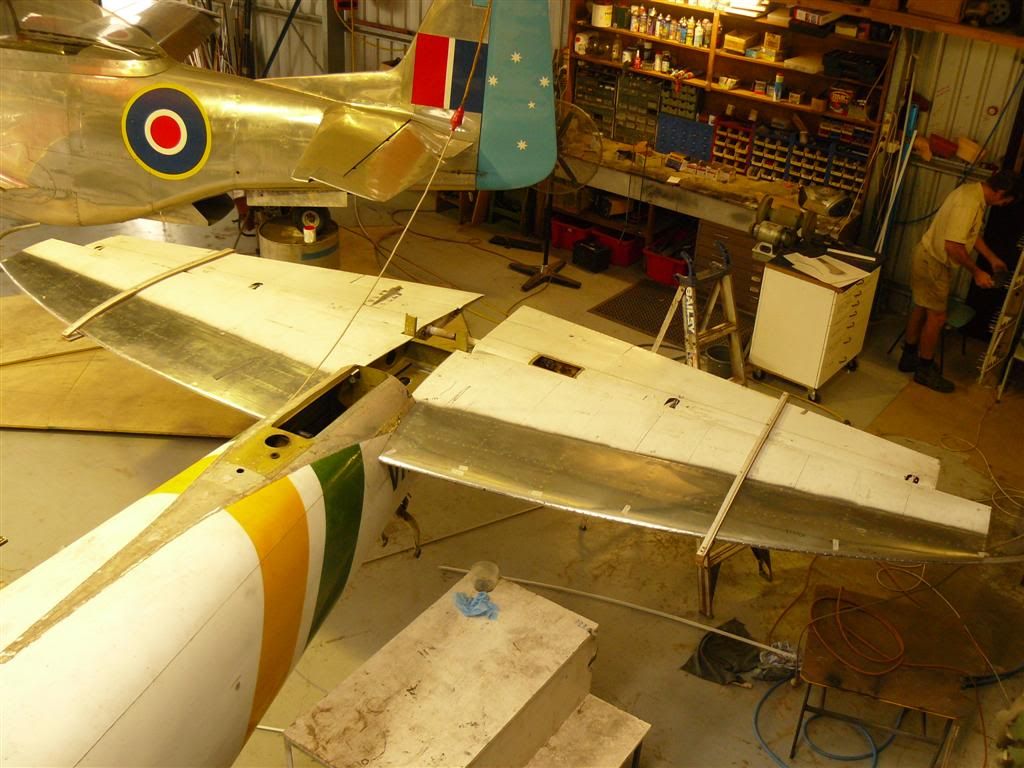
regards
Mark Pilkington
mark_pilkingtonwell done, and good job in sticking at it!
regards
Mark Pilkington
mark_pilkingtonNo, as I said, the name of the dog is irrelevant. I wonder what the 53 aircrew that failed to return would think if all we can discuss about a film of their exploits was the name of their CO’s dog.
I absolutely agree!, I do wonder if the same outcry will come forth if the defending german aircraft do not display the historically correct swastika on their tails?.
Its a “Movie” its not a “Documentary”, its not a “biography” its not a “museum display”, lets get it into context.
If you dont like it, “dont go see it”, if you prefer the original version , sit at home and “watch it” instead, and if someone wants to spend their money re-making an Aviation Classic and introducing the story to new generations – then “let them”.
The story is about Barnes Wallis and his bouncing bomb, the modified Lancasters and the training, the crews and their sacrifices, and the impact of the raid on German production and morale, not a dog and what it was called.
If my kids are enticed to see it because of the Directors reputation with the Lord of Rings films then they will learn about something they probably no nothing about, if they are incorrectly informed about the code word for the mission and the name of the CO’s dog thats little cause to be concern!
regards
Mark Pilkington


 Sign In







