 lukos
lukosLibya works well because you have NATO airfields close to the Libyan main cities which happen to be on the coastline, and also because there was no AA threat preventing high altitude egress flights with tanker support close to the FLOT.
Now, what if you have to perform a low altitude high speed penetration before you get to the release point, reducing dramaticaly the range of your aircraft and missiles ?
Can you bet that all future air campaigns will be the same as in Libya ?
Come up with a hypothetical scenario then. I bet you end up coming up with something ridiculous where no aircraft with 3 tanks and 3 ~3000lb missiles would survive anyway. Low altitude penetration – again, worked real well in Desert Storm. Works fine against LR SAMs, but all you need is one guy with an Igla-S, or any other multitude of SR threats that are absolute hell to avoid. Performance-wise a fighter with 3 tanks and 2 3000lb missiles is about as capable as a Cessna.
lukosI don’t think anyone has claimed that three external drop tanks is an essential requirement while carrying two Storm Shadow cruise missiles. If the ability is there then it’s going to be exploited should the need arise. What’s more, during the Libyan campaign aircraft were on CAP waiting to be called upon to deploy into the country or/and launch from outside it’s boarders. So yes, three drop tanks would come in rather handy in that regard thus easing the burden of tanker aircraft and their crews, however.
And the Typhoon regularly carries 3 drop tanks for CAP. It’s just that some people are making a big deal out of a really, really small deal because it’s going to be all they have to try pass-off as an advantage in 2 years time.
You should mean Captor-E. There is a difference.
I don’t differentiate – CAESAR (Captor AESA Radar). I know the trial radar was called CAESAR but to me the final article is just a development of that.
Do spare the pointless comparisons.
Perhaps you’re unaware of the EW-enhancement program taking place for DASS. Then there’s the fact that CAESAR is a bigger, more powerful, more capable AESA radar than RBE2-AA, with passive, active and RF cyberwarfare jamming capabilities. But… drop tanks… LOL.
Since they all get munitions from the same sources, the bigger question is why they are not used by the various aforementioned aircraft. Scalp and Storm Shadow are similar, yet incompatible. Typhoon cannot use MICA, although its been tested on Gripen. None of the Eurocanards use Brimstone even though it has obvious value well into the future. AMX, Jaguar, and Tornado – international designs – suffer the same. It’s almost like NATO members are growing further apart as they cooperate.
Brimstone will go on around 2018, most likely Brimstone II by then.
lukosYou did not ask about range – you asked “When have Israelis ever gone into well-defended air-space?” And that was the question I answered.
Oh sorry, you regard Syria as well-defended.
Israel’s radar coverage extends into Syrian airspace, and Syrian radar coverage extends into Israeli airspace. So both countries have good local situational awareness. And a SAM system is potentially lethal irrespective of whether the target came from an airfield five miles down the road or from one a thousand miles away.
Or from mid-way through last century.
I’ll leave you to your opinions in this area.
And the opinion of over 200+ UN member states.
You are entitled to believe reports on the RB199 or even the text of the Code of Hammurabi to be BS, but the rest of us must form our own conclusions. Information that you regard as BS, we may well accept as valid – unless you can demonstrate good reason why that evidence should be disregarded.
https://de.wikipedia.org/wiki/Eurojet_EJ200
The Nachbrennerschub should be increased by 40% [8] to 90-100 kN. [4] In the dry thrust specific fuel consumption of the RB199 should be maintained while the specific consumption of the afterburner should be reduced by 30%. [5]
Since the engine has been optimized for air combat, it should consume less fuel in the afterburner, the turbine inlet temperatures should be around 150-200 ° C higher than at RB199 lie
Jane’s has indeed been wrong in the past. How terrible!
But you have been wrong in the past.
I have been wrong in the past
Aircraft manufacturers ‘ official publications have been wrong in the past.This is because everyone who puts pen to paper makes errors.
I committed a ‘howler’ in a report last week (luckily the customer spotted it), while I found an error in a Jane’s yearbook earlier today.
But does this mean that you, I, Jane’s, and aircraft manufacturers are not credible because we/they sometimes make mistakes? No – it is up to anyone studying a subject to decide which sources are generally reliable. That is the sort of judgement call that a good researcher must make. No sources are infallible.
If Jane’s has published RB119 data that is available nowhere else in open form, then we can regard that data as valid until it is proved wrong. The compiler of Jane’s Aero Engines in the RB199 days was the late Bill Gunston, former technical editor of ‘Flight’, who has written enough technical articles on aircraft and engines to make his expertise in this field well-known. If “The Gun” accepted those RB199 figures as valid, that is good enough for me.
Nevertheless both MTU and RR stand-by the SFC for the EJ200. There is no such substantial support for the RB199 SFC that has been claimed. If you look at similar engines in the Tornado/Typhoon class, none claim less than 0.7lb/lbf.hr and only the EJ200 and M88 seem to quote less than 0.8lb/lbf.hr.
lukosWhat kind of analysis is that ?
You compare the Rafale and the Tornado as if they were tasked with exactly the same range of missions with the same choice of weapons… that’s completly absurd.For instance, the low number of scalps fired by the Rafale was directly related to the stand off efficiency of the Spectra and ASSM combo against High value Libyan ground assets (including SA-6 and SA-3 SAM sites), hence reducing the necessity for using a more expensive 300+ km range cruise missile in most of these missions.
As for the number of tank kills scored by the Tornado, it was, indeed, very impressive and mainly due to the fact that it was its main role in the conflict thanks to the brimestone, a highly specialized (and effective) anti tank missile which was not used by any other fighter jet.
You must also realise that :
1- Italian and UK A2G missions relied heavily on the Tornado because the typhoon was still a little bit green at the time, while the French were spreading the different A2G tasks more eavenly between Rafale, Mirage 2000D, SEM, gazelle and Tigers (Helicopters performed a big share of the French tank kills).
2- Therefore, the Rafale were mainly assigned to high value targets (ammunitions depots, command centers, airfields, SAM sites) with consistent Air defenses, not tanks.
3- 45% of the 1900+ Rafale sorties were recce/ISTAR missions.
4- It’s also worth noting that all the Rafale sorties were flown without any external ECM or SEAD support which was not the case for the Tornado.
The only thing absurd is that some nut-jobs are trying to sell carrying 3 large drop tanks with 2 large long-range stand-off missiles (yes 300++++++++++LOL km) as some kind of essential requirement, when it’s a known fact that no modern campaign has required this capability. How about some people pull out a map and measure some distances rather than talking out of their hat and realise that using Italy, Malta, Greece and Cyprus you can fly a Typhoon with one drop tank and 2 SSs and hit any point in the whole of Libya. Or alternatively fly a Typhoon, with Paveway IV and 2 tanks, or Brimstone (when qualified) and 3 tanks and hit any point in Libya….. even without refuelling over the Mediterranean….. and then consider that Tripoli is right at the top and the vast majority of the action happened there. Then consider that many missions were flown from the likes of RAF Marham, which is well beyond the range of any fighter without refuelling anyway. Stop the null-pointery.
We know Typhoon only had one guided A2G weapon qualified at the time. Integration has been and still is slow, what with cash-flow etc.
SEAD support – null point. The air defences were dog-**** anyway. And when CAESAR and EW upgrades come online in the next 2 years, Rafale has no EW advantage either.
Tornados also took out SAMs using Brimstones and ALARMs(?):
https://en.wikipedia.org/wiki/Operation_Ellamy
Multiple air force defences severely disabled.[5]
>200 armoured vehicles, tanks, artillery pieces and SAMs up until 12 April.[6]
lukosI seem to recall that in 2001 the IDF attacked and destroyed a major node of the Syrian ADS, effectively leaving Damascus unprotected for more than a week.
Yeah, now look at a map. Note the distance between Israel and Syria.
For a more recent example of penetrating defended airspace, how about 6 September, 2007?
Another completely irrelevant reference to a very short range strike on Syria, which does nothing except to prove that Israel thinks it has a right to conduct arbitrary pre-emptive strikes whenever/wherever it sees fit, whilst practising double standards by not opening their own nuclear sites to IAEA inspection.
https://en.wikipedia.org/wiki/Operation_Orchard
To put things into perspective, Typhoon could have taken off with no tanks and 2 SSs and fired them immediately at that target and then landed. Thanks for proving my point.
Further evidence of lack of necessity for further range?
Iraq Wars – TLAMs fired from Persian Gulf all the way into Baghdad. This required less than half a TLAM-D’s full range. A Typhoon with SS has a greater strike radius than its full range.
Operation Ellamy (Libya) – A Typhoon flies with 2 1000L drop tanks and 4 EPW II non-stand-off weapons and an LDP and AAMs. 4 EPW IIs and an LDP plus an extra drop tank have a weight greater than 2 SSs and a greater drag index. Yet the fuel was sufficient for the Typhoon to fly all the way to the target area (no stand-off) and succeed.

Similarly, the Tornado did the same with 12 Brimstone AGMs and 2 drop tanks and took out over 200 Libyan tanks:

Show me a valid combat example where 3 drop tanks plus SS stand-off range is actually required.
Ah, the endless desire for ‘links’ – if data is not available in unclassified and open form on the internet, it is apparently not real?
If it’s not available from RR or MTU then I’m entitled to believe it’s BS, especially given the history of EJ200 development.
I would not rate Wiki as the most reliable of sources
Did I rate it as a reliable source? Eagle stated that it was on wiki. I stated that I couldn’t find it there and then I tried looking for manufacturer specs. Very reasonable, yes?
However, far from being ‘preposterous’, the figures bypass ratios and SFCs Eagle has cited match those given in the detailed description of both powerplants in Jane’s Aero Engines.
I can find the EJ200 figures at Rolls-Royce and MTU but the RB199 figures aren’t stated anywhere credible (Jane’s has been wrong in the past) and all sources indicated that the aim going from RB199 to EJ200 was to improve dry SFC and massively improve wet SFC. Then you’ve got the fact SFCs are valid about a given speed range. At 600mph with 2 tanks and 2 SSs, the RB199s with 9,000lbf dry are likely to be having an asthma attack, whereas the EJ200s with 1 tank and 2 SSs are probably capable of supercruise, or pootling along subsonic. Furthermore the GR4’s empty weight is 30% more than a Typhoon, so it need far more thrust anyway.
lukosPressure ratio is 28:1 for the F135 in the doc linked…
Yes but it’s only 23:1 for the Tornado’s RB199.
At the moment there are only 1000Ltr SFTs for Typhoon, 2 types, non pumped and pumped. The pumped have a longer pylon nose fairing which can cause interference problems with the slats.
Thanks. So the currently stated ferry range must be with just 3 1000L tanks.
lukosAnyone have envisaged the possibility that they may have had to go through balancing the pitch only via the elevons since the deflexion of the large frontal canards imparts the flow so badly that the large body weapon might be lifted by the airstream ?
Solution by using a pusher in the pilon might have imparted the trim problem that Hallo was mentioning (action equate reaction x g load with the adverse torque generated by the frwd position of the weapon)
As I understand it, the natural instability puts CoP ahead of CoG, so the Storm Shadows would act to counteract that instability.
lukosTornado can carry 2 Storm Shadows on the wing pylons and a single fuel tank under the fuselage. But why would you when you can carry 2 tanks and 2 missiles at the same time.
I forgot about the centre-point. In Libya it exclusively carried 2 wing tanks and 2 Storm Shadow under the fuselage, giving it the same range as a Typhoon with 1 tank.
Are you sure. Bypass ratios: around 1.1:1 (RB199) vs 0.4:1 (EJ200). SFC dry thrust: 18,38 mg/Ns (RB199) vs 22 g/kNs (EJ200). Data from wikipedia.
Add to that external fuel: 2x Hindenburger 2250l tanks vs 3x 1000l tanks, 1 tank with heavy stores. Thats 4500l vs 1000l, hence the CFTs.
Link? Data is inaccurate. Wiki gives no value, nor does Rolls-Royce or MTU (only reliable sources) and the figures you quote are preposterous:
https://en.wikipedia.org/wiki/RB199
http://www.rolls-royce.com/defence/products/combat_jets/rb199/
http://www.mtu.de/de/products_services/military_business/programs/rb199/index.html
The F135 has a higher BPR than an EJ200 but worse SFC. As for wet thrust SFC EJ200 vs RB199 – no comparison.
https://en.wikipedia.org/wiki/F135
http://all-aero.com/index.php/contactus/64-engines-power/13432-pratt-whitney-f135
http://www.pw.utc.com/Content/F135_Engine/pdf/B-2-4_F135_SpecsChart.pdf
EJ200 has a lower specific consumption than RB199. You’re failing to recognise the imortance of pressure ratio in efficiency just as compression ratio is important in combustion engines.
26:1 vs 23:1.
http://www.mtu.de/de/products_services/military_business/programs/ej200/EJ200.pdf
http://www.mtu.de/de/products_services/military_business/programs/rb199/RB199.pdf
Try reading the link I posted. A Typhoon with 3 1000L (1 1000L + 2 1500L???) tanks has the same ferry range (2000+nmi) as a Tornado with 2 2250L and 2 1500L tanks. It’s 7,000lbs lighter empty. It has a better L/D ratio and newer engines with a lower SFC and it has canards for better lift efficiency.
http://forum.keypublishing.com/showthread.php?56511-Drop-Tanks
It goes just as far with 3500-4500L less fuel (not sure about the 1500L drop tanks on Typhoon???) when ferrying, even when carrying an external load that’s bulkier in proportion to its clean configuration.
https://en.wikipedia.org/wiki/Eurofighter_Typhoon#Specifications
https://en.wikipedia.org/wiki/GR4#Specifications_.28Tornado_GR4.29
So yes, it goes as far on 1 1000L drop tank and internal fuel as a Tornado with internal fuel and 2 1500L underwing tanks as per link.
lukosWho the hell has talked about “full load” or “strike at targets over 2500 km into defended airspace”? Hello, wake up, Western Air Forces have been awfully busy for the last three decades, and they have massively used external tanks, thats a fact.
By now i am really having problems trying to understand your point!
Null post. Tornados managed just fine in Libya with the same overall range/endurance on 2 tanks as a Typhoon has on one. It didn’t need 3 tanks to deliver vastly more Storm Shadows than the Rafale did. It also killed vastly more tanks than the Rafale did. The tank-kill rate achieved by each Tornado is Libya was beyond anything ever managed in Desert Storm or by any other aircraft. And you haven’t addressed the point about ‘well-defended’ airspace in any way. Please try sticking to the point.
Being able to carry external fuel tanks is a “moot point”?! Tell that to the Israeli´s, the RAF, the Adla, the USAF, etc…
And when was the last time that Western Air Powers went after China or Russia?! That was sixty years ago!
This is getting very strange.
When have Israeli’s ever gone into well-defended air-space? They spend most of their time bombing civilians in Palestine. The Typhoon is used by the RAF. The Tornado issue has already been covered. F-15E uses its only wing-stations for JASSM just the same. Your point is now null, void and moot.
lukosThis is also a non-factual pilot claim. Panavia 200 Tornado flight manual says Tornado tops out at M1.1 at “Max Reheat”, and around M1.12 at “Combat Power”. Many aircraft can beat a Tornado in terms of top speed at the deck.
IDK if GR1 has different performance than the Tornado variant stated in this manual, however.
Manuals – LOL. Ask around and you’ll hear stories of 850+knots. An F-111 pilot also said they were once doing 750knots at the deck and a Tornado flew past him with at least 100knots on him. The GR4s got restricted to 1.2 as far as I know.
lukosCarefull there, you´ve just called “backwards air forces” to the USAF, the US Navy, the RAF, the IDF/AF, the Adla, the MN, and a few others… If you are going into long range mission into contested airspace, you get off the ground with the maximum external fuel that you can, you use the external fuel while in transit, then, when you enter the “defended airspace”, you drop the external´s. Thats basics. Thats what the IDF/AF did on “Opera”, what they do today when they go over Syria, thats what was done over Vietname, or Jugoslavia, thats what every Western Air Force does, far from being a “moot point”, thats the norm…
Not really. I rarely see a fighter in operational combat carrying anything like a full load. If you have air assets it’s just inefficient, not to mention unworkable behind enemy lines in well-defended airspace. If they’re carrying bombs or short range weapons, then they might. It’s simply rare for fighters to strike at targets over 2500km into defended airspace.
Let’s forget half-arsed wars for a while. If you were up against one of the 5 permanent UN members, would you try flying over 1500km into their airspace with 3 drop tanks and 2 near-3000lb cruise missiles? Thought not. Very very, unbelievably moot point.
lukos[QUOTE=xena;2143553]@halloweene:
Taurus doesn’t work with hard points in front of the landing gear. I attached an image I made on the fly. Taurus and EF are in scale and you can see how big this beast is. I pushed the Taurus to front so that the landing gear can be used. It is impossible to use it so.
[ATTACH=CONFIG]228959[/ATTACH]
That is literally how far forward munitions are mounted on those inner pylons and don’t forget that Storm Shadow is a lot narrower:

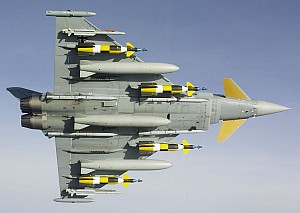
I am not that opinion, Sir. :p
Tornado has an equivalent range like Typhoon. But Typhoon has this range in Hi-Hi-Hi and Tornado in Lo-Lo-Lo mode. In an wide land with heavy anti-aircraft, one can perform his job only in low level and use all the obstacles an the way to hide himself. Tornado is designed to do such a job very easy in a smooth ride. I doubt that Typhoon, or any other temporary fighter, will ride so low over a wide range so smooth like a Tornado. Flying so low for a long time means AFAIK a heavy bumpy ride that will exhaust the pilot and the systems. Imagine a wide country like Libya, Algeria, Sudan, Russia, Ukraina, China, India and so on would have a very effective anti-aircraft umbrella and you have to penetrate very deep into that country with no opportunity to refuel once inside the country… and you are forced to stay low or you risk to be shoot at…
Seriously, give up. The Tornado’s range is nothing like a Typhoon range. All sources I can find state the internal fuel load as being the roughly the same (circa 5,000kg) and it weighs 7,000lbs more than a Typhoon and has older, less fuel efficient engines.
I doubt the Typhoon is as good at low altitude but it still manages Mach 1.25. Don’t see how that factors into anything though.
As far as I can see the Typhoon ferries as far on 3 smaller drop tanks as a Tornado on 4 larger drop tanks.
http://forum.keypublishing.com/showthread.php?56511-Drop-Tanks
https://en.wikipedia.org/wiki/Eurofighter_Typhoon#Specifications
https://en.wikipedia.org/wiki/GR4
So I rest my case. The Tornado carries two drop tanks with Storm Shadows because it needs to.
Also your understanding of survivability is limited. They found the exact opposite during Desert Storm.
http://www.gao.gov/archive/1997/ns97134.pdf
There’s a misconception that long-range SAMs are more lethal, they aren’t. They’re typically less manoeuvrable than short-range SAMs and the time to intercept is lengthy, giving fighters chance to duck and cover. If a short-range SAM gets you at low altitude, you’re done.
The British Tornado had a visible and consistent role in the strategic air
campaign, being one of the few non-U.S. coalition aircraft assigned
missions in the final, command-approved, version of the Master Attack
Plan. A primary planned mission for the Tornado was attacking runways
with the JP233 munition at very low altitude. However, the combination of
four British Tornado losses in the first week of the air campaign and the
command decision to go to medium-altitude operations brought an end to
these planned missions.
In the remaining 5 weeks of the air campaign, the primary Tornado
mission was air interdiction at medium altitude against a variety of target
types. Many of the new targets were point targets, like hardened aircraft
shelters and bridges believed to necessitate LGBs. Because the Tornado
had no laser self-designation capability, buddy lasing tactics with the
British Buccaneer aircraft were attempted. A British Ministry of Defense
report suggests that the buddy lasing experience demonstrated the need
for laser self-designation capability in the Tornado.3
The whole purpose of stand-off missiles is to stand-off and avoid the contested airspace. What’s so difficult to understand?
lukosoriginal mig 35
inforgram mig 35sf
🙂 4 internal weapon bays
Good luck doing a cobra with the intake there.
lukosF-22 is apparently quite a speedster and can do Mach 1.4 on the deck.
Yeah….. gonna need some evidence for that.
The F-22 inlet isn’t entirely fixed, it can bleed excess air overboard. Also, at such relatively low Mach numbers the penalty of a fixed inlet is virtually non-existent – especially in this case, where the design point of the F-22 inlet is going to be somewhere around Mach 1.5 (supercruise requirement). I would not be surprised if the Raptor actually achieved better inlet efficiency in that part of the envelope!
Whole lot more to flying fast at ground level than engine thrust. There are planes with a higher TWR than the F-22 that can’t beat a GR1 at ground level.
lukosLybian inventory wasn’t top notch, but still quite defended :
Air defense : (5 regions)
– 3 brigades (each 20-24 SA6 or SA8)
– 2-3 brigades (12 SA3 each)
– 5-6 brigades with 18 SA2 each
– 4 brigades using SA5A (1 radar and 6 lauchers each)
– 4+ batallions anti aerial artillery
Most of which, especially the larger ones, were hidden away because Gaddafi thought he could wait it out and save his best weapons. Some manufacturers made a big deal of flying with no EW support but, truth be told, you could have flown a Cessna in there without EW support.
Many of the strikes were against stated ‘SAM Storage’ facilities:
https://en.wikipedia.org/wiki/Timeline_of_the_2011_military_intervention_in_Libya
5 June: NATO strikes attacked three command and control centers, one SAM storage facility, one ground forces compound, one air defense compound, four SAM launchers, one radar, three military vehicles and an armored fighting vehicle.[129]
6 June: 42 strike sorties were conducted, hitting one command and control center, one SAM storage facility, two command and control nodes, one vehicle storage facility and four SAM launchers in Tripoli and one mobile command and control node near Sirte.[130]
What little was fielded was hit before CAS and other ground-attack/interdiction operations were launched. That’s just the way things are done. Establish air-superiority -> SEAD/DEAD -> The rest.


 Sign In








