halloweene
you know, http://www.portail-aviation.com is not really a journalistic reference. Guys with an agenda they are and the quality of their editing is really low, if we make exception of some of their collaborators.
Thank you for your heartening compliment. Coming from you, it is a certificate of quality…
halloweeneOk, but which are the proper data? The only available are either F-35A with engine or the three variants without engine… So lets stick to a point : the whole contracts under LRIP7. It might not be perfect, but it is as precise as JPO definition of price which omits tons of costs. And no nothing to do with Pogo. Pogo looked at contracts, we looked at actually awarded money…
So be it, not the best way to estimate the value of a fighter, (if ther is one) but still as good as the one JPO use.
halloweeneIt seems that the author has corrected the mistake which was present right at the start of his article but seems to for some reason only refer to a partial cost of the contracts announced in support of the LRIP-7 contract. But lets ignore that since it may be asking a bit too much.
It would still be wrong. According to the JPO, LRIP-6 uni cost was $122 for the F-35A. Even the current ammended version is still WRONG. Let me help him out –
Hopefully this helps.
As explained earlier, the basic reporting measures in the SAR are URF, APUC and PAUC etc. Two of these (APUC and PAUC) are congressionally mandated to be reported for all acquisition programs of this size. Beyond this you can look into other production cost metrics, O&S, LCC etc etc.
If the objective was to show that there are indeed multiple ways to measure weapons system cost even within the broader acquisition and procurement categories than it seems to have done a half decent job of showcasing the obvious. But some of the parts quoted including sustainment contracts awarded to the vendor that have absolutely no place in an acquisition cost tracker.
Perhaps Part II of this article could tell us about how the JPO supplied unit cost for LRIP-10 does not include the cost to build the X-35 and X-32 demonstrators.
kk engine not included : 98, 104, 116. + 17 millions/engine. 115(116), 119, 131 with engines. (i’m one of the editors, i’ll correct)
If you divide the 2 main sub contracts (plane and engines) , you get an average 114 M$ value. However, there are things that imho should be included like retrofits of engines (question : is it purely for lot7 or also previous ones?), design changes etc. etc. We’ll make a cost analysis later, but Schubi already spent a lot of time digging info…
However, some acronyms remain mysterious to me :
CLIN (corrective something?)
incremental funding?
DMS redesign effort?
incorporate repair and replnishment?
DCS effort modification?
PNR in “PNR tooling and spares”
Seems there is a sustainment contract, do you know how long?
Your figure about costs is very nice, but quality degraded as posted i guess. Where can i find the original?
Btw feel free to comment the article. Basically as indicated it “brute” data listing every Navy contracts concerning LRIP7. Further analysis is needed and we’ll try to perform when we have finished to dig on every lots (curiously some contracts are awarded directly by JPO for example)
TYVM.
halloweeneYou would have to dig into each contract to see which block it goes into, and whether it is totally new spending or a mere release of money specified in an original contact as not all funds are allocated at the time of award. I wouldn’t rule that out since its POGO information that is being used here when all the author could have done is simply asked about lot spend through a FOIA request as organizations like Flight and Aviation use and then compared the two lists.
Instead the article you cite appears to source a POGO analysis and appears to get some basics wrong. It states that the JPO/LMA claimed LRIP – 7 costs at $103/109/120 Million whereas the F-35 website lists them at $98/114/116 – for the LMA contract alone. If one were to read this carefully these are not to total system URF’s. These are for the Lockheed contract signed in 2013 so you would need to add the P&W contracts to factor in engine costs as well. The JPO over the last years has released the URF’s for full systems together i.e. the recurring flyaway cost of the aircraft including the propulsion and fees. This was done for LRIP-9, and 10 and may have even been done in LRIP 8. They have supplied this number for earlier lots as well.
https://www.f35.com/news/detail/lrip-6-7-contract-agreements
The POGO lists even the sustainment contracts which would be strange since you are capturing O&S costs (and not production or acquisition costs) here since the contractor footprint in sustaining the fleet is quite large and will remain so for the next few years. While that may be helpful in figuring out the log term, life-cycle-cost of a lot of aircraft it does not factor into its acquisition cost which the three metrics (URF, APUC and PAUC) measure.
As far as CTOL URF’s, Defense One reached out to the DOD/JPO and LMA and developed a URF graph for the F-35A over its production lots –
The URF they received for Lot-7 is 12% higher than the author of your article has erroneously attributed as the “JPO supplied” URF for Lot-7. Could you check with him to see whether he even reached out to the JPO?
It is not POGO information at all. POGO is only cited when siad “costs have been discussed in press…” look at the tables below, there is the listing of the 3 main contracts and all the subsequent sub contracts from 2012 to 2016. and yes i’ll join him and i’m sure he’ll correct ASAP. Reading your link i suppose he quoted LRIP6 price tags instead of 7. If you read the article, as said above, the author says “cost perimeter is disputable”. This listing comes straight from USASPENDING.gov (that is Awarded money)
halloweeneYou would have to be more precise. Which US gov website are you referring to?
Usaspending, the one used in the article.
halloweeneThere are many ways SAR reports program cost, and even additional ways some advocate cost be measured. The three most common measurements focus on the Recurring fly-away cost, Average Per Unit Cost, and Program Acquisition Unit Cost. When the Program Office, Lockheed Martin and the US Services refer to the $85 Million 2019 (procurement) target they are aiming for the Recurring Unit Fly Away cost specifically that of the CTOL variant.
As per last acquisition report (2016), the APUC estimate in FY 2012 $ is $102 Million ( $86.4 Million for the Aircraft, and $15.7 Million for the Engine). This APUC applies to an average cost of procurement of all three variants and their propulsion systems. Individual variant APUC would obviously vary with the F-35A being the lowest. Similarly, the last SAR calculated PAUC at $128 Million spread over the acquisition program including all the three variants.
The reason the program office concentrates on the URF is because it is most significantly impacted by the cost to produce the aircraft and is therefore a good indicator of removing cost through higher volumes and/or efficiencies. APUC and PAUC get effected by higher MILCON, RDT&E costs or long term acquisition program variations. Your cost of production could be going down YoY but your APUC could be rising significantly on account of a smaller program. For example your production rate could be stable at 100/year, cost of production could be coming down YoY on account of a higher rate but your APUC and PAUC could be headed in the opposite direction because a decision was made to end the program 4 years early shaving 400 aircraft from the overall program (hence impacting the denominator).
I guess that’s the reason of “costs perimeter disputable” According to your graph, what is listed on US gov website is WSC.
halloweeneAccording to Portail-Aviation study of LRIP7, cost/AC was 191$. Although precised “costs perimeter disputable”
http://www.portail-aviation.com/2017/03/le-veritable-prix-du-f-35.html
halloweeneGiven the financial constraints in Malaysia perhaps Gripen is still in the race?
Perhaps. Notice PR Hollade and DM Le Drian visiting LAAD
halloweeneDenmark may respond to Boeing lawsuit in April
Part of Denmark’s defense strategy will be to block access by Boeing to technical reports and records dealing with the evaluations conducted on the various competing candidate aircraft on the grounds that such documents fall under Denmark’s classified data laws.
http://www.defensenews.com/articles/denmark-may-respond-to-boeing-lawsuit-in-april
halloweeneThales won its trial against Elbit for the motion tracking system of F-35 helmet… Another french part (not design) on F-35 after obogs and tyres 😉
http://www.defenseworld.net/news/18677/Thales_Wins_Appeal_In_F_35_Helmet_Patent_Case#.WMQTHYWcHIU
halloweeneOn IAF.org, first night flight happened 2 days after the raid…
halloweeneJ-20 officially officially serving in Air Force. http://www.eastpendulum.com/avion-de-combat-j-20-est-entre-en-service
(announcement the 7th on CCTV-7)
halloweeneconfused…
halloweeneWell, I’ve thought of doing so but I would eventually be updating this thread whenever I get an additional information and news so I’ve posted it here. Seems like people aren’t giving much attention to this thread or the topic so I would rather make a new dedicated thread named, for example “Plasma application on fighters” if possible, tho I’m not sure if its alright to post a same thing on a different thread on the same time.
Personally, I find this thing very interesting and maybe can be a game changer of aircraft and weapons development in the near future, well not only weapons but so many varieties of possible application and would like to discuss more about this topic so I’ll do make a new thread if anyone tells me that it’s ok to do so
i think you can google translate if you wish. ONERA is working on plasma, but they did not publish any paper about stealth since. (Although they did about actuators, laminar flow control etc.)
halloweenek, now comes the interesting part and thus the sole motivation that made me start this thread : the plasma stealth and flow control with help of plasma.
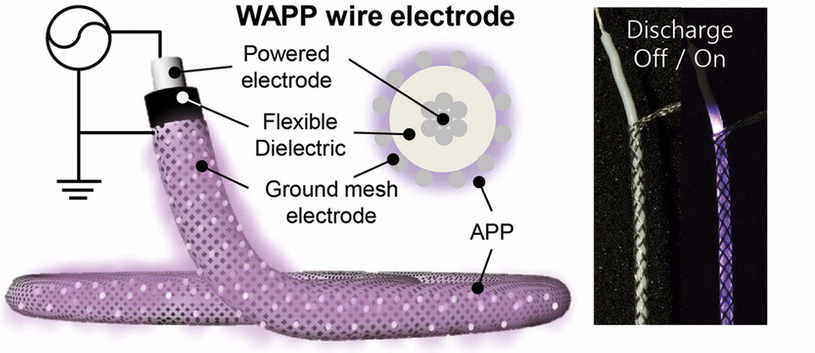
First, I will introduce u guys about a recent groundbreaking result of ADD’s R&D on plasma, which is, a flexible electrode and its application, a Wearable Plasma Fabric – its always something wearable or elastic these days ヾ(´∀`○)ノ – or a WAPP(Wearable Atmospheric Pressure Plasma) fabric, which is a gas supplier independent system, therefore doesn’t needs a gas supplier to supply Argon or Helium unlike the legacy plasma producing electrodes in order to create plasma.
[ATTACH=CONFIG]251824[/ATTACH]
As you can see here, the electrode necessary to create a plasma from the atmosphere is in a flexible fabric form.
Until now, it was seen impossible to create a 3 dimensional electrode but only a simple shaped flat-surfaced ones.Anyways, there are are various possible application of this WAPP such like wearable plasma anti NBC protective suit or detoxification blanket against hydro-soluble chemical weapons and so on.
[attachment=1]1487084918.jpg[/attachment]
fig.2) dissection of plasma blanket – abstract from “100 new major patents of ADD ver. 2016”[attachment=0]1486907809 (1).jpg[/attachment]
fig.3) weaving of WAPP and fig.4) possible applications – abstract from “100 new major patents of ADD ver. 2016”Now, plasma, apart from its various useful characteristics, also acts like a very effective RAM, absorbing electromagnetic waves of an incomparable bandwidths/wavelengths with even higher energy. Applied on an aircraft, one may achieve a lower radar signature even compared to those 5th gen design without current aerodynamic-unfriendly stealth profiles but in a rather conventional and “more aerodynamic” 4th gen form.
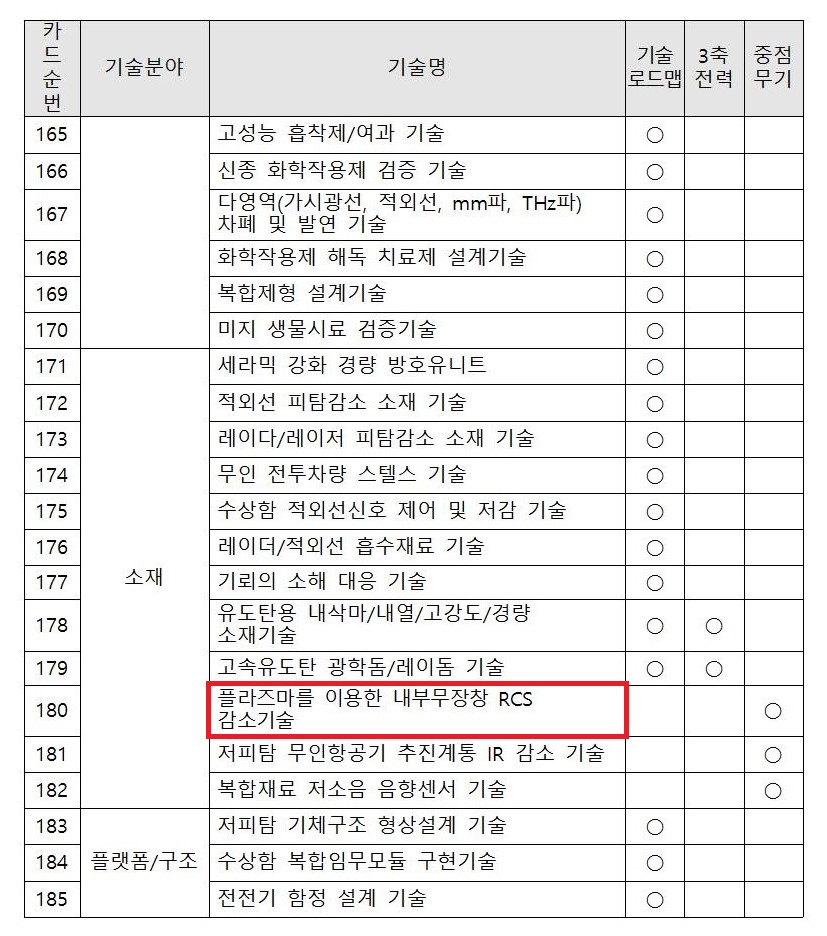
Apart from plasma stealth, it is also known able to control the flow of a fluid through use of plasma, which means an unstable and unwanted flow of air caused by IWB or any other compartments of the aircraft can also be controlled by the plasma created by WAPP, stabilizing the flow and more over, improving the aerodynamic characteristics of the aircraft without major structural change.For now, the plasma stealth technology will only be applied on vital parts for decreasing the RCS, such like IWB of the KFX.
abstract from “core technology priority planning for national defense (ver. 2017)”. part in red box reads : IWB RCS reduction technology through use of plasma”
“Study of Aerodynamic Drag Reduction Using Plasm Flow Control” – 2012
“Flow Actuation by Plasma Actuator With Different DC Discharges” – 2015Well, above studies doesn’t emphasize the usage of WAPP due to the fact that those have been written before WAPP was revealed, though there are already research programs going on such like “flow control system using 3 dimensional surface discharge”
[ATTACH=CONFIG]251825[/ATTACH][ATTACH=CONFIG]251825[/ATTACH]
(click to enlarge)In page 48, it states that WAPP can create plasma state oxygen and nitrogen. fig.1) shows the legacy atmospheric pressure plasma generator and its application, namely : [(dielectric barrier discharge and downstream processing), (Corona discharge and In-Situ processing of wafers), (plasma torch and In-Situ processing of textiles) and (atmospheric pressure plasma jet and medical sterilization & decontamination)]. As one may see, those legacy APP generators are not suitable for aircraft application and like what I said on the top, needs a gas supplier to supply necessary gases like Argon or Helium in order to create plasma.
In page 49 part 3, it states that WAPP’s TRL will reach level 5 by September this year, so there are long way to go for WAPP to reach TRL-9 but KFX still needs around 8 years to get fully developed so time-wise, there ain’t no problem regarding it. In part 4 are the listed further R&D programs and the possible application.
Its been applied for a international patent in the US and Germany so if you have interest on it, you may search for it few months later when it gets registered as a PCT patent.
Overall, unlike shady plasma stealth technology of PAK-FA which is still in the dark in the ocean of rumors, ADD has revealed quite a lot of information regarding the plasma stealth technology using WAPP which is to be applied on KFX. I guess DAPA may use this as a jack on their hands to get more out of the US like sensor fusion technologies as an offset for exchanging technologies. Well, that’s what Japan did in the 20th century developing FS-X or F-2 so why not Korea?
P.S – I’ve posted this also on the other forum and copied it here so if you find this post somewhere else, that’ss probably written by me.
Nice, but shouldn’t it be on a different dedicated topic?


 Sign In