 quadbike
Can you compare what the LCA cockpit was back then and now? Can you even give comment about Indian sitting in the JF17 cockpit and telling that it was not good…?
What he meant was, the former PAF commented on LCA in a bad way without even seeing it, while the former IAF chief checked out the JF 17 simulator and he appreciated it.
quadbikeComment in the movie is very unprofessional.
Its national media and just sabre rattling, ignore the comments and just take the news.
I run across similar stuff in Pakistani media as well. 😉
quadbikeU.S may still have potential conflicts and stand off with Russia, I don’t mean an allout War or anything but heated issues are bound to happen.
How wise would it be for them to invest on Russian aircraft for their refuellers under these circumstances ?
One thing good about IL 76-78 is you can always get spares from Ukraine.
quadbikeIAF to get CBU-105
quadbikeIndia to induct smart ‘suicide bomber’ drone
It’s an aircraft described by experts as a “flying suicide bomber”, except there is no pilot involved. It carries no weapons – instead, the aircraft itself is the weapon. It is built to creep into enemy airspace, ” loiter” for as long as necessary hunting for targets, and then dive to decimate the chosen one. It is widely considered as one of the smartest airborne strike systems yet built.
This year, the Indian Air Force will begin receiving a batch of 10 such systems, built by Israel and called the HAROP. At a little over $ 10- million (about Rs 45 crore) apiece, HAROPs are essentially drones with one- way tickets.
The Indian Army – which has followed the air force’s example and initiated procedures to acquire its own loitering munitions – has a classified scenario that is likely to be war- gamed jointly with the air force once the HAROPs are inducted.
The scenario ties in with the post- 26/ 11 rhetoric of surgical strikes across enemy lines, and with home minister P. Chidambaram’s recent assertion that India’s response to another Pakistan- supported attack would be “swift and decisive”. Military analyst Lt- Gen. Shankar Prasad says, ” These systems have a great deterrent value, whether there is war or not. Pakistan must not be allowed to think India is a weak nation.”
The air force has decided to rotate HAROP drone operations from sites in Rajasthan, Punjab and Kashmir, and may choose to buy 10 more later.
quadbikeAfter all this, some posters in forum still have the gall to assume that someday india will take the fgfa for exercises !!!
If we dont it would be our loss not anyone elses. Am sure Red Flag was great for the IAF.
quadbikeMauritius builds global data bank, with Indian Navy help
The island nation of Mauritius wants to become a global database hub, and helping it realise that ambition is the Indian Navy.
It is pitching in to operationalise a new green technology that will keep the thousands of servers being planned on the island, to host data from business houses across the world, from getting too hot.
Keeping the servers cool was one of the biggest problems standing between Mauritius and its hopes of becoming a data centre hub. It found a unique solution in a technology that brings up cool water from depths of more than 1 mile under the ocean which could be used to run the air conditioner system for the data centres. At such depths, the water temperature is as low as 1-2 degrees Celsius.
The Indian Navy has now deputed one of its best hydrographic vessels to the island nation to help map out the sea bed, along which the system will be laid. The INS Nirdeshak, which in the past has carried out surveys of major ports in Mauritius, left for the task on Wednesday. The work will be done as a goodwill gesture by the Indian government under a cooperation agreement between the countries.
During a six-month deployment to the island nation, the Nirdeshak will survey the entire seabed and chalk out a route for the ‘Sea Water Air Conditioning’ (SWAC)’ system using its multi-beam sonars. While it has done shorter stints around the island republic in the past — it recently completed a survey of the country’s main Grand port — this is by far the most extensive deployment of the hydrographic vessel in Mauritius.
The Navy has been helping Mauritius draw up hydrographic charts for five years. Besides helping it map its Exclusive Economic Zone (EEZ), the charts would ease setting up of infrastructure and shipping routes.
While similar help has been given to Maldives and Bangladesh, this is the first time the Navy is helping someone set up a sea water air conditioning system. An officer familiar with the project said that the cool sea water that would be pumped up would also be extremely low on salinity, given the depths from which it would be drawn.
“Mauritius plans to first use the cold water to run the air conditioning plants. After that, due to the low salinity, it will be distilled and used as drinking water,” the officer said.
The Nirdeshak also has another interesting association with the region. Last year, the hydrographic vessel which was carrying out routine survey work was deployed to Seychelles on an emergency basis after the nation sent a piracy SOS to India. The vessel helped keep the waters safe till a fully armed warship was sent over and helped catch nine pirates.
quadbikeDosa or dum aloo. What will India’s first astronauts eat?
Bangalore: The Mysore-based Defence Food Research Laboratory (DFRL) is busy working on the menu for India’s first astronauts—vyomanauts —who will embark on a space odyssey in 2015.
But there’s a problem. DFRL scientists don’t know whether the menu should be north or south Indian as the vyomanauts have not yet been selected.“We have not readied the menu yet. It will depend on who the astronauts are. For instance, if he is a south Indian, we will make items to suit his taste buds,” AS Bawa, director, DFRL, said.
It could be lemon rice or dosas if it is a south Indian vyomanaut, or chapati bites or mixed vegetable for a north Indian. Or, it could be both if one is a north Indian and the other a south Indian, as the Rs12,400-crore maiden mission will carry two vyomanauts 300-400 km into space for a week.
DFRL scientists are taking a lot of care to ensure the food for the two vyomanauts is palatable. “Indians like spicy food. Hence, the task is going to be challenging. The food should be palatable for seven days,” a senior scientist working on the mission said.
The scientists are looking at fruit bars, granule bar, mutton or chicken pulav to include in the menu. “We will go for traditional curries, paneer and non-vegetarian stuff — mutton or chicken pulav,” Bawa said.
The food will be packed into morsels, so that it’s easy for the vyomanauts to eat. It will not be the conventional method of eating in which food is served on a plate. In the zero-gravity environs of a spaceship, packaged ready morsels are more convenient as they can be better controlled from floating around and getting lodged in the control panels of the spacecraft.
“The food will be frozen and dried so it is light to carry,” Bawa added.
The vyomanauts, however, will have to suck the food through a tube. “The food will have to be consumed directly through the pipe. Or we will widen the tube to a fruit bar size,” Bawa said.
DFRL had also prepared and packed food for Rakesh Sharma, the first Indian to go into space in 1984.Meanwhile, the Bangalore-based Defence Bioengineering and Electromedical Laboratory has been approached by the Indian Space Research Organisation for preparing space suits for the vyomanauts. “We have the technology to prepare the suits and are ready to make them whenever asked,” RB Srivastava, director, life sciences, Defence Research and Development Organisation, said.
quadbikeHAPP, Tiruchi develops indigenous version of RGB 60 for Indian Navy
The HAPP (Heavy Alloy Penetrator Project), Tiruchi, has developed an indigenised version of the Russian Anti-Submarine Rocket Guided Bomb 60 (RGB 60), for catering to the needs of Indian Navy.
The 110 kg RGB 60 rocket developed through in-house Research and Development process within a duration of one year, has been designed to deliver a war head mass of 25 kg to a range of 5.8 km within ten seconds. The rocket is fired in formations from the RBU 6000 (Rocketnaya Bombometnaya Ustanovka) Rocket Depth Bomb Launcher mounted on ship.
The first batch of 20 indigenously manufactured and assembled RGB 60 rockets will shortly be despatched for test trials with support from the officers and staff of the NAI (Naval Armament Inspectorate) detachment of CINA (Chief Inspectorate of Naval Armaments), the HAPP General Manager M. Ravi told presspersons here on Thursday. The hardware manufactured by HAPP will be filed with high explosives and propellents, and the fully charged Rocket will be issued to the Navy by AF Khadki, a Sister Ordnance Factory, he said.
One of the 41 Ordnance factories under the Director General of Ordnance Factories, Ordnance Factory Board, the HAPP, a production unit primarily engaged in the manufacture of High Kinetic Energy Anti Tank Projectiles of different calibers for use as Tank ammunition and various other ammunition items, successfully developed the smaller range RGB – 12 Rocket with 1.5 km range last year. Ten RGB 12 Rockets were now in advanced stage of test trials, Mr. Ravi said, exuding confidence that the bulk production of these two varieties of rockets could be started at the HAPP by this year-end. The indigenisation will reflect in enormous foreign exchange saving, he said.
On the on-going R & D initiatives and expansion plans, Mr. Ravi said the HAPP was in the process of manufacturing ammunition required for the shoulder-fired Carl Gustav rocket launcher, and co-production of125 mm IMI. The HAPP was one among the 12 ordnance factories where facilities will be expanded for scaling up manufacture of Pinaka rockets to the extent of fulfilling entire requirement of the Army, he said.
As part of celebration of the Ordnance Factories Day, Mr. Ravi earlier inaugurated an exhibition featuring the models of the RGB 60 and RGB12 and photos displaying various important events and milestones in the history of HAPP.
Mr. Ravi also honoured two recipients of the prestigious Ayudh Shri Awards. M. Ramesh, Master Craftsman, and S. Sundarapandian, Fitter, are among the 25 Ayudh Awardees identified by the OFB from all the ordnance factories on the basis of a set of parameters including innovation and cost-saving. They belong to the team that has developed the two Rockets for the Navy.
quadbikeOh Abhimanyu, here is something that may make you happy 😉
Hindustan Aeronautics to go it alone on observation helicopter
Hindustan Aeronautics has decided against seeking an international partner for its light observation helicopter programme, and will undertake the development by itself.
“We have gained a lot of experience and learnt a lot over the years manufacturing the Cheetah and Chetak, and then developing the Dhruv [advanced light helicopter],” says a senior official at the state-owned firm. “There will be some degree of commonality in terms of systems with Dhruv and the LCH [light combat helicopter], but this will otherwise be a new helicopter.”
In 2009, the defence ministry asked HAL to develop and manufacture 187 utility and observation helicopters for the Indian air force and army by 2017.
The company has begun preliminary design studies into a 3t helicopter powered by a single HAL/Turbomeca Shakti engine. The aircraft will have a range of up to 500km (270nm) and a 500kg (1,100lb) payload. The first example should fly by 2015.
Observers had expected HAL to develop the new helicopter with help from the winner of an international competition for 197 helicopters that will cover interim requirements. AgustaWestland, Eurocopter and Russia’s Rosoboronexport agency responded to a 2009 request for proposals, but India missed a self-imposed deadline to begin trials by the middle of last year. These should start in mid-2010 and a decision is expected in 2011, say industry sources.
HAL, which will also maintain the Western-manufactured helicopters, has a created Helicopter Complex division that brings together its rotorcraft design, development and manufacturing activities under one umbrella. This includes the light observation helicopter, the Dhruv and the LCH that will imminently have its first flight.
Separately, the HAL sources confirm that India’s navy has decided against buying additional Dhruvs and will look to foreign vendors for both its utility and anti-submarine warfare requirements.
The navy has Dhruvs performing utility missions, and had planned to buy dozens more to replace its Chetaks and potentially also meet an ASW requirement. However, the service has decided to go ahead with an international tender for both requirements and could issue a RFP this year, say HAL sources.
“The navy says that for their particular roles, the Dhruv is probably not suited. They are not considering it as a long-term solution at the moment and want to look elsewhere for their utility and ASW requirements,” says one.
The service is likely to assess the NH Industries NH90 and Sikorsky S-70B Seahawk for its ASW missions, while Eurocopter’s AS365 Dauphin is likely to be a leading contender for any utility requirement.
quadbikeArmy wants missiles that hover before attack
NEW DELHI: After Israeli UAVs (unmanned aerial vehicles) or spy drones which act like cruise missiles, the Indian armed forces are looking to induct `loitering’ missiles that hover before selecting and hitting targets of greater priority.
Army has issued a global RFI (request for information) about medium-range loitering missile systems, seeking details about their day and night camera payloads, ground control stations, data links, launchers and the like. Only a few armament majors like Israeli Aerospace Industries and Raytheon make such missile systems.
“The RFI was issued earlier this month. The loitering missile is basically a UAV which can transmit data after hovering over a target undetected for about 20-30 minutes and then hit a selected target,” said an officer.
The RFI has sought details on the missile’s cruising speed, maximum range at which it can engage a target, its loitering time, data link’s range and the like. The system should also have the capability to abort an attack after locking on to a target and then later hit another redesignated target.
Army wants the loitering missile to have a conventional warhead, apart from anti-tank and anti-material warheads with deep armour-penetrating capabilities.
The armed forces, of course, are still some years away from inducting combat UAVs like the American Predators, which let loose Hellfire missiles with devastating effect, which are being used in operations against the Taliban and al-Qaida in Afghanistan.
They are, however, inducting some loitering killer drones like the Israeli Harpy UAVs, which are designed to detect and attack enemy radars as anti-radiation missiles.
Such a UAV first tracks and verifies hostile radar emissions after being launched in any kind of weather. It then enters into an attack mode to dive almost vertically and finally, detonates its warhead just above the enemy radar to effectively `kill’ it.
IAF has also ordered the advanced version of these UAVs, called Harop, which add electro-optical sensors to the radio-frequency seekers to ensure they can hit even enemy missile sites and other important military installations.
Since the 1999 Kargil conflict, Indian forces have inducted over 100 Israeli Searcher-II, Heron and other UAVs as `force-multipliers’ in reconnaissance missions as well as for precision-strike operations.
quadbikeAN EYE ON THE COAST
Admiral Noman Bashir, brother of the Pakistani foreign secretary, Salman Bashir, who was in New Delhi to hold talks with India, recently said, “The Indian navy’s current force structure and future expansion plans reflect its hegemonic mindset to further flex its muscles and become a ‘blue water’ navy.”
Yes, India must have ‘blue water’ navy; but that is not a reflection of its “hegemonic mindset to further flex its muscles….” Bashir, despite being the navy chief, displayed a lamentable lack of knowledge and understanding of the naval situation in Asia.
Compared to Pakistan’s 567 nautical mile Arabian Sea coastline, India has a 4,104 nautical mile coastline with the Arabian Sea, the Gulf of Mannar and the Bay of Bengal. That makes India’s coastline, approximately, 7.23 times bigger than Pakistan’s. India, therefore, cannot afford to have a tiny navy with archaic machines to protect its territorial waters.
The differences in role, operation, tactical doctrine and deployment of these two naval forces need to be analysed carefully. According to Jane’s World Navies 2009, the Pakistani navy’s tactical doctrine includes, among other things, “aggressive deployment of submarines to destroy Indian navy’s major surface combatants”. In naval parlance, the Pakistani naval doctrine emphasizes “fleet-in-being”(guerrilla-warfare). Islamabad’s submarine assets would be a major factor in a combat with the Indian navy as the enemy carrier group would be extremely vulnerable to underwater operations within a limited combat radius. Understandably, therefore, the overall operational task of the Indian navy is daunting. However, India’s self-imposed diplomatic and defensive restraint does not allow its navy to go beyond limited sea-denial capability.
Theoretically, however, the Indian navy has the ability to undertake a two-fold role: sea control and sea denial, say up to 1,500 nautical miles from its operational base. Sea control is essentially about cooperation with littoral and other friendly navies. For sea denial, however, submarine and anti-submarine capabilities would be essential to counter any hostile manoeuvre by non-littoral fighting ships. Being larger and more populous, India has its own share of problems, given the hostile environment. It is imperative that the Indian navy pre-empts hostile guerrillas in sea and secures the shore.
The Indian navy’s vision of a “force architecture centred around 140 to 145 vessels by 2020”, of which “more than half will be ocean-going and the remainder assigned to coastal duties”, makes a lot of sense. The only caveat should be to have more indigenous warships on the naval inventory. With the growing threat of piracy, the rapid modernization of the Chinese navy and Islamabad’s fleet-in-being acquisitions, it is now time for some restructuring in the Indian navy. A balanced naval force, consisting of missile destroyers, frigates and corvettes, based on at least two aircraft carrier battle groups, supplemented by submarines and aviation assets equipped with long-range, precision-guided weapons capable of anti-ship and land-attack missions, is compulsory.
Admiral Bashir would perhaps be better off managing Pakistan’s coastline instead of eyeing India’s shoreline.
quadbikeIndian navy deploys INS Nirdeshak for hydrographic assistance to Mauritius
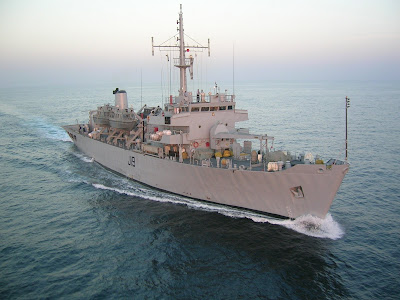
1. INS Nirdeshak set sail for Mauritius for a hydrographic survey mission on 17 Mar 10. The ship is likely to operate in Mauritian waters for about four weeks.
2. The deployment of INS Nirdeshak is in accordance with a Memorandum of Understanding (MOU) with the Mauritian government. During the last four years about ten hydrographic surveys have been conducted by the Indian Navy in Mauritian waters. Some of the important surveys undertaken include those for Mauritian capital Port Louis harbour, Port Mathurin in Rodrigues Island, Carajos Cargados Shoals and Agalega Island. It is noteworthy that before the survey by the Indian Navy, Agalega was last surveyed over 100 years ago.
3. In addition to hydrographic survey of important ports, harbours and designated sea areas around the islands, the MoU encompasses training of Mauritian hydrographic personnel at National Institute of Hydrography at Goa and provision of expertise for setting up of a hydrographic infrastructure at Mauritius.
4. As a result of the sustained hydrographic assistance, four navigational charts of Mauritian waters have been produced and handed over. This is likely to give a boost to their sea trade. The survey will also be assisting land based ocean industries being set up in Mauritius.
5. This survey will also include collection of supporting data for the continental shelf claims of Mauritius. Surveys related to the development of the tourism industry in the islands are also conducted.
6. The regular presence of Indian Naval survey ships in Mauritius has generated a swell of goodwill and further reinforced the strong links between the two countries. The crew of the survey ships have not only been involved in surveying unchartered waters but have also endeared themselves to the local populace by participating in community building exercises during their short visits to the harbour, providing assistance in reaching supplies to far flung islands and acting as goodwill ambassadors.
7. It may be recalled that Indian Naval Ship Nirdeshak was the last ship to visit Mauritius during March – April 2009. On her return passage to India the ship was diverted to Seychelles to demonstrate Indian Naval presence and to deter piracy in the region. During her deployment off Seychelles the ship was involved in the successful capture of nine pirates in an operation which was coordinated with Spanish frigate Numancia.
quadbikeIAF wants to pull out from Maoist zones
The Indian Air Force (IAF) wants the Border Security Force to take on a bigger and riskier role in the fight against Naxals.
It intends to pull its Mi-17 helicopters out of Naxal territory where they ferry security personnel, carry out reconnaissance and casualty evacuation, offloading the responsibility to the BSF’s air wing.
A top IAF officer told HT, “We are hamstrung by inadequate resources. We have diverted helicopters to support anti-Naxal operations at the cost of training and air maintenance operations. It’s about time that the BSF steps into our shoes.”
The air force has assigned four Russian Mi-17 helicopters for the logistics support of the state and central police forces engaged in anti-Naxal operations.
The helicopters have frequently drawn hostile fire, compelling the IAF to seek the government’s permission to shoot down Naxals in self-defence last year. The IAF’s unmanned aerial vehicles are flying surveillance patrols everyday to keep track of Naxal movement.
The BSF’s air wing consists of six Mi-17 helicopters. The choppers are being used for surveillance and transporting troops in Naxal-affected states. The air force considers the number to be adequate for supporting security forces fighting the Naxals.
“The serviceability of BSF helicopters has improved. The force is capable of facing the challenge on its own. This role was not envisaged when the air force bought these helicopters. We are sacrificing operational duties by diverting the Mi-17s,” the IAF officer said.
The BSF’s air wing chief, R. Khurana, refused to comment.
The air force says its resources are stretched thin. Seventeen of the IAF’s 200 Mi-17s are deployed in various UN peace missions.
The IAF is using armoured Mi-17 helicopters to transport security personnel in Maoist zones. The helicopters are armed with machine guns manned by the air force’s Garud commandos.
The IAF is not carrying out offensive operations against the Naxals.
“The main role of the armed forces is to defend against external aggression. We’d ideally not want to be sucked into internal security duties,” the officer added.
quadbikeIndia, the New Land of Opportunity for Defense Contractors
Traditionally a reliable Russian customer, India is also looking further west for its new fighter and attack aircraft; proposals from the U.S., France and Sweden are on the table. The first step of the process is a “fly off” to make sure the proposed aircraft meet the basic requirements. With domestic sales stalling, the contract with India will be one of the most important of the next ten years.
Lockheed Martin (LMT) has proposed the F-16 while Boeing (BA) has entered the F/A-18 into the competition. France’s Dassualt has its Rafael and Sweden has its SAAB-manufactured Grypen. Russia is proposing an updated version of the venerable MiG-29, known as the MiG-35. Most of these aircraft fall into the same size range and are twin-engined with modern avionics and sophisticated weapon suites. The winner will be a significant upgrade for India from its current mix of MiG-27, 29 and Su-27 aircraft.
India wants to make the first cut by early summer. The plan is to use the fly-off to cull the field; the remaining companies will then submit a financial proposal. The planned budget is about $11 billion for 126 aircraft.
India has signed several deals lately with American and Israeli companies to provide hardware. They have also kept buying Russian equipment such as a planned purchase of MiG fighters for their new aircraft carriers. Two contracts that stand out are the P-8I maritime patrol aircraft from Boeing and an airborne radar and control system (AWACS) from Israel, plus a contract to construct ammunition factories.
The contract reflects two Indian realities. One is its concern about its neighbors – a restive Pakistan and an emboldened China. The other is India’s increasing economic openness. In the past, domestic requirements were so onerous that making a profit was impossible. Joint ventures were difficult to set up and Delhi limited which domestic companies could participate. Not surprisingly, foreign companies were not eager to enter the market. In the last couple of years, though, India has eased its regulations and expanded joint-venture opportunities.
These changes will help India attract better and more proposals which in the long run should reduce costs.


 Sign In







