 Mondariz
It seems there are no need to bomb the dam.
From Wikipedia:
“In February 2008, the lake is currently at 50.44 percent of its capacity, threatening to make the Las Vegas valley’s primary raw water intake inoperable. Though the small rise since last year has eased the current crisis, if the lake doesn’t receive enough inflow this spring, problems may arise later this summer.[1] Arrangements are underway to pipe water from elsewhere in Nevada by 2011, but since the primary raw water intake at Lake Mead could become inoperable as soon as 2010 based on current drought and user projections, Las Vegas could suffer crippling water shortages in the interim.[1] Lake Mead draws a majority of its water from snow melt in the Western Colorado Rockies. Since 2000 the water level has been dropping at a fairly steady rate due to less than average snowfall. As a result, marinas and boat launch ramps have either needed to be moved to another part of the lake or have closed down completely”
Just sit back and wait. In a few years you can walk to her.
Mondarizsome actual pictures of the aircraft http://sanctuaries.noaa.gov/maritime/expeditions/b29.html
she looks to be in pretty good condition, though i would have thought raising a wreck of that size from almost 200 feet wont be easy or cheap!
Not easy if you pull her up, but what if she rise herself?
Although she won’t hold her pressure cabin any more, there is still enough fuselage to displace the water with something (styrofoam balls comes to mind, but maybe something that disolves slowly in freshwater, to protect the environment).
If the tanks have leaked (and im sure they have by now) you could also displace the water in them, and gently she would rise.
Maybe an untested method, but im pretty sure it would work.
I’m in two minds here (quite normal for me), would be nice to let the sun shine on her again, but its a bit insane even to think about.
MondarizIf Lake Mead is man-made, presumably there’s a dam at one end. Why not let all the water out, walk in and pick it up?
Just my tuppence;)
John
Best idea yet :p
Bring a few engines and you could fly her away.
MondarizFoulness is full of odd structures that are difficult to understand, on the areas I’ve managed to access there’s also evidence of the use of some pretty powerful weaponry.
It’s a good place to look at on GE, what was the purpose of those wavey lines in the natural ground above your site, what are those two long thin structures pointing out to sea, and further south, theres a perfect concrete circle, what was that for?
If you look further south, next to the area used for storing redundant trains, there seems to be a load of turretless tanks, candidates for a bit of target practice no doubt.
What surprises me is that I can’t spot any airframes, TSR-2 used to be dumped there, I’m surprised I can’t find any others.
If you use Google Earth application, rather than Google maps, you can switch on information about the area.
Near the armored vehicles is says “MOD Tank testing Ground”.
Man! There are some really strange structures in that area….is that where they film Dr. Who? 😉
MondarizI have found it on Google Earth.
Its near Foulness, Essex, UK.
As seen on the image, its north of the village of Churchend.
From an article on the area:
“Foulness is a remote and windswept place. The island passed into the hands of the War Department in 1915 and its marsh flats have made an ideal proving ground for military munitions ever since.”
So munitions storage seems right.
MondarizLake Mead is a man-made resevoir, it might be in a National Park, but would that make a difference?
If someone actually got around to executing a recovery, I’m pretty sure strings could be pulled.
However, this thread is more about the technical possibility (wreck conditions and recovery methods) and the concept of large scale recovery efforts.
WIX forum is not here :p
I’m looking for ideas/posts from people in this forum.
MondarizThey used 5 Hanriot H-320Et2 from 1927.
c/no 1001-1005.
Thats all i have.
MondarizI have had a quick browse around and can help you with four aircraft. All delivered to El Salvador Air Force in 1974.
Serial: 707 c/no: 218 (destroyed at guerrilla raid at Ilopango 27.1.1982).
Serial: 709 c/no: 40 (preserved at Air Force Museum)
Serial: 710 c/no: 43 (crashed 15.7.1978).
Serial: 714 c/no: 185 (stored at Ilopango).
Three more are stored at Ilopango.
MondarizIMHO The F-84 in Randers is not worth the bother. It has been used (as you say) for fire and rescue training.
Unless you are looking for just an airframe display (maybe a gateguard), its really too much work, considering that the F-84 is not rare.
I’m have recently become a member of a Danish aviation museum, and will hopefully begin working with them soon. They are well connected with the Danish air force and the Danish arms collection museum. I will ask around to see whats stored around the country.
They might want to know a few things before even looking at allocating a stored aircraft. Would you mind answering these questions, and maybe fill in any other information you find important to mention. You can do so in a PM if you like.
What would be your future plans for such an F-84?
What museum are you affiliated with?
MondarizMondariz – There are no examples of F84G’s in the U.K despite the prominent role they had with the USAF in the U.K . I would dearly like to bring the Randers machine to the U.K for museum display. If either yourself or Kenneth could help in any way I would be delighted for the help.
I did not see your question before now.
I will try to find out something about the F-84G from Randers. I think it would be a lot easier than getting one from China Lake :p
Not sure who owns it, but both the major Aircraft collections in Denmark already have a F-84G on display.
MondarizI found these in my “wreck and relic” folder. I THINK those were published along with the describtion mentioned above. If anyone know different, please post.
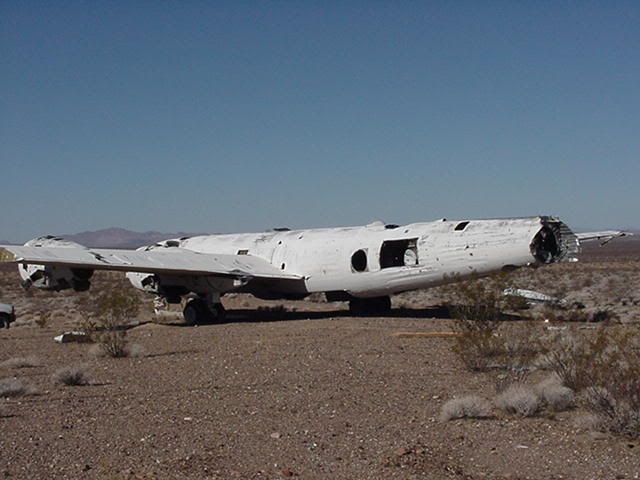
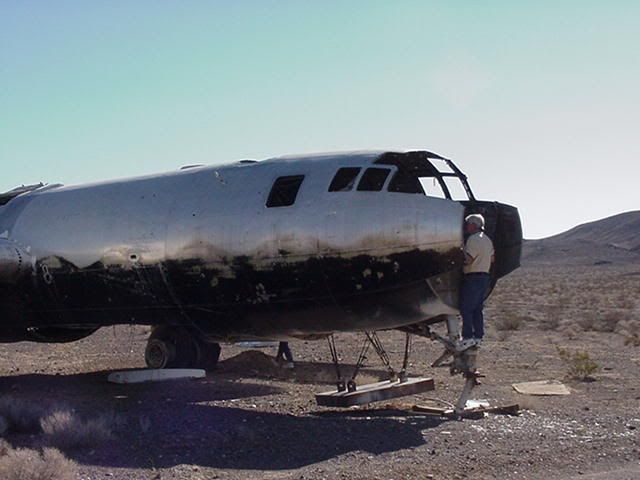
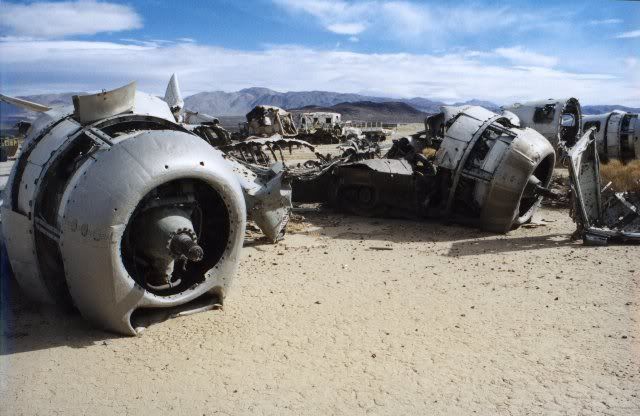
MondarizThe resolution is not too good around China Lake.
I got the location from another forum, where a guy had been digging on the China lake range (some sort of geological dig, not aviation related).
I think this is called Echo range area: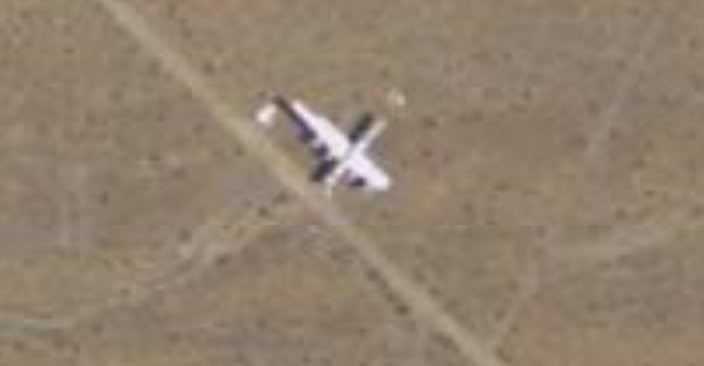
No idea what this area is called. There are smaller aircraft nearby. They look like pistons, but its hard to tell: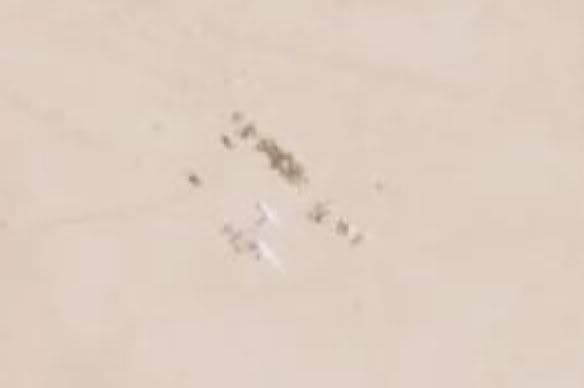
MondarizOf all the planes disposed by the US armed forces after the war. Some were purchased with the intend of salvaging usefull equipment and fuel. Most would have ended in the big old melting pot, after having been stripped, but maybe some slipped through.
As you said, we are not talking about B-17’s and other large aircraft, but fighter size birds, that would sit quietly somewhere on the farm.
This process of disposing of surplus war material, was not only a US thing. Besides the allied inventory, they also destroyed the full Luftwaffe inventory ( 1100 Aircraft in little Denmark alone). Is it unlikely that some thrifty soul got his hands on some?
I have seen pictures of RAF/USAAF bombers being dismantled by local scrapmerchants, after they had ditched in shallow waters, or landed on fields due to damage. There might no longer be a whole aircraft, but maybe someone kept a gun-turrent, a cockpit, or something else as a souvenir.
In post-war Europe, I can easily see “dirty” deals taking place. Some allied officer selling equipment to a local, who then stash it away for later use. Again, maybe not whole aircraft, but engines and spares. If such things exist, they are likely to come into the light of day soon, as unfortunatly such dealers are getting quite old.
Does anyone know about engines and equipment, that have found their way to the warbird community, after years in storage?
MondarizI just remembered the ultimate “Holy grail” of aircraft recovery: The landfills on Clark Air base.
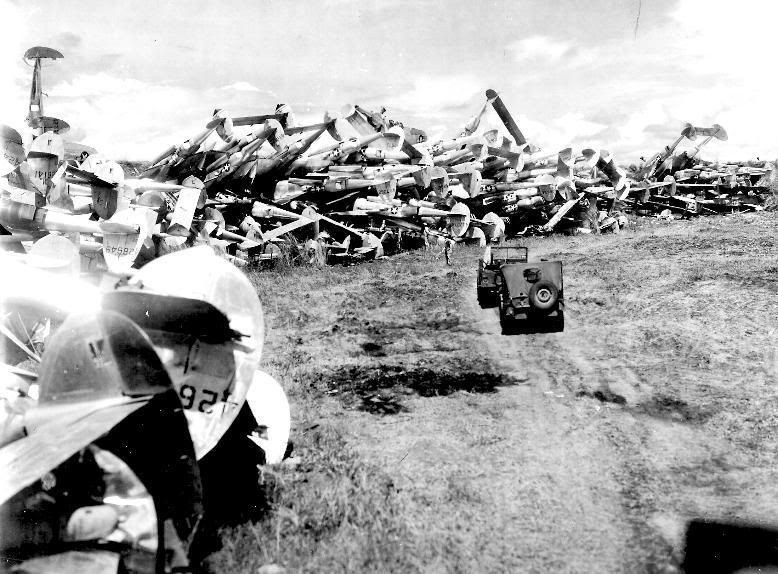
In the 1960’s one of the dumpsites was excavated and materials, including aircraft, was removed and destroyed.
Appearently a Canadian firm had digging rights in 2002, but not sure what happened.
http://www.sunstar.com.ph/static/pam/2002/06/01/news/us.aircraft.buried.at.clark.dug.up.html
A powerplant was build over the second dumpsite. But since when has that stopped anyone 😉
MondarizI just had a quick browse on Google Earth and came up with this:
F-86D at Aalborg Air Base (decomissioned 1964)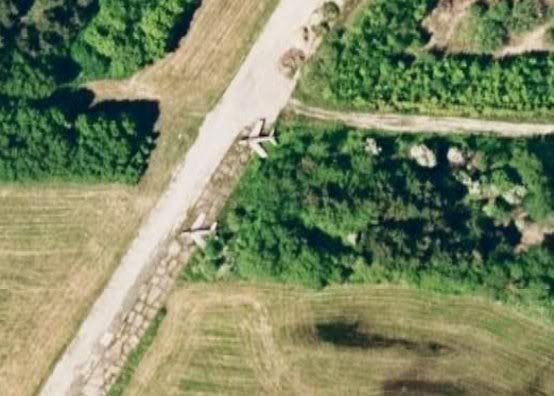
RF-84F at Karup Air base (decomissioned 1974).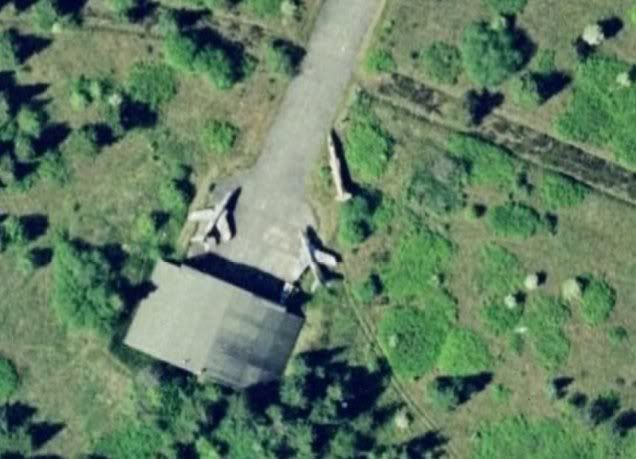
F-104 at Karup Air Base (decomissioned 1986).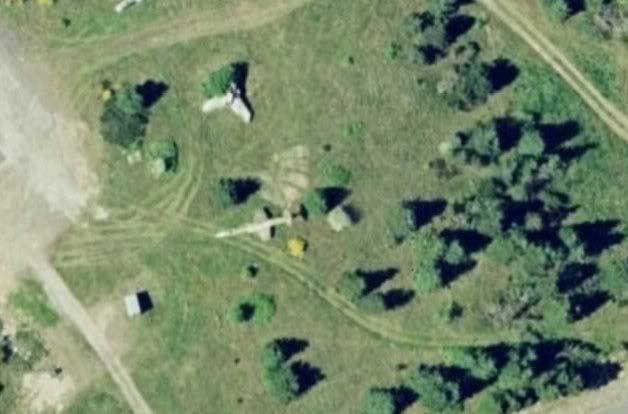


 Sign In







