 MiG-23MLD
Here is an analisys of the AJ-37 Viggen.

Any one who has seen the Viggen has distinguished several features it has, it is a double delta close couple canard
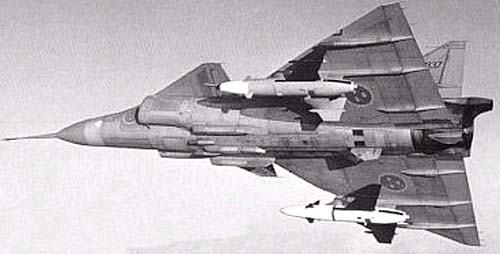
A)the AJ-37`s wing its a low aspect ratio delta wing with the outer panels swept at 60 degrees for low drag at high supersonic speeds, elevons are used for roll and pitch control, the elevons are deflected down for low speed operations, the inner wing panels are of less swept to improve pitching moments characteristics in the downwash of the canard in the transonic speed range
B)The canard is a low aspect ratio also, selected to provide max lift and reliable flow behavior at high AoA and sideslip angles. The canard incidence is fixed. The rear surface or flap is moveable to provide only a trim function and is therefore not a maneuvering (pitch) control. there are two positions of the canard flap. a mid position for take off and full down for landing. These positions are actuated by the landing gear control level; thus the pilot load is minimized – the flap is mechanically connected to the landing gear lever.
An interesting design consideration of the canard was the requirement to remain unstalled over a larger AOA range than the main wing Thus, instead of providing the usual passive stall limiting where the canard stalled before the main wing, its primary function was to enhance overall lift to reduce touch down speeds. this was achieved by wind tunnel testing to determine a suitable (trapezoidal) planform and placement (close coupled and above) related to the main wing.
Upwash from the main wing provided favorable (interference) flow conditions such that the Max lift coefficient of the canard was increased by 40% and the AOA for the max lift coefficient for the aircraft extended beyond that used in landing approach.
The low speed characteristics of this configuration are considered to be satisfactory.
Initially, a reduction in stabillity occurred at AOA of 8 degrees. which produced an unacceptable nose up trim change, This was caused by flow separation at the outer wing panel. A sawtooth (notch) leading edge modification cured the problem and pitch stability is linear up to 30 degrees AoA
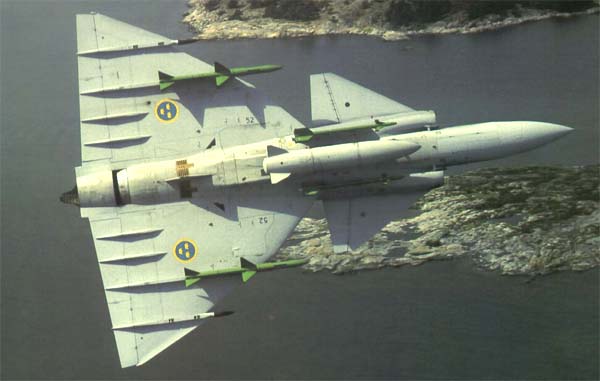
This basicly shows that the F-16XL leading edge notch, the LCA wing and the AJ-37 delta wing notch are used with the same intent of reducing pitch up movement through out a less sweep lnner leading edge that reduces vortex formation.
Like the MiG-23MLD, the AJ-37 has a dog tooth to improve AOA handling,
Howeve the AJ-37 is a very stable design and pays dearly at supersonic speeds do to the fact the center of gravity is well ahead of the center of lift of the main wing and quit close to the canard center of lift, this increases trim drag at supersonic speeds, this is a product of the fact the canard upwash is a destabilizing and the center of gravity has to be move forward for a stable Pitching movement coefficient.
Vortices shed from the canard at high angle AOA strogly influenced flow at the vertical tail and lateral directional stability changed, improvements in lateral/directional characteristics were achieved by reducing dihedral of the canard from 10 degrees to 0 degrees
The high speed performance of this canard aircraft is strongly affected by the trade off bewteen stability and performance.
Subsonic trim drag is determine by the wing/fuselage pitching moment. Optimun subsonic drag therefore requieres that the center of gravity be located such that zero or low positive tail loads are needed. For an aft-tail fighter aircraft, the tail is sized to provide positive pitch stability, adequate control power for more wheel lift-off, and for maneuvering at supersonic speeds. the same sized tail placed forward at the same moment arm provides similar control power for the wheel lift off; however, pitch stability has changed. Thus, the canard operating in the up wash is destabilizing and the center of gravity must be moved forward for a stable pitch coefficient movement.
This obviously requieres the canard to carry a significant proportion of the total lift, roughly 15% with a corresponding drag penalty.
Going to supersonic speeds, the aerodynamic center moves aft approximately 15% mean aerodynamic chord for this wing plaform.
This increases in stability further increases the upload requirement of the canard, with severe trim and maneuver drag penalties
MiG-23MLDcrobato, let me warn you before you go farther…..debating with MiG-23MLD is has almost become something of a faux pas here……He will flat out ignore just about everything you put his way, and when you get him started on turn rates, there’s just no stopping it. Gracefully stepping out of the “debate” is your best choice unless you just like constantly typing the same things over and over again….
If you review some older threads you’ll see what I mean. I was one of the few who attempted debate with him, and it wasn’t much fun after a while…..
Just a fair warning…..
Phantom II
Man why you do not let others be like they want to be, what bothers you about me if i like turn rates? number one i do respect you and i am not going from thread to thread saying this guy is this or that, i suggest you be a gentleman, and being a Gentleman means respect others i do respect you and i am not making you a bad reputation like you are trying to do to me, respect other`s opinions is a part of the forum rules, respect the areas i do like, respect me, and debate me if you do not agree with the figures i give, however if you do not like my opinions please do as i do to you simply let others be, you have opinions and attitudes to which i do not agree but i do respect you, why? because i simply know you won`t change your mind at least in the near future and it is better let you be rather than that start a campaign against you, in fact if i did ignore your opinions in past debates it was simply because you were wrong but of course everybody thinks about themselves as being right and the opposition wrong and that applies to both of us but try to see that respect is the basis for harmony between humans and try to see some of your opinions are as subjetive and bias as mine and if you can not get to an agreement it is better let pleople be.
By the way i do admit when i am wrong in the best of my capabilities and i have acknowledged in the past my mistakes however Phantom II if you prefer this way of debating see that basicly i won`t consider you discuss matters with reason and figures but rather you attack the persons reputation as a politician does.
MiG-23MLDThe Mirage III would have problems tackling the very fast MiG-23, but the Mirage III won’t be a walk over for the MiG-23 however.
MiG-23 suffers from many of the problems mentioned with the MiG-21. Hard controls in high speeds (however it seems Russians actually prefer this); disorganized and cluttered controls (yet for some reason its not disorganized for Russian peasant boys), and worst yet, poor visibility in the cockpit (unavoidable). Its worst on the MiG-23 than it is on the MiG-21 due to the shoulder mounted wings and seating position on the MiG-23.
Aircombat with VG shows you don’t really fight plainly with wings setting to a mid setting. You still have to sweep forward and backward to match the occasion, since the middle setting is always a compromise. However because you need to variably sweep wings, that adds to the pilot workload and increases the time the plane needs to maneuver. You can call it “lag”.
This is not to say the MiG-23 has other qualities that merit debate for the “classic” category. Its physical sturdiness, robust landing gear, versatility in operation, high speed, and most important is the proven ability to work in a wide variety of conditions, environment and mission roles.
Crobato
The Mirage III was not a very advaced delta wing fighter, niether a fighter of the fourth generation, the MiG-23 can sweep its wing quit quickly and the VG is only swept depending in the speed range, so the MiG-23 is not sweeping its wing in a low speed combat unless is passing from a different part of the flight envelope that requires sweeping the wing, sweeping the wing also takes seconds not minutes niether more than 15 secs, it is a quit fast process even in a manually controlled swing wing system.
The Mirage III were not a real menace to the british Harriers in 1982 and Argentina lost several Kfirs (Neshers) and Mirage IIIs due to the fact the Harriers had better missiles like the MiG-23s had in the AA-8 and AA-11, the Harrier is not a really agile machine and except because it can do VIFFing this is not an aircraft very different from a MiG-23 in what respect turn rate.
MiG-23MLDYou are somewhat in contradiction with the article you pointed previously. Static margin make a whole lot of difference.
And the article you pointed, also pionted that the tailess delta (without tail or canards) has the highest lift coefficient of all, did it not?
Crobato
Static marging improves drag, and the least drag you can get of course is the tailess delta, nevertheles the lift coefficient is totally different, the Tailess delta is the configuration that provides less lift trim coefficient followed by the canard wing configuration
source http://www.aoe.vt.edu/~mason/Mason_f/canardsS03.pdf
and you can see in this other article they say the same
The differences between aft-tail and canard configurations’ maximum lift capability is again related to the trim constraint. There exists one position of the center of gravity for which each surface carries maximum lift. This optimal static margin is shown in figure 11. Nearly neutral stability is required for canard designs while static instabilities from 0 to 20% are necessary for aft-tail designs.
http://aero.stanford.edu/Reports/MultOp/multop.html
by the way i have been trying to find out why the J-10 and Eurofighter have dihedral and anhedral canards and it seems it has to be with lateral stability
MiG-23MLDYour often quoted Gripen is a perfect example on how the unstable delta/all moveable canard design has improved the performance and partitially overcome the disadvantages of earlier deltas. Unstable design, all moveable canards, excellent FBW, improved fuselage design, lower wing loading and better TWR is all going to offset the disadvantages of a pur stable delta to a high degree. You see that the Gripen achieves twice the STR and more than 50 % more ITR over the Kfir while maintaining a similar TWR. For Typhoon and Rafale you now have to add a very low wing load factor and high TWR which is all goining to further improve the performance over the Gripen.
It’s not that true for advanced configurations such as that of Gripen, Rafale and Typhoon, the significant performance superiority over old stable pure delta or delta/fixed canard designs proves this. Ignoring it doesn’t change reality!
Every aircraft has a corner speed where it achieves its best turning rates. Basically you can say the turning rate increases with speed until the corner speed is reached and after that reduces with speed. Typhoon’s corner speed is probably below that of the MiG-29. As mentioned the main difference is that the MiG-29 isn’t able to pull 9 g below mach 0.9 and if pulling 9g there the aircraft will lose speed and the amount of gs starts to drop. The Typhoon on the other side will further accelerate if full RH is selected, of course the increasing speed will reduce the turning rate, but the pilot can deselect RH and it will drop as well.
Scorpion82
You are fantasizing, deltas with or without static margin and with or without canards continue having the same aerodynamics, with canards the delta wing delays its own local high AoA vortex generation and burst, with static margin and instability reduce trim drag and the canards protect the delta wing from stalling first.
All this improves substantially their high AoA handling and this coupled with good thrust to weight ratio gives good instantaneous turn rates however deltas since their geometry creates vortices easily also suffer more from early flow separation and vortex burst than high aspect ratio wings this is the reason they do not have superb turn rates.
The Tailess wing and the canard and wing configuration in fact do have lower lift coeffiicients than tailed wings so then why they have aircraft with delta wings and canards? well delta wings are good for speed and are excellent for supersonic flight also are easy to build, canards are usually smaller than taiplanes so relatively might generate less drag if an aircraft uses a bigger tail.
Longitudinal instability also frees the aft part of an airplane making it less draggy, that was one of the reasons the canard delta wing configuration was chosen in the Gripen case.
If you can understand that you will see that basicly the Eurocanards do have advantages but also suffer from drawbacks, aerodynamically speaking the canards when deflected also can change the delta wing center of lift and the canards can either change the center of lift either behind the center of gravity or ahead of it if there is vortex break down on the wing`s outer part, this makes difficult canard deflection and made troubles for the Gripen
MiG-23MLDYou must read wrong, though I know where this one comes from.
http://www.flightsim.com/cgi/kds?$=main/review/mig21/mig21.htm
The MiG-21 should roll a lot faster than 90 degrees a second but this is within the first 90 degrees, so this is a mis read. I think what it should mean it gets the best control authority within the first 90 degrees. It is said in a TV interview that the MiG-21 rolls so fast you actually risk the plane going out of control. F-16 is screaming around 325 deg/sec within the first 90 deg, though this says nothing about the roll rate past 90 deg.
Mirage III can deal with MiG-23, just as F-86 is able to shoot down MiG-21s,
Something interesting.
Crobato
Honestly i do not think the Mirage III would had tackled the MiG-23 or MiG-23ML with ease, these two fighters first were basicly single seat F-4s, they were armed with better weaponry than a MiG-21, were faster, had quicker acceleration and would had ruled the engagement, at WVR with a MiG-23 were not handicapped, basicly they were much better than the Mirage F1.
The MiG-23M against the Mirage F1
Practically in the entire altitude range at the speeds of 700-1100 km/h, the MiG-23M surpassed the Mirage F-1 on maneuverability and rates of climb. At speeds more than 1100 km/h at average and high altitudes, the MiG-23M had lower sustained turn rates than the Mirage F1.
The Mirage III was not as good as the Mirage F1, the Mirage III would not had an easy kill, in fact it was not armed as well.
The Mirage III in some aspects was inferior to the MiG-21 however the Israeli did use the Mirage more wisedly than the Egyptian and Syrians their MiG-21s, it is not that the MiG-21 were inferior, but that the Israeli were better trained and teh same they said about the Bekka Valley, they said they were better trained not that the MiGs were inferior.
In August 1966, an Iraqi pilot defected to Israel in a late-model MiG-21F-13 (Fishbed-C). The IAF began studying the plane. The first to fly it was – who else – Danny Sha-pira, the IAF’s veteran chief test pilot.
The systems in the cockpit were bulky and unwieldy. The pilot’s view of the out-side world was almost completely blocked off, and turning his head sideways was difficult. The Russians believed that the pilot should look forward at all times.
In the air, Danny Shapira discovered that the MiG-21 was a powerful bird. When taking off simultaneously with a Mirage, the MiG shot ahead and accelerated better, in both subsonic and supersonic speeds. Its drawbacks became apparent at low-altitude high-speed flight: the high pressure on the rudders limited the plane’s maneuverability, which – under those conditions – was not much better than a Piper’s.
In the course of the test flights, Shapira gradually discovered the areas in which the MiG-21 could be outperformed by Mirages. He imparted his discoveries to pilots from the different squadrons, advising them to try and engage the MiG-21 in specific altitudes and speeds, which would put the MiG-21 at a disadvantage.
“No Margin for Error” (1993) by Ehud Yonay
On August 16, 1966, an Iraqi defector landed a MiG-21 in perfect working order on the Hazor tarmac and Dani Shapira, the IAF’s chief test pilot, took the MiG through every nook and cranny of its flight envelope. “We found out that at high speeds it had trouble maneuvering as well as the Mirage, which meant that we had to try to get it into tight turns at high speeds. Also, at slow speeds it had a tendency to spin out, and at tight turns at low altitudes it would snap and flick into the ground.” After completing his test series and writing a book on the MiG-21, Shapira began flying it alongside and against the Mirages. By the end of the year, each Mirage squadron was thoroughly familiar with every as-pect of what was heretofore the world’s most mysterious and formidable fighter.
“Israel’s Best Defense” (1993) by E. Cohen
When the Chief Test Pilot of the IAF, Danny Shapira got into the cockpit of the MiG-21 for the first time, he was surprised by a plethora of levers and buttons in an illogical order. It looked very inferior to the elegant Mirage with its ‘no hands’ flight. Iraqi Captain Muneir Radfa, who brought the plane to Israel from Iraq, agreed that the cockpit was uncomfortable and disorganized, but insisted that the plane was easy to fly. The first flight confirmed his words; it was easy. To Danny, it felt like the Mirage, but was a bit faster and had a lower peak altitude of 40,000 feet. When Danny began to maneuver, he discovered how the MiG differed from the Mirage. The MiG was difficult to steer at speeds over 500 knots. Danny had to use tremendous strength on the stick to steady the plane in turns, especially in sharp ones. At greater speeds the danger increased. The nose and the right wing pulled downward. Since the back of the cockpit was obstructed, the pilot’s field of vision was severely limited. After many dogfights, Danny concluded that in terms of handling, the MiG-21 was even with the Mirage.
“Air Warfare in the Missile Age” (1985) by Lon Nordeen
The Israelis highly rated the MiG-21 as a medium-altitude dogfight aircraft. With its slightly higher thrust-to-weight ratio and lower wing-loading, it was able to out-accelerate and out-turn the Mirage IIIC. Nevertheless, the Mirage’s pilots managed to shoot down MiG-21s as Arab pilots generally did not fly the plane to its limits of performance.
However, the MiG-21 was found to be highly susceptible to battle damage, having a tendency to burn or explode after being struck only a few times with 30-mm cannon fire. On the opposite, a Mirage was hit by the Soviet-built Atoll infrared-guided air-to-air missile fired from an Iraqi MiG-21 over an Iraqi airbase where the Mirage was patrolling. The Mirage’s tailpipe suffered extensive damage, but the pilot was able to return to the base.]
Peebles, Curtis. Dark Eagles. Novato, CA, USA: Presidio, 1995
Capt. Monir Radfa, an Iraqi pilot, took off from Rashid Air Base outside Baghdad and landed at Hatzor Air Base in Israel on August 16, 1966, with his Mig-21F-13. For the next several months, it was subjected to a series of flights to learn its strengths and weaknesses. These were made by Lt. Col. Dani Shapira, the Israeli Air Force’s chief test pilot. He recalled later: “We found out, for example, that at high speed it had trouble maneuvering as well as the Mirage, which meant we had to try to get it into tight turns at high speeds.”
At low speeds, the Mig-21 would tend to spin out in tight, low-altitude turns. The Mig-21 was then used to train Israeli Mirage pilots. Some 100 hours were spent flying in mock combat with Israeli Mirages. By the end of the year, every Mirage squadron had been familiarized with the Mig-21.
XXX
MiG-21: Its delta wing allows it to turn very well, but the induced drag of that configuration ‘bleeds’ energy rapidly and when MiG-21 turns, it costs. So the trick is to get the MiG-21 down to an altitude below 20,000 feet. That’s where the Phantom really performs well with its wing; it turns and accelerates well. But if you get above 20,000 feet and tangle with a MiG-21, he will chew you to pieces because of the advantages of his wing and his speed.
Steve Ritchie, a Phantom ace, considers the MiG-21’s speed and turning ability to be excellent, but the MiG has roll rate troubles at maximum speed, as well as longitudinal stability problems.
The delta–wing design of the Mig-21 also loses energy in turns faster than the F-4 does and the Mig has a tendency to lose speed in turns.
“Aircraft vs Aircraft” (1986) by N. Franks.
Full-afterburner thrust:
MiG-21 — 13,117 lb.
Mirage 3C — 13,670 lb.
The MiG-21’s delta-wing configuration gave it poor lift at subsonic speeds.
In a high-angle-of-attack situation, the MiG-21 bucks about almost uncontrollably and can only be pointed rather than aimed.
“The Threat” by Cockburn.
The handling of the MiG-21 was bad. U.S. pilots who flew the 12 MiG-21s presented to the U.S. by Egypt in 1978 reported that below 15,000-feet altitude, where the air is dens-er, the control stick becomes very difficult to move: “Like pulling on a telegraph pole” was one comment. The cockpit visibility was extremely bad.
“Modern Fighter Combat” (1987) by Mike Spick.
The MiG-21 design is based on tailed delta wing planform while the French Mirage was a tailless delta. The pure delta has many advantages in high-altitude, high-speed flight. It also has no clearly defined point of stall and develops max lift at very high angles of incidence. But it pays a high price in increased drag. Drag is also high while maneuvering.
The tailed delta avoided the worst drawbacks of the tailless variety.
Turning ability of the MiG-21 is good and at the lower speed levels it is very good. But increase speed to Mach 0.9 at 15,000-feet altitude and the MiG-21’s instantaneous turn rate becomes worse than that of the Phantom though still better than the Mirage 3C can achieve.
The controls are heavy, to a degree where a fair amount of muscle is needed. The pilot’s view out is not good, rear vision is almost non-existent and even the view ahead is restricted by both avionics displays and a heavy canopy bow. A fairly low fuel fraction reduces the combat radius without external fuel to a ridiculously short distance. The performance above 20,000 feet was described as poor.
The truth is that the MiG-21 is a very ordinary fighter and had it been of Western origin, it would have probably sunk without trace prior to 1970.
At the same time, the latest MiG-21bis (Fishbed-N) has a more powerful engine and a far superior thrust-to-weight ratio. Its performance has to improve dramatically and it must be a formidable dogfighter.
http://www.waronline.org/forum/viewtopic.php?t=5472&postorder=asc
MiG-23MLDYou have the the right to assume anything you want of any fighter you want to. As long it’s not backed up by hard facts it’s just speculations from your part, thats the only thing I want to point out. Also using these speculations to make long going conclusions without considering things as TWR and speed seem to me as a bit careless.
If I were to speculate I would say that the 30 deg/s ITR of Gripen hints at that it’s achived at quite low speeds, as otherwise the G load would be to high. That indicates that the aerodynamics of Gripen gives good authority at low speeds. With a relatively low TWR it would be natural that the STR is a bit lower, but how much lower we don’t know.
If you compare Gripen to an aft tailed fighter with a slightly better TWR and known for it’s good STR, namely F-16, the numbers I’ve seen is 18 deg/s. If you assume this is correct, and the 20+ deg/s STR for Gripen is correct, what does it tell you about delta canards?
Rogerout
The only fighters i know that have a Sustained turn rate of 18 deg/s are the F-18 and F-14, the F-16 has a sustained turn rate of 19 deg/s or 21 deg/s those are th figures i have seen, now i am not expeculating you are the one who is expeculating, all the reports you read in books and the internet say the Gripen has a sustained turn rate of 20 deg/s, you are the one who is expeculating and thinking the Gripen can achieve a better sustained turn rate, upon a suposition the 20 deg/s is not the real figure, personaly i do not know the turn radius the Gripen has, however the MiG-23ML for example has a really big radius of more than 1500 meters at 5000 meters of altitude and 900km/h.
Turn radius is the best way to know the true agility a fighter has on the horizontal plane, the F-16 will have a turn radius of around 1200 meters and the MiG-21 one around of 2300 meters at the speed of Mach 0.85 and an altitude of 6000 meters, at sea level the F-16 will have a turn radius even smaller of only 800 meters
MiG-23MLDAs I said these turning rates are not necessarily wrong, though the lock on figure in terms of max. STR looks even more reasonable. However exact data are unknown. I predict a STR of 24-26°/sec at best depending on the speed. Typhoon will probably reach its best turning performance at 350 kts. Unlike the MiG-29 or F-16 the Eurofighter is not only able to achieve 9 g over a wider speed envelope, at higher speeds 450 kts+ the Typhoon will even accelerate at high g, while the MiG-29 or F-16 will loose speed even with full AB selected. The result is of course a lower STR if the pilot does not reduce thrust. I assume the Eurofighter’s STR at 750 km/h (~400 kts) is similar to that of the MiG-29 or F-16, but Typhoon can sustain them longer and maintain more energy. At lower speeds the Typhoon is likely to be superior as well as at supersonic speeds.
I don’t know why you repeatly bring up examples of stable delta and delta/non moveable canard designs. They are more or less pointless for the discussion.
I will tell you why i do compare the Viggen with its limited 15.6 deg/s instantaneous turn rate and the Kfr with its instantaneous turn rate of 18.9 deg/s and sustained turn rate of 9.6 deg/s to the recent Eurocanards, the reason is to prove you that despite the gread advances with delta wings and canards even with static margin instabilities, some aerodynamic properties seen on the delta wing do not disappear, yes you now have better canard and delta wing aircraft, however some properties of the configuration are still present.
When it comes to static marging and max lift coefficient the tailed configuration offers better lift and the issue of the use of canards in many aircraft configurations will depend in many aspect among them: the type of mission the aircraft will do, costs, performance etc etc.. another thing is time frame and technology available, in the 1980s of course the Eurocanards were quit advanced, now with Thrust vectoring, stealth and new materials well you can build a fighter like the F-22 and F-35 without canards.
The Issue of the instantaneous turn rate and sustained turn rate only proves you that many do not accept a known fact that the delta canard configuration bleeds energy fast and among one of its drawbacks is it does not endow the aircraft configuration with sustained turn rates as good as the instantaneous turn rates it does provide.
You can expect if you want turn rates in the range of 24-26 deg/s, personally Lock on has the most likely highest value for its sustained turn rate of 24.5 deg/s and this is at relatively low speed and once the Typhoon gets at a speed beyond 750km/h its turn rate drops abruptly, this is logic if you see it from the aerodynamic point of view, because delta wings always struggle with enduce drag during turns
MiG-23MLDFact is that the exact turn rate of Gripen is classified. The number given is 20+ deg/s, it might be 20.1 or 21 or 25, you don’t know. This means that even if you would include the real TWR, your calculations would still be useless.
Rogerout
I can understand your your belive in canards will give to the Gripen a better sustained turn rate, however the must common figure is 20 deg/s, aerodynamically this is the most likely number, however of course you can not accept figures that make look bad the Gripen, let me say this from my humble point of view, the Gripen is one of the best fourth generation fighters in overall capabilities armed with excellent weapons , fitted with advanced avionics and all of this with cheap operating costs, definitively the aircraft is more advanced than the MiG-29A and MiG-29C built in the 1980s and operated during the Soviet times.
Do i think its Sustained turn rate is 20 deg/s yes, i do, do i think this makes it less advanced than early MiG-29As? no i do not because it has a better instantaneous turn rate and more advanced avionics, definitively i believe it is a great aircraft but it is not a super machine many want to imagine.
MiG-23MLDIn fact the Gripens TWR is not that much different from that of a Kfir.
The Gripens superior turning performance is primarily achieved by its superior aerodynamical design. And BTW Kfir is based on a 2nd generation fighter from the 1950s.Lets say they are at least not entirely wrong.
Close and long coupled canards has both their pros and cons. BTW the Rafale has a lifting body as well, like the LERXes of MiG-29 etc., though a bit different. In fact there is no best design, every one has its finer or less finer points, it is ever going to be a compromise.
Except a similar airlift intake configuration and the low mounted wings, the J-10 and Eurofighter haven’t that much in common.
Typhoon’s canards were in fact placed to affect the wing and fin airflow as few as possible. Their main task is to stabalize the aircraft, which is more unstable than other delta/canards. All the aircraft’s control surfaces adjusts to mach number and AoA to optimize performance, meaning keeping drag low and optimizing the lift.
Scorpion82
See for example this, the AJ-37 has a Max overload factor of 7Gs and an instantaneous turn rate of 15.6 deg/s at the speeds of Mach 0.5 and Mach 0.6, consider we can not expect things that are not in the order of the possible range of reality.
The Eurofighter is more less in the class of the MiG-29 and F-15 and probably is slightly better in agility up to some level, so i consider it must be more or less in the range predicted by Gordon, Fomin and even Lock on.
In order to make the airframe smaller, it was early decided to replace the navigator with a good navigational computer. It’s designed to withstand 12 G, but the limit in operation is 7 G.
sources
http://www.canit.se/~griffon/aviation/text/37viggen.htm
MiG-23MLDMiG-23MLD,
what bothers me is the fact that you try to prove things with articles or graphs which are a) not credible or b) doesn’t suit the situation.
No one denies that deltas in general bleed more energy than some other wing forms, but you have to take into account that there is a significant difference between a stable pure delta wing and an unstable delta with slats and all moveable canards digital FBW etc.. You take Formin for serious about the Eurofighter’s sustained turning rate and I ask YOU from where he can know about it? From where the creator of the graph you have shown could know about it? The answer is that are guesses/assumptions but not hard fact data. Turning rate data about Typhoon aren’t available in the public anywhere. All the data you see until now are nice guesses/assumptions which might be more or less correct.
Honestly I prefer to stick with what real world pilots say who have flown BOTH types. I don’t stick with the graphs from Eurofighter GmbH itself as they are “marketing”. But even that is more credible than a graph whose creator is unknown or an author which had probably few to none real world contact with the aircraft or people involved. I see Formin/Gordon as good source for russian aircraft (I have at least a book for my self), but it’s for sure not the best person to ask about the Eurofighter.
What I want to say with it is that one must be careful in presenting articles or graphs as “proofs”. See behind the source, question its context and try to find more confirmation.Another thing that bothers me is this argument from you:
Gripen is NOT = Eurofighter! That’s something you are unwilled or not able to understand I don’t know. If you would look more carefully you would notice that their aerodynamics haven’t more in common than the basic unstable delta/canard layout. Wing area in relation to the aircraft’s overall size, position, sweep angle and profile are very different. The canards are totally different in position, relative size and shape, the fuselage configuration is different, the airlift intakes are totally different, the fins are different, their degree of aerodynamical stability is different, let alone the overall size and weight differences and the fact the Gripen is a less powerfull single engined fighter and the Typhoon a twin engine fighter. And don’t forget about the fact that Gripen has a close coupled arrangment while Typhoon has a long coupled one.
To sum it up things which are true for the Gripen aren’t necessarily true for the Typhoon and the other way round. Same for the Rafale. That’s the point you should get!I don’t like it as I can’t see the source behind the graph and I question its crediblity. The other question is how is the sustained turning rate defined at speed. Is it the average TR for a 360° turn with that starting speed or is it the max TR you can achieve and hold at a given speed without loosing energy?
Scorpion82
Undoutedly your complaigns have some degree of reasoning i do not deny that, of course i do know probably the real figures are unknown since i am sure those figures probably do not come from a manual, however see this other points:
A stable aircraft like the Kfir has a turn rates way below a MiG-29, just a mere 9 deg/s sustained turn rate, the JAS-39 an instable aircraft with better thrust to weight ratio has a turn rate of 20 deg/s, now current aproximations give to the Typhoon a sustained turn rate of 22 deg/s or 24.5 deg/s the question is how believeable are these figures? in my opinion they are believeable, why? simply the Typhoon up to what i have read about canards is not the best design, i think the Rafale its better with is close couple canards 
If you compare the J-10, Eurofighter, Typhoon and Rafale from my opinion the Eurofighter and J-10 are similar in configuration, however the J-10 has its canards placed closer to the wing while the relatively high aspect Eurofighter`s canards are designed to have less drag, the Viggen has a design more optimized for lift rather than drag with its small aspect ratio canards.
The advantages i see in the Eurofighter`s canards are they have a wider range of Center of Gravity shift with respect of the wing and canards aerodynamic lift centers, also its canards are farther from the wing therefore when these are deflected affect the wing not as inmediatly as those on the Rafale and they can generate relatively more lift for a few moments

MiG-23MLDLol once again you show that you consume everything you can find which suits your mind. Where is the reference behind these graphics? From where did they get the data? Looks much like flying the MiG-29 in Lock On and the EF2000 in Eurofighter Typhoon, creating the graph and you take it as serious lol. Honestly Lock On has good flight modells, only stupid that you can’t fly the Typhoon there.
Scorpion82
You are first the one who does not accept anything that goes against your own mind set, it is obvious that the graph comes from Lock on but also see that Gordon fives you similar figures for the Eurofighter sustained turn rates, in fact lock on gives you a better sustained turn rate that what Yefim Gordon or Fomin give, they give a pure max sustained turn rate 22 deg/s, in aerodynamics it is known that deltas bleed energy and speed faster, if you look at the graph it is most likely accurate because also the Gripen bleeds 10 deg/s from its instantaneous turn rate of 30 deg/s to its 20 deg/s sustained turn rate why you do not like the graph? well easy you are simply workshiping the eurocoanards and anyting that makes them look bad bothers you even to the degree calling others with bad words such as abjectives used to denigrate the reasoning capability of others, please buddy first learn to argue in peace, a smart people does not need insults specially when he or she is right;) insults are only a reflex of lack of evidence and lack of convincing arguments
MiG-23MLDCobra is a useless tactical maneuver, why would aircraft penalize their design in order to achieve that?
And I told you Eurocanards and J-10 cannot perform the Cobra because their FBW does not permit it, and likely has no provision for FBW override because of their levels of relaxed stability. In fact, unless you have an FBW override, the Russian aircraft with digital FBW cannot do it either.
What’s important is that the ECDs may have superior transient performance; the ability to quickly convert energy/motion/direction state from one to another as these planes are designed around John Boyd’s EM theories.
Now going through the charts. It just looks to me the charts does have one fundamental flaw. One is that it is comparing a design (close coupled canards) tha is quite capable of already generating vortices to a design that does not (delta with tail). Start showing me charts when the aft tail design has a LERX, because LERXed designs are draggier than non LERXed designs.
Crobato
If you look at this graph it will give you answer about LERXes, the Su-27 has long LERXes and Tailplanes and the F-15 small LERXes and tailplanes
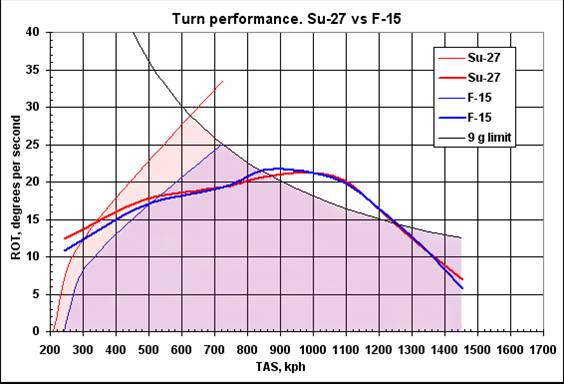
source http://www.lockon.ru/?end_pos=10&lang=ru&scr=list&page=4
This prove that these two fighters which have similar thrust to weight ratio, weight and configuration have different turning capability thanks to the LERXes the Su-27 has and the fact the Su-27 has integral layout fuselage wing blending, see the webpage is Russian, see also that this shows you the Su-27 has better performance.
If you look at the other two graphs i attached you can see the MiG-29 has better sustained turn rate than the Eurofighter at some speeds see that they are considering the Eurofighter has a Max sustained turn rate close to 24.5 deg/s and the MiG-29 a Max sustained turn rate of 23.5 deg/s however it bleeds speed and angular velocity really fast and at some speeds is inferior to the MiG-29 and the Cobra is useful in combat so do not think the MiG-29 and Su-27 are simple designs in fact they were the first aircraft to have what today we call supermaneouvrability considering the application of the cobra in combat, note the fact they are giving to the MiG-29 a lesser Max instantaneous turn rate than the typically reported of 28 deg/s
See that basicly at speeds higher than 750km/h the MiG-29 begins having better sustained turn rate and at much higher speeds the MiG-29 has a much much better turning capability than the Eurofighter Typhoon
MiG-23MLDFor your convenience, videos from the Dogfight episode of modern jet combat in the Middle East are up in Youtube. You can see how Mirage III, superior roll rate but inferior turn rate, just pwns the MiG-17, which has superior turn rate but inferior roll rate.
You’re right, turn rate is only one parameter in agility, but you always treat it like its the ONLY one. You keep forgeting about other factors, such as roll rates and transient performance.
When swing wings are extended forward, they generally produce do not good roll rates. Wings with typically long physical wingspans, including variable wings, cannot put large ailerons that would exert better authority to roll. Wings that are longer in length but shorter in wingspan, allow you to put longer ailerons. Long wingspan also increases lateral stability, hence more resistance to roll, due to both wing pressure. and inertia (more weight outboard of the plane’s centerline). Another factor comes in because the wings are shoulder mounted, which also increases lateral stability, not in the center or below, which decreases lateral stability. For planes that have shoulder mounted wings, they compensate with an anhedral layout (wings canted downward, like in Jaguar and Harrier), and anhedral wings improve roll ratates but swing wing layout forces you to keep the wings flat.
When you don’t have good roll rates, you cannot start a turn quickly, since you have to roll in order to get the position to turn. It also affects you with a whole bunch of BFM like scissors. One of the main centerpieces of the F-16’s agility is its prodigous roll rates (its the fastest in the US inventory), and roll rates also excels in planes like the Mirage 2000, Mirage III, F-5E, A-4 Skyhawk, and not the least, the MiG-21 Fishbed.
For that reason, the MiG-23 prefers to fight with its wings swept back,mostly because it does best in hack and slash attacks but also because it gets the best roll rate that way, even if turn rates are lower.
Another problem with swing wing, is that the position of the swing wing already gives away the plane’s energy state and telegraphs that to the opposing pilot. Thus for an experienced pilot, they would already be figuring out a counter move. Something the Israelis rely on from their Phantoms and Kfirs when they engage the Floggers and VG Fitters.
Crobato
The MiG-23 and F-14 are good examples of VG wing aircraft, the F-14 with VG can roll better than a MiG-21, just to cite you some information the F-14 can have roll rates of 120 deg/s while up to what i know the MiG-21 only of 90 deg/s, the MiG-23ML will deal with a Mirage III quit easily in fact it is not a real adversary, and the israelies knew it that is the reason they bought F-15s and F-16s.
Comparing a MiG-17 with a Mirage III is not the best example why you do not compare a F-14 versus a Mirage III?
MiG-23MLDTurn rates are not agility. Agility also means your roll rates. Remember, before you have to turn, you have to roll to bank for a turn. MiG-23 roll rate is not the best, compared to MiG-21.
Crobato
You are wrong, the instantaneous turn rate in the max parameter for horizontal agility because its basic definition:
Instantaneous turn rate: it is the max angular velocity a fighter can achieve without incurring in any structural damage, basicly means a fighter`s corner velocity; corner velocity by definition means the speed in which a fighter achieves its max instantaneous turn rate
When you have the instantaneous turn rate you have the tightest horizontal turn a fighter can achieve at the begining of a turn, the sustained turn rate to the contrary is the average angular velocity a fighter has while turning.
See this is a corner velocity graph for the F-16
source http://www.21club.neostrada.pl/lagotka/corner_vel_en.html
So if you say that a instantaneous turn rate is not a parameter of agility you are totally wrong, another parameter of agility is vertical angular velocity or basicly how good a fighter executes loops, it is known for example that the F-4 is superior to the MiG-23M in that arena to cite an example, because the MiG-23 will lose more speed and height when it tries tighter vertical turns or loops.


 Sign In







