 MiG-23MLD
You’re not hearing me. I didn’t say it’s not in production. Where else do you get operational test rounds? But the fact that the weapon is undergoing operational testing is just that-the weapon is still in the testing phase. Is it the final phase? Yes. But it is still testing.
And the article even states, again, that the EF-2000 won’t be able to fully utilize all of the features of the IRIS-T (they mentioned LOAL as one such feature) until Tranche 2 aircraft enter service.
SOC
The Tranche already is in production and final assembly of the first examples is already planned to October 2006
check the article
First Tranche 2 Typhoon Takes Shape at Samlesbury Source: BAE Systems; issued Nov. 17, 2005)
Assembly of the first production standard Tranche 2 Typhoon has started at BAE Systems Samlesbury in the North-West of England. The Tranche 2 aircraft will provide the UK痴 Royal Air Force and other customer Air Forces with an improved operational performance, including a full air to surface capability.
The build of the first Tranche 2 Typhoon commenced with the spigot frames, part of the aircraft痴 front fuselage, being loaded into assembly jigs in the Typhoon Major Units Assembly Facility at Samlesbury.
Gary Hodkinson, Product Manager for Typhoon at BAE Systems, said: 典he start of Tranche 2 Typhoon assembly marks a significant milestone in the programme. These aircraft will ensure that our customer Air Forces have even more capability to meet their operational requirements for decades to come.・
擢ollowing the signing of the Tranche 2 contract in December 2004, the design and engineering teams, our suppliers and the Customers have all worked together to ensure we successfully achieved this key milestone. We now expect to have eight Tranche 2 aircraft in assembly by the end of the year.・
The front fuselage of the first aircraft, BS037, is scheduled to be delivered to the UK痴 final assembly line at BAE Systems Warton in October 2006.
BAE Systems has major operations across five continents and customers in some 130 countries. The company employs over 90,000 people and generates annual sales of approximately 」14.8 billion through its wholly owned and joint-venture operations.
So by 2007 you can expect fully operational IRIS-T on tranche 2 Eurofighters
MiG-23MLDThat is NOT what that page says. They are saying that in February of 2006, the first stocks of IRIS-T missiles were delivered to Jg (yes, I put Jg :diablo: ) 73. You must have missed this quote:
“Here in Laage the operational testing and evaluation of IRIS-T on the Eurofighter is now beginning, while tests on the Tornado will follow in a few months’ time.”
OPERATIONAL TESTING. Meaning the weapon is not yet fully cleared for operational use by line units. This is the same thing the USAF did with the F-22A at Nellis AFB. And the testing is now beginning. So, 1) full capabilities won’t be available until Tranche 2 anyway, and 2) the thing is still being tested.
SOC
Operational testing means the operational use and evaluation of a weapon system by a test unit, however series deliveries have started and will end in 2011, series production already has begun check the article
here they state deliveries have begun
IRIS-T: DELIVERIES HAVE STARTED
“This is a good day for the Luftwaffe,” said Air Vice Marshal Klaus-Peter Stieglitz at the ceremony marking the occasion of delivery of the first IRIS-T to Fighter Wing 73 (FW 73) “Steinhoff” in Laage near Rostock. “IRIS-T is not only the most advanced short-range air-to-air missile currently available, but it is also an emblem of the capability of the European defence industry,” said the Chief of Air Staff.
here already they are stating the last IRIS-T will be delivered in 2011 and initial deliveries have already started, 3159 IRIS-T will be purchased
As well as the Federal Republic of Germany, five other nations – Sweden, Greece, Norway, Italy and Spain – are all involved on the programme. Between them, the six nations have ordered 3,150 IRIS-T missiles, the last of which is expected to be delivered in 2011.
Here they state that the first unit to have deployed OPERATIONALY the IRIS-T will work as an evaluation unit of the operational IRIS-T missiles and that in few months operational test on the Panavia Tornado will follow
“Here in Laage the operational testing and evaluation of IRIS-T on the Eurofighter is now beginning, while tests on the Tornado will follow in a few months’ time.”
Check they used the word operational meaning the IRIS-T already is operational.
-“Finally in December 2004 the contract for serial production was signed. Its total value is around Euro1 billion and it will go a long way towards securing Diehl’s core missile competencies.”-
Already the contract for the production was signed and the initial deliveries have started.
The missile is already operational but only with few units so they can modify and improve it so the next tranche of IRIS-T will have best features and the least operational problems.
the first test trials were made in 2003 see this article
05 September 2003 – Eurofighter Typhoon Begins IRIS-T Flight Trials Eurofighter GmbH announced the first Eurofighter Typhoon captive flight trials of the IRIS-T (Infra Red Imaging System – Tail/Thrust Vector Control) short range air-to-air missile. The tests were undertaken by Eurofighter Typhoon Development Aircraft 1 (DA1) at EADS-CASA, Getafe, Spain, on 27 August 2003.
source http://www.eurofighter.com/News/Article/default.asp?NewsItemId=151
IRIS-T completes demonstration campaign The performance demonstration firings carried out within the context of IRIS-T development were completed on November 18, 2003 with excellent results: in a total of seven firings, seven direct hits were scored against maneuvering target drones taking countermeasures.
Check already the missile has demostrated 360 degree engagement capability
This performance is all the more remarkable as IRIS-T allows unprecedented engagement scenarios thus revolutionizing air combat. 360° engagements are no longer a dream.
source http://www.flug-revue.rotor.com/frnews1/FRNews03/FR031130.htm
Do not confuse flight trials with operational test evaluation.
FLIGHT TEST TRIAL means see the launcher-missile integration and the IRIS-T flight characteristics.
Operational test is the last test in order to eliminate problems on operational missiles testing the missiles operationally on a test unit.
Already flight test trails took place in 2003 and 2004, operational test are only to find any problem in operational use.
It does not mean the missile is not in production or not operational simply they are monitoring how smooth is the induction in operational service of the first operational tranches
MiG-23MLDanother thing is that we are all on this forum lovers of aircraft, some of the people have worked or are working with aircraft of all different types and ages, others just have a passion for aircraft, everyone has there own opinions. one thing you have to learn on this forum is to dont take everything you read personal. i think most people on here try there best not to offend or insult other people. take the replys you wasnt looking for with a pinch of salt, have a laugh as well as being serious. if this forum was serious all the time it would be boring. the members of this forum have a huge knowlage of aviation but they also have a sence of humer…. 😀 😀 🙂 😉
Man you have said something really cool and truthful i agree with you 100% 😀
MiG-23MLDIRIS-T, according to that webpage, isn’t fully integrated until Tranche 2. And RAF EF-2000s for the moment appear to be carrying AIM-9s if they’re operational aircraft. In fact the only aircraft I can think of that actively employ the ASRAAM operationally are the RAAF Hornets (and maybe RAF Tornados?).
here is the page that says the IRIS-T has became operational
http://www.flug-revue.rotor.com/frheft/FRHeft06/FRH0602/FR0602d.htm
source of pictures http://www.eurofighter.com/News/Article/default.asp?NewsItemId=226
With supercruise ASRAAMs and IRIS-T the Eurofighter is a excellent fighter
Here is the J-10 carring lot of fuel 
MiG-23MLDIf i were the defence minister of a rich nation i would recommend the purchase of
one hundred F-22, two hundred Su-35BM and two hundred F-35 for defence force.
my attack force would be another one hundred F-35.
The attack bomber aircraft would be twenty Tu-160 and ten B-2.
Several An-124 and C-17s.
Some Astor, and EMB-145.
Some Ka-52/Ka-50 and the rest Mi-28 around seventy helicopters.
If i were the defence minister of a poor nation i would buy twenty F-35s, fifty MiG-29OVT and some EMB-145SA plus some An-124
And a great amount of Python Vs and AIM-9Xs
MiG-23MLDIn the armament arena as well. Bring up Meteor all you want, but right now, with AMRAAM and AIM-9M, there is no big capability advantage in terms of A/A weapons in favor of the Eurofighter over a J-10 armed with PL-8 and PL-12.
At this moment the Eurofighter is armed with ASRAAM and AMRAAM, also with supercruise speed has advantages in BVR combat, in wvr combat it has the ASRAAM and IRIS-T both have became operational
Here you can watch the Eurofighter and the Panavia Tornado
http://www.youtube.com/watch?v=xUHI6w87y3c&search=eurofighter
Source http://defence-data.com/eft/eftpage45.htm

MiG-23MLDHmmm … just a question ! What does this ongoing discussion on US naval aviation have to to with the topic ???
“F-10 compared to EF and Rafale?” :confused: :confused: :confused:
Cheers, Deino
I guess has to do with the fact basicly the J-10 is`nt in the Eurofighter class and still the F-18E/F can deal with it armed with AIM-9X, but of course many people think the F-18 is not as good as the F-14, they think the F-18E can not defeat the J-10.
here is the weapon that has made the F-18E/F an aircraft that can fight J-10s watch the nice video of AIM-9X fired by F-18s and F-15s
http://www.youtube.com/watch?v=KpBpzuDRt0A&search=sidewinder
While the J-10 is a 4 generation fighter it is not a fighter that will surpass easily other aircraft such as the F-18E or the more advanced Eurofighter.
The Gripen armed with Meteors and ASRAAM or IRIS-T still is quit ahead, the question is many still think fights are win only by pure agility, the reality that was in 1945 but in 2006 agile missiles and stealth something the F-18E/F have, make the best machine

MiG-23MLD[QUOTE=Levsha]
What is that supposed to mean?
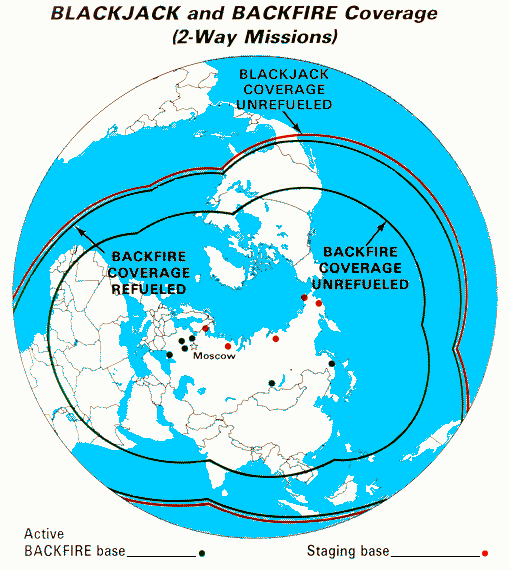
What exactly was the Tu-22M trying to be and was it a success or failure?
If there were indeed some failings in the design of the F-111 (some people in Vietnam, Libya and Iraq might disagree), how do you explain the Soviet Union bringing into service the Su-24: an aircraft with a remarkably similar layout, appearance and mission profile to the F-111.
Was the Su-24 a success or failure?
Personally i do not think the Tu-22M is better than the F-111, niether there are aircraft without shortcomings, any aircraft is surpassed by new and more modern designs.
The F-111 of course had some design features that were excellent, some world firsts, it had a moderately successful carreer, and to my point of view has been one of the most influential designs of the 20th century.
The Tu-22M also is an aircraft that no one can claim has been a failure in overall terms.
It has been produced in large numbers, has good performance, politically and militarily did it`s work as a deterrement tool and can be considered as one of the most sophisticated aircraft built by the USSR.
Both aircraft have different niches and roles, the F-111 can not fill the role the Tu-22M had but it does not mean it is a failure simply it means it was designed with different goals in mind.
The Tu-22M is an aircraft that fills a role between the B-1B and the F-111.
Some F-111 variants were envisioned that supposed to get the F-111 close to the Tu-22M role but this was not built, the FB-111H was a variant never built but with some performance and capabilities closer to the Tu-22M.
from http://www.strange-mecha.com/aircraft/VG/US-VG.htm
We can not regard the F-111 as a failure in the terms of strategic bomber because the Tu-22M also can not be compared to the B-1B.
The Tu-22M can be seen as a Tu-16 replacement and in this it was a success, the F-111 served well as a tactical bomber but as a fighter was a failure, it never attained the Su-27 versatility, but any way as a tactical bomber and trend setter was a success.

source
http://www.fas.org/nuke/guide/russia/bomber/tu-22m.htm
MiG-23MLDYes, East German MiG-23BN were referred to as MiG-24BN. This was derived from the 32-24 bureau designator (as Flogger explained), and done more or less to separate the odd-numbered fighters (MiG-21, -23, -29) from the even-numbered bombers (Su-22, MiG-24). Obviously they ignored the Su-7 in that respect, but hey, they never claimed to be consistent.
This is very interesting, few days ago i was reading a book about the proposed MiG-23 variants that never were built.
First of all, i have to admit i was wrong when i argued with you and airsande plus about the MiG-23 HMS, i was wrong the MiG-23MLD never operated HMS, however some MiG-23MLD subvariants such as the MiG-23MLDG or MiG-23MLS indeed were fitted with HMS but these never entered series production.
Very likely only the Angolan MiG-23ML upgraded in Ukraine to MiG-23-98 standards have HMS but that still is a mystery to me i do not know if it has been confirmed
There were other MiG-23 variants worthed to talk about, the MiG-23A, MiG-23MD and MiG-23K, the MiG-23A and MiG-23K never entered production or were ever built, but were supposed to be powered by two R-33 or a single newer R-100 engine or even a single R-69F engine, these naval variants were to be fitted with air refueling probes, twin ventral fins and arresting hook besides having better visibility, the MiG-23A were to be built in three subvariants the MiG-23AI (interceptor/fighter), MiG-23AB (attack) and the MiG-23AR (recoinnassance).
The MiG-23A was basicly a navalized multirole MiG-23ML
The MiG-23MD was basicly a MiG-23M with the radar of the MiG-23MLA.
there were also an attack version powered by a Al-21 named MiG-23TS/МиГ-23Ш
It is interesting the R-33 was considered as a powerplant for the naval MiG-23 because the MiG-23K and MiG-23A were to be powered by two engines not one in some configuration models these interesting because some MiG-25s and MiG-31 aerodynamic models were also powered by two engines and VG wings, however the MiG-23K and MiG-23A were to be light versions of those models http://www.testpilot.ru/russia/mikoyan/mig/31/mp/img/e155mp.jpg
here are some MiG-25 and MiG-31 models with VG wings
here is an article in russian
На базе МиГ-23МЛ был разработан вариант МиГ-23А – проект многоцелевого корабельного самолета с двигателем Р29-300 в вариантах истребителя, штурмовика-бомбардировщика и разведчика на базе проектировавшегося истребителя МиГ-23МЛ для базирования на авианесущих кораблях проекта 1160 с катапультным взлетом и аэрофинишерной посадкой. От прототипа отличался опущенной вниз для улучшения обзора из кабины носовой частью фюзеляжа, усиленным шасси, установкой посадочного гака (поворотный подфюзеляжный гребень при этом заменялся на два гребня), увеличенной площадью и высотой киля. Разработан в 1972 г., в связи с отказом от строительства кораблей проекта 1160 реализован не был. Так же был разработан самолет МиГ-23К (32-31) – корабельный истребитель на базе проекта самолета МиГ-23МЛ с двухконтурным двигателем Р-100 (23-15) для базирования на авианесущих кораблях проекта 1153 с катапультным взлетом и аэрофинишерной посадкой. Являлся развитием предыдущего проекта МиГ-23А, отличался от него крылом с двухщелевыми закрылками увеличенной площади, введением беспереплетного козырька фонаря кабины и системы дозаправки топливом в полете. Проект разработан в 1977 г. В связи с прекращением работ по кораблю с катапультами и началом разработки ТАВКР проекта 1143.5 “Рига” (ныне – “Адмирал Флота Советского Союза Кузнецов”), рассчитанного на базирование самолетов Су-27К, МиГ-29К и Як-41, реализован не был. Позднее для отработки посадки корабельных самолетов на аэрофинишер на базе МиГ-27 № 603 была создана летающая лаборатория, проходившая испытания на комплексе “Нитка”.
MiG-23MLDThis is pl-9 btw, pl-8 and 9 use similar level of seeker.
http://www.sinodefence.com/airforce/weapon/pl9.asp
“The PL-9 features an all-aspects cryogenic liquid nitrogen gas-cooled seeker infrared-homing seeker head unit utilising proportional navigation guidance techniques. The missile seeker ’s off-boresight capability is said to be better than that of the AIM-9L/M Sidewinder missile, and comparable to the Russian R-73 (AA-11 Archer). 607 Institute has improved upon the PL-9 by marrying it to the Chinese indigenous helmet-mounted sight (HMS), which is similar to the Arsenel helmet sight from the Russian R-73. A Chinese brochure credits the helmet sight with a 60 degrees off-boresight capability, or a 120 degrees field of fire. At the November 1996 Zhuhai Air Show, a Chengdu (CAC) engineer confirmed that the PL-9 HMS will be fitted onto the F-7MG fighter.
“
I should have said 120 degree OBV, I meant +/-60 degrees.
Thuang
The PL-9 seeker is not as good as the one on the R-73 here is the same article
The missile is fitted with a cryogenic liquid nitrogen gas-cooled IR seeker capable of +/-40 degree off boresight angles.
+/-40 degree of offbored sight angles is surely an improvement over the +/- 30 degree of off bored sight angles the PL-8 or Python 3 can achieve but still is not as capable as the R-73 +/-45 degrees or the R-74 +/- 60 degree of offbore sight angles and still far but far away from the Python IV or Python V.
It is funny because it claims the Helmet has a 60 degree offbored sight capability but the missile it self only 40 deg :confused: do not you find it confusing unless it works as the ASRAAM with inertial navigation.
The off bored capbility of the missile it self there is quoted as +/-40 degree :confused: does it work as an ASRAAM?
only explanation is either is a mistake and the page should say +/- 60 or it works with inertaila navigation like the Python V and ASRAAM 😉
MiG-23MLDI didn’t say it’s as good as python 4 or python 5 either. But rather that it’s a highly upgraded python 3. And to dismiss because it’s rooted in python 3 is quite unfair. And at its current setup, it has most of the things you would want in a modern SRAAM. It uses a digital processor, has a multi-band seeker, compatible with HMS and has 60 degree OBV. The only thing that sticks out as a major flaw is the fact it’s not using an IIR seeker.
I didn’t artificially compare J-10 to typhoon. Other people did. Read what I wrote again. Did I state anywhere that I personally think J-10 is as good as typhoon?
Yes, typhoon has higher thrust, but it’s also has a larger airframe.
J-10 can at most boast the T/W ratio of F-16? Why can’t iit do better? It’s lighter than F-16C and it’s engine has more thrust than F-16C with the exception of F110-GE-129 (about equal in that case).Increased maneuverability is useful in many different areas. Evading missile is not the only one.
As for F-35, nobody is foolish enough to think that J-10 is better than or close to F-35 in terms of overall performance. And nobody has stated that. You are getting way too defensive.
Tphuang
The Python 3 built in China is not more advanced than current Python V or R-73, the Python V has 360 degree of angular engagement capability same is the ASRAAM and AIM-9X, the R-74 has close to 120 degree of angular engagement capability. the Python V has the same 120 degree angular engagement.
60 degrees is basicly a +30 and -30 degree cone little bit more than the R-60MK cued with a HMS.
The R-73 has a 90 degrees of engagement capabilities or +45 -45 of angular capability
MiG-23MLDYou know that the F-35 wont supercruise right?? it has been designed not to supercruise but to economically add a lot of range….What they wanted was 2.5 times the combat radius on internal fuel as compared to the F-16 with same weapons load (2 2000lb bombs and a2a weapons) as a result the smallish F-35 gives about the same range as that of the raptor and much much more then the viper or super hornet.
I do know it has not supercruise, but what i meant a J-10 might have thrust vectoring nozzles and canards and be quit agile but stealth and ASRAAMs couple with an IRST system and a Helmet Mounted Sight and Display will make the F-35 a trend setter.
I meant stealth and missiles like the Python V give a total superiority that no 4.5 generation fighter can dream, the J-10 and MiG-29OVT are 4.5 generation aircraft and no match for F-35s, now if anti-stealth technics are developed soon and the J-10 is updated with new missiles and thrust vectoring only the F-22 has overwhelming superiority.
But in General the F-16I can still deal with the J-10, but i consider perhaps the JF-17 is a more lethal aircraft because it is very small and i guess it has a small RCS and armed with good missiels and thrust vectoring well i guess it`s large numbers can overwhelm F-35s if anti stealth technics work
MiG-23MLDSorry, I just need to address a few issues I have with your post.
agreed
Twin engine is not an issue, since J-10 is lighter than the other two. The thrust w/ afterburner of J-10 is 13.2 tonne and the normal liftoff weight of J-10 is most likely less than that (people have speculated 11 to 12 tonne). That’s actually pretty good, because you get a T/W ratio of over 1. I think generally, people compare J-10 to the eurocanards because it also has canards and that it has large delta wings.
J-10 uses PL-8B, which is really upgraded from python 3. It has all of the good features of R-73 like OBV and HMS compatible. Its IR seeker is also a multiband seeker. China believes it is superior in performance to the imported R-73.
armament combination of PL-12/PL-8B isn’t that bad really. I would take it over R-77/R-73.
TPhuang
Up to what i know missiles also are sorted by generation, currently there are only few Fifth generation missiles available, the Python 3 built in China is not as good as the Python IV or Python V, the Python 3 is more less the class of the R-60MK.
Also you can not artificially compare the J-10 with the Typhoon, at full take off load the Typhoon has more power, AAMs are quit light some are quit but quit light so basicly an aircraft carries fuel, the J-10 at the most can boast a thrust to weight ratio as an F-16.
watch the video of the IRIS-T being launched
http://www.youtube.com/watch?v=-8wnb27z3vc&search=IRIS-T
The J-10 with thrust vectoring won`t beat a Python V cued by a HMS, same is aplicable to the MiG-29OVT or Su-30MKI and with some few updates you can keep the F-16 capable of dealing with the J-10
The main thing is many think because the J-10 has canards and delta wing will surpass any thing, but as we can see the MiG-29OVT has not canards and is one of the most agile aircraft.
From my humble opinion i consider the AAM an aircraft carries coupled with stealth and supercruise makes the best fighter and the F-35 is a good example, the F-22 added up thrust vectoring but good Python Vs AAMs will basicly make redundant Thrust vectoring.
In 1988 thrust vectoring was super becasue in that time the AIM-9L or the R-60 were relatively primitive missiles but after Python Vs, IRIS-Ts, ASRAAMs and AIM-9X i can tell you that the US navy has taken the right path with the Super Hornet meanwhile there are no stealthy fighters flying outside the US.
MiG-23MLDHow accurate is this F-10 assessment? Does it really compare with the EF and Rafale or is DoD trying topull a fast one to justify more F-22s?
——————————————————————
China has deployed more than 700 advanced combat aircraft in the region of Taiwan and is continuing to acquire advanced Su-27 Flanker derivative types from Russia, build its own versions under license, and develop its own indigenous combat aircraft.DOD seemed to offer a re-assessment of the capabilities of China’s F-10 fighter, which it previously had compared to the F-16 Block 30. (See “Washington Watch: Chinese Military Is Catching Up—Fast,” September 2005, p. 12.) In this latest version of the annual China report, the Pentagon said the F-10 is probably more comparable to the Eurofighter Typhoon and French Rafale, considered among the top three fighters in the world today, after the US F-22A. The Pentagon expects more than 1,200 F-10s will be built, and improved versions—the F-10A and “Super-10”—are in advanced development.
From my humble point of view the J-10 is comparable to the Gripen but not to the Rafale or Eurofighter, reasons:
The Eurofighter has a better thrust to weight ratio, Meteor, ASRAAM and AMRAAM outclassing any thing possesed by the J-10 at this moment in Air to Air weaponry, the J-10 has not supercruise because is a single engine and is far from the twin engined Eurofighter combine thrust to weight ratio same will be with the Rafale.
The F-18F and F-16E are armed with IRIST or Sidewinder AIM-9X that makes them literaly as good as a Su-30MKI armed with R-73, the J-10 only carries third generation Python 3 AAMs in the class of the AA-8 Aphid, probably they aso can carry the AA-11 but i have not seen a picture of it.f-18f-8421.jpg)
So if am flying a F-18F i would not be scare of the J-10 if my F-18F is armed with AIM-9X and can cue it with a HMS besides the fact the Super Hornet carries lots of AMRAAMs or if i am in a F-16I armed with Python V

MiG-23MLDThe Mig-24 was the export model of the Mig-23BN used buy the East German AF.Now,to be honest,I’m not sure what the difference between the standard Mig-23BN and the Mig-24 was.I’m thinking it was the name the East German AF gave it,kinda along the lines of the Malaysian AF calling their Fulcrums Mig-29Ns.Although I suppose there is a chance that maybe it was the official designation from Mig and represented a version more advanced then the standered export Mig-23BN,but not quite to the standard of the Mig-27.I myself am going with it just being the East German name for it.
Up to what i have read in Russian books and webpages there is not MiG-24 at least from the manufacture`s perspective.
The MiG-23BN in house nomenclature is “32-24BN” and for the MiG-23B is “32-24”, however for the MiG-23BM is “32-25” and for the MiG-23BK (MiG-27) is “32-26”.
The only explanation i could give is they used the in house nomenclature of 32-24 but it does not make sense in one way because there are nomenclatures such as those of MiG-27D “32-27” and the MiG-27M “32-29”


 Sign In







