 MiG-23MLD
The fat old gits could bomb a target 1500km away on internal fuel, with internally carried bombs. Their low-flying performance is excellent when clean. Trouble is, without TFR, the pilots can’t fly low most of the way. Too tiring.
MiG-23MLD. You haven’t understood me. Yes, the TFR gave the Tornado an advantage over the Buccaneer. But with a TFR – which could have been fitted – one was tested in a Buccaneer before the Tornado was even thought of, & worked pretty well – and the other avionics later fitted to the Tornado, the Buccaneer would have been a much better bomber than the Tornado. The Tornados superior speed is only usable for short dashes, & at the expense of range – which is greatly inferior to the Buccaneers anyway. If I want to sink 4 ships 1500 km out to sea, without getting within 50 km of them, I can do it with one Buccaneer, or two Tornados and a tanker. The Buccaneer will do that quicker than the Tornados, because it can do it with no big draggy tanks hanging off it, & without having to refuel, which slows things down a bit. Which is better?
I don’t understand what you say about a Tornado using its speed to escape enemy fighters or SAMs. Are you seriously suggesting that it could outrun a SAM? Or outrun a fighter armed only with AAMs, when it has a load of bombs & fuel tanks under its wings?
The Tornado has served the RAF pretty well. But I consider it a flawed concept. I think we’d have done better with a real fighter, and a real bomber. And something for CAS.
BTW, how did the TSR.2 become obsolete as an attack concept? It’s exactly what you say is the correct concept, i.e. supersonic at all altitudes & M2+ at high altitude, with TFR & all the other goodies. It was designed to do a supersonic dash to the target. The Tornado was a poor mans version of it. You’re not being consistent.
In the 1960s VG wings were the fashion like todays is Supercruise, stealth or super maneouvrability.
The Panavia Tornado belongs to the 1960s VG wing concept, VG wings offers you STOL with high speeds, the F-111 concept was a fighter-bomber that had STOL with high supersonic speed
The Panavia Tornado has STOL with high speed even with low thrust to weight ratio, the F-111 had several world`s first among them VG wings, Terrain following radar and engines with afterburner in an operational aircraft.
The Buccanner is very slow for two reasons, first very low thrust to weight ratio and a relatively low sweep wing, yes the aircraft has good range and a good payload, but lacks speed and contrary to the Harrier it is not agile, to remain a difficul target to SAMs or Fighters needs to fly very low but it lacks Terrain following radar, this stresses a crew, the F-111, Su-24 and Panavia Tornado got terrain following radar operational from the start for that reason.

STOL was very important in the 1960s, specially for a fully laden strike aircraft, General Dynamics, Sukhoi and Panavia understood that, Sukhoi modified the T-6 with VG wings instead of the Su-15`s proven tailed delta.
The Panavia Tornado was designed as a compact design contrary to the big F-111 or Su-24 but it still delivers large payloads at good range,
The TSR.2 was in that sense not like the F-111 but more like the T-6.1, Sukhoi understood from the begining VG wings were needed to give a large aircraft heavy payloads with STOL, in that the TSR.2 was a flawed design for the 1960s besides the fact England could not afford it

MiG-23MLDDid you read any of what I said?
The Tornado can fly at M1.2 at sea level, clean, with afterburner. That is completely irrelevant to its usefulness as a strike aircraft. With weapons, at low level, the Buccaneer & Tornado fly at the same speed. With some loads (e.g. 4 x 1000lb bombs, fuel for 1500 km strike mission) Buccaneer is faster. Do you know why?
The Tornado is immensely superior as a fighter. But that’s not what we’re discussing.
You’re confusing the platforms (what I said) with the systems. As a platform, for strike, the Buccaneer is at least as good as a Tornado. Terrain following radar could have been fitted to Buccaneer. It was considered, which would have given Buccaneer the same ability years before Tornado entered service, & was rejected because of political infighting between the RAF & RN.
Development of a TFR variant of Blue Parrot went the same way as TSR.2. The Tornado TFR was tested in a Buccaneer – one of two Buccs to have one. The other was the testbed for the TSR.2s TFR. Shows it could have been done.
Swerve
I did read what you wrote, but consider that without Terrain Following Radar the Buccaneer was wasted to a high degree, if the Panavia Tornado included Terrain Following Radar and the Buccaneer did not well that is because of economics, yes always the newer aircraft will include the most advanced package, why? simply because the newer aircraft can exploit better new weapons and avionics and when you have limited budgets it`s better and more cost effective fit the newer aircraft with all such new technologies.
In the real world the military needs to choose the most cost effective weapon system and in that the Panavia Tornado beat the Buccaneer
In the 1970s the idea of Supercruise was not as important as it`s now, the extra boost and speed the Panavia Tornado can get will help it to anihilate the target and return safe to it`s base.
The Panavia Tornado can cruise at the same speed the Bucanner can but will go faster if needed with Terrain Following radar or simply go faster to escape from enemy fighters or SAMs.
In the 1970s a fast attack aircraft with Terrain following radar assured stealthiness, for the 1970s the Buccaneer was in that sense obsolete.
A terrain following radar is really an excellent tool at low altitude because it helps the pilot to a such degree to do not crash into the ground
The Panavia Tornado was the European Equivalent to the F-111 and the Su-24 while the Buccaner was more in the class of the A-6 Intruder

The TSR.2 was very similar to the Sukhoi T-6 but as the Su-24 got VG and terrain Following radar the Panavia Tornado followed similar lines because the F-111 was so advanced in the 1960s that the TSR.2 and Buccaneer became obsolete as attack aircraft concepts when the F-111 entered service
MiG-23MLDBut the Buccaneer could have been fitted with equivalent avionics to those the Tornado entered service with, before the Tornado was built. The reasons for not doing so were mostly political. Terrain following radar & a lot more were under development in the early 1960s, for the TSR.2, & the Royal Navy was pushing for them to be incorporated into the Bucc. The RAF strongly opposed it, because they saw a Buccaneer with decent avionics as a threat to the TSR.2. Unfortunately, when the TSR.2 was canned, so were its avionics, despite navy lobbying for them to be used in the Bucc. So the RAF (which ended up with Buccaneers after all) shot themselves in the foot.
The Tornado serves as an interceptor, which is something the Bucc couldn’t do. For that role, it is undoubtedly far superior. But as a strike platform, it has no advantages over the Buccaneer. The higher low-level speed is only achievable with afterburner, & using it on a strike mission would mean aborting due to excessive fuel use. In practice, with a ground-air weapons load, they have about the same operating speed. In the 1990-91 Gulf War, Tornados & Buccaneers sometimes flew joint strike missions, both at their normal operating speeds – i.e. the same speed.
The Buccaneer has one great advantage as a strike aircraft: range. Any load the Tornado can deliver the Buccaneer can deliver over a greater distance. Its internal weapons carriage sometimes came in handy, as well.
As for weapons delivery accuracy: well, that depends on avionics, & for a while in the 1980s & early 1990s, the RAFs highest precision strike missions could be flown by Buccaneers alone, or by Tornados accompanied by Buccaneers to mark targets for them, because they couldn’t do it themselves.
Swerve
The Buccaneer is slower at sea level, the Panavia Tornado can get Mach 1.2 at sea level, the Buccaneer won`t surpass the Mach 0.92 at sea level.
The Blackburn Bucanner can not be better than the Panavia Tornado simply because the Panavia Tornado it`s newer, faster and has better avionics, VG gives excellent performance to the Panavia Tornado, it`s true for a subsonic aircraft well the Blackburn Buccaneer flies fast very low but it`s Blue Parrot radar did not have terrain-following capabilities so the real aircraft that can fly low hugging the ground is the Panavia Tornado not the Buccaneer.
http://www.air-defense.net/dossier/9/intro9.jpg
In 2006 with SCALP the Panvia Tornado is much much better weapon than any Blackburn Bucanner variant ever was.

MiG-23MLDAlthough I agree that the Tornado does not represent a big step in performance, actually it is a step back in some areas, the linked website has some doubtful information:
– The Tornado can fly at low level. It does not brake and crack when it flies more than 2h55min in low level. I think the author (due to the presented information I don’t consider him as an aviation expert) has misinterpreted some information.
I give out praise for everybody who can provide me the following information:
– speed with max dry thrust at low level for Tornado GR.1 (=IDS) with 2xECM/Chaff, 2x Fuel, 2x AIM-9 and typical medium drag ordonance (2x HARM or 2x 2.000lb LGB or 4x CBU).
– operational range with same configuration considering high-low-high profile
– maximum sustainable altitude and speed in max dry with that configurationThe Tornado suffers from its versatility and the supersonic performance. The Buccaneer carries most fuel and payload inside giving him much better drag characteristics. The Tornado is generally too small, at least for today’s standards. For the low-level attack against heavily defended targets in a Cold War environment it was best suited.

I guess the Panavia Tornado`s advantages over the Buccaneer are higher speed, higher weapons load and better avionics.
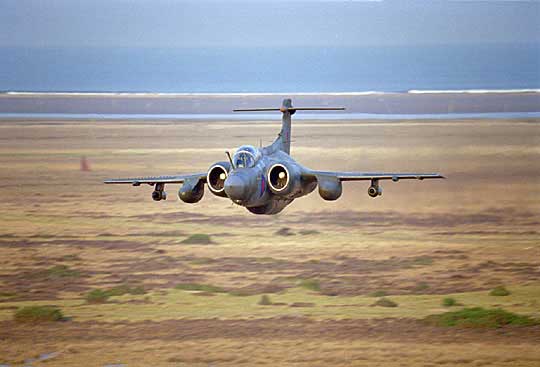
By better avionics it means better situational awareness and weapons accuracy delivery.
The Buccanner is a subsonic attack aircraft while the Tornado can fly at more than twice the speed the Blackburn Buccaneer can
At sea level the Tornado is also faster it`s maximum speed at sea level : 920mph(1,480km/h) while the Balckburn Buccaneer only gets to Mach 0.92(1040km/h)
MiG-23MLDwell if the money technological risk were no concern, how would u modernize your favorite aircraft?
Mirage 2000-5Mk2
F100-PW 229 (with Thrust vectoring nozzle 😀 ) instead of Snecma m53-2
moving canards instead the small static.
RBE2-AA Radar
Thales/SAGEM OSF infrared search and track system
Thales Spectra ECM
comformal fuel tanks😀 😀 😀
I would put into production the Yak-141 modernized with new avionics, radar, uprated engines with Supercruise and armed with R-37, Python V, Meteor and R-77

MiG-23MLDthe Sea Harrier..
give it a modern look down, multi purpose radar, a BVR AAM, like the AMRAAM…. electronic and structral improvments.. for another 15/20 years service… :confused: :confused:.. WAIT THERE A SECOND !!!!!!!!!!!!!!!!!!…. 😡 😡 😡 😡 😡 😡 😡 😡 😡
In my opinion there are very few aircraft that in 2006 with a decent upgrade offer advantages that new airframes do not.
But i would say the Harrier is one of the best aircraft ought to be keep in service for at least another 15 years more if not in the West at least in the third world.
MiG-23MLDSu-15
MiG-23MLDMiG-23MLDNo. Ferry range of vanilla Mig-29 is about 3000km with drop tanks. Ferry range of Mig-29M or Mig-29SMT with drop tanks is about 4500km. These are hard, doubtless facts. The data you quoted shows Mig-31 interception range as 720km – which is quite consistent with 720*2 = 1440km max distance at 2.35 mach. Note, however, what 2.35M is NOT full AB for Mig-31. Its just “average” afterburner setting, and fuel consumption is not as high as in full AB setting.
Chrom
I do believe very likely the MiG-31 can fly at 2.35 Mach for little bit less than 34 minutes, nevertheless the MiG corporation uses the term Range not radius of action, this is very important because in reality the terms have to be universal.
If Mach 2.35 equals 2500km/h, then in 6 minutes it flies 250km and 1500km in 36 minutes so a range of 1440km will mean 34 minutes
so very likely it flies around 34 minutes at Mach 2.35
I do understand Range as the Max distance an aircraft can fly with max fuel one way from point A to point B.
Radius of action as the distance it can fly from it`s base to a point X and back.
But i am not utterly convinced because MiG corporation used the term Interception range and not radius of action
MiG-23MLDInterception range is unambiguous: it is the distance from base at which a target can be intercepted, i.e operational radius of action. It implies that the plane returns to base after the interception.
“Operational range” is not unambiguous. It could mean the distance the plane can fly, i.e twice the interception range.
I can agree with that definition since for the MiG-29 says operational range and not interception range if the MiG-31 can fly 40
minutes> MiG-31`s time of flight at mach 2.35>30minutes well that is truely amazing, but if interception range means range well i doubt if will fly so many minutes at such speed
but if interception range means operational range then i do not think the MiG-23 has a range of 6200km because Mig corporation has this data for the MiG-23/27
Maximum operational range MiG-23ML, km 2 800
Maximum weapon load MiG-23ML/MiG-27M, kg 2 500/4 000
Ferry range with three fuel drop tanks MiG-27M, km 3 100
Maximum operational range with three fuel drop tanks MiG-27M, km 800
MiG-23MLDIts word twisting. “Range” means both “operational range” and “combat range” – depending of context. Of course, writing “combat range” would clear all doubt, but sometimes ppls in PR department dont even know difference between both. In case of MIG-31, we have numerous sources to confirm 40 min. at 2.35 mach.
Huh, compare 1.5 mach in clean configuration with 2.35 mach? See the difference? Moreover, its not clear what F-22 can fly even 30 min at 1.5 mach. As for IR… lets put it stright: at 1.5 mach you WILL be detected far, far away no matter afterburner or not. You cant hide your IR and radar signature at that speed – at least, not from modern IRST and radar. Thought i agree, what IR signature of F22 flying at 1.5 mach will be somewhat lower than IR of MIG-31 at 2.35M – its no way “stealthy”, but the difference between 1.5 and 2.35 is in fact even bigger than the difference between 0.9 and 1.5.
Chrom
What are you saying is MiG corporation people are wrong and Yefim Gordon and http://www.airwar.ru are right, i mean let`s be honest, if for the MiG-31` range the data is the following
Interception range at M=2.35, H=18,000 m, km 720
Interception range at M=0.8, H=10,000 m, km 1 450
Interception range with one inflight refueling at M=0.8, H=10000 m, km 2 250
then for the MiG-29 from data of the same MiG corporation should have a range of 5000km because
Operational range MiG-29/MiG-29UB, km
– on internal fuel 1 500/1 450
– with one fuel drop tank / with three fuel drop tanks 2100/2900/2000/2500
So then clarify me can the MiG-29 surpass the F-15 in range?
MiG-23MLDRANGE Got it? Means both ways, i.e 720*2 = 1440 km = 40 min. And then something still left for take off and landing.
would not be better call it combat radius? if i would not know how much fuel any jet spends at full afterburner i would believe you but i know the F-14 at totally full afterburner will gulp 18635kg/h per engine or in few words 37 tonnes in just one hour or it`s own weight fully loaded
Check this
Operational range MiG-29/MiG-29UB, km on internal fuel 1 500/1 450
– with one fuel drop tank / with three fuel drop tanks 2100/2900/2000/2500
So the MiG-29 will fly 5000km?
this is for the Tu-204
Service range depending on payload at accepted fuel reserves is equal to following: at max payload of 18000 kg – 5800 km, at payload of 13500 kg – 7500 km. The values are given for maximal take-off weight of 105000 kg, flight level 10100 – 11600 m and M=0.76-0.78.
so the Tu-2004 will fly 11600km?
This is for the Tu-160Range
14.000 km (with a load of 9.000kg)
10.500 km (with a load of 40.000 kg
so the Tu-160 will fly 28000km?
I understand by Combat radius an equivalent of half range, i will be utterly honest with you, Yefim Gordon in his book claims the MiG-31 has a 40 minutes range at Mach 2.35 like you do, http://www.airwar.ru claims it as the combat radius and this is 720km
Боевой радиус действия, км
при полете к на сверхзвуковой скорости 720
при полете на дозвуковой скорости 1200
при полете с дозвуковой скоростью с ПТБ 1400
but MiG corporation calls it range not combat radius
Interception range at M=2.35, H=18,000 m, km 720
Interception range at M=0.8, H=10,000 m, km 1 450
Interception range with one inflight refueling at M=0.8, H=10000 m, km 2 250
The reason i asked you if the definition of range equals combat radius then the Tu-160 according to FAS which has a range of 14000km then will fly 28000km extrange is not it?
MiG-23MLDTotal flight distance at mach 2.35 is 1,440km. Travelling a 320m/s x 2.35 equals 0.752 km/s. That means just over 31 minutes to fly 720km, engage the target, and fly back to base.
Though I am really not sure how important how long it takes is. The main points are that it will be firing its missiles at higher speed than any current fighter or projected fighter can supercruise at.First of all no. It is not supercruise. and second the Mig-31 already does fly at mach 2.35 for the entire mission… and it is faster than any current aircraft supercruises at.
You aren’t getting it are you. Firing a missile directly behind you at a target will result in a missile that can fly straight forward 20km and hit a target to have a range of less than 5km when shooting at something behind the launch aircraft. It makes much more sense to turn you entire aircraft around to shoot at something that is behind you than loose off a missile that does the turning for you.
The loss of energy from the aircraft is more than compensated by the shorter more direct path to the target… the missile accelerates much faster than any aircraft can, the aircraft carries rather more fuel than the missile.The only aircraft that would have enemy fighters sneaking up behind them would be Su-34s or F-111s or ground attack Tornados due to their flight profile and the fact that they are not operating with AWACs or ground radar support. Protecting its own airspace an Su-30MKI is rather unlikely to be attacked from close range from behind, where a Python V might make a difference.
Garry B
The MiG-31 will fly a little less than 20 minutes at 2500km/h because it`s range at that speed is less than 720km
The F-15 first won`t loose energy performing a Cobra niether speed so it willl launch the missile at good speed in a front hemisphere engagement, second it won`t need a radar on a tail sting for an aft firing, The F-15 pilot won`t experiment high overloads stressing him contrary to the Su-30 pilot pointing the nose even in a front hemisphere engagement, the Python V will do everything
The Su-30 will become a slow aircraft impacting in the R-73 and in the speed it will exit the combat area, the F-15 won`t have such problem with Python V
Both Missiles will experiment G forces in order to hit the target but the Cobra transfers energy too impacting in the G forces that the R-73 experiments.
MiG-23MLDThrust vectoring doen’t kill anything on its own of course. But pointing your nose at the target before you fire means a shorter flight path for your missile and more energy for your missile to use to hit the target. If you fire off the rail at a target behind you the missile enters a hard turn on launch that bleeds a lot of energy that should be speed for the missile. This greatly reduces range and manouver capability for the engagement. It also takes up time… a target behind you can shoot and kill you before your missile hits him so he can concentrate on defeating your missile instead of manouvering to defeat your missile and trying to keep you in sight at the same time.
Old missiles didn’t have fixed sights either. They were crammed into small noses and couldn’t turn very far off straight ahead but they weren’t fixed either.
A HMS is only good for targeting missiles the missile seeker can see. In the case of the ASRAAM that means 90 degrees off boresight is the limit. The HMS just tells the missile seeker where to look, it doesn’t send data to the missile about the target, like its position in 3D space… it has no range finding capability at all.
Two Su-30MKIs in a dogfight, both armed with ASRAAMs, one is on the others tail and they both fire at each other at once the guy on the other guys tail will live longer. If they are flying on a head on course with a 4km seperation and one fires an AMRAAM that has to turn 90 degrees, while the other does a 90 degree flick roll onto his side and pulls his nose up 90 degrees so he is pointing directly at the target and then fires then the guy that manouvers missile will hit well before the other guys missile. Whether he can gain energy enough to manouver to avoid the incoming missile is another question but the other guy will be dead before he is as his missile will accelerate very rapidly directly toward its target with minimum drag as it is not moving its control surfaces and the target is in the centre of its seeker.
Python V has lots of high drag control surfaces… hardly comparable to thrust vectoring. Thrust vectoring can’t stall. In fact the only reason the R-73 could be used in a rear firing mode was because its engine maintained its seeker on target even when fired backwards… ie initially flying backwards at a few hundred km/h and then through zero km/h with just the rocket motor holding the seeker on target and then accelerating forward towards the target. A missile like Python V would drop its nose with all its control surfaces useless with no air flowing over them and accelerate into the ground.
You seem to think that targets would have no problem evading an R-73 with only a 120 degree field of view. Wonder how planes managed to get shot down with missiles like Lima and Mike model Sidewinders with FOVs of 15-18 degrees either side of zero. The Brits had no problem taking on targets with such missiles…
A missile fired directly at a target will get there faster and with more energy than one fired from a high off boresight angle. R-73 can be fired from almost any aircraft, I doubt the Python could be used as effectively from a Helo… the low launch speed would make over the shoulder launches difficult due to the lower launch speed reducing the initial manouver capability. With thrust vectoring the R-73 is manouverable from stationary launch and can efen be fired backwards.
Flying around really fast and high just makes you a better IRST target, and the Russians and the French are the only ones currently to have long range IR guided missiles.
The Tornado is being replaced because it is old. Whether the Typhoon had a HMS or not it will replace the Tornado.
The 30km range is high altitude head on engagement with target and launch aircraft at high speed. The 0.3km range is the minimum launch range against a tail on target.
It makes you fly high, where long range SAMs can see you from great distances, and increases your IR signature to the point where long range IR guided missiles became more than a tail chase weapon.
(I am referring to nonstealth supercruisers).How about the company that makes the R-73?
According to their data it is 20km range for a 12 g target and 30km max range for a head on target.
+-45 degrees before launch and +-75 degrees in flight.
Of course that is for the R-73E and R-73EL export models.Modern all aspect IR seekers can see the really hot stuff from longer range, but as thermal imagers show, everything gives off IR energy… if you are going to target the hottest thing you can see (like first gen IR AAMs) then you will spend a lot fo time chasing the sun.
As I mentioned above it is 14km at altitude.
So a Typhoon supercruising at mach 1.4 fires a BVR missile at a Mig-31M firing back R-77Ms at mach 2.3. How does the fact that the Typhoon is using less fuel have an impact? Bigger prettier fireball?
So it makes smaller aircraft more viable, but for an aircraft like a Mig-31 with 20,000 ltrs of fuel will fuel use be a problem? Aircraft like Flankers would need to use up a lot of fuel before they become manouverable.
Or he could be saying it is still a theory… lets wait and see if it works first.
A fully fuelled Flanker is in a position where it needs to burn off fuel to get into a state where it can turn and fight if the BVR missiles fail.
All those control surfaces… it had better be carried internally or it is going to ruin any stealth features the carrier had.
The Mig-31 cruises at mach 2.4. How fast does the Typhoon supercruise at?
Doesn’t that show that supercruise without stealth is kinda not that great?
A super manourvering plane will not be doing more than 9gs with a pilot in it. The R-73 can engage 12g targets.
Calculate how many minutes a MiG-31 will fly at Mach 2.4?
from MiG corporation
Interception range at M=2.35, H=18,000 m, km 720
Interception range at M=0.8, H=10,000 m, km 1 450
Do you call that supercuise? real supercuise is in the F-22 that can fly almost all the mission at that supercuise speed.
Saying the SU-30MKI will surpass the F-15I armed with Python V is not exactly very accurate because you will bleed speed when you point your nose you won`t keep the same high speed that affects your missile too in range besides you can not fire a rear ward missile without a an extra radar on the tail facing rearwards
MiG-23MLDDoesn’t the number of FOXBATs blown out of the sky by Iran and the USA kinda DISPROVE that argument? In the case of the FOXBAT, at least? 😀
The point is that a supermaneuverable fighter will have a better chance of getting away from a new-generation AAM.
Well, that depends. You are, of course, assuming that the Jag or the Tornado even make it to the merge in the first place, getting by the BVR weapons the FLANKER tosses their way…
Confirmed kills of MiG-25 Foxbat are very few, less than 10 shot down by US and Israeli aircraft, the Iranian claims are only confirmed by Iranian Claims, Israel which is one of the best air Forces in the middle east and the world never claimed more than 3 or 4 MiG-25 shootdown, the americans the same and the Russian sources do not claimed large numbers of MiG-25s even in the Bekka valley the Israeli did not shot down many MiG-25s, the main aircraft lost there was the MiG-21 .
The Su-30MKI has a drawback in what respects the F-22 and Eurofighter and that it has not super cruise, the agility of a Su-30MKI does not mean unvulnerable to AAMs but having the first chance when firing a missile
The Tornado will be able to attack a Su-30MKI at long range because it has AMRAAM and at WVR has ASRAAM, both aircraft are moreless match in what respect odds, but remember what the USAF or RAF want is supremacy and for that you need the F-22 and Eurofighter


 Sign In








