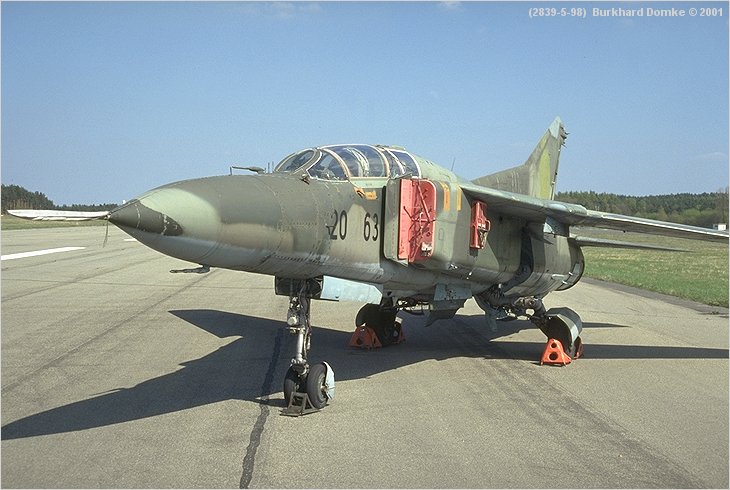
MiG-23MLD
I’ve said that data Sukhoj web given are very WRONG.
I must knew that EW of electric combat a/c generally bigger than other variant version.
F-111 and Su-24 have similar EW EXCEPT EF-111.
It is possible but remember the Su-24 has also variants and some are lighter or heavier,
MiG-23MLDVery Well, It seems that we have a consensus on the major part.
But this paragraph I quoted from you, which I have a little different view.1) EF-111 will never carry fuel more than or same as any other vertion of the F-111 serious. so the 15000kg is a suspicious data since the fuel loaed in other F-111 version slightly less than this number.
2) The data lost unit liter or kg may obscure the editor who wrote the article concerning the internal fuel capacity Su-24 carried. Around 16000 or 17000 must be liter with two 3000 liter EFTs, whereas the data around 13000 or 14000 seem to be kg as unite. If you reduce two EFTs weight from 14000kg, the result is quite closer to the weight of internal fuel JAWA adopted. Certainly, no matter 16000, 17000, or 13000, 14500, both of them are approximate number around the actual data.
Well franc of course some are aproximations because of the disparity in data.
If i am to believe Sukhoi, the internal fuel capacity is 11100kg and it will carry 8000kg of fuel tanks or weapons if you rest that from its MTOW weight gives you that the Su-24 weighs around the same an EF-111 at empty weight or 24000kg.
Now if you are to believe the data given by Yefim Gordon, the Ukranian and Belarussian air forces, then the Su-24 weighs around 22000kg at EW.
The EF-111 weighs around 25000kg at EW and carries around 15000kg of payload.
Since the EF-111 can carry two fuel tanks it carries a similar amount of fuel to the Su-24 why? well simple if the Su-24 carries around 5000kg in two fuel tanks, its internal fuel capacity must be something around 9000kg if we take the Ukranian and Yefim Gordon`s data so you get around 15000kg of fuel, using sukhoi data we get something like 16000kg of fuel including two fuel tanks.
In my opinion the EF-111 might have a smaller internal fuel capacity than the average F-111 variant but if it also carries fuel tanks it must have a total fuel capacity including internal and external fuel tanks similar to the internal fuel capacity of other F-111 variants
Since the range difference is not so far off from each other i guess their fuel tankage is similar since both weigh around the same weight and have similar ranges
MiG-23MLDMiG:
This paragraph may tell you why, if internal fuel wouldn’t be reduced, I couldn’t image why EW of the EF-111A surprisingly jump 20%!!
Specifications of the EF-111A Raven:
Two Pratt & Whitney TF30-P-3 turbofans, 10,750 lb.s.t. dry, 18,500 lb.s.t. with afterburning. Maximum speed: 1377 mph at 40,000 feet. Initial climb rate 11,000 feet per minute. Service ceiling 45,000 feet. Normal range 929 miles. Dimensions: wingspan 63 feet 0 inches (maximum), 31 feet 11 1/2 inches (minimum), length 76 feet 0 inches, height 20 feet 0 inches, wing area 525 square feet. Weights: 55,275 pounds empty, 70,000 pounds loaded, 88,948 pounds maximum takeoff.
The normal range which means no EFTs carried is 1495km. quite believeable.
I do agree, the EF-111 has an empty weight higher than the Su-24 but also a MTOW weight higher than a Su-24 according the Ukranian, Belarussian and most of sources except Sukhoi`s webpage, nevertheless The EF-111 must be even heavier than a Su-24 carrying two fuel tanks even if we use the Sukhoi`s data, nevertheless both aircraft are in the 40 tones range, probably the Su-24 in the range of 39000kg and the EF-111 in the range of 40000kg so even if the EF-111 has slightly more drag it has slightly better SFC and the Su-24 is slightly lighter .
If we consider that both aircraft have similar drag since the difference in range is not so high the Su-24 has a range of 2775km according to Sukhoi and the EF-111 something like 3150km this show the F-111 is not super economical but just slightly more economical and this is the closest aproximation to a real equivalency of both SFCs in real operations
Why to use these two airplanes? well because very likely both aircraft have similar fuel capacity see the EF-111 will carry at least 15000kg of fuel and the Su-24 very likely will carry around 16000kg of fuel according to Sukhoi or around 14500kg according to the Ukranian air force and Yefim Gordon, since the EF-111 can carry too two external fuel tanks


MiG-23MLDSee, canards are forward tail-planes only. There is no other function. As a secondary effect, canards generate a vortex above the main wing, a function which is already performed by Tejas’ sloping lower-swept part of the wing.
Again, canards are used for pitching moments only, whereas for rolling the delta-wing’s airelons are used (canards cannot oppose each other like airelons).
There is also a misconception that delta-winged planes like Tejas or Mirage-2000 are less manoueverable because they have only 2 control surfaces, whereas planes like F-16, MiG-29 or Gripen, EF etc. are more manoueverable because they have 3 control surfaces. It must be remembered that the Tejas and Mirage-2000 can also perform all the 3 movements i.e. pitch, yaw and roll. Combinations of these movements is also possible.
We may consider the airelons and elevators of the F-16 or Su-30. The airelons ALWAYS oppose each other, whereas the elevators ALWAYS support each other. In a delta like the Tejas, the 2 elevons (elevator + airelon) can oppose as well as support each other, thus performing the actions of elevators and airelons as and when needed.
Assume that an F-16 is executing a roll while simultaneously pitching up. The Tejas can also execute this manouever simply by deflecting one elevon lower than the other. Now assume that an F-16 is pitching up and banking. The Tejas can execute it in again the same manner.
It is known that pure delta configs have higher instantaneous turn rates than canard-delta configs. High sustained rates may also be achieved by lowering the AoA and by the vortex generation of the sloped lower-swept wing.
Abhimanyu
The Canard Delta is more effective in several aspects, because the canards is a trimming plane, the pure delta wing has more fluctuations and sensibility in center of lift shifts, it can not trim so well as a canard or taiplane configuration.
Example the MiG-21 was more agile than the Mirage III, the Israelies knew it, but they knew too the Arabs did not fly their MiG-21s to their full potential making it a pray of their Mirage IIIs.
What you are trying to say is the LCA will beat the MiG-29, Gripen or F-16, however it is over simplistic the LCA is agile no one denies that but its a fact the Rafale is better than the Mirage 2000 thanks to the canards and higher TWR
MiG-23MLDactually I find the two seater Typhoon more attractive than the single seater ones..and the twin seater Rafales are very attractive too..and the twin seater Gripen is not at all ugly ! if anything, its the twin seater Jaguar, and the twin seater MiG-29UB which are the two most ugly two seaters combat fighters around..the MiG-35 looks a lot better than the MiG-29UB, but still, the smaller radome makes it look a lot less attractive than the MiG-29KUB which otherwise looks similar.
I love the Jaguar twinseater and also the T-2, however my favorite fighter in that category is the F-1 http://pagesperso-orange.fr/aeromil-yf/jaguar.htm
MiG-23MLDF-16B ftw.
is the F-16B ugly? now i do understand why you call your self madrat the F-16B is the most beautiful F-16 variant.
This is ugly but the F-16B is not

MiG-23MLDFranc here you have an excellent site for Su-24 pictures some are very contemporary pictures taken recently, these are from current russian air force Su-24s
MiG-23MLDTo show, that you tried to cheat the readers here and not even be ashamed about that.
Primary function Electronic countermeasures support
Contractor Grumman Aerospace Corp.
Power plant Two Pratt & Whitney TF-30-P-109 engines
Thrust 2x 18,502 lb 2x 82.32 kN
Length 76 ft 23.16 m
Height 20 ft 6.10 m
Wingspan minimum 63 ft 19.20 m
maximum 32 ft 9.74 m
Wingarea (min. wings ext.) 525 sq ft 48.77 sq m
Max. speed 1,587 mph 2,554 km/h
Initial climb rate 551 ft/s 168 m/s
Ceiling 45,000 ft 13,715 m
Max. takeoff weight 89,000 lb 40,050 kg
Range 1,430 miles 2,300 km
Sensors AN/ALQ-99E jamming subsystem
Unit cost $35 million
Crew Two (pilot and electronics warfare officer)
Date deployed June1981
Inventory Active force, 29; ANG, 0; Reserve: 0
Interesting Sens the EF-111 weighs almost the same weight a Su-24 does and has almos the same range how can you explain that diference? similar weight similar range it seems the SFC is not the answer for that since it has more advanced TF-30 variants than earlier F-111 variants see it is 14 tones lighter then the FB-111 as the Su-24 is and weighs almost the same a Su-24 does and has a similar range even closer to the one quoted by Sukhoi, remember the Su-24 has less internal fuel capacity than the F-111 and even if the EF-111 has more electronic equipment is range is not far too different from the Su-24 it is very close to it indeed

MiG-23MLDMiG:
The 17883 liter fuel for the Su-24 is believeable, whereas over 19000liter fuel for the Su-24 could be conceived as 3 EFTs carried.
The mistake made by Sens mas a cause de your confusion.
Some concepts of dynamic increment will make clear for you:
presume
△EFTs is an increment for Su-24 EFT added more
△Rs is an increment of range for Su-24 accompany with more EFTs added.
△EFTf is an increment for F-111 EFT added more
△Rf is an increment of range for F-111 accompany with more EFTs added.
Then real thuth is △Rf/△EFTf >> △Rs/△EFTs (EFT >2)
Indubitably, because the basic number of internal fuel for the F-111 has already been much more than Su-24, so it was possible that range for the Su-24 with a couple of standard EFTs would be still less than F-111 only carry internal fuel a little bit. But they are almost same at this time. otherwise, if the F-111 carry two EFTs,which won’t enlarge 1/3 more range for itself, how can it take 1/3 more range compare with Su-24 which two 3000liter EFTs has already been loaded? Remember each EFT for Su-24 almost 1/4 bigger than F-111’s.Certainly, if the F-111 carries four 2270 L EFTs, its range possibly be large enough, but meanwhile, warload on F-111 under this situation won’t be reach 3 tone as well as the Su-24.
The war-load for each pylons underwing was also maximum warload for F-111’s pylon each I ever saw.
So, our stand is if warloads was equivalent, there would be no more EFTs for enlarging the range of the F-111, because no more pylons provided.BTW,Would you please post all of Slavonian web concerning Su-24 specifications follow.
Well Franc it depends in what is the real SFC and range, i think and you can see, that in reality the AL-21 indeed is spends more fuel at its max SFC at military power since its max SFC at military power is 0.86kgf/kg/h however it is not 30% since the TF-30 has a SFC of 0.67 but at lower thrust.
The Sens concept is this TF-30 SFC is 0.67 and the AL-21 is 0.86, by logic the ratio is 0.67:0.86 is 1.28:1, so efectively the AL-21 is at its max military SFC 30% more fuel thirsty, however this would be true only if the TF-30 has the same thrust at its max military power, if the TF-30 gets its thrust at 79KN already is using afterburner, so its SFC is higher than 0.67 for sure, if the Al-21 has a thrust of 66KN then its SFC is lower than 0.86 very likely 0.76 in cruise regime
Now how can we explain the claimed difference in range, the EF-111 has a shorter range and has a MTOW in the class of a Su-24
Specifications StatsCentral
Model General Dynamics / Grumman EF-111A Raven
Length 76.02 ft | 23.17 m
Width 62.99 ft | 19.20 m
Height 20.01 ft | 6.10 m
Engine(s) 2 x Pratt & Whitney TF30-P-3 (later TF30-P-9) turbofan engines with afterburner delivering 20,840lbf of thrust.
Empty Weight 55,274 lbs | 25,072 kg
MTOW 89,001 lbs | 40,370 kg
Max Speed 1,855 mph | 2,985 km/h | 1,612 kts
Max Range 2,000 miles | 3,218 km
Ceiling 44,997 ft | 13,715 m | 8.5 miles
Climb Rate 11,000 ft/min (3,353 m/min)
Hardpoints 2
Armament OPTIONAL:
2 x AIM-9 Sidewinder air-to-air missile
2 x 600 gallon external fuel tanks
Accommodations 2
Operators the United States of America
http://www.militaryfactory.com/aircraft/detail.asp?aircraft_id=277
So as you can see the EF-111 is not very different to an Su-24 in range and it weighs more or less the same
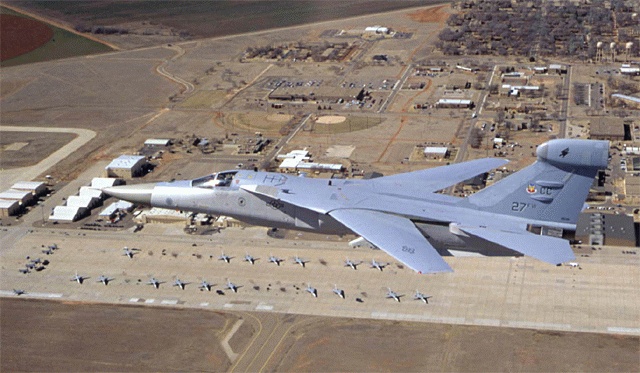
Specifications (EF-111A unless noted)
Data from The Great Book of Modern Warplanes [7]
General characteristics
Crew: Two (Pilot and Electronic Warfare Officer)
Length: 76.0 ft (23.17 m)
Wingspan: 63.0 ft spread, 32.0 ft swept (19.2 m / 9.74 m)
Height: 20.0 ft (6.1 m)
Wing area: 657.4 ft² spread, 525 ft² swept (61.07 m² / 48.77 m²)
Airfoil: NACA 64-210.68 root, NACA 64-209.80 tip (F-111F)
Empty weight: 55,275 lb (25,072 kg)
Loaded weight: 70,000 lb[8] (31,751 kg)
Max takeoff weight: 89,000 lb (40,370 kg)
Powerplant: 2× Initially Pratt & Whitney TF30-P-3, later upgraded to TF30-P-9 turbofans with afterburner, 20,840 lbf (TF30-P-9) (92.7 kN (TF30-P-9)) each
*Zero-lift drag coefficient: 0.0186 (F-111D)
Drag area: 9.36 ft² (0.87 m²) (F-111D)
Aspect ratio: 7.56 unswept; 1.95 fully swept. (F-111D)
Performance
Maximum speed: Mach 2.5, (1,650 mph) (above 30,000 ft for all F-111) (2,985 km/h (F-111))
Range: 2,000 miles[9] (1,740 nautical miles)
Service ceiling 45,000 ft[8] (13,715 m)
Rate of climb: 11,000 ft/min[8] (3,353 m/min)
Thrust/weight: 0.598
Lift-to-drag ratio: 15.8 (F-111)
Armament
No normal armament, possibly 2xAIM-9 Sidewinder
2×600 gal fuel tanks possible
http://en.wikipedia.org/wiki/EF-111A_Raven#Specifications_.28EF-111A_unless_noted.29
General characteristics
Primary function Electronic countermeasures support
Contractor Grumman Aerospace Corp.
Power plant Two Pratt & Whitney TF-30-P-109 engines
Thrust 2x 18,502 lb 2x 82.32 kN
Length 76 ft 23.16 m
Height 20 ft 6.10 m
Wingspan minimum 63 ft 19.20 m
maximum 32 ft 9.74 m
Wingarea (min. wings ext.) 525 sq ft 48.77 sq m
Max. speed 1,587 mph 2,554 km/h
Initial climb rate 551 ft/s 168 m/s
Ceiling 45,000 ft 13,715 m
Max. takeoff weight 89,000 lb 40,050 kg
Range 1,430 miles 2,300 km
Sensors AN/ALQ-99E jamming subsystem
Unit cost $35 million
Crew Two (pilot and electronics warfare officer)
Date deployed June1981
Inventory Active force, 29; ANG, 0; Reserve:
http://www.military.cz/usa/air/in_service/aircraft/ef111/ef111_en.htm

MiG-23MLDHow about the MiG23UB?
i do not like too much the MiG-23UB it is kind of ugly looking most of the time for me but sometimes it has moments when it looks kind of beautiful but love also borns by getting use, it is not a beautiful aircraft in my opinion but the ugliest twin seater fighter built in Europe now is the Gripen
MiG-23MLDsomething on the lighter and uglier side :dev2:
Rafale B
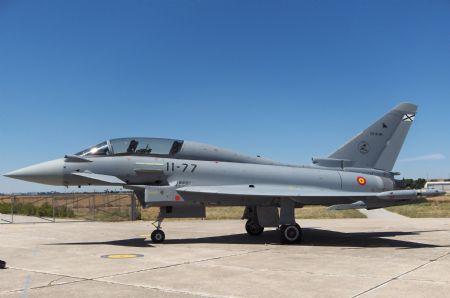
Typhoon Two seater
Gripen B/D/Demo
MiG-35
Definitively the Rafale is not ugly
The Rafale is beautiful as any jet aircraft built in France (well most of them) i can not say the same about the Russian aircraft which many are definitively ugly such as the twin seaters variants of the Su-7, Su-9, Su-15, even the MiG-23UB.
In beauty constests the French always win in what refers Dassault fighters

MiG-23MLDMiG:
I think that three EFTs carried by SU-24, which is out of question, as well as 6 EFTs carried by F-111. Most official web wouldn’t give a correct data, esp, for important data of combat or judgment.I only cheat you here, just because the process I made in calculation was not in terms of your hope.
I believe you didn’t cheat me because you hid the data you adopted from me.:p
Well to tell you the true data is many times unaccurate, for example if we are to believe the Ukranian air force, the Su-24 only weighs 39700kg at MTOW, it means it only has around 17000 liters of fuel with a range of 2775km and the F-111 will have more than 19000 liters with a range of more tha 4700km according to some data.
if the Su-24 has a max range of 3800km it means it uses its cruising regime SFC of 0.76, now if the F-111 indeed can fly a range of 7600km more or less the relation corresponds to the difference in fuel and SFC.
Now Sukhoi gives a minimun of 19000 liters for total fuel capacity, with 19000 liters of internal fuel the F-111 might have a range of 4000+ km so its possible the relation is not as high as we suppose.
However neither Sens me or You have proven facts because we have different values and Sens is not using data from the Ukranian air force since a lighter SU-24 with longer range contradicts his preconceptions, however some data does support his view, but i guess some data even for the FB-111 is hard to believe because they say the range is far too long almost like a Tu-22M something i do not believe since the Tu-22M is a more powerful bomber
and still in use so this means the F-111 might have some drawbacks
MiG-23MLDIts not established that pure delta configs have higher instant turn rates—Gripen, Rafale and Typhoon has higher instant turn rates over the Mirage 2000, all three planes at least over 30 degrees per second.
A pure delta config has its elevons closer to the center of gravity or better yet the fulcrum point of the plane. If you understand the mechanics of lever action, the closer you are to the fulcrum point, the greater the effort or in this case, control authority exerted to lift the other side of the lever, which in this case, is the nose to pitch.
With this in mind, you can start to understand why some tailed configurations like the F-22, try to extend the tail planes as far away from the plane’s fulcrum. You want the least amount of control authority to exert the same force to turn the aircraft on the same degree, or the same amount of control authority to turn the aircraft on a higher degree. Being efficient on this is a major factor in maneuverability. This is the reason why tailed configurations have an inherent advantage on maneuverability. The Soviets knew this early and hence why they junked the pure delta configuration early and went to the tailed delta. Note the way the MiG-21’s tailplanes extend backward, and it isn’t just for sweeping.
If the control surfaces is more efficient producing the same amount of authority thanks to lever action, the control surfaces can trim less to produce the same amount of authority and turn. That means less drag, and less drag means better sustained rates. That’s one reason pure deltas don’t have good sustained rates and have a high energy bleed on turns.
Canards offer a variation to the control authority issue by providing a second lifting force on the other side of the lever which complements the downward force from the elevons on the other side. So you have two forces acting simultaneously. And because of this too, the required trim for all four surfaces amounts to a lower degree than if you have two large control surfaces as the elevons. This produces less drag on the sustained turn.
Canards differ from cranks or LERX because they are _variable_ which means they can adjust dynamically to the changes in the downstream vortices using an air flow sensor downstream.
The canard has also drawbacks among them the fact they also affect the wing flow dynamics and not always this means this will benefit the aircraft, also they increase buffeting and in some types of wings they even might reduce the benefits by moving the center of lift and affecting stability.
true in some conditions they might help and increase agility.
The Tailplane as you have said needs to be farther away from the center of gravity but this is not always the case farther back it will reduce the effects and benefits the wing`s down wash might have on the taiplane, same is with canards, the Rafale has very close the canards to the wing to benefit the wing.
a moving canard also affects the center of lift sometimes it might benefit but some times it won`t, also canards sometimes increase drag and reduce lift, this constraints force the canard to be relatively small and in some cases ineffective
No aircraft is perfect in fact any configuration is a compromise.
The advantages of the canards are lower landing speed and higher ITRs, but usually their STR are not as high since the delta wing generates very powerful vortices that can burst quit easily, they have excellent AoA behavior then they have good ITRs but their vortices usually burst quit easily, contrary to a less swept outer wing section of a LERXed wing.
The LERX and tailplane configuration also has benefits, and it does not affect the wings aerodynamics since the tailplane is behind the wing and still has extra lift ahead of the wing`s center of lift thanks to teh LERX, for the Russians it was the best configuration and the Su-35BM already deleted the canards; the LCA deleted them too becasue it allows a smaller fighter with less drang and more range (consider the LCA is too light it needs to have longer range since it won`t carry a lot of fuel)
MiG-23MLDexcept repeat same word, what more can you do?
I kind of accept the AL-21 is a more fuel thirsty engine than the TF-30, why? well it has a SFC of 0.86, yes it has more thrust, around 15% more but still is far far more thirsty.
The range published always changes either for the Su-24 or F-111.
For example Sukhoi claims a range or 2775 km with only two fuel tanks, which is not the max fuel in reality the Su-24 can carry, the real max range of the Su-24 is still something difficult to guess specially with three fuel tanks.
If the Ukranian air force webpage is right the max range of the Su-24 could be 3800km because with an inflight refuelling it will reach 5000km according to Sukhoi it self.
However if the FB-111 can reach up to 7600km with four fuel tanks and two nuclear bombs in the bombs bay indeed it is a really long range bomber.
the speed for that mission well we can only guess since fully loaded the FB-111 is at least 10 tones heavier than the Su-24 and at military power has less thrust it is probable its ferry range it is at very low speed perhaps 500-600km an hour but that is only a guess.
The vast majority of data is inconclusive, compared to the Tu-22M the FB-111 carries only a symbolic warload, now how far it can reach with six fuel tanks well that is something very difficult to guess.
MiG-23MLDModern Attack Aircraft – Mike Spick
Some further data from: Modern Fighters and Attack Aircraft – Barry C. Wheeler
range with max internal fuel
(A/D) 3165 miles (5093 km)
(F) 2925 miles (4707 km)
(EF) 2484 miles (3998 km)
Sens
This information is what i have in one of my books the 7000 galons of total fuel is not in a aircraft carrying 6 external fuel tanks, in fact it carries only 4 external fuel tanks it means the 6 tanks are much more than 7000 galons however to be honest the book also says the range with four external fuel tanks and two nuclear bombs is 4150nm around 7500km, the max weight for the FB-111 is 54 tones, more than 10 tones than a Su-24.
Now if this information is true then the FB-111 indeed is a really very long range bomber


 Sign In