 MiG-23MLD
Now you get carried away again.
To make something comparable related to range. You have to look, how many km you can generate from every kg of fuel carried.
Much more reliable than any guessing or strong claims in books.
Another yardstick to make things comparable is the ratio between empty equipped and MTOW. So use your time for the benefit of all and give us some data about that. When I remember well no problem, when it comes to your Russian aircraft books.
Yeah you have given a very important aspect see this fact
The TF-30 has less thrust at military power, its SFC at military power is 0.69 kg/kg/h and the F-111 is heavier at MTOW then you have the Su-24, its AL-21 has a SFC at military power of 0.76kg/kg/h it is lighter at MTOW and has a thrust higher at military power.
Then if the F-111 is heavier at takeoff weight since it carries much more fuel, and its cross section is wider, what makes you think its lower yield engines are used more efficiently? you imply that the heavier F-111 has much less drag having even a wider cross section and having heavier MTOWs its lower yield engines will make it fly at the same speed.
is it logic? no it is not logic the F-111 carries more fuel and the AL-21 has a SFC just slightly higher but it has a higher thrust at military power and powers a lighter aircraft, the F-111 achieves more range mostly thanks to a larger fuel capability
see that even if Sukhoi is right the Su-24 carries at the most 21000kg is fuel while the F-111 according to the MTOW cited by the RAAF will carry around 32000kg in fuel and that is almost the same relation in range
MiG-23MLDThe only way the range demands could be reached, despite high-tech engines.
Vietnam operation Combat Lancer in 1968 did show, that the F-111A was in need of modification. The main cause came clear by the loss from dec 22 in 1969. The failure of the forged pivot fitting. The Air Force ordered all F-111s grounded, and the plane did not return to service until the following July.
There were still some problems left with the new-tech engine and some electronics including the terrain-following radar. But the F-111 was “over the hill of main problems” now and an excellent striker.
The starting problems of the F-111 were noted by the Russians and they were not eager to repeat that again or learn it the the hard-way, when it came to the related high-tech. Even than it was a long way for the Russians from the Su-24 to the later Su-24MK. Range capability became sacrificial.
The Russians did indeed want a better engine in the Su-24, they wanted to fit the AL-31 into the Su-24, however it meant a total redesign of its inlets, some Sukhoi designers even proposed a third inlet should had been fitted on top of the fuselage of the Su-24.
At the end it never happened but you overstimate the F-111, the Russians had the Tu-22M and niether Europe or the US designed an aircraft in its class, the Russians never wanted a FB-111 type of aircraft, just a more fuel efficient aircraft by fitting the Al-31, but later they realized the Su-34 was a far better proposition than the F-111 or F-15E type of fighter bomber.
One option never applied onto the Su-24 was applied on the Tu-22M3, the Tupolev bureau did modify the inlets of the original Tu-22M0, this made it a much much better aircraft than the FB-111 and allowed a cheaper more standarized version of Su-24s since the AL-21 was used by other Russian combat aircraft of that time

MiG-23MLDMiG-23MLD, I’m afraid you are once again mistaking the “notch” in the wings of Viggen or Tejas to be the crank. This notch is discernible in both the aircraft from the top-view only.
However, the crank is the lower-swept leading edge, that is “hammered down”. It is visible from the side-view. A hypothetical 90 degree “hammering” will make it perpendicular to the rest of the wing — however, in Tejas’ case it is done to the limit of 5 degrees only.
This is the portion of the wing, which generates the vortex above the wing. It is absent on the Viggen.
Reference :-
Sorry i could not open the webpage you recomended me.
Well in general since i have not the experimental results and i am not an aerodynamist i can not tell you how it affects the vortex, however the less sweep angle in the inner board section of the wing leading edge in the LCA, F-16XL and Viggen is to reduce vortex formation, since a less swept leading edge angle delays it and very spefically in the F-16XL and Viggen helps them to control pitch loads caused by vortex formation
If it has a 5 degrees wing gull like the Corsiar or Stuka

I guess it might also delay further the vortex formation and flow separation
MiG-23MLDWing internal fuel tanks is OK. The second point is about the landing-gear.
Every technological decision has its price. Another is about external load stations related to VG.http://www.globalsecurity.org/military/systems/aircraft/images/f-111f-DF-ST-91-02452.jpg
http://www.aeronautics.ru/sukhoi/su-24_fencer/su-24m-022-ukraine.jpg
http://www.aeronautics.ru/sukhoi/su-24_fencer/su-24m-010.jpg
Sens
Independently of your riddles it seems you like riddles like the Sphinx, the Sphinx sat outside of Thebes and asked this riddle of all travelers who passed by
What goes on four legs in the morning, on two legs at noon, and on three legs in the evening?
and a modern riddle:
Something “unknown” does beat the Su-24MK by a wide margin, when it does not the F-111 in a similar way. What are the technical secrets of that?
Data from JANE’S
~14,1 tons empty equipped
internal fuel (RAF) 5.090 kg
over 9 tons of external load
over 28 tons MTOW and in overload conditions >30 tons
ferry range > 3900 km
radius of action with heavy weapons-load (hi-lo-lo-hi) 750 nm or 1390 km
Mach 1,2-2,2
You should change it what uses three external fuel tanks, has an engine with a SFC in military power of 0.76 and has only fuselage tanks?
You`ve already gave one before for the Panavia Tornado.
Any way less fuel tanks=less range, SFCs of 0.69 and 0.76 show a slight difference in fuel consumption, the riddle is simple SFC in engine technology does not explain by itself the range difference.
MiG-23MLDYes, just forgotten. Someone put the specs in the trash before design was finished. Was a long night again in the design office.
Anyways, a fuel tank in a swept wing comes with price in weight and complexity. It also has a structural knock-on effect, for example on the already highly loaded pivots. So, if your specs don’t ask for more range, you cancel that.
It seems general dynamics did not care about riddles and made the F-111 with internal fuel tanks and ability to carry external fuel tanks hanging from the wing pylons.
The Su-24 only carries three external fuel tanks and one is hanging from a fuselage centerline hardpoint and the other two from the wing gloves.
Yefim Gordon only reports the Su-24 has internal fuselage fuel tanks and the cutaway does not show any internal wing fuselage fuel tanks.
MiG-23MLDhowever up to what i understand the main wing has the notch of less swept to reduce pitch down loads created by the canard down wash.
The vortex effect on the aft-section on the wing? (the canard generated), what you are saying there (if is that the case), resulting in a downward nose pitch?
All very swept wings have the tendency to generate vortexs at a specific speed, is probably the Viggen engineers preferred these vortexs at that section, than the very energized canard flow on a more backwarded wing surface
That is not the case of the Lca, which seems to use the very angled swept to generate vortexs, and if you take a look, that section starts in a forwared position, and it doesnt have canard to worry about, i dont know the efficiency for that configuration (compared with other “styles”), but probably it was chosen due size/weight savings and size limits for the wing…among other possible reasons
Well up to my understanding and if you want you can read both articles where i have taken the information:
This webpages is very important to understand why the have a notch, in the F-16XL they have a compound wing which has a leading edge notch and a trailing edge extention to control down pitch movement when the wing looses lift at high AoA
http://www.aoe.vt.edu/~mason/Mason_f/ABMSThes.pdf
any wing generates vortices, however the delta wing generates very powerful vortices and they begin at the root of the wing, the Delta wing generates by it self vortices likewise the canard also does the same, it generates a vortex, the interaction of both vortices improves the main delta wing`s lift, however they can also move the center of lift
this webpage gives a very detailed analysis of the Viggen`s aerodynamics
http://ntrs.nasa.gov/archive/nasa/casi.ntrs.nasa.gov/19870013196_1987013196.pdf
And this explain the basics about stability
http://www.aoe.vt.edu/~mason/Mason_f/canardsS03.pdf
Tailplanes have a natural downward load force this makes tailplanes very practical despite they are bigger than canards, however in the Viggen`s case its canards also create the same force in the wing so the downward force has to be reduced, since the straight wings generate less powerful vortices, reducing the sweep of the delta wing at its root will delay the vortex generation in the delta wing increasing lift and higher AoA handling.
In the Gripen`s or J-10 this is not needed since the wing is far ahead and the stability is not so affected as in the Viggen`s case.
The LCA has no canards, so they Indians new in order to keep it small they needed a wing far ahead and not aft as in the Viggen`s case, this aided the design to dispense of the canards
MiG-23MLDIm really not so sure that Viggen use the vortex generation as a primary aerodynamic feature, the crank shape is located very aft-side of the plane , in the case of the viggen im not sure if they chosen that wing for vortex generation or just to move a bit forward the lift vector location relative with the airframe, or to increase the wing area, etc..
not because it have a crank means it use some specific aerodynamic concepts (or was meant to), you can have sometimes some effects…but these can even been counter-productive
the topology of both wings also are quite different (something that most ppl dont obverve on the wings is actually it topology)
The canard down wash keeps the main wing vortex attached to the wing delaying the flow separation the wing might experience and the center of lift shift it might create.
however up to what i understand the main wing has the notch of less swept to reduce pitch down loads created by the canard down wash.
I have read one of the drawbacks of the use of canards is the adverse effect they have on the fuselage and sometimes in the center of lift and therefore stability, so since the Viggen already is a very stable design that uses mostly the canard for STOL operations it will turn even more stable and less agile
MiG-23MLDMiG-23 MLD, the crank is seen from the side-view, but is indescernible from the top-view and front-view. This is because, it is a downward bend similar to the downward “droop” of the cockpit of Su-30. The angle of bend is 5 degrees.
Thus, this cranked feature of the leading edge (as highlighted in red colour in the photo posted earlier) provides a vortex above the wing — which is the same function as that of canards. The degree of this vortex may be a matter of debate, however it augments manoueverability at low-speeds at low altitudes.
Again, it must be noted that other than the Tejas, no 4th or 4.5 G fighter, in service or experimental has had a cranked wing.
In contrast, the Mirage-2000’s wing is a plain delta and is not “chiseled” enough in all 3 dimensions, to provide the measured air-flows as provided by the Tejas’ wing.
It must be noted that as per media reports, the Tejas’ test pilots have rated it higher than the Mirage-2000 in take-off, landing and also in general handling.In the schematic diagram of the Tejas posted by you, the anhedral of the wing that was referred by you earlier is not visible in the front-view. Your perception was because, as mentioned earlier, the Tejas’ rear wheels are at a lower level than the front wheel in order to assist the Tejas during take-off.
To be honest i do not see that, it might have it but from my point of view the wing is very similar to the one seen on the Viggen but with more fuselage and wing blending and some degree of anhedral since the front view picture does not show the sea gull style wing you claim, it has 100% sure a chiseled delta wing cut of less sweep angle but i can not see any sea gull wing, just more fuselage wing blending than in the Viggen.

In both aircraft, the LCA and AJ-37 Viggen the wing notch, its designed to reduce vortex formation to delay flow separation and Center of lift shifts, however the Indian design does not use canards to keep the LCA`s dimensions small and its weight light enough
Nevertheless the Mirage 2000 also has strakes on the inlet nacelle just ahead and above of the main delta wing to delay vortex formation and flow separation
Each design shows different parameters and solutions to the effects of vortex formation and flow separation at high Angles of attack

http://lh5.ggpht.com/_S-dOsNxwIIk/R7lDumTtbFI/AAAAAAAACks/Eid4lEOmHss/11.jpg
MiG-23MLDWell, not relevant to my my post regarding PRC engines, but I decided to quote you post because:
I am a big enough person to admit when I am wrong. And, I know my wording was rather let say “unprofessional”.
Post deleted and re-posted below!
** Edit,
Actually no…
This is the wrong thread for the question in the 1st place…
Apologies to all…..
No problem i guess it would had been better just to say send me a Private message since in that way you could get the technical specifictions without any possible deviations
MiG-23MLDGood finding. Look into the cutaways of both aircrafts and you will find out, where that “extra” fuel is housed.
independently of the riddle, the Su-24 has only fuselage fuel tanks and the F-111 has wing internal fuel tanks, however the Su-24 has narrower fuselage.
MiG-23MLD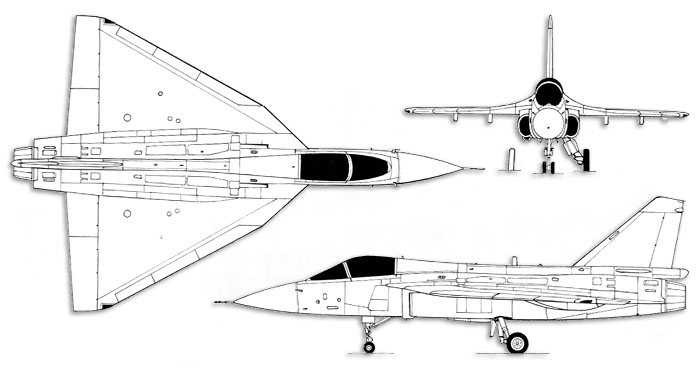

comparative view of the LCA and Viggen
MiG-23MLDHow large the fuselage is not only depands on the gap between the engine nacelles but also depands on the size of engine. meanwhile,
how many fuel the fuselage carry not only depands on the size of fuselage but also the size of engine.
The TF-30 and Al-21 are almost the same size and ironically, the TF-30 is slightly bigger, however it is obvious the Su-24 has a slimmer fuselage and smaller wing gloves, and in general dimensions is slightly larger, that is the only way to explain the smaller fuel capacity it has.
MiG-23MLDADA explored the canard delta configuration on the N-LCA and did’nt find it improving performance, so decided that could be done without.
also, the TVC option is being studied for the Tejas’ future batches. anyway, if the Tejas meets or exceeds the Mirage-2000’s performance, its already done well enough. with the avionics that it’ll have on board, it’ll be on par with the Mirage-2000-5 and that’s one good fighter.
feel free to believe whatever it is you want to believe. I’m not going to post more on this, because neither of us will change our arguments.
the LCA has a set of specifications, canards have advantages but probably the Indian specifications are not going to be compromised even if the canards give some advantages since probably the benefits in performance are not worthed if they want to keep drag low, a light weight and a relatively longer range , in reality if the LCA is as good as the Mirage 2000 and is armed with good missiles i bet i can defeat the even the Su-35BM or Typhoon but in turning and high AoA it is very likely it might be as good or better than the Mirage 2000 but without Thrust vectoring control nozzles it is unlikely it will be more agile than the J-10 or Su-30MKI
MiG-23MLDWARNING: Strictly for the guys into PRC military developments (Not interested in urinating contests).
Pinko and the rest of you guys,
Could you give specs for the following engines (thrust, fan/compressor)…(Preferably official but more than happy if you could just give some speculations, rumors etc, etc)
WS-10
WS-10A – Taihang
WS-13
WS-15 – Taihang-II?I am trying to get all details in one and but too lazy to do it myself :o.
Thanx a million
– Hyper
The forum is for everyone, and not for a few, a thread is for everyone to participate, for everyone to give his or her opinion, your warning frankly is not nice niether goes well with the forum rules, please accept opinions even if you do not like them, a forum is a forum and by forum means any one can participate and opine
MiG-23MLDvery likely..:rolleyes: its talk like this that has built up the J-10s reputation..where are the OFFICIAL figures ? you just look at canards on the J-10 and that automatically means the aircraft has performance that matches latest Euro canards?
had the LCA not been so much in the news through official and media reports, any Indian could have claimed that it had a “likely” max AoA of 30 degs and it would have become “one of the best fighters in the world”.
You are claiming this based upon pride and not upon aerodynamics, the reason why the J-10 has to be as good as the JAS-39 is simply based upon aerodynamics and statements made by the US navy.
The MiG-29 and Su-27`s configuration assures good AoA and turn ratios, the Eurofighter configuration too, any analysis made in the West considers its aerodynamics and the AL-31 to calculate its weight and performance and just by the Al-31 they consider its weight and its planform easily gives some performance data way
You dream the LCA will be a super fighter with a tailess configuration, just why? well simply by national pride, however if you are cold you know the LCA has real aerodynamics and real limits, if you know the real limits of the tailess configuration you understand that the tailess configuration is used to keep weight down but it has some aerodynamic drawbacks and the reports go well along it, the AoA is limited simply by the use of flaps, no other aerodynamic pitch control devices can be applied unlike the tailed and canard configurations.
The LCA has to be kept light enough because the Kaveri has an specific thrust yield and to achieve a performance, it is needed to keep an specific weight, thrust and lift /drag relation
If you want a simple striaght answer the Su-35BM, F-16MATV and MiG-29OVT are the most agile fighters ever designed since the TVN technology has a 3D capability unlike the 2D of the Su-30MKI, the Su-35BM deleted the canards because the TVN technology makes it not necesary to have canards, canards became superflous in the Su-35BM, thrust vectoring means you can vector the thrust and the 117s can vector the thrust in pitch and yaw, unlike the AL-31F version used on the Su-30MKI which only vector it at pitch, then canards are needed in the Su-30MKI because canards also can be used for roll, pitch and yaw .
The J-10 is indeed one of the most agile fighters now and you like it or not the J-10 is in the class of the Gripen, while the LCA is in the class of the Mirage 2000, simply by aerodynamics and you know perfectly the Rafale surpasses the Mirage 2000 by a great margin


 Sign In








