 MiG-23MLD
MiG-23MLD, by crank I meant that the leading edge with lower sweep is bent downwards (toward facing the earth) as shown in this photo. The red lines of the plane behind, show the part in question. They bent can be seen more clearly in the plane in the front :
This is the crank, and which creates the vortex over the wing.
I do not think the wing has that shape, see
The wings have some degree of anhedral but i do not see what you see, the wing is basicly a Viggen type delta wing with anhedral to increase instability
MiG-23MLDMiG-23 MLD, the WS-10 may not be compared with Kaveri as the former is in the 129 kN class (same as F-16’s engine). The Kaveri may instead be compared with the JF-17’s RD-93 engine or the planned WS-13A engine. The Kaveri has superior dry and wet thrust as compared to both of them.
Again, it must be remembered that as the Kaveri is not yet complete, it is yet to be installed on the Tejas.
As per an official technical document by ADA made public, the Tejas has achieved 20 degrees AoA and 22 degrees has been achieved very briefly, contrary to press reports that the Tejas has reached only 17 degrees AoA with the requirement being 21 degrees. The requirement for the max. AoA is 26 degrees. AoA of 20-22 degrees may be sufficient for a delta plane like Tejas.
Regarding canards of Viggen, it may be mentioned that the Viggen DOES NOT have a crank on it’s lower swept wing of the leading edge. The Tejas possesses this facility and hence, as canards were not found to increase lift, or enhance flight performance in any way in the wind-tunnel tests of the naval variant of Tejas, they were removed from the Tejas.
The naval variant of the Tejas will instead have LEVCONs (Leading Edge Vortex Controllers), which shall be control surfaces along the leading edge of the wing upto the wing root. These were added after the removal of the canards.Reference :-
Abhimanyu
I agree with you up to a level, but the Viggen has not a cranked wing as the F-16XL but only a notch, its inner wing part has a lower sweep angle.
The main difference between the LCA and the Viggen, is the LCA has a less stable configuration by locating the center of lift farther forward, the Viggen in the other hand has canards, but because canards also have negative effects since the vortices they create do affect pitch, then the notched wing with less sweep in the inner board section of its wing, this aids the Viggen by reducing the stabilizing effects the canard has at pitch since the vortices move the center of lift.
Consider the Viggen is very stable so if the canards affect negatively the pitch down load will make the AJ-37 Viggen really not very agile, and without thet notch cut it will be even less agile, the JAS-39 does not need that notch simply because it has the Center of lift like the LCA further forward
Now 26 deg of AoA is not something we can call it spectacular, the MiG-23MLD has been allowed to fly at those AoA.
The Rafale has more than 30 deg of AoA limits and the J-10 very likely is in that area.
however you do not understand what i am saying the LCA is too light, so it needs a very light engine but ist engine is not powerful enough so its weight specifcations are compromised either you get a heavier more powerful engine or you modify the LCA.
So in that sense the Chinese were very practic, they first fitted a foreign engine and later they fitted the domestic one, this has paid off with several doznes of j-10 operational perhaps a hundred and few dozens
MiG-23MLDyou’re totally twisting the truth !
the requirement from the IAF was for a light fighter to replace the MiG-21..they laid down the ASRs, and were not the least bit concerned about what technology existed in India, that was to be the headache of those who were to build the LCA.
Indian designers knew what thrust specifications the Kaveri had to meet..if it did’nt have to power a medium weight fighter like the J-10, why the hell would its thrust have to be higher than the F-404? its only now, after extensive flight testing that the IAF feels that the F-404 does’nt meet its thrust needs and that there is a requirement for a higher thrust engine. besides, GTRE could’ve easily taken Russian help to develop a RD-33 or AL-31 derivative if it wanted to and used the RD-33 for the Tejas prototypes. instead they chose the to develop a more western like engine and for the prototypes, chose the F-404, which is extremely reliable and closely matched the specs they’d set for the Kaveri.
also, there has been extensive requirement creep in the program due to the fact that the Tejas is now meant to be a lot more than a simple MiG-21 replacement. its avionics are top notch and in many instances better than any current IAF fighter, including the Su-30MKI.
if the Chinese are so whizbang at the cutting edge of technology, why’re they still buying AL-31s and not developing a Al-41 type WS whatever?? fact is that they’ve learnt a lot from the Russians and their own engine building capabilities were very modest till now.
man i am not saying that India did wrong but the reality is China has been more practical and they have a fighter that in reality is one of the best in the world, how they did get it well it is another matter.
India was in many ways less practical and its engine less ambitious, the WS-10 is a more powerful engine and the J-10 a heavier fighter, the kaveri is not as powerful and this has doomed the LCA in some ways
MiG-23MLDMiG-23 MLD, I disagree with your view. As per news reports, the IAF and ADA prefer the Kaveri engine to be installed on the Tejas, as it not only has 87 kN of wet thrust, but also because unlike GE engines it is flat-rated i.e. provides invariable thrust at varying altitudes and temperatures.
However, as the Kaveri is still under development, the IAF has demanded foreign engines with thrust levels of the order of 90 kN.
Regarding flaps, it is true that Tejas has a higher take-off and landing distance because the flaps have to be deployed separately from the elevons. Also, while take-off, the Tejas is already “pitched up” by the rear wheels, which stand at a level lower than the front wheel. This is to assist take-off only.
It must also be mentioned that the crank of the lower swept wing of Tejas’ leading edge generates a vortex even at level flight due to it’s downward ‘droop’. Hence, the canard’s secondary function is performed to quite an extent by this.
Again, as mentioned earlier canards were applied on the wind-tunnel model Tejas’ naval variant. But as they did not result in ANY enhancement in manoeuverability or lift increase they were removed. Instead, the naval variant of Tejas will feature LEVCONs i.e. controllable surfaces on the leading edge upto the wing-root.
Reference :-
I will recomend you some NASA webpages were you can read why the LCA has that type of wing also seen in the Viggen
http://www.aoe.vt.edu/~mason/Mason_f/ABMSThes.pdf
http://ntrs.nasa.gov/archive/nasa/casi.ntrs.nasa.gov/19870013196_1987013196.pdf
When you read it you will see the Viggen has the inner wing panels with less sweep to improve pitching moment due to the down wash of the Canard, the F-16XL also uses this technology with the same intent
MiG-23MLDMiG-23 MLD, it must be mentioned that the Tejas compensates the lack of canards by a structural modification of that part it’s leading edge wing, which has a lower sweep. This part is cranked downwards at an angle of 5 degrees, due to which a low pressure vortex is created above the wing.
Hence, the secondary function of the canards is performed to a substantial extent by this crank. This shall increase its maneouverability at low altitudes. It is also likely that for this reason, canards were added on the naval Tejas (wind tunnel model), only to be removed later as no significant improvement in performance was observed.
The Tejas’ design is “one of a kind”, as cranks are not known to be operative in ANY fighter jet since some experimental NASA prototypes of 1960s.
It must be mentioned that canards are primarily forward elevators only, and operate antithetically to achieve the same effects as elevators in pitch motion. It must also be noted that NONE of the F-teens, the MiGs or flanker series of planes have canards and no performance shortfall has been observed on them since the past 3 decades.
Abhimanyu
There are several reason why the LCA is a tailess aircraft but i would say the main reason is the Kaveri is a low power engine and the LCA is a very small aircraft, therefore the tailess configuration offers the best range with the least weight and drag
However the tailess configuration has also drawbacks, mainly the fact that limits the use of flaps, flaps also are pitch and roll devices, however to increase lift you deflect them and you make a pitch down effect, a canard or a tailed aircraft can trim the flap effects more easily.
A Thrust Vectoring Nozzle is more desireable for the tailess configuration.
Canards also have side effects among them they affect the wing and fuselage in positive and as negative ways, they increase drag and buffeting and since sometimes they are smaller than tailplanes at times can not create enough pitch control without inducing excessive drag
The americans and russians opted for tailplanes and LERXes for such reasons, the LERX basicly does the same effect of a cranked wing since a lower sweep outboard section is used and that is basicly the main wing contrary to the wing of an F-16XL , the LERXes generate vortices like canards and with the use of tailplanes the Su-27, F-16, F-18 and MiG-29 can assure limited drag since the downwash of the main wing generates a tail down load and this allows for less drag while using the tail for pitch control
MiG-23MLDThat is precisely my point. Everything you know about the J-10 is based on pure speculation. I wouldnt take an article in the Hindustan Times as the gospel truth either. The media in India publish a lot of good stuff along with a lot of unverified stuff. I wouldnt believe it unless it is from the ADA or official sources and as far as I know ADA or the IAF have not commented on the AOA. An airplane design is based on many factors. If it all came down to canards every plane would be having one. How come none of the American planes like the F-16, F-22 and JSF have one. Canards may or may not help based on the rest of the design and other factors.
The Gripen definitively its the closest fighter to the J-10 in operational service, you can expect similar performance, in my opinion the J-10 might be even better than the Gripen.
The exact numbers might be matter of debate but very likely the J-10 has similar numbers and more or less in the range of 30 deg/s instantaneous turn rate and a sustained turn rate in the range of 21 deg/s
MiG-23MLDMiG-23MLD, stuff that you’re talking about are very commonly known among aircraft designers..what makes you think that all of this was not taken into account during the initial design phase before the configuration was frozen? there was extensive wind tunnel work done before that and a lot of consultancy from Dassault as well..I’d imagine that the stuff you’re pointing out was more than well known to the people who designed the LCA..actually, the low wing loading will make the LCA a very nimble fighter, with high instantaneous rates, but lower sustained rates.
as I’ve pointed out, using the analogies you’re using in your arguments, kindly show how the new Su-35BM is more maneuverable than the Su-30MKI..with its TVC control and canards it can turn on a dime, which the Su-35BM cannot, so that makes the Su-35BM inferior to the MKI as far as aerodynamics goes. I’m sure you agree, since I’m using your own argument to prove this.
by the way, ADA has plans on introducing TVC on the later batches of the Tejas LCA.
Well i will tell you my opinion of the LCA
In order to make competitive the LCA you need missiles like the Python V and Meteor and in the future TVC.
In my personal opinion the LCA configuration was chosen because in India they wanted the simplest design configuration with the least weight, because the Kaveri is a low yield engine.
Technologies like the TVC nozzles and agile missiles like the Python V and HMS can make the LCA a better design than its simple aerodynamics really allow it.
Do not get confused, the reality the LCA is not super agile, however with good missiles and avionics it can overcome its poor agility.
Of course you will read in many webpages tha the LCA is the 10th wonder of the world, but the reality is not more than an upgraded Mirage 2000 type fighter, it is lighter and smaller, with probably better avionics and weaponry but in aerodynamics its not as agile as the J-10.
The J-10 configuration only can be surpassed by the Su-35 and Su-35BM, since already fighters like the Rafale have ITR in the range of 30deg/s and STR of 21deg/s or more. the canard allows the J-10 to reenergize its wing and allows high ITRs, the SU-30MKI of course its better than the J-10 but also has canards and TVC, however if the LCA has problems even having a 21deg AoA limit means it is not very agile since even the MiG-23MLD has a AoA limit of 26deg, so i would not say the LCA is very agile
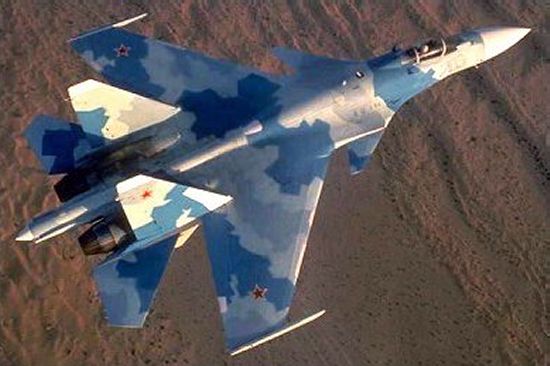
the Su-35 is very agile because it has very complex aerodynamics, it has LERXes, canards, wing with less swept than a delta and taiplanes, the J-10 can not compete with these aerodynamics, however it can compete in terms of simplicty and costs.
The LCA might be agile better than a Viggen even perhaps better than a Mirage 2000, but i doubt better than the J-10 or MiG-29
However the TVC nozzle the 117S engine has is far more advanced than the fitted to the Su-30MKI and basicly leaves the Su-30MKI as an old design

MiG-23MLDexactly! its a combination of several factors, with avionics and EW systems being a very important part of the efficacy of a fighter in service.
so, just by looking at whether the LCA has fewer control surfaces than a J-10, you cannot judge which is better.
otherwise, I’d simply say the Su-30MKI really is the world’s finest fighter, judging by its triplex canard config and you’d have no other go but to simply agree, otherwise you’d contradict your own hypothesis. 😎such simplistic analyses are hardly technically very sound.
If you see also the F-16XL and LCA both designs are also very similar, why? simple because a real delta is a wing that generates very easily vortices that burst very fast as the AOA is increased, designers have tried to reduce that by simply changing the leading edge by several means such as dogteeth like in the Viggen, compound wings like in the Concord, leading edge cuts like in the LCA and Viggen or adding canards.
the MiG-21 has a simple delta with tailplanes

this configuration is not very different from a canard delta wing configuration like those seen in the Viggen or JAS-39 and in the same way the foreplanes or canards are used the tailplanes are used as pitch control devices however they are behind the center of gravity and do not reduce the delta wing vortices like a canards, foreplanes or LERXes do by creating vortices that reduce the wing vortex separation of the delta and main wing
the Chinese J-7s have a lesser swept leading edge in the outer part of the wing improving vortex control

However the Indians wanted a small aircraft since their engine capabilities were still modest and building an AL-31 or WS-10 type of engine was out of their reach, so they opted for the delta wing with a notch at the root of its wing leading edge like the one seen in the Viggen.

the F-16XL has also several features to improve the delta wing such as a notch at the leading edge wing root, and a lesser angle of swept at the outer wing like the wings seen in the Concord or SST designs of the 1970s.
the F-16XL has a trailing edge with increased area aft of the main trailing edge in the inner part of the wing to reduce the effects of supersonic center of lift shift, the Indians despite they have designed a good aircraft in reality is a more modest design similar to the Mirage 2000 and not like the JAS-39 Gripen or F-16 like the J-10 is.
The LCA is simply the lightest airframe with the a relatively big wing and powered by a modest engine to be designed in India.
MiG-23MLDexactly! its a combination of several factors, with avionics and EW systems being a very important part of the efficacy of a fighter in service.
so, just by looking at whether the LCA has fewer control surfaces than a J-10, you cannot judge which is better.
otherwise, I’d simply say the Su-30MKI really is the world’s finest fighter, judging by its triplex canard config and you’d have no other go but to simply agree, otherwise you’d contradict your own hypothesis. 😎such simplistic analyses are hardly technically very sound.
Not like you are saying and i will examplify it for you fighter by fighter.

The Mirage III has a simple delta wing, good for high speed but not as good for low speed handling. still generates vortices and has flow separation at relatively low AoA, has still a very stable center of gravity (CG) and center of lift (CL) relation, however this wing is better than a simple swept straight wing since at supersonic speeds as the Center of lift shifts aft the extra area ensures better lift and handling, besides other structural advantages
Next generation fighters added a fixed canard like in the AJ-37 and IAI Kfir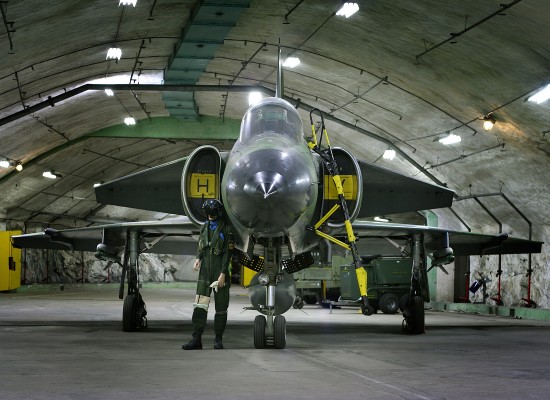
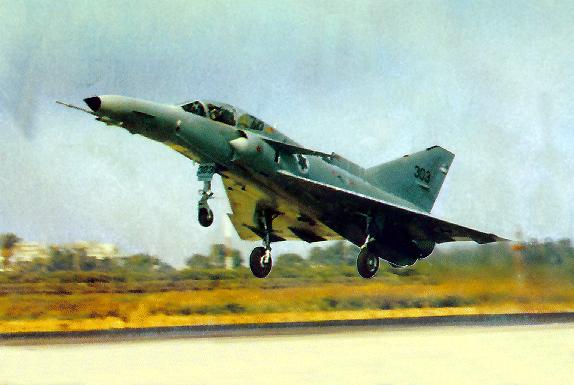
in the AJ-37 the Delta wing was basicly a delta wing with two sweep angles exactly like the one seen in the LCA
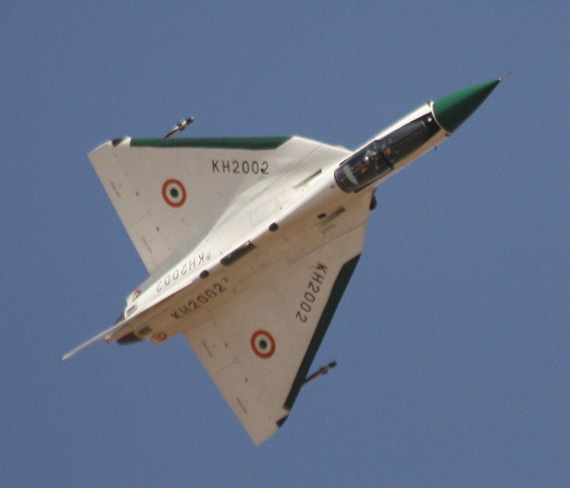
See how the leading edge in the wing of the AJ-37 has two sweep angles, one angle at the leading edge root with less swept and one more accute with more swept after it, this wing is the same type of wing the LCA has
in the Viggen the canards and the wing angle cut at the leading edge with less swept reduce the separation vortices, basicly improving the AoA and landing characteristics of the Viggen, however this aircrat is still very stable due to the fact the CL still is located far too aft or in few words the delta wing has its trailing edge almost in the same line where the engine nozzle ends.
The next generation is typified by the J-10, Lavi, Gripen, Rafale and Eurofighter.
However the swedes modified the original Viggen design with new improvements moving the center of lift (CL) forward, this has also been applied into the J-10 and by making the fixed canards of the Kfir and the canards with trailing edge flaps of the Viggen, fully moveable foreplanes.

The LCA of course is also a modern aircraft and has a CL farther forward to improve stability and make it more instable unlike the AJ-37 Viggen that can be out turn by a MiG-29 even MiG-23s, nevertheless the LCA still lacks canards.
If the D/L ratio is favourable and the wing has good AoA behavior something that i doubt because as i posted before they say the AoA is not satisfactory i doubt the LCA is better than the J-10.
The initial operational clearance is slated for 2010 end but besides the engine issue, the LCA is facing problems on two other fronts — the angle of attack and the landing gear. While the angle of attack achieved by LCA is 17 degrees, the IAF wants it to be 21.
http://www.hindu.com/2008/06/06/stories/2008060654911200.htm
Just consider that the F-16 and F-15 have AoA higher than 21 degrees
With the F-16A the AoA limit is 25deg where as the MiG-29 has been cleared of an AoA of up to 45deg.
http://vayu-sena.tripod.com/comparison-f16-mig29-1.html
The J-10 very likely has a AoA limit like the JAS-39
MiG-23MLDmore likely due to higher T/W ratio, better FBW and better actuators than just adding canards.
Its a combination of several factors but the canads do help and enhance the AoA flow separation control created by the delta wing vortices.
MiG-23MLDThe bomb bay was planned as the F-111 was required to make the last 180nm supersonic. It actually never achieved that mark.
For delivering the nuclear bomb a bomb makes sense, for anything else it is not very useful (except for stealthy aircraft).Fitting a gun into such an aircraft seems doubtful.
As I said, the F-111 was slightly overengineered.
An early Su-24 might look like it had a wider gap between the engine nacelles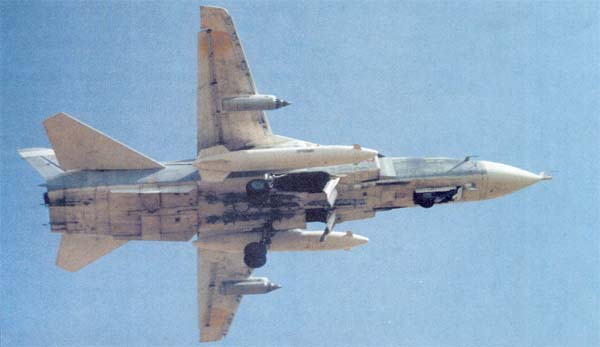
however in this picture is clear the F-111 has a wider gap between the engine nacelles

In the same way in this picture it is clear the Su-24 has a narrower fuselage and a narrower engine gap with each other see

http://www.n-e-c.ru/foxbat/maks/kiev_museum/index.php?picid=kiev_museum102
This explain easily why the F-111 has more volume capacity, the fuselage tanks are bigger in the F-111
MiG-23MLDI always thought the Tunnan had ordinary swept wings, like the F-86 & most of its other contemporaries. Well I never! Turns out Saab was even more innovative than I thought. 😀
Sorry i made a typing mistake i meant JAS-39 not the Tunnan
MiG-23MLDyup, when there are no official reports or journalistic reports based on official reports, it ensures that most of the issues/problems with the program never really get known..all we hear are reports from fans of the program and bias will always ensure that the reports are favourable to the J-10. I’m not saying that its not good, but for analysts to compare it to F-16s and F-18s based on internet speculation and youtube videos is hardly believable.
however using aerodynamics and basic aerodynamics it is obvious the LCA has less systems to control flow separation and therefore very likely less high AoA control.
More control surfaces or at least more flow separation control devices assure more agility and tail planes and canards are prefered by other manufacturers rather than a simple delta with two leading edge swept angles, in fact see the Mirage 2000 and Rafale have canards, in the Mirage 2000 well strakes but the canarded Rafale is far far more agile than the Mirage 2000.
the canarded Su-27 aka Su-35 is far far more agile than the Su-27.
MiG-23MLDIt is very difficult to compare a plane like the LCA which is pretty much an open book (of which a lot is known from official sources as well as reliable and unreliable news sources) as compared to a plane like the J-10 which is a closed book and all that is known is based on pure speculation by the J-10 fan club. So to say one is superior to the other without relevant verifiable information is a total waste of time in my opinion. Even saying one is superior to the other just based on the existence of things like canards is ridiculous. (By the way canards were considered and modeled on the LCA and were discarded as they were deemed to not improve performance in any of the flight regimes)
It is not as difficult as you think, basicly it is pretty easy, of course in detail is not as easy but definitively, the very basic aerodynamics have been studied since the early 1960s because the LCA wing and J-10 configuration are not new neither innovative.
The LCA wing appears in the JA-37 Viggen albeit in the LCA there is no canards, and the J-10 configuration has been applied in the JAS-39, Rafale and Typhoon
Delta wings have been studied too, infact it is a type of wing that was used in the MiG-21 and Su-9/Su-11 in Russia and in the F-106 in the US and of course in Europe in the Mirage family and derivatives such as the Kfir.
The LCA has a wing with two leading edge angles, one of lower swept to reduce flow separation and the other for high speed.
The Canard in the J-10 works in a similar way reducing the flow separation however it also increases lift forward of the fuselage CG and CL and lift in general.
So the Gripen and J-10 opted for canards the LCA simply is too small and very likely canards were deemed to add too much drag,
The F-16XL also like the LCA has a lower sweep angle at the root of the leading edge however it went further reducing the angle swept at the wing tip increasing agility and range.
The advantages of canards are several and assure high agility and high instantaneous turn rates with a safety factor since the canard reduces the risks of wing stall.
the LCA has no canards and less control surfaces, if you look at the MiG-1.44 it had more control surfaces and the Su-37 too, however the 117 engine has eliminated the need for canards.
Without thrust vectoring i do not think the LCA is better than the J-10 in agility.
MiG-23MLDThe bulky electronics are probably part of the reason on earlier Fencer variants in particular and the Su-24M has both an interal gun and an internal laser designator installed at the same time. Meanwhile the F-111 carries either one OR the other in its internal bomb bay, optionally foregoing both in favour of more fuel. AFAIK, in practice the bay was rarely used for anything other than those loads, except on the FB-111 where it actually housed weapons (SRAMs).
Not sure how much this eats into the volume available for fuel, but it will have had some effect.
In my opinion and i remark it is just an expeculation, the Su-24 has different shape and therefore it does not have the same ability to house fuel tanks.
The Su-24 for example has longer and narrower inlets; the shorter and wider inlets inlets in the F-111 allows in my opinion larger volume capacity fuel tanks since the shorter but wider inlet ducts are not so deeply buried in the fuselage, also the F-111 has bigger wing gloves and contrary to the longer and more deeply buried fuselage inlet ducts that the Su-24 has. the wing gloves can house fuel in the F-111.


Probably this different shape and form account for part of the difference in fuel volume capacity plus the Su-24 is slightly longer and might have heavier avionics


 Sign In







