 MiG-23MLD
Are you sure? how often did the Su-24 fly from a rough field?
How often did any Warsaw Pact type operate or train away from conventional surfaced runways? I think it’s a capability that’s well past its sell by date.MiG-23MLD, you’re the one who is always referring to Soviet built aircraft as been ‘cheaper’ than western aircraft, without coming up with hard figures to back it up.
As if the F-111 and Tornado weren’t?:rolleyes:
prices are difficult to determine if you do not get the rpice and the year of that price
see a modern Su-30MKA cost around 52 million dollars
see System
Su-30MKA fighter
Producer and Design Engineer
Sukhoi Corporation, Irkut Corporation
Number
28
Cost
$1.5 billion
Notes
Design based on Indian Su-30MKI and Malaysian Su-30MKM
See that the MiG-29 according to this webpage costed the same but algeria wanted 34
http://mdb.cast.ru/mdb/2-2007/item3/item1/
however see a F-14D Tomcat in 1991 costed 71.9.
http://www.aeronautics.ru/nws002/military_aircraft_prices.htm
Greece’s top brass had opted for the F-15 which had the best test reviews but its high price, about $75 million each, rendered the purchase prohibitive. The F-16 cost about $45 million and the Mirage about $58 million. The officials said a combination of all three types of planes being purchased was also being examined.
http://www.f-16.net/f-16_users_article5.html
this are current prices but let us see in the past
Su-24 Fencer 1997 approx. 24-25
Panavia Tornado ECR 1997 38
F-111 1973 14.6
MiG-23/MiG-27 Flogger 1996 approx. 15
F-111 Unit cost $FY98
[Total Program] $75 million
See the Su-24 was plainly cheap it costed almost 60% less than an F-111 in 1997
http://www.fas.org/man/dod-101/sys/ac/f-111.htm
See the MiG-23 in 1997 costed the same that a F-111 costed only after 23 years the same price, however in 1998 an F-111 costed 75 million dollars
See thet Su-30 costed only the same of an F-15E after 14 years.
http://query.nytimes.com/gst/fullpage.html?res=9405E1DE163FF934A35754C0A962958260
The announcement comes six weeks after a Lockheed rival, the McDonnell Douglas Corporation, proposed building up to 36 Air Force F-15E’s for $50 million each. The F-15 is a larger, longer-range fighter aircraft that can carry a heavier weapons payload but is less maneuverable than the F-16. The Northrop Grumman Corporation is also proposing to build an additional 20 B-2 Stealth bombers at its Los Angeles-area plant for $12 billion, or $600 million each.
see the price of the Su-24 was merely USD $ 5.5 million dollars in 2001 of course these were used ones but still a bargain
NAPO is a state-owned unitary enterprise with personnel of about 10,000. It specializes in the production of Su-24 frontline bombers and is preparing to launch the serial production of fighter-bombers of a new generation Su-27IB (Su-24, export version Su-32FN). The plant has no orders for such aircraft at the moment. Its financial difficulties lasted throughout the 1990s and only in 1999 the $12 mln contract with Algeria for three Su-24 bombers somewhat improved the situation. A new $120 mln contract for 22 such aircraft was signed with Algeria in 2000. Besides, NAPO is preparing to launch the serial production of the An-38 medium range aircraft
http://mdb.cast.ru/mdb/3-2001/di/sgpst/
MiG-23MLDI guess it would be smaller and without internal weapons bay (which is great, but only useful for nuclear strike) and more reliance on external fuel. On the end of the day, it would look like a Tornado (tandem seating) with a bit more length& volume, possibly with fixed conical inlets. And hopefully someone had corrected the afterbody engine exhaust integration.
The key advantage of the F-111 is its engine and the higher internal fuel volume (which comes with a price in complexity).
Aerodynamic shortcomings on the Suchoi 24 (wing fences, no leading edge devices) surely had its share, too.
It has leading edge devices, see them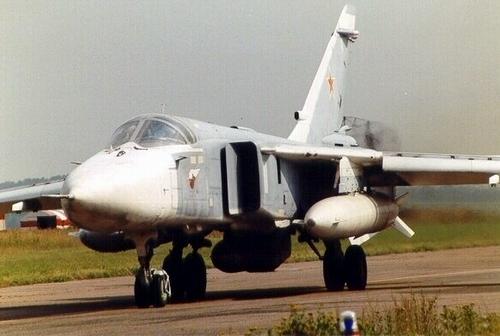
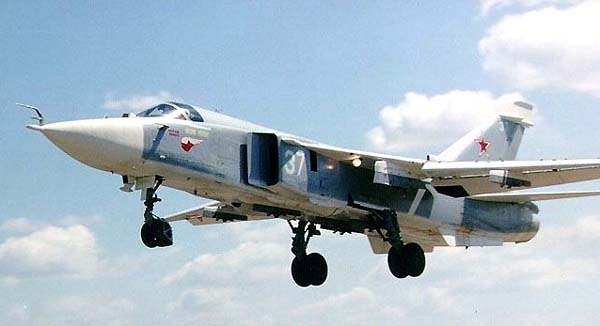
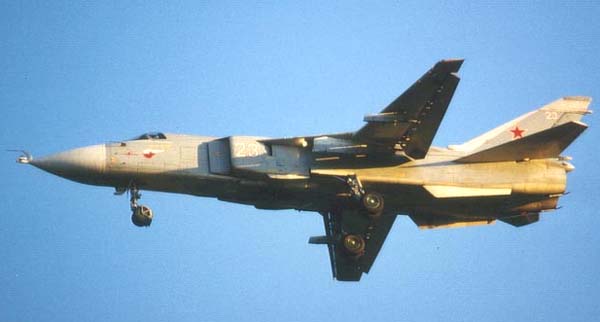
some variants had no wing fences

The Tornado was not a design better than the F-111, probably equal to the Su-24 in some flight envelopes and in performance parameters slightly superior, but in producibility still not as good as the Su-24, the Su-24 still outproduced the Tornado 2:1
in fact besides range and speed these three aircraft are basicly the same concept without any real advantage over each other beyond range and payload
If you want a superior design only the Su-34 is a generation ahead followed by the Su-30 and F-15E, but only the Su-34 is a superior machine.
in fact the Europeans made the same mistake the american did with the F-111 they made a strike aircraft a fighter in the Tornado ADV, it was not a Su-30 niether a F-15E it is just a strike aircraft with air to air missiles, in fact a MiG-23/MiG-27 concept with better payload but less agility
MiG-23MLDI think in relative terms (cost per unit in relation to domestic gross product), the F-111 was cheaper, not because it was so economical but because the USA was so much more wealthy. It was by the way a huge technology program and introduced turbo-fan engines and swing wings.
Not to be misunderstood: I think the F-111 was a failure in the beginning due to the USAF’s tendency to oversophisticate the aircraft (esp. in terms of Mach number/Airspeed requirements). Electronics were unreliable (not an F-111 specific or an USA specific or a West specific problem), some lessons on the production and material section were learned the hard way (again: that happened in Soviet development programs, too).
But: when the biggest problems were finally ironed out, the F-111 evolved as the superior aircraft due to better design and better technology.
You seem to be so sure the Su-24 was either equally expensive or more expensive in PPP US dollars in 1980.
It is possible but without data you are just speculating and basicly giving information based upon personal preferences.
Now that theory that the F-111 was superior is not a reality.
Example WWII
When the Luftwaffe operated over the Soviet skies, the early soviet aircraft were no match for the BF-109, however as the soviets started building fairly good fighters numbers were more important than a slight edge in technology.
The same was in Vietnam, or for the matter of fact any war, cheaper more affordable weaponry with almost the same qualities will always prove superior.
If the F-111 and Su-24 would had found themselves involved in european operations the F-111 and Su-24 were going to suffer almost equally in losses however the Soviets always had more aircraft.
proof in 1991 the ratio of losses of the western coallition and the Iraqies was 1:1 according to western sources, against the Soviets would had been the same but larger numbers would had been the decisive factor if nuclear war would not happened in few words having a 2.4:1 production ratio advantage over the F-111, the Su-24 was far more survivable in real operations
now the only real advantage the F-111 had was longer range for semi-startegic missions but the Soviets had Tu-22Ms to fill the gap and the Su-24 were fitted with refuelling probes so basically there was no superiority since the soviets had Su-24s and Tu-22Ms doing better than the F-111 the missions they had to do
MiG-23MLDIt would characterize flying actual combat mission into the toughest airspace at that time (North Vietnam) as “operational”. No doubt the F-111A (but also other versions) had design deficiencies, some the result of over-specification of the TFX, some of the very ambitious avionics suite, some just because the F-111 stretched the state-of-the-art.
So gulf war I was a walk in the park? easy for the Su-24 let us analize the situation.
Vietnam: Less than 100 MiG-21s, MiG-21 second generation fighter no long range missiles niether look down shoot down capability so Basically the F-111 had no problem flying at low altitude against a MiG-21, the MiG-19 and MiG-17 were basically useless, early generation SAMs and AWACS however no AWACS used by the Vietnamese against the F-111, war duration more than a decade several lost according to the US none to enemy action
Afghanistan: no Su-24 lost to enemy action only one or two lost due to accidents , less than 50 american F-16s with no AIM-7, mostly MANPAD SAMs against Su-24s, a few AWACs, war duration a decade
Libya: F-111 versus MiG-25s, Mirage F1, MiG-23s supported by F-14s and F-18s, surprise attack only one loss according to US, war duration few days, there were some advanced SAMs and AWACS.
Iraq desert storm: few Su-24, less than 40 supported by less then 40 MiG-29s and very few Iraqi AWACS, versus at least 200 F-15 and F-16s and at least 200 F-14s, F-18s and Mirage 2000.
all the western fighters had look down shot down capability capability armed with AIM-7s and AIM-54s supported by AWACs
Advanced SAMs
no Su-24 lost niether in accidents or due to enemy action
F-111 supported by F-117 stealth fighters and EF-111 and Panavia Tornado in the anti-SAM role defended by F-15, F-16, Tornados ADV, Mirage 2000, F-14s and F-18s.
Several F-111 and Tornados lost to enemy action during operations, western sources claim only a single EF-111 lost and seven Tornados.
War duration a month
So as you can see the Iraqi war had more advanced weapons and no Su-24 was destroyed even considering the US patrols were using F-14s and F-15s to patrol NO fly zones.
See that we are using mostly western accounts for the F-111 losses in Vietnam and Iraq
MiG-23MLDI am working my way down towards the validity of your statements.
The mentioned aircraft all have look-down radars and can easily follow the aircraft in some altitude. Besides, at deck the Suchoi will hardly hit Mach 1. A continued run at Mach 1 on the deck will let it die on fuel exhaustion.
The main reason why no Suchoi 24 was ever lost in combat was that it never saw combat comparable to the F-111 (Lybia, Iraq) or Tornado (Iraq, Serbia).
With the little disadvantage that their aircraft needed ages to maturity, the Suchoi 24 entered service over 10 years after design was begun.
That the mainstay of the Soviet air force attack aircraft (Su-17/22) ist “basically the same model” as the first generation supersonic Suchoi 7 is surprising.
Stuff your F-117 story. It doesn’t fit here.
The Suchoi 24 was surely no “simple aircraft”. Although I agree that Western aircraft are often over-sophisticated for particular missions, the Suchoi 24 was a complex and expensive bird. Good indicator of its complexity is the long time needed to make it operational. Would be interesting though to compare the avionics capability of a 1975 Fencer “A” versus an F-111F or F-111D.In general the Suchoi 24 was the F-111 minus advanced engines and about 8 to 10 years later.
The German air force have not procured any American fighter aircraft after the F-4F. Maybe you see a pattern that led from Starfighter over VAK-191 over NKF to Tornado.
Actually, the Australian bought their F-111 in the 1960ies (that is 40 years ago!). And you compare that with the present discount offer to Algeria? Man, you are really twisting reality.
The Su-24 as the F-111 suffered from low maintainability, the Su-24 Fencer A flew six year after the F-111, true but the F-111 was not ready when it was introduced in Vietnam and several were lost due to ” design problems” later to be redesigned and put into production much later remember the F-111 flew in 1964 as a fighter, in a role in which it failed miserably . http://www.f-111.net/t_no_A.htm
Iraq bought its Su-24s in the 1980s.
in fact the F-111 became operational in reality only a year after the Su-24 made its first flight, in fact it flew exactly 38 years ago when the T6-2I performed its initial flight on 17 January 1970.http://www.vectorsite.net/avsu24.html
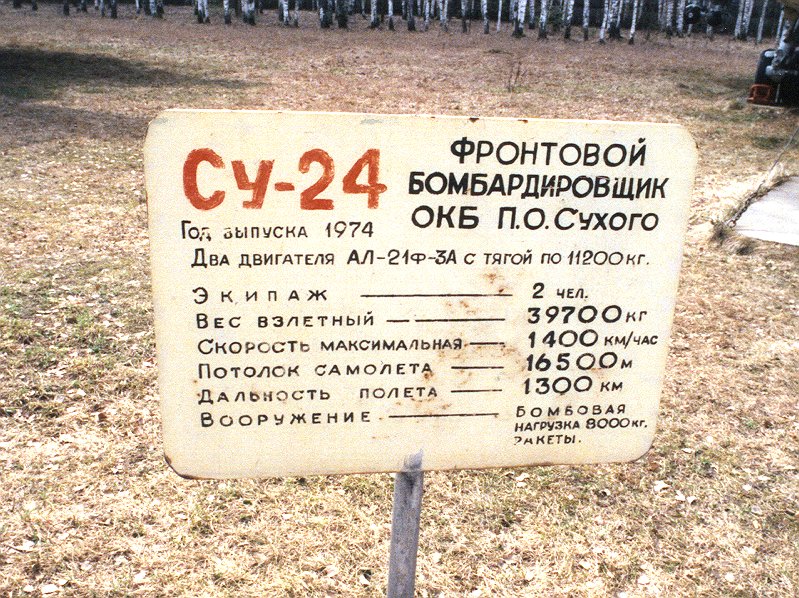
See this specifications sign for a Su-24 the weight is 39700kg and the max speed is 1400km/h and says it became operational only three years after the F-111 really did it in 1974
MiG-23MLDWhich once again shows that the Soviets considered higher numbers necessary to fulfill the same mission.
Actually, the last F-111 was nearly delivered when the Suchoi 24 was accepted into service. The first truly capable Su-24 (the M) entered service not before the Tornado.Maybe because it never dropped a bomb in anger in an airspace defended by Western fighters?
Maybe they didn’t need it, but still from the technical point view the question how a similarly sized aircraft with roughly similar weights can have such a shortfall in performance.
The answer is on the table: less advanced aerodynamics, less advanced engines, less advanced structures.Let say it this way: it was cheaper and more expendable, which lines up favorably with Soviet thinking.
At roughly similar OEW and size, which let’s room for the question, what the Suchoi engineers did with all the volume? Stuffed it with analogue electronics?
Countries that had equal access to Western and Eastern hardware like Iraq, Lybia, Syria and Algeria. Erhh … what a minute … 😉
By the way, when the first -24s were exported in 1988, the F-111 was long out of production and for countries with access to Western markets the Tornado would have been the much much better alternative.
Schorsch
Do not make claism that are unrealistic:
First the Su-24 was never caught by the Western fighters simply because it has terrain following radar, this made it too difficult to catch flying a low speed and having swing wings no F-15, f-16 or even F-14 was going to be able to chase it at Mach 1.35 speed and low altitude.
true the Tornado lost several examples while the Su-24 none in bombing missions, however saying the tornado did better is not true, the Soviets Su-24 flew very close to Pakistani F-16s and never were destroyed, Iraq never was a first class air force, in 1990 the iraqi air force was a third class air force (since it had no aircraft industry)and destroyed Tornados and F-111s, the West chased MiG-23s and Mirage f1s and destroyed them but the Su-24 were capable enouigh to elude any persuers.
The Russians and western defences were capable of destroying either F-111s and Tornados as well as Su-24s, however the Su-24 was as good as the F-111 flying the low level mission
Second The Soviets always built more aircraft because their aircraft always used a great degree of standarization and simplicity allowing a same factory built different aircraft faster
the Su-7 , Su-17, Su-22, Su-11 and Su-9 were basicaly the same model, the MiG-23, MiG-29 and MiG-21 had similar cockpits and systems.
The Su-24 was a simple design avoiding over sophistication, in fact the downing of the Tornados showed simply SAMs and cheaper fighters were able to destroy more expensive systems and that was epitomised when a F-117 was destroyed by a simple SA-3 missile.
in General the Su-24 was as good as the F-111 and was simply a design more practical in terms of price and producibility, not less advanced simply more practical
By the way F-111 were even offered to Germany and England and they did not buy it, too expensive for smaller air forces in NATO and over priced for third world countries only one nation bought it and they bought no much more than Algeria Su-24s
NAPO is a state-owned unitary enterprise with personnel of about 10,000. It specializes in the production of Su-24 frontline bombers and is preparing to launch the serial production of fighter-bombers of a new generation Su-27IB (Su-24, export version Su-32FN). The plant has no orders for such aircraft at the moment. Its financial difficulties lasted throughout the 1990s and only in 1999 the $12 mln contract with Algeria for three Su-24 bombers somewhat improved the situation. A new $120 mln contract for 22 such aircraft was signed with Algeria in 2000. Besides, NAPO is preparing to launch the serial production of the An-38 medium range aircraft.
MiG-23MLDAircraft are best compared by operating empty weight or by maximum take-off weight. In these terms the Suchoi 24 fails miserably against the older F-111, in terms of
– range
– radius
– war load.
Any claims about smaller fuel volume are academic. One rather has to ask why the similarly heavy (in terms of OEW) has substantially less fuel volume.I further doubt that a 1991 Suchoi 24M/MF can have the punch the F-111F displayed during GW#1. Or that a Suchoi 24M/MF can fly the mission the 48th TFW flew in 1986.
In short: the Suchoi 24 falls short in technology and capability despite being younger. it still was a major capability improvement for the Soviet forces, as it represented the first all-weather capable fighter bomber with useful payload-range characteristics and useful defensive electronics. It filled a gap between the smallest bomber and the largest fighter-bomber.
That is not true, you say it fails not true, that is just a cliche exposed by you and sens to claim the Tornado is better disguised as the F-111.
The Su-24 outproduced the F-111, has similar weaponry and the same survability.
I ask you when has the Su-24 been shot down by western fighters? Do you know the pakistani F-16s attacked several times soviet Su-24s and never nailed a single one? are you aware the Iraqi Su-24s escaped without a single lost to Iran when the west had total superiority in fourth generation fighters?
The Su-24 was made with less range because for the Russians the Tu-22M filled much better the mission the F-111 failed, yeah the FB-111 failed miserably as a bomber and was replaced by the B-1B and by a shorter range fighter the F-15E
The Su-24 was practical and more easy to produce and left the Tu-22M fill the gap between the Tu-160 and the Su-24.
The F-111 at least has 6000 liters more fuel than the Su-24 and some sources say up to 8000 liters.
The Su-24 was built in very large numbers and was exported to more countries
MiG-23MLDStill, the F-111 achieves better radius for similar mission profile.
That is not necesarily true, if you consider what Sukhoi says with a Max take off weight of 43tons it has a worst range but if you take what is the operational weight according to the Ukranian air force, Belarrusian air force and many other sources like Yefim gordon or airwar.ru, the Su-24 carries much much less fuel and they are not exactly comparable if you do not have the exact same amount of fuel.
The max take off weight is the same in the Ukranian and Belarrussian air forces respective webpages.
максимальна злітна вага – 39700 кг 39700kg max take off this is the Ukranian air force http://www.mil.gov.ua/index.php?part…ang=ua&sub=vps http://www.mil.gov.ua/index.php?part…ang=ua&sub=vps
The Belarussian air force
Максимальная взлётная масса, кг – 39700 /39700kg max take off weight http://mod.mil.by/s31su24.html http://mod.mil.by/s31su24.html
however Sukhoi claims a higher take off weight see
Takeoff weight:
– normal, kg 38,040
– maximum, kg 43,755
http://www.sukhoi.org/eng/planes/military/su24mk/lth/
by SFC the AL-21 is not super fuel thirsty. The range might be better but not substantially better only marginally depending in the data you use
MiG-23MLDAfter the assessments I did I find the ~2800km ferry range with two drop tanks quite realistic. The mission radius for lo-lo-lo seems very realistic, too. Data-wise, the Wikipedia article on the Su-24MK looks as one of the better ones.
The most unreliable information source is normally the operator of an aircraft.
Most reliable are normally “merged” information sources, like Wikipedia and some other web resources (quite OK is vectorsite).
In general, most “sources” copy from each other. Some include wishful thinking. Sometimes people cannot see the difference between a mission radius and a range, and often the values given are “best” values. A real mission includes lots of reserves and allowances. The 330nm for the Suchoi 24MK in a lo-lo-lo mission profile are not a bad figure, by the way.
I would not consider the Ukranian and Belarrusian air forces as unreliable their webpages only show different aspects of the Su-24 performance, Sukhoi does the same Sukhoi claims a range under some specific conditions even the speed seems to be only the speed for a sea level or low altitude mission,
The max take off weight is the same in the Ukranian and Belarrussian air forces respective webpages.
максимальна злітна вага – 39700 кг 39700kg max take off this is the Ukranian air forcehttp://www.mil.gov.ua/index.php?part=armament&lang=ua&sub=vps
The Belarussian air force
Максимальная взлётная масса, кг – 39700 /39700kg max take off weighthttp://mod.mil.by/s31su24.html
however Sukhoi cliams a higher take off weight see
Takeoff weight:
– normal, kg 38,040
– maximum, kg 43,755
http://www.sukhoi.org/eng/planes/military/su24mk/lth/
Sukhoi and the Belarrusian agree in the max speed, the ukranian air force agrees too but also posts a higher speed (probably under different coonditions)
sukhoi Maximum flight speed at sea level (without external ordnance and stores), km/h 1,315
Max Mach (without external ordnance and stores) 1.35
http://www.sukhoi.org/eng/planes/military/su24mk/lth/
максимальна швидкість – 1400 км/год the Ukranian air force also quotes 1400km/h http://www.mil.gov.ua/index.php?part=armament&lang=ua&sub=vps
The Belarrussian air force also claims something similar Максимальная скорость полёта, км/час – 1320http://mod.mil.by/s31su24.html
however th Ukrainian air force claims a higher speed only in its english version Maximum speed – 2240 kmphhttp://www.mil.gov.ua/index.php?lang=en&part=armament&sub=air_force
The Ukranian air force webpage has a range almost equal to the belarrussian air force and also a longer range than the one quoted by Sukhoi.
Sukhoi Ferry flight range with 2xPTB-3000 external fuel tanks, km:
– with PTB external fuel tanks dropped 2,775
– with one in-flight refuelling 5,000
http://www.sukhoi.org/eng/planes/military/su24mk/lth/
See how the Ukranian and belarrusian air force more or less concord
Ukranian air force дальність польоту – 2080 км range 2080km
http://www.mil.gov.ua/index.php?part=armament&lang=ua&sub=vps and see is almost the same range for the belarusian air force
Дальность полёта, км – 2500 max range 2500km
http://mod.mil.by/s31su24.html
however the Ukranian air force quotes a very long range for the Su-24
Range – 3800 km
http://www.mil.gov.ua/index.php?lang=en&part=armament&sub=air_force
MiG-23MLD22300kg was adapted by Wiki, the range is clearly wrong, which should be combat radius.
On internet, which one is more logical and reasonable should be judged by self brain.
I guess wikipedia is a good source but not always a very reliable one.
For Su-24 specifications i would quote first Sukhoi, later the Ukranian air force and Belarussian Air force and only later other russian webpages
Since all of these present different facets of the same aircraft, i would say the Su-24 has a sea level speed of Mach 1.35 and a max speed of mach 1.6.
The Mach 2 speed might be with VG ramps or a speed not recomended by Sukhoi.
The range should be considered a minimal range of 2775km with two fuel tanks and a probable 3050km or 3800km with three fuel tanks and a confirmed ferry range with one air refueling of 5000km.
the weight should be 22tons empty, 26 tons ready to fly, 27tons minimun weight for landing, 39700kgs regular max operational take off weight and a Sukhoi quoted weight of 43 tons.
MiG-23MLDMOSCOW (Reuters) – Russia is to replace Ukrainian-made engines in its cruise missiles with local ones, an arms producer said on Monday.
Moscow’s statement was the second signal in as many days of Russia’s fierce opposition to its neighbor’s entry into NATO, and came as NATO Secretary General Jaap de Hoop Scheffer was visiting Ukraine.
On Saturday, Russian First Deputy Prime Minister Sergei Ivanov said Ukraine would lose industry ties with Russia and suffer reduced trade cooperation if it joined NATO.
On Monday, Yevgeny Kablov, director general of the All-Russian Aviation Materials Research Institute, said Russian Prime Minister Vladimir Putin had ordered officials to revise some ties with Ukraine.
“Vladimir Vladimirovich has set a task of replacing engines in cruise missiles to end dependence on Ukraine,” he told visiting government officials and journalists.
He gave no further details. Kablov’s institute is involved in designing alloys for aviation and space engines.
Ukraine, which built the formidable SS-18 nuclear missile — codenamed “Satan” by NATO — in Soviet days, now supplies engines for Russian X-35, X-55 and X-59 cruise missiles produced at its aviation and helicopter engine maker Motor-Sich.
Motor-Sich is a major foreign economic partner for Russia’s aviation materials institute. Earlier this year it said it planned to open a cruise missile engine venture in Russia.
NATO has given Ukraine an undertaking that it can eventually join the alliance, but has given no firm timetable.
(Reporting by Denis Dyomkin; Writing by Dmitry Solovy
http://www.reuters.com/article/worldNews/idUSL1627442520080616
MiG-23MLDThe Wiki has already given the most reasonable answer. The VG inlet version of Su-24 Fencer A has top speed above 2 M but the fix inlet version of Su-24 get the lower top speed down to 1.6M. Such decrease also appeared on some other aircraft. The 1.3M is an unreliabe data for depreciative purpose.
I think probably Sukhoi is only quoting the max speed at sea level see
Максимальная скорость, км/ч
на высоте 1700
на уровне моря 1400
airwar ru quotes a Max speed of Mach 1.6 speed at altitude and 1.4 at sea level
same is aviaport ЛЕТНЫЕ ДАННЫЕ (Су 24М). Максимальная скорость 1700 км/ч, максимальная скорость у земли 1400 км/ч, практический потолок 11 000 м
http://www.aviaport.ru/directory/aviation/458.html
however the belarussian air force has different data too
Тактико-технические данные:
Экипаж, чел. – 2
Число двигателей – 2
Тип двигателей – 2хАЛ-21
Максимальная взлётная масса, кг – 39700 Max weight 39700kg
Максимальная скорость полёта, км/час – 1320 (max speed 1320kmh)
Практический потолок,м – 11500
Дальность полёта, км – 2500
Максимальная бомбовая нагрузка,кг – 7500
Габаритные размеры: длина – 24,5м, высота – 6,2м, размах крыла- 17,7м.
http://mod.mil.by/s31su24.htmlhttp://mod.mil.by/s31su24.html
It is funny because it does not concord with Sukhoi on matters of weight
however other webpages quotes different speed
Максимальная скорость, км/ч – 2320 Max speed 2320 km/h
Максимальная скорость у земли, км/ч – 1400 Max speed a sea level 1400km/h
Практический потолок, м – 17500
Максимальная дальность полета, км – 1300
Перегоночная дальность полета, км – 4270
Разбег, м – 900
Пробег,м – 850
MiG-23MLDThe trick with variable geometry intakes is the control of the shockwaves. An intake that works best at Mach 1.3 may encounter severe difficulties at higher Mach numbers. All aircraft that started with variable geometry intakes and later got those fixed lost their Mach 2 capability, so for example the Tornado, the F-14 and the Starfighter, all with similar or more installed static thrust. The Tornado hardly makes it over M1.3 with the inlets fixed.
I am inclined to think the Su-24 has a max speed of Mach 1.35 since the vast majority of sources have that speed quoted as the max speed.
in fact i think most likely it is the max speed and i am 99% sure the speed is Mach 1.35 however the 1% i am not sure i think it is possible the speed is around 2100km/h and think there is a small probability the Ukranian air force meant the Su-24 can fly that speed and the reason is as you said it might encounter problems we do not know really if the inlet will not work well or simply sukhoi recommends that speed to increase the operational life of the Su-24.
The Range is something that still baffles me because i think it is a fact it wil fly 2775km with two external fuel tanks.
If it flies 3800km well i do not know if it is true or not but i do not think is not possible.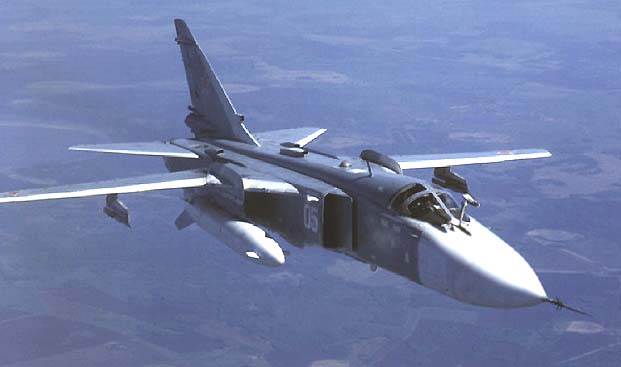
MiG-23MLDBecause both did field different inlet-systems.
Despite unregulated the special compromise form of the inlet of the F-16 does allow speeds up to Mach 1,6 , without too much thrust losses from that. The idea about that was, that air-combat may start at over Mach 1 sometimes, but it is down to subsonic, when the related fighters had to maneuver. Here the propulsion system has to offer the highest thrust to cope with the related forces (remember G-forces!).
Above Mach 1,2 the losses from the inlet-system of the F-16 are noticeable in that that way, that a Mirage 2000 with its regulated system f.e. has a higher thrust above Mach 1,2 despite the higher installed thrust in the F-16. Just the very high installed engine thrust and little drag did allow a clean F-16 to hit Mach 2 briefly under optimum conditions, despite the inlet system was clogged before. But we keep in mind, that behind Mach 1,6 there is no longer something like acceleration for the F-16, just some kind of momentum as your car hill down.
For that findings you are not in need to ask a manual about that.
A second thought does show, that the F-16 and its propulsion system is at best at low to medium level and its inlet-system pose no restriction, when it comes to speed. To reach Mach 2+ every fighter as to go high, below that even regulated ones have to face speed limitations through air-pressure.
Up to what i know aircraft not only use the inlet ramp as a way of slowing down the supersonic flow to subsonic speeds they also use the nacelle inlet duct.
Convergent Divergent Diffuser
The diagram to the left shows a simple convergent divergent diffuser. This simple design works because of the fact that supersonic flow will slow down as it enters a constricted area. You will note that this is the opposite response to subsonic flow, which tended to accelerate through a constriction ( In a Venturi Subsonic flow accelerates due to the pressure waves it generates as the the air particles are pushed together. As we know, the air attempts to maintain a constant density and as a result a pressure wave is set up which causes the air to accelerate through the constriction.)
However, at supersonic speed pressure waves can not move out ahead of the air and cause it to accelerate. Therefore the air piles up, becomes more dense, and slows down. This is still all in accordance with Bernoulli’s equation which tells us that if the static pressure increases and the density increases, then the velocity must decrease in order to keep the total energy constant. (Generally this tendency of supersonic airflow is more intuitive than subsonic airflow to most people.)
http://selair.selkirk.bc.ca/aerodynamics1/High-Speed/Page7.html
In my opinion the F-16 has an inlet ramp and inlet duct that allow the F-16 to slow the supersonic flow with oblique shockwaves and compresibility that allow speeds of Mach 2, i do not know if the same applies for the Su-24 if it really does it
MiG-23MLDNothing wrong with 2240 km/h or Mach 2,1 at height with a regulated inlet-system, what was at hand at first. Later it was locked, because the gains from a regulated inlet are limited at low or medium heights.
The websites from the Ukrainian air force were not written by Su-24 technicians or Su-24 pilots.
You are a fan boy for sure, as your blind believe in websites or books do show. I am neither a technician nor a crew member of a Su-24, as all of us here. But I used the opportunities offered to me, to visit the cockpits of both, the F-111 and the Su-24 and question the crew-members and technicians about that. Not all of my questions were answered, but several ones. Security considerations aside, even such persons are not informed about all details of their aircraft or had ever the opportunity to fly it to the limits.
When you do note two very different range claims by the Ukrainian, it is your duty to verify that by asking other reliable sources about that. When unable to do so, you better do not post that nonsense. Not our work to relieve you from that task. Your guessing with the different MiG-23 has nothing to do with the Su-24, just to distract, that you are unable or unwilling to stick to facts, you do not like as your “however” did show.
As long as you stay with pictures, you are excellent, but that is just one side from the same coin.
Sens
The Su-24 information of the Sukhoi webpage has something that is an obvious mistake
Number and type of engines 2 x AL-21FZA
Thrust:
– in afterburner, kgf 111,200
– at full power, kgf 11,200
compare the what it is written for the Al-31 in the Saturn webpage the say 12500kgf and that is a more powerful engine than the AL-21
Технические характеристики АЛ-31Ф/ФН:
http://www.npo-saturn.ru/!new/index.php?pid=53
http://www.sukhoi.org/eng/planes/military/su24mk/lth/
This proves you even Sukhoi makes typos or mistakes, by the way without having a Su-24 manual is difficult to sift all the contradictory information and data from the Ukranian air force an Sukhoi.
also the range posted by the Ukranian air forces (armed forces to be specific) is 3800km
The F-16 can reach Mach 2 at 12000 meters and has a fixed inlet why the Sukhoi Su-24 won`t be able to do it? in few words is possible sukhoi`s information is the best however the Ukranian air force is a reliable source since it is a user and maker since some elements were also built in Ukraine


 Sign In







