 MiG-23MLD
A. The powerplant for the MiG-21 was the best the Chinese had in the early ’60s, so it is only natural they would use it in a twin engine fighter. What else could they use?
B. Yes both use the same aerodynamics as the MiG-21, which the Chinese got.If you had to build a Mach 2+ interceptor with superior range and altitude to the MiG-21, and the MiG-21 being the best aircraft you had, it would make perfect sense to design a larger twin engine version of the same planeform. In fact they had little choice otherwise. It wont surprise me that Chinese designers working with the Soviets on other MiG projects learned of the Ye-152 concept and took it from there. The question is to what extent were the Soviets involved? You assert that this involvement was extensive.
Which takes us back to C. the lack of reliable corroborative evidence.
You could be right. However the Chinese manufactured the MiG-17, 19, and 21 copies among other aircraft such as the Tu-16 in a very short time. These make a much better comparison than a much more sophisticated aircraft like the Su-27.
You are trying to disprove the established J-8 development history. The burden of proof requires more than what you’re providing. I think you should understand that your present evidence does not support your conclusion. At this point all anyone could say is that some degree of Soviet involvement could not be ruled out.
things are not as you claim as simple as saying the same aerodynamics are a result of similar skills.
The J-8I looks definitively a copy of the Ye-152A, and it is obvious because simply each country designs for its own needs, the Mirage III, MiG-21, F-104, F-106 all have some similarities however in this case the J-8 lacks total originality the aircraft is not an aircraft very different to the Ye-152A, the aircraft does not look as a result of very intensive Chinese research in the area of aerodynamics, what you are trying to say is this, i do not believe the Russian sources because i need more details, this means you are in search of a good excuse to claim the aicraft is an original design, several Russian webpages i provided are very professional because some work with ex Soviet pilots or have ex-soviet military personel contributors.
The Evidence is enough to have good certainty the aircraft is not an original chinese design, the J-8 might be up to a level the product of Chinese research however it is a fact they got soviet documentation, what type of documentation is important to know.
in my humble opinion the J-8 very likely recieved some documentation and some data from the Ye-152A, in my opinion the design is a chinese aircraft with up to a level was completed thanks to the MiG-21 program and probably some incomplete data from the Ye-152A, that the Chinese aerodynamists and engineers did their work and created some original design from a russian basic model is something i do not doubt however the aircraft is not original in fact it is so similar to the Ye-152A simply because China did not have enough skills to create something more complex and they needed at least a basic russian draft to create something new
the Tu-16 is a good example of how china has never been able to create a bomber up to now and relies in 1950s Russian tech, the J-6 was for decades the main chinese aircraft and all the modern Chinese aircraft have direct non chinese technologies proving China lacks still some tech and the J-8I can not be a real authentic original design specially for a 1964 project
MiG-23MLDBut the J-8 is not as complicated as the Su-27. In fact it’s a 1950s era design built in the 1980s. That it took so long to mature wont make a lot of sense if substantial design work were already done by the Soviets. The amount of time put into this project suggest it’s entirely likely an indigenous product.
If a country could make the MiG-21 and its engine, the J-8I is the simplest and most obvious way forward.
Although you say there are Russian sources who make the claim that J-8I is Ye-152 based, it is also entirely possible that they are wrong. Just as your source wrongly represented Lavi specs as J-10 specs on the other thread. The trouble with internet sources is that people copy and paste without careful scrutiny. And after awhile it becomes accepted fact. This happens all too often for internet reference to be taken seriously.
To establish your claim as fact you’ll have to provide more than that. What you have done so far is establish motive (yes the Chinese would have loved to have data on the Ye-152), and circumstancial report that it happened.
What would be more convincing would involve a detailed story on who, when, what, and how this transfer was made. For example a magazine article including interview with Russian designers claiming personal involvement would be strong evidence.
Multirole
i understand your point perfectly a more detailed account would be of great help however it is not easy to get one like that, so far we have enough cirscunstancial evidence, not only a motive.
A) both aircraft have the same engines
B)both aircraft have the same aerodynamics
C)Russian sources claiming the documentation of the Ye-152A was transfered to China
In the other thread very clearly i posted according to the Russians the exact J-10 data is unknown but according to the specialist in the field this is the data…i posted that very clearly so to say the exact data was not known but what we do have is an approximation.
If you tell me about the time why i took so long simply is because China was very backward for many years and even with some Russian data, The J-8I lacked enough details to make the design process very hard to the Chinese engineers.
An example is the Su-27 license even today China has not mastered 100% the Su-27 manufacture even after several years of Russian assistance, it is true they have increased the contents of Chinese made parts in the manufactured of the Su-27 from a 70% to a 90% and eve with the WS-10 China still needs AL-31s since as recently as 2007 Russian and China were in talks for the delivery of additional AL-31s
Но китайцы справились быстрее. «Прорыв в технологии производства двигателей позволил довести удельный вес китайских деталей и технологий с 70-75% до более чем 90%», — пишет уполномоченный представитель «Рособоронэкспорта» в КНР Андрей Плотников в журнале «Проблемы Дальнего Востока». Работы над двигателем «Тайхан» WS-10 c характеристиками, близкими к АЛ-31Ф, китайский авиапромышленный холдинг AVIC-I официально завершил в 2006 г.
По словам сотрудника авиадвигателестроительного КБ, WS-10 недостаточно надежен для серии. Но в 2007 г. китайцы заключили новый контракт на поставку 54 АЛ-31ФН (модификация АЛ-31Ф) и обсуждают закупки усовершенствованного АЛ-31Ф-М, знает он.
Sourcehttp://www.vedomosti.ru/newspaper/article.shtml?2008/02/21/142195
MiG-23MLDI don’t know what the fuss is all about. The Chinese wanted a twin engine MiG-21, they got it. They were probably aware of the Ye-152. But why do they need the Ye-152 documents when they already got the MiG-21 as template? Doesn’t seem that big of a leap.
The question it is not like you think, an aircraft takes many hours only of wind tunnel test for example the Su-27 took an equivalent of 20000 hrs or an equivalent in work time of several years around 8 years in fact only big aircraft like the Boeing 747, Tristar or space shuttle took more hours of wind tunnel, saying that having an template is just making a bigger aircraft is completly wrong, the Ye-152 information was of great utility for the Chinese since it was a test aircraft to try different configurations in several areas ranging from weaponry to avionics or aerodynamics to propulsion, by 1961 the aircraft was already getting behind the Ye-152-1, so then why the Chinese would had not have taken data from the Ye-152A?
MiG-23MLDI included it because the figure meant operational weight, not just take off weight. This is rather vague but in Western parlance for F-16Cs, it includes 2 BVRAAMs and 2 SRAAMs. (For F-16A it would indeed be two SRAAMs, but for F-15 it also means carrying four Sparrows.)
The J-10 videos show the aircraft capable of high angles of attack in short take offs and landings. That’s quite indicative of low wing loading.
Now to the specs posted by that idiot Flogger, please note many of his numbers are directly identical to the Lavi’s.
Точные характеристики самолета неизвестны, но приводятся вот такие спецификации J-10: пустой вес 9750 кг, максимальный взлетный вес 18500
Despite the exact characteristics are unkown, experts in the field consider the J-10 specifications as follow, empty weight 9750kg and max weight 18500kg
Clearly the Russians said the specifications are approximations and the weight and fuel capcity are not taken from the Lavi see
Weights:
Empty weight: 7,031 kg. Normal take-off weight: 9,991 kg. Maximum take-off weight; 19,277 kg
this is way much lighter that the specifications given for the J-10`s empty weight
and later
Fuel capacity:
Internal fuel capacity: 3,330 liters (2,722 kg). Internal fuel fraction: 0.24. External fuel capacity: 4,164 kg in two 2,548 liter drop tanks.
they also give different fuel tankage capability Вес максимальный Max take off weight 18500 кг
Вес пустого Empty weight 9750 кг
Вес топлива Fuel weight 4500 кг
Вес нагрузки warload 4250 кг
http://www.jewishvirtuallibrary.org/jsource/Society_&_Culture/lavi.html
however you do not want to see a real fact if the J-10 is powered by an Al-31 of 12.5 tonnes at take off you can not expect a thrust to weight ratio of 1.9:1 but something more like in the range of 1.08:1 at normal take off for a point defence interception, its thrust to weight ratio at max take off won`t surpass the MiG-29 and Eurofighter`s that boast something close of 0.90:1 at max take off weight, the J-10 must then have a weight in region of 9700kg as mention by the Russian specialists, Why Crobato? well simply the MiG-29 has twin engines and a max take of weight in the range of the J-10`s, the Eurofighter has two engines of around 9000kg of thrust that is a total of 18000kgs and its max weight is in the region of 21000kg.
Модификация МиГ-29 Aircraft MiG-29
Размах крыла, м 11.36 Wing Span 11.36 m
Длина самолета со штангой ПВД, м 17.32 Length 17.32 m
Высота самолета, м 4.73 height 4.73
Площадь крыла, м2 38.06 Wing area 38.06
Масса , кг Weight kg
пустого самолета 10900 empty weight 10900
нормальная взлетная 15300 normal take off 15300
максимальная взлетная 18100 max take off 18200
Тип двигателя 2 ТРДДФ РД-33 type of engine RD-33
Тяга, кгс:
форсированная 2 х 8300 at afterburner 2X 8300
максимальная 2 х 5040 at Miliatry power 2X 5040
sourcehttp://www.airwar.ru/enc/fighter/mig29.html
the J-10 must have at least a warload and fuel capacity equal to its own empty weight, the russians just by seeing that engine can calculate a realitic empty weight in the region of 9700kgs even having the latest technologies specially since the J-10 has a heavier bulky VG inlet than those fitted to the F-16 and Lavi lack
MiG-23MLDTotal nonsense. Compare the links about size by yourself. The external data about the F-16s are not disputed to start with.
Технические характеристики J-10. technical characteristics J-10
Размах крыла Wing span 8.78 м
Длина Length 14.57 м
Высота height 4.78 м
Площадь крыла wing area 33.1 кв.м
Площадь ПГО canard area 5.45 кв.м
Вес максимальный Max take off weight 18500 кг
Вес пустого Empty weight 9750 кг
Вес топлива Fuel weight 4500 кг
Вес нагрузки warload 4250 кг
Двигатель Engine АЛ-31ФН
1 * 12500 кгс
WS-10A с УВТ
1 * 15000 кгс (?)
Максимальная скорость max speed M 2.2
Точные характеристики самолета неизвестны, но приводятся вот такие спецификации J-10: пустой вес 9750 кг, максимальный взлетный вес 18500
Despite the exact characteristics are unkown, experts in the field consider the J-10 specifications as follow, empty weight 9750kg and max weight 18500kg
MiG-23MLDso why u include 2 BVR missiles in weight calculation for J-10 when FC-1 has 2 SRAAM from the link and logically it can have 2 SRAAM for 9100KG NTOW weight.
Dont try to assume NTOW from other fighters.it proves u cannot include 2 BVR missiles beyond doubt.
Модификация J-10 Modification J-10
Размах крыла, м 8.78 Wing Span 8.78 m
Длина, м 14.57 Length 14.57 m
Высота, м 4.78 Height 4.78 m
Площадь крыла, м2 33.05 Wing area 33.05 square meters
Масса, кг weight kg
пустого самолета 9800 empty weight 9800
нормальная взлетная 18000 Normal take off
Топливо, л Fuel liters
внутренние 2625 Internal capacity 2625
ПТБ 4165 Fuel tanks 4165
MiG-23MLDSorry your figures are wrong. As a matter of fact I got my Ye-152 figures from a post Sens made long ago in this forum and he mentions the figures being taken from MiG OKB.
You are struggling to reconcile the impossibility that you have two aircraft with greatly different dimensions and you are claiming one is a copy of the other? You are a fool, people can see what you are up to. People are already pointing to you that you need to put up authoritative evidence, and up to now, you are incapable of such.
Such is a person living in LALAland.
You are the one contradicting yourself because signing for the MiG-21 deal does not mean you are signing up for the Ye-152, when as a matter of fact, none of the SU’s allies like Warsaw Pact or India ever got it. China only got the blue prints for the MiG-21F in 1962, an aircraft less advanced than the Ye-152, and even incomplete at that. Already at that time the MiG-21F is considered a failure and the SU is going directly to the second generation MiG-21PF, which China never got a single example much less a blue print, although allies like N. Vietnam did and India did. So how the hell can China get the blue prints for the much more advanced Ye-152?
You have not proven that the Ye-152 was a terminated project even in 1962, much less in 1959. And even in 1962, the split is already deep enough, and the SU is just finishing the last of its commitments made to China, and even then the information is incomplete.
You have no concept how the Soviet Union approves or disapproves whatever is given to its allies or not. They have to go through the Russian General Staff, and if MiG OKB furnishes these plans to China without the approval of the General Staff, this action is considered HIGH TREASON.
And the fact that you are pretty stupid because you are claiming that China does not have the technology to make the J-8I, but getting the blueprints for the Ye-152 will not change that. What China needed was engine technology, not the ability to design airframes because they do have that ability, given they designed the Q-5 and the original J-12 fighter, which flew in 1966. And they perfected the WP-7 from the R-11 engine, and that’s not due to the Ye-152 plans since you already alleged there are no engine plans to go with it.
You have no historical proof.
You have no documentable proof.
You have no empirical proof, when you put the two aircraft’s dimensions and numbers side by side.
You continue to allude that similarity is proof enough and that’s the think process of an idiot.
Взлетный вес 13505 кг take off weight 13505kg
http://www.cardarmy.ru/hobbymod/e152.htm Facts i have given you, sources i have given you, however you do not admit what you do not like, China was uncapable of creating a real fighter from 1960 to 1980, in engine technology they were quit uncapable of creating a jet engine until the end of the 1990s, in 1964 the only option they had was base their J-8I upon the Ye-152A for such as reason it looks like the Ye-152A
Максимальный взлетный вес с двумя ракетами К-9 составлял 13600 кг, а с дополнительным подфюзеляжным подвесным баком на 600 л – 13960 кг MTOW with two K-9 13600kg with one under fusleage fuel tank of 600 liters, 13960
Взлетный вес, кг 13550 (12720) take of weight 13550 (12720kg)
http://www.avia-mig.ru/mig_e152a.php
http://www.testpilot.ru/russia/mikoyan/e/152/a/e152a.htm
Another fact you forget is the Tu-128 and Su-15 were what the Russians wanted, the Su-15 first flew in 1963 and the Tu-128 in 1961
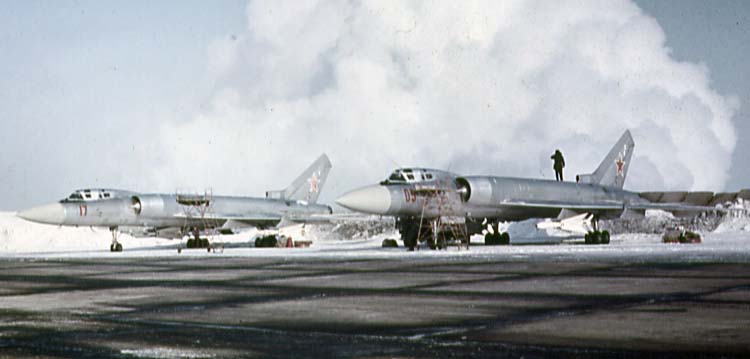
So by 1961 Russia had already an interceptor far more advanced that the Ye-152A that you claim as a very advanced aircraft, the Tu-128 had K-80 air to air missiles and the Su-15 was already
on its way to its first flight in 1961.
making the J-12 does not mean China was able to put into production a fighter program without any help the J-8I still has Russian engines, and basicly it is a very similar aircraft based upon russian tech according to some russian sources. Egypt, India and Argentina also did design some fighter aircraft in the 1950s and 1960s however the J-12 like the Pulqui was just a spark that did not lit a fire and never entered operational service.
original) J-12: Nanchang interpreted the PLAAF request as being for an ultra-lightweight fighter and produced a four-tonne design with a nose intake for its single WP-6 afterburning turbojet. The J-12 project started in 1969 and it only took 17 months for detailed design, wind tunnel tests and the production of three prototypes. After three years of test flights beginning in 1970, Nanchang made a series of revisions to the design to cope with problems including poor engine performance. The redesigned J-12 made 135 test flights, achieving a maximum speed of Mach 1.386 (surpassing the J-6) and showing sprightly acceleration, a takeoff run of less than 500 metres and a ceiling of 17,300 metres (also superior to the J-6). The J-12 was fitted with a 30mm and a 23mm cannon and had provision for up to 3 AAMs. However, in 1978 the PLAAF decided the J-12 was not suitable for the demands of modern air warfare and stopped development. Of the six prototypes produced two are retained in the Chinese Aviation Museum collection.
in fact the WP-6 engine is another russian engine build under license in China and this engine powered the J-12
В начале 1958 года Китаю была передана документация на советский двигатель Туманский (Союз) РД-9БФ-811.
At the begining of 1958 china recieved the documentation for the RD-9BF-811 Tumansky
WP6B был предназначен для истребителя J-12,и производился в небольшом количестве.
WP-6B was installed in the J-12 fighter, it was built in small numbers
sourcehttp://www.airwar.ru/enc/engines/wp6.html
http://www.china-defense.com/aviation/chinese_fighter_development/chinese_fighter_development-3.html
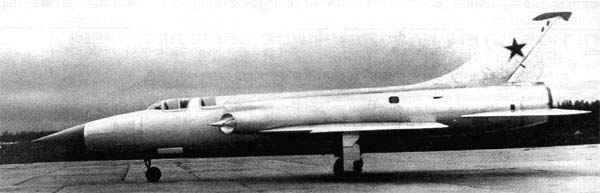
In fact if you look at the west wing 113 project it looks not very different to the Russian P-1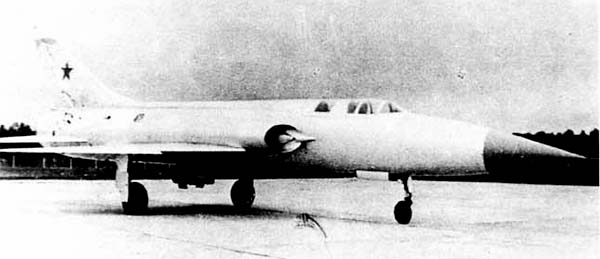
MiG-23MLDMiG-23MLDWhen was it (exact date)? Interesting to see the long pitot. Could mean that there is no Irbis installed yet.
It was on 19 February 2008 at the air ase of Zhukhovsky however thre report is from 20 February, this was reported by Itar Tass and Lenta Ru quoting Sukhoi`s head director Mihail Pogosyan
ЖУКОВСКИЙ (Московская обл.), 20 февраля. (ИТАР-ТАСС). Новый многофункциональный истребитель Су-35, первое летное испытание которого состоялось 19 февраля, поступит на вооружение в российскую армию в 2010-2011 годах, сообщил глава компании “Сухой” Михаил Погосян
Думаю, что серийные поставки Су-35 для нужд ВВС России начнутся в 2010-2011 годах. Мы также намерены продвигать этот истребитель на наши традиционные рынки в Юго-Восточной Азии, Африке, на Ближнем Востоке и в Южной Америке”, – сказал сегодня Погосян журналистам в подмосковном Жуковском.
It also thinks by 2010-2011 the series production will start for the Russian air force and export customers in South east Asia, Middle east, Africa, and South america
http://arms-tass.su/?page=article&aid=51463&cid=25
Как сообщила пресс-служба “Сатурна”, программа первого полета Су-35 выполнена полностью. Замечаний к работе двигателей нет. Время полета составило 55 мин, высота полета – до 5000 м. Полет выполнил заслуженный летчик-испытатель РФ Сергей Богдан (ОКБ “Сухого”).
In a press realese by Saturn the Comented thet the Flight lasted for 55 minutes and the max hieght attained was 5000 meters, the test pilot was Sergei bogdan
http://arms-tass.su/?page=article&aid=51452&cid=25
Двигатели 117С планируется устанавливать на новых и модернизированных самолетах ОКБ Сухого, поставляемых для ВВС России и на экспорт. Эти двигатели также будут использоваться в качестве промежуточных на перспективном истребителе 5-го поколения до завершения разработки новой силовой установки.
The engine 117S it is planened to be installed in new Sukhoi fighters as an interim engine till the Fith generration engine is ready for the PAK FA
http://www.lenta.ru/news/2008/02/20/su35/
however the report does not mention any thing about other details with respect the radar or avionics
MiG-23MLDYou just contradicted yourself. This really means you have no real brain logic.
You just proved to yourself that China only formally obtained a less advanced aircraft in 1962.
Now try to explain how China could have obtained an aircraft more advanced than the MiG-21F in 1959.
Not in height, length, weight, wingspan. The J-8I is significantly larger in all four dimensions.
Ye-152
Span: 8,488 m or 27 ft 10,2 inch
overall length: 19 m or 62 ft 4 inch
fuselage length (except cone): 15,45 m or 50 ft 8,3 inch
wing area: 34,02 m² or 366,2 sq fttake-off weight, 12500 kg or 27550 lb
max TOW, 13960 kg or 30770 lb
fuel, 3560 kg or 7845 lb
sweepback, 60°
wing loading 367,4-410,3 kg/m² or 75,3-84,1 lb/sq ft
operating limit load factor, 7.J-8I
Length 21.52m
Wingspan 9.344m
Height 5.41m
Wing area 42.19 square metres
WEIGHTS
Empty N/A
Normal take-off 13,850kg
Max take-off N/A
Fuel capacity N/A
Max payload 4,500kg
the weight is not correct
Масса, кг weight kg
пустого самолета empty weight
максимальная взлетная 13550 MTW 13550kg
топлива 3560 fuel 3560
sourcehttp://www.airwar.ru/enc/xplane/e152a.html
However Crobato you are who is wrong you are contradicting your self the Ye-152A was already two years old when the Chinese and Soviets signed the MiG-21 deal and in the same year the Ye-152-1 flew, China got documentation for the Ye-152A project because their original west wind project 113 and 117 were too far ahead of any real workable design
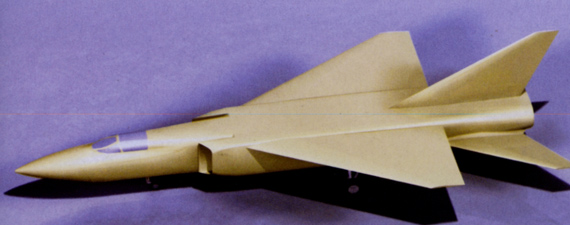
sourcehttp://sdycyz.vicp.net/bencandy.php?fid=10&id=1970
source http://military.china.com/zh_cn/dljl/wqzl/11035918/20051124/12883575.html
See that the orginal aircraft is far different from the Ye-152A look alike J-8I why? simply because China had no technology to make them, now many make a myth that those designs had any future without even a suitable engine and only with the R-11F-300 and the MiG-21 technology, yes Crobato the only option was to base the J-8I upon russian data as the Russian sources say and i have given you
MiG-23MLDYes, i agree. what you said above is absolutely right, the soviet influence is important.
The rule in those designers of china minds that time is: If we do not know how to do,check russia’s. If it is the first time we try, use what soviet used. These are the MUST steps of learning and growing.
That’s why J-8 looks similar with YE-152A,and J-8II looks like Su-15 while there are NO direct relationship between them and they are in fact totaly different from each other. Same level tech and same thinking way made this.
But i always should point out is, the different air battle expierence and different situation made different usage and requirement for a war plane in CHINA and Russia,thus made different plane.
Because the expierence of the air battles in Taiwan straits, PLAAF paid more attentions on Dog fight, and because the unstable and unreliable early AA missles, Gun fight is the only useful way.
The J-8 is designed to armed with two 30mm five-chamber revolver gun like DEFA and ADEN (sorry but this gun failed to be developed and have to use NR-30 instead, then used two 23mm twin-barrel gun). And the atleast requirement for J-8 is can win a dog fighter over J-7, and it DOES do that. Everey type of J-8 series is more manoeuvrable then the same time build J-7 type series(Except J-7E series,because these types are modified for dog fight and can hardly fly Mach2 as the cost).
And if we look back to Ye-152 and Su, Big radar,no gun, two missles,poor manoeuvre. etc..
So i think, J-8 is a design under soviet influence, and that’s all, NO tech transfer like YE-152…
Man your assessmet is only a empirical one, the J-8 and Ye-152 were very similar , in weight height and performance however the Ye-152A was a fighter with a max overload of 7Gs quit comparable to the MiG-21, according to what i know the first generation J-8I had a max overload of 4Gs, later variants could hold a little bit more or 4.83Gs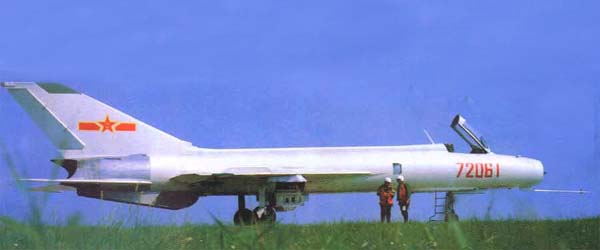
This means that the fighter was seriously handycap structurally, however it had a faster rate of climb almost twice as fast than the Ye-152A.
To beat a MiG-21PMF was basicly a dream when this variants are more agile than F-4s.
MiG-23MLDSomething i should say, according to chinese Book from SAC/CAC about the J-7 history.
EVEN NO Mig-21F-13 design blueprints given to china, russia gave serveral Mig21,some pits for assembling, and blueprints ONLY tell how to assemble a mig-21.
In fact, after assembing 26 Mig21,because lack of tech, NO J-7 enter service until middle 70s,and only very little j-7 were build during 60s-70s.So it’s funny that russia even denied to give Mig21’s design documents when they gave the experimental and more advanced、strategic intercepter’s blueprints.
And, J-8 is designed NOT to be only a intercepter!!! It’s designed to be more a fighter than a intercepter. When E-series and those Su-7/9/11/15 are pure intercepter or we can say : ‘A flying SAM launcher’
Man you do not believe even that historical account, the construction of an aircraft is a very difficult endevour, it is not an easy thing, first you need to have the machinery to build the airplane, second you have to have the trained technicians and workers and third you have to have the scientific knowledge in aerodynamics, mathematics, chemestry, metallurgy, electronics, physics etc etc.
China recieved all that from the Soviet Union, and that is the real reason they could fill up the gaps and solved the problems create by the lack of some MiG-21 documentation
The chinese did recieve not only documentation but also machinery and training, this allowed them to build the MiG-21 even if the Soviet Union did not deliver the whole documentation
MiG-23MLDSorry, but unlike you, I don’t take dishonest tactics like repeating a lie to make it a truth.
Add a few things to the list.
The fact that the Ye-152A was a very immature and incomplete project at the time before China and the SU split.
The fact that the Ye-152A was only concluded and terminated long after the split occured.
And once again, you failed to answer my points directly, especially one point most of all.
PROVE THAT MIG OKB COMMITTED HIGH TREASON.
How is going to be a very inmature project since the MiG-25 flew in 1964? and the Ye-152A flew in 1959 even before the first Chinese J-7 was recieved
In March 1961, the People’s Republic of China (PRC) and the Soviet Union signed the official agreement of a technology transfer package, which allowed China to build the MiG-21F-13 Fishbed-C) fighter, the Tumansky R-11F-300 turbojet engine, and the K-13 (NATO codename: AA-2 Atoll) air-to-air missile (AAM) locally under license. The production of the MiG-21 was carried out by Shenyang Aircraft Factory (now Shenyang Aircraft Corporation, SAC), while Shenyang Aero Engine Factory (now Shenyang Liming Aero Engine Company) was responsible for the production of the R-11F-300 turbojet engine.
Shenyang received few MiG-21 examples as well as some kits for assembly from the Soviet Union. However, the delivery of the technical documents was not completed due to the rapidly deteriorating relation between Beijing and Moscow. As a result, Shenyang had to build the MiG-21 by reverse-engineering
http://www.sinodefence.com/airforce/fighter/j7i.asp
so Crobato if the Ye-152-1 with R-15-300 engine did fly in 1961 why then the onterim Ye-152A from 1959 was before the soviet Chinese rift;)
MiG-23MLDThose are not authoritative sources. Those are just one innuendo after another, trying to gain credit for something that cannot be historically and technically proven. You are quoting biased hearsay—all without proof, all without unquestioned authority—that is being repeated from one fansite after another. Repeating one lie after another does not make it a truth.
You still cannot reconcile the historical inaccuracies and contradictions.
The fact that the Soviet Union does not SELL but GIVES.
The fact that the fighter is an experimental project that is far from conclusion, and no one in the world, not the least the Soviet Union, would just give away or blueprints to anyone.
The fact that you have no precedent of similar cases, before and after this.
The fact that there are many similar designs in this world, which has no direct design relationship with each other (Mirage III vs. Delta Dagger, Boeing SST vs. Concorde).
The fact that even at that time, there were already tensions with Chinese.
The fact why closer allies never got a hold of the project instead.
The fact that the Soviet Union would give away the blueprints of a strategic
asset to someone it already knows is building the BOMB.The fact that you cannot “sell” or give away such blueprints without the permission of the General Staff.
And the fact that what you claim amounts to Mikoyan OKB committing High Treason.
Madrat,
How the hell can a program be canceled years before it was actually initiated?
You really have no sense of the timeline and history of what happened. The Q-5 is based on an aircraft that has an earlier history than the MiG-21, the MiG-19, and the information to build that aircraft was furnished in the early 50s. China only got the blueprints to the MiG-21F around 1962 and never got that plane flying until 1966 due to some gaps in the documentation.
It has everything to do with it because the principle is identical. You are supposedly furnishing a weapons system to another Communist as part of your global revolution. The T-62 was a more advanced tank design than the T-54/55, and if the SU was so generous in furnishing their state of the art fighter design to China why not also provide their state of the art tank design as well? The fact is, if you want to allude that the SU is providing state of the art blueprints of weapons systems to China, you need to show a GENERAL and CONSISTENT PATTERN of this behavior across a whole spectrum of examples. Much like today, India getting a lot of stuff from Russia, from subs to missiles to the latest tanks and fighter jets, and for that understandably they are getting a hand in the PAK-FA project. The behavior cannot be an isolated one, it has to be an entire spectrum, as that is how it is demonstrated in actual HISTORY.
China was getting a whole spectrum of designs in the early to mid fifties, but every SU design after that representing their next generation pretty much dried up. The T-62 would have been to tanks and the T-54 like the MiG-21 is to fightes and the MiG-19. And the T-64 would have been like the Ye-152.
Crobato
yeah yeah yeah so when a historical account is given you jump in to conclusion to say basicly what is authoritative or not according to what you want to hear and fits your ideals.
Of course i have read Chinese accounts where they claim the Ye-152 has only similarity in engines and even that the Ye-152A was an excellent design, now all the authors i have read will always mention all the details, however they mention that the Ye-152 did indeed have the same engines the J-8 has and the main reason the J-8 has a different nose inlet is because the chinese did not have a powerful radar and in fact their radars were inferior to any thing the Soviet fitted to their Ye-152A and Ye-152-1 aircraft something that fits well the Russian accounts because they say the chiinese did not recieve the Orugan radar or any of the weapons of the Ye-152A , and funny the chinese webpages i have read say that the designers of the J-8I chose the R-11F-300 funny they say Chose because in reality they did not have any other alternative:rolleyes: later we find that that the Chinese could not fit better air to air missiles why then their aircraft looks like the Ye-152? because they only could copy what they did have access however they did have no Ye-152`s radar and no Ye-152A`s armament.
In fact Crobato your opinions are not very authoritative and are not very different from the Fanboys opinions your self critize;)
The J-8I looks like the YE-152 becasue it is based upon it, it has the gaps the Russians did not give radar and missiles and it has the only option they could take the R-11F-300, the original Ye-152A was a more powerful interceptor that the first J-8
MiG-23MLDOf note, before continuing, J-9’s required empty weight was 6400 kg. And that’s the ancestor of J-10. In fact, you can get an idea of the requirements by looking at CAC’s earlier projects.
I know where you got that figure from, but that’s wrong.
J-8F is over 1 as I calculated in the other thread.
Believe what you must, that’s what they stated.
J-11 is a flanker, what else is it suppose to look like?
JF-17 is 6320 kg and J-8II is 9230 kg. If you ever looked at their photos, you’d see J-10 is closer in size to JF-17 than J-8II. It’s in fact not much larger than JF-17. On top of that, it uses more modern material than both, far more composite. As for composites/titanium, you should first lower the weight of the aircraft by good design and that’s what J-10 has. It achieved all weight requirements by being designed well and with increased composite usage in the future, it will only help with the weight situation.
Why do you insist on using such old numbers when everyone who follows PLA will tell you that they are wrong?
J-8I uses heavier and weaker material than J-10. The materail used on J-10 is a couple of generations ahead of J-8I. This comparison is frankly just sad.
is it J-10’s fault that F-16E and F-2 are such overweight designs?
Rather than using Chinese fighters JF-17 and J-8II as the basis of comparison, you pop up overweight fighters like F-2 and F-16E.yet, J-10 has a far better safety record than flankers. Says something about the quality of its FBW.
lol, those extra fuel tank can never reduce the advantage against the unstealthy behemoth that is su-27. You speak as if you’ve never seen the plane.
If 2 PL-12 + 2 PL-8 can’t kill the opposing plane, it probably would be dead already.
nope, all interviews conducted point to J-10 having visibly better maneuverability than flankers.
mirage 2K
length 14.36 m
span 9.13 mJF-17
length 14 m
span 9 myet, JF-17’s empty weight is over 1000 kg lower than that of Mirage 2K. You can find this from sinodefense, which takes this from CAC’s official published data. So, why are you using Mirage 2K to compare to J-10?
I will give you data from the F-18, the F-18 LERXes increase the main wing`s lift by 50% a canard will increase the wing`s lift 20% or 30% because the canard produces a wake that reduces the wing`s main lift.
However it will increase the wing`s total lift at high AoA , this means that the canard and delta wing`s total lift is in fact less that the sum of their individual lifts due to drag.
Canard delta aircraft use the canards as pitch control mechanisms rather than as lift enhancers, the Su-27 has 40% at least of fuselage lift and a higher direct lift by its LERXes, having twin fins will make it a safer aircraft, the Cobra is a good example how the Su-27 moves the center of lift over the wing and makes its nose pitch down to recover after 120 degrees AoA in few seconds without any side slip yaw movements, this means the aircraft has excellent stability doing the cobra and it does not create any assymetric nose yaw movement to make it flat spin or stall.
I have heard too much about canarded aircraft but i have not seen them doing the Pugachev Cobra without thrust vectoring.
The F-16 and F-2 are not overweight aircraft but multirole fighters, for the J-10 to fly with three fuel tanks and missiles needs at least similar engine and aerodynamics to a latest F-16 variants, but it will be as good at them because contrary to common belief, the LERXed aircraft do not yield to canarded aircraft as many think, both aircrat have cons and pros and the J-10 also has compromises.



 Sign In







