 MiG-23MLD
Oh boy. They are doing almost the entire Esquilo there.;)
Fabricação de peças e instalações opcionais
A Helibras já produz no País algumas peças, conjuntos e instalações opcionais para o Grupo Eurocopter. Entre eles, está um conjunto de suporte de espelhos retrovisores do modelo Esquilo, o conduto de distribuição de fluxo de ar condicionado para a cabine do Colibri EC 120, kit aeromédico para o helicóptero Esquilo, carenagens blindadas em materiais compostos e instalações de armamentos axiais para versões militares do Esquilo e Dauphin.
Source: Helibras website.
What pieces of tecnology from the brazilian high-tec aerospace industry.;)
I believe that in the 80s the brazilian company Aeromot manufactured some basic avionics for the Esquilo but since the current instruments are much more complex they quit manufacturing those instruments due lack of money for development and expertise.
The only good news is that France finally allowed Helibras to perform a major overhaull in the Panther, refurbishment of Cougars still forbidden. According to one source they only did that because Sikorsky offered to the Brazilian Army the UH-60 Blackhawk and would acept the Panthers as part of the payment. Sikorky had no problems allowing Brazil the right to perform major overhaulls in the UH-60 fleet.
I´m sorry, but theree´s a big diference between Manufacturing and Assembling. Helibras only assembles foreing made parts.
Man i do not understand all your whining, in Latin america as in any part of the world market demands is what drives a civil program, military programs in Latin america barely have been successful.
http://www.aviationcorner.net/gallery.asp?aircraft_type=Cicar%E9+CH-14+Aguilucho
What Helibras has done is something normal to have a viable program, are they learning? yes they are, however they are not going to start a domestic program if it is not economically sound because it requieres an investment too large and so much expertise to design a totally domestic design.
Can Mexico or Brazil build domestic helicopters? the answer is probably yes, however it is more practical to make fuselages for Bombardier and Mcdonnel Douglas in the case of Mexico or Embraer aircraft in the case of Brazil because the programs do cheapen the learning progress of the local industries even if the entire aircraft is not Brazilian in the case of Embraer or the patent is gotten by a foreign firm in the case of Mexico when mexican engineers design jet engine control systems for General Electric.
The Cicare CH-14 is not de most advanced helicopter in the world however at least is a domestic design if Brazil or Mexico assemble or built some parts or spares of non domestic designs is also good because it gives expertise and jobs in a very practical way, Cicare in that is in disadvantage, unless it can have enough firm orders it is difficult to know the real future of the project and even of the company it self.
MiG-23MLDEurocopter/Helibras only assembles helicopters in Brazil. There´s no production line there, perhaps the paint is brazilian made. Of course they promissed to Brazil in the 80s that a production line would be open there if they bought the Panthers which they did and it did not happened.
In the 90s they did the same with the Cougars and again there were no production line openned there. Another lie. To get worse this situation, only France is allowed to refurbish Panthers and Cougars. Helibras was not certified by Eurocopter for this level of maintenance. So Brazil has to send those helicopters to France if they need a major overhaull which usually takes more than six months and costs the triple or more if the job was done in Brazil.
Well no one said they do everything, i only said they assemble and license built the Esquilo and Panther i know i few have been built of the former

In fact Helibras has built more than 300 helicopters and at least 151 military helicopters for the brazilian armed forces

http://www.segurancaedefesa.com/laad2005_noticias.html.jpg)
http://www.protocolo.com.mx/articulos.php?id_sec=4&id_art=1608&id_ejemplar=0
Now in Brazil like in Mexico they have opted for a different approach, built the helicopters or helicopter parts and get some degree of technology transfer either by training specialist in the area of helicopter building or getting some machinery from the stablished manufacturer in this case Eurocopter or Mc Donnel Douglas Helicopters.
You can not expect the stablished manufacturer will loose or be in disadvantage, Cicare in argentina has followed another path in the application of foreign components to a domestic design.
Both pathways are good, one gives economic insentive to the economy, for example Mc Donnel douglas Helicopters Mexico builds fuselages of the MD-500 for the US army and other customers, however the technology transfer is very limited, the viability of economic and manufacturing independence is also very limited since the company is owned by foreigners.
Helibras up to a point has more freedom however it is only stimulated by the market and is a Brazilian company but is limited in the sense it is dependant in foreign designs.
Cicare has more technological independence and complete technological leadership however it is dependant upon market needs too and a very unreliable market the domestic military market.
The Cicare CH-14

The only way Cicare can succeed is if only can sell its designs all over the place in Latin America and the Argentine Government does buy at least a large order as India did with its Druv
the CH-16 a future Helicopter
the CH-7

source
http://www.dintel-gid.com.ar/articulos_sistemas/articulo45.html
MiG-23MLDExactly…they may even make a light CH-14 to replace the MD-500 and light helicopters used by Argentina, and a heavier CH-14 to become more of a dedicated attack helicopter. If you think about it, Argentina would not even need a very heavy attack helicopter (like an Apache or Tigre). A lighter one, almost like an in between the attack MD500 and Cobra, would probably be better for it’s needs (maybe even start a new category of medium weight attack helicopters).
—–JT—–
Argentina has a long stablished helicopter industry for latin american standards here are some of the previous Cicare Helicopters, in fact the CH-14 was not exactly the first military helicopter developed in Argentina, however it is probably the first to have a real potential as an attack one.
Currently Cicare is developing a side by side helicopter, the CH-9, that will probably be in the MD-500 class
http://www.helis.com/timeline/cicare.php
On the pictures are the CH-5, CH-7 and CH-14 all built and designed in Argentina
MiG-23MLDThis seems to be very unlikely.
Isn’t it premature to make this sort of statement? So far, all we see is a demonstrator with dynamics that would have seemed outdated 40 years ago, and a pseudo-stealth fuselage shape.
Helicopter production in South America is more likely to stem from an established international consortium like Eurocopter, than an inexperienced start -up. I could more easily imagine a production line moved from Germany or France to Brazil, than a crude domestic design gaining international sales.
In fact one of the main golas of the CH-14 project is make it a exportable aircraft
The Ansat is the result of a long design process, funded by international sales of Kazan produced Mi-17s. The Ansat is credible design that has evolved over time, from an established company.
Your statements are well founded, however they lack an element you miss and that the argentine webpages do consider.
Eurocopter already has stablished production plants in Brazil and Mexico, Brazil did assemble a few Panther helicopters domestically and in Mexico at least some production is going on i do not know if they have built parts, spares or assembled helicopters look
MEXICO CITY- With a US$60 million investment, the helicopters
assembler. Eurocopter de Mexico, expanded their inventories,
logistics, maintenance and workshop areas to cover the growing
demand of the Mexican and Latina American markets.
With 25 years in the domestic market, Eurocopter de Mexico, one of
the five subsidiaries Eurocopter has all over the world, is planning
to assemble 30 units this year, which they will sell in Mexico,
Central America and South America, according to
Phillipe Harache, Eurocopter Executive Vice-president
http://www.maquilaportal.com/cgi-bin/public/board.pl?klie=11
Helibras did assemble the Panther Helicopter in Brazil, McDonnel Helicopters does build fuselages in Mexico.
However there is one thing where Argentina is ahead, niether Brazil or Mexico have designed a helicopter, consider that Mexico and Brazil do have large fleets of Helicopters.
Eurocopter and Mc Donnell douglas Helicopters do not allow the development of local industries, and despite the CH-14 might be slightly more expensive that a foreign counterpart it does allow the development of the local argentine industry.
In fact Cicare is built by an argentine designer and with the participation of Argentina`s Universities and armed forces and the main purpose is to spread the knowledge in the design of helicopters.
In fact one of the porpuses of the Cicare company is to export the Helicopter.
http://www.airfighters.com/photo_14264.details.large
Buenos Aires, 23 November (Telam) -The Army today presented the first military helicopter developed and built in Argentina at a ceremony at Aviation Command, in Campo de Mayo, headed by the chief of the force, General Roberto Bendini.
The CH-14 is a two-seater powered by a turbine and was developed by Augusto Cicare, dean of the activity in this country and creator half a century ago of the CH-1, the first helicopter built in South America, an Army source told Telam.
Bendini emphasized the achievement that the aircraft represents, which he called “a source of pride for the Army and a source of national pride,” while speaking at a ceremony held this afternoon for the 49th anniversary of Army Aviation.
He also detailed the expansion of a hangar and other Army Aviation facilities, made possible by the budget increases of the past few years and the effort of the military personnel.
In another section of his speech, he praised the “courage” of the military aviators in various missions, especially those carried out during the Malvinas [Falkland Islands] war.
The CH-14 is a tandem two-seater (one crew member forward and the other aft) for surveillance and light attack, which Cicare designed on assignment from the Army.
“This craft is a very important step for the development of a domestic helicopter industry and a contribution so our country can regain a leadership position in the aeronautical field,” the source consulted said.
The prototype of the CH-14 uses an imported turbine and other components, but in future stages of manufacture increasing integration of domestically produced components is planned. In addition to the manufacture of the CH-14, Cicare is working with the Army on developing two other helicopters, a “side-by-side” two-seater (with its two crew members in parallel) and a four-seater for training, liaison, transport, and rescue.
Besides the CH-14 and the two projects mentioned, in the past few years the Army successfully carried out the conversion of the UH-1H Huey helicopter to the Huey II version, done by the 601st Aircraft Maintenance and Supply Battalion. This updating has costs much lower than those which doing it in the United States at the Bell company, which certified the Huey II, would have involved.
Among other improvements, it includes more turbine power, more payload, range, and flight altitude, as well as operating costs 40 per cent lower than those of the UH-1H, according to specialized publications.
As for Cicare, 70, at age 21 he already flew his CH-1, the first helicopter built in South America, for which he used materials and instruments that were not of aeronautical origin. Between the 1960s and 1990s, he developed other civilian-use helicopters, including the CH-5, for agricultural use; the CH-6 and its improved version CH-7, a mini-helicopter with an innovative system of controls; and the CH-8, ultralight, two-seater, twin-engine. He also worked on the CH-9 (a “side-by-side” two-seater in two versions: with one or two turbines of Argentine design), and together with CITEFA [Armed Forces Scientific and Technical Research Institute] on the development of the CH-11, an RPV [Remotely Piloted Vehicle] (pilotless surveillance) with counter-rotating rotors.
In addition, in 1969 he created an airplane flight simulator and in 1994 the remarkable SVH-3 helicopter flight simulator/trainer, winner of many awards and sold to Argentine companies and government agencies and to countries like Great Britain, Canada, and Australia.
Outside the aeronautical industry, Cicare manufactured engines as a teenager and years later designed and built a V-4 with a cogged timing belt for installation in DKW automobiles, at the request of Juan Manuel Fangio [note: famous race car driver].
During the event at which the CH-14 was presented, Bendini awarded prizes and recognitions to the outstanding Army Aviation personnel.
He was accompanied by the chairman of the Army Aviation Technical Troop Committee, General (retired) Arturo Grandinetti; the Commander of Army Aviation, Colonel Gustavo Serain; and other military, civilian, and religious authorities, and guests.
The ceremony ended with a parade of troops on foot and the flyover of helicopters from the Army Aviation units of Campo de Mayo, Neuquen, Parana

http://www.zibb.com/article/2242454/Argentine+army+presents+first+homegrown+military+helicopter
http://foro.loquo.com/viewtopic.php?t=97012&highlight=
http://elaustral.foroactivo.com/ejercito-argentino-f2/presentacion-del-cicare-ch-14-t319-15.htm
MiG-23MLDits similar to Russian Ansat,but I think the Russian better than
Aguilucho
The CH-14 is just a prototype ordered by Argentina`s army and it might be the begining of a domestic helicopter industry in Argentina and probably in South america.
In general if this helicopter advances into a production model and gets comercial success it is probable it will become the basis of the whole mercosur and latian american domestic helicopter industry.
I agree the Ansat has more advanced features but the AH-14 Cicare is just the begining and it has a disadvantage of 50 of experience with respect Russia.
MiG-23MLDIt has the right sort of look, but it is simply not an attack helicopter – the payload capability simply isn’t there. It might be uprated, and perhaps carry a machinegun or grenade launcher, but it will still be no more of an attack helicopter (in fact much less so) than helos like the Gazelle and Squirrel (or early Kiowas).
In effect, if it is a technology demonstrator for a larger helo, then it is great. If, on the other hand, they expect to stick a GPMG on the side and call it an attack helo, then that’s their right, but by most normal standards, that’s not what it is.
It is an army helicopter and it is more a prototype than an operational helicopter, it can carry 700kg load, your assesment its right it is more a scout surveillance helicopter than an anti tank attack helicopter, however the only real thing why it is an important feat it is because it is the first ever domestically designed and built latin american Helicopter.
When Argentina sold its FAMA aircraft company to Lockheed, it seemed the end of the domestic Argentine aircraft industry, however this aircraft it is totally built in Argentina (except the engine of course) and has the potential future of becoming an army helo sold throught out Latin America and the developing world
MiG-23MLDYou can make what you want of the link/info I provided, but according to Russian official sources the Su-27SM will outperform the Su-30MKI (all export models, rather), so the Russians are clearly not spilling the beans on what exactly they are installing aboard the upgraded home Flankers.
I do not think so, Russia has displayed the best Su-27 Flanker variant, in fact they call it the ultimate Flanker and the last variant to be produced before the PAK FA, yes i am talking about the Su-35BM, why Russia will hide a simple upgrade? i can understand they do not unveil details about the PAK FA or even about the Su-34, but an upgrade is not a matter of top secret, in fact it is probable the Su-27SM is basicly a fighter that uses fifth generation fighter`s electronics, some modern weapons and new weapins perhaps long range weapons as those seen in the MiG-31 upgrade package.
Nevertheless that package is the Su-35BM, so it is probable it is not as advance as the Su-35BM.
Also what the Russians claim by official, can mean many things perhaps they are just saying the electronics (avionics) used for the Su-27 upgrade are better than the ones used in previous Flankers such as the Su-30MKI or Su-30MKK, however technologically speaking still yields to the Su-35BM.
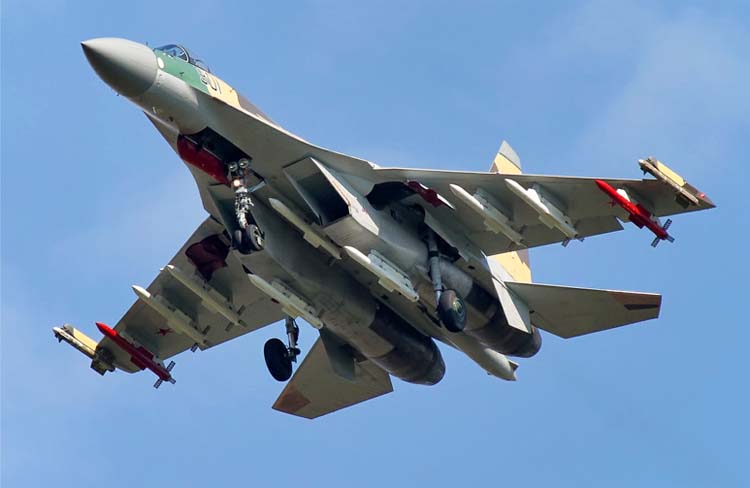
MiG-23MLDGiving the su-27 or whatever aircraft thrust vectoring does not make it more AGILE, but more MANUOVERABLE Two very, very different concepts. Are you sure the su-27SM can supercrusie, I though it only will wll the larger engine that only pssibly the su-34/5 will get.:confused:
On supercrusing wing planforms. Surely not only the type of wing, but where the wing is placed on the actual aircraft will determine where the CP will lie, so you could use it to supercruise. But the lighting wasnt meant to anyway, it just happened to do it. I wasnt in the specification like Euro or F-22.
Well i do not know if the Su-27SM can supercruise, it was just a guessing of my part, nevertheless i doubt it can supercuise, the Su-35Bm i know it can supercruise.
About the Lighting and supercruise, supercrusie is a thing related to the engine however the wing will determine the longitudinal stability, flutter, drag and stall characteristics of the design.
The Lighting was designed in a time when sweptback straight wings were seen as the best compromise between speed and agility.
Later on designers saw the delta wing offered the same speed characteristics but better supersonic behavior.
Determine the wing`s aerodynamic center shift behavior is not an easy task, but delta wings and cranked delta wings such as those seen in the F-16XL are better suited to handle the supersonic center of preasure wing shifts.
Wings that have compound design and different leading edge swept angles do have improvements in center of lift wing shifts and flow separation behavior.
The Lighting wing was designed for speed but still it is a 1950s design and up to some degree a very conservative design if we compare it to the then more revolutionary MiG-21 or Mirage III.
The F-16XL was a design very optimized to deal properly with flow separation and supersonic aerodynamic center wing shifts, canards also can affect the supersonic center of lift shift in an unfavorable or favorable way

Mach Tuck
Previously we have learned that wings have an aerodynamic center and that center is at approximately the 25% chord point. However, as the aircraft moves into supersonic flight the up wash ahead of the wing disappears (since no pressure waves move out ahead of the wing.) As a result it is not surprising that the aerodynamic center and center of pressure, both move back to the 50% chord point.
The nose of the aircraft always tends to pitch nose down as the aircraft transitions from subsonic to supersonic speed. This tendency is called the “Mach Tuck.” In aircraft such as Concorde the “Fly by Wire” controls compensate for this tendency automatically, so the pilot never notices it. However, if the aircraft was never designed to enter supersonic flight (like most airliners.) the nose would pitch down significantly during the transition through the transonic speed range.
Longitudinal Stability Increases in Supersonic Flight
We know that the longitudinal stability of the aircraft depends upon the center of gravity being ahead of the aerodynamic center. But, as the aircraft moves into supersonic flight the aerodynamic center suddenly moves back. This will have two effects. It will produce a tendency for the nose to pitch down. It will also increase the longitudinal stability of the aircraft making it harder for the pilot to make pitch changes.
The above phenomenon was first encountered during the second world war when some P-51 and Spitfire pilots got too close to the speed of sound, usually in a dive to catch, or escape from, the enemy. The pilots experienced a tendency for the nose to pitch down even more and reported that it took all his strength to pull the nose back up. Some did not make it and dove into the ground, or broke up, as their aircraft exceeded the maximum design speed.
Trim Changes Upon Entering Supersonic Flight
Modern supersonic aircraft have little difficulty passing through the sound barrier because they are designed with very large and powerful elevators (or Elevons) with “Fly by Wire” to help the pilot move them. However the nose up trim change which is always required on transition to supersonic flight will result in an increase in trim drag (because the down force on the tail will require more lift from the wing.) One solution to this problem is to use forward located strakes, or a canard to offset the pitch change. We can see strakes on most third generation jet fighters such as the F-18, or Canards on most fourth generation jet fighters such as Euro Fighter.
The designers of Concorde, in the 1960s took a more obvious approach. They equipped the aircraft with a second fuel tank and high speed pumps which allow the center of gravity to be shifted back for supersonic flight.
Mach Over Speed
Flight at more than the speed of sound is no great problem if the aircraft has been designed to do it. However, inadvertently exceeding the maximum design mach number in a subsonic aircraft can be disastrous.
Modern jets are almost always equipped with a mach over speed indicator (slang “hen pecker” ) This warning device generally makes a loud clicking or beeping sound which some people think sounds like a chicken clucking, hence the slang name. If the aircraft accidentally exceeds the maximum permissible speed the power must be removed and the nose raised. In aircraft equipped with trimmable tails the trim should be run nose up.
Recovery from an over speed must be prompt because if the aircraft accelerates too much shockwaves may form at the intersection of the elevator and stabilizer reducing the effectiveness of the elevator. This combined with the overall nose down pitching tendency upon transition to supersonic flight (described above) may quickly make it impossible to recover.
sourcehttp://selair.selkirk.bc.ca/aerodynamics1/High-Speed/Page6.html
MiG-23MLDFor the 3rd time, and this time, please get this through your head.
Russian officials claim the Su-27SM is better than the Su-30MKI, check the posts before this for source. Also, in the next 5-8 years most if not all of the Su-27/MiG-29 upgrades should be done, which will bring the upgraded # of aircraft into the hundreds.
The AIM-9X was just recently re-admitted into service, so it’s questionable how many are even available at the moment since the missile wasn’t hitting anything, not to mention the R-73M is in service and should be comparable.
The Su-27SM to be superior to the F-15I, needs a Python V equivalent and a missile better than the Meteor, i do not know but up to what i know Russia has not deployed yet an equivalent to the Python V, IRIS-T and AIM-132, Israel, Germany and Britan have alredy deployed the Python V, IRIS-T and AIM-132.
You do not need thrust vectoring if you have Python Vs, now if the current Su-27SM is equivalent to the Su-35BM then the aircraft still needs a weapon like the Python V.
If the Su-27SM has supercruising ability then the aircrat is slightly close to the Eurofighter, but still the Eurofighter is more agile if the Su-27SM has not thrust vectoring and with AIM-132 the Eurofighter will rule.
In fact the Su-30MKI is not as capable as the Eurofighter or even JAS-39, weaponry is very important and the Russia has not deployed a weapon as good as the Python V
however up to what i have read the Su-27SM is not an equivalent of the Su-35, yeah it is better than the average Su-27 but is not a Su-35BM equivalent
В связи с тяжёлым финансовым положением в российских ВВС, было принято решение не закупать новые Су-35, а ограничиться модернизацией Су-27 приблизительно до уровня Су-35. Опять же, из-за недостатка средств, Су-27СМ уступал по характеристикам Су-35, но значительно превосходил исходный Су-27.
Here they say the aircraft due to economic limitations still is not a Su-35BM equivalent even despite they originally wanted that, they say it is better than the older Su-27 but still is not a Su-35 equivalent and because of lack of money they could not buy Su-35 niether upgrade the Su-27s to Su-35 level

http://forum.boinaslava.net/showthread.php?t=9231&page=3
http://rusarmy.ru/unit.php?id=49
MiG-23MLDquite right. Its not that simple just to throw a FBW system here and there 😀
But the lightning could pull 8-9g and supercrusie in some rare conditions. It was a super high performance aircraft of its day, and stuffing it with modern systems would only make it equal to todays, not better, but still a prick in anyones foot.
I doubt it is a good supercruising aircraft, wing shape affects aerodynamic center shift a lot and this affects longitudinal stability, a delta wing is better for supercruise than the arrow shaped sweptback wing platform used on the Lighting, once the aerodynamic center shifts back of the gravity center and gets close to the wing`s trailing edge, its good qualities disappear, delta wings and compond wings like cranked delta wings are better for a supercruising aircraft.
The F-22 has a very large delta wings with almost trapezoidal shape more adequate than the Lighting`s swept back wings
MiG-23MLDLol im pretty sure the BAC lightning armed with araam and asraam capability, modern avionics, possible FBW, would give any modern aircraft a run for its money. Be rather like a shorter ranged F-16.
It won`t be a superfighter as you think, the MiG-23-98, F-4 Kurnass, J-8IIF and other third generation aircraft are more or less armed like that but old airframes have also aerodynamic limitations that won`t be cure by simple FBW modifications, the wing profile, the wing aerodynamics, the stall speeds, the static stability parameters and other aspects are physical limits that FBW can not modify.
It is better always buy a new airframe and fit it new weapons rather than take an old airframe and fit it new weapons.
MiG-23MLDWhat are you about, with the exeption of the F-22 the “Russian” Su-27/MiG-29 are much better that the F-15/16/18’s
and so far 180 MiG-31’s have already been upgraded.
The Russian dogfight aircraft lack a decent modern air to air missile in the class of the AIM-9X and AIM-132.
Long gone are the times when the R-73 was king, now the Python V, AIM-9X and AIM-132 are real present kings of the air to air arena at close range.
In performance the Su-27B and MiG-29C which are the main Russian aircraft are not as advanced as the Eurofighter and Rafale.
In reality Russia is behind in fighter technology in terms of operational deployment.
The Su-30MKI is an exception but it lacks a good air to air missile too made from Russia.
The few Su-34 deployed still are not enough and basicly Russia needs the Su-35BM to catch up at least with Europe in fighter technology.
MiG-23MLDI see nearly everbody has been talking about modern aircraft but are there any fighters from 10, 20 even 30 years ago that could cause serious problems for modern jets?
Lightning, Phantom and Hunter springs immediately to mind. :confused:
I guess any fighter aircraft has the ability to cause damage however it has also limits stablished by physics, in the case of a Hunter let us say against a Su-35BM, i doubt the Hunter has any real advantage in performance or agility and very likely is a sitting duck for the Flanker.
If you upgrade a F-4 with modern avionics, thrust vectoring and modern armament, probably you can have a degree of real gains but the cost of doing that is in part worthless, the aircraft aerodynamics and structure is ill suited to accept all those changes and exploit those new technologies as a new airframe does.
The F-22 basicly outfights all the possible rivals
MiG-23MLDJeez guys you still haven’t learned anything after all these years:
1) JF-17 (I have seen definitive YouTube videos that prove that it can shoot down an MKI. 1 JF-17=3 MKI + 1 Mig-29)
I tell you guys…..you really need to do your homework. Here is a link (if its not already posted). How can you even ask for more proof?
http://www.youtube.com/watch?v=03gD1gDfqL42) Habib Sitara- (yes there is a flying version and yes its better than the F-22)
The FC-1 is a simple aircraft not an F-22 class fighter niether a F-35 class aircraft, the Russians helped in its aerodynamic design, in fact it is a fighter that has MiG heritage, it won`t beat a MiG-35 niether a Su-35BM; and a Su-30MKI in close combat will always beat it in gun fights, thrust vectoring makes the Russian aircraft better fighters.
A video game won`t represent the reality in fact it is probable that late blocks of F-16 will beat it.
The FC-1 also has low thrust to weight power compared to a MiG-29 and it is not armed with AIM-9Xs or Python V, basicly is a good modern MiG-21 type.

http://www.chilehardware.com/foro/ff-aa-chile-t104098p4.html
MiG-23MLDIt was developped in the timeframe of the Mirage 2000, so it could have worked in a high/low mix in the Armée de l’Air and could have been sold abroad as a competitor to the F15 for instance. It would have been evolved like the Mirage 2000-5/9, and eventually replaced by the Rafale too.
Nic
I agree but i think the french did right, the Mirage 2000 was cheap and was available and there were new specifications for a far more advanced fighter in the form of the Eurofighter original program in which the french did take part.
The Mirage 4000 was unable to satisfy the Eurofighter program specifications and adquiring both aircraft would had meant a very short replacement time, the Mirage 4000 and Rafale are not much very different after all, however the Rafale is more agile, smaller and much more advanced, so it would had meant in some way an extra expenditure.
For the Mirage 4000 the only way if had guaranteed a place in Dassault`s production lines was export orders.
But undoutedly the Mirage 4000 was a very beautiful aircraft i do like it a lot too


 Sign In







