 MiG-23MLD
There was one fuselage station almost between the ventral fins, I remember seeing ALQ-131 ECM pods being hung there. As far as I know this was not a hardpoint wired for weapons carriage though.
Different radars, for one. Differing RCS requirements, for two.
You’re making an assumption. It probably has more to do with lowering the RCS than anything else. Ride control can be effectively managed by flight control software and canard action. The Russians are far from stupid in the FCS arena, they did manage to de-TVC the Su-37 and give it all of the agility that the TVC-equipped aircraft had, and that is pretty impressive in my book, speaking volumes about the aerodynamic capability of the FLANKER airframe.
I think you mean the baseline Su-30/Su-30K…
SOC
The radome`s shape geometry has to do with several compromises, radar size, radar diameter, vortices asymmetry sideslip, drag, the general configuration of the aircraft, RCS treatment etc etc…. to reduce to a single factor is irrealistic and anti scientific.
If you remember the YF-16 and T-10/Su-27A prototypes you will remember they had different radomes than their production models, true radars do affect the general configuration, but they do not do it to completly determine the general shape.
If you read the F-15 article that i posted, you could see how very small imperfections in the radome can lead to tragic consecuences, same with the F-14 or X-31.
Undoutedly the Su-34 has a contoured radome taking in consideration several factors, same is the F-16 or F-111.
The big head Flankers that have large crew stations like the F-111 and Su-24 needed to reprofile the radome to match it to a big crew cabin seating a side by side crew.
Your explanation does not hold water because if you look at the Su-33KUB and to the Su-34 they not only have different radomes but also diferent LERXes and a different contouring of the whole crew cabin with respect the fuselage, their canards are also different.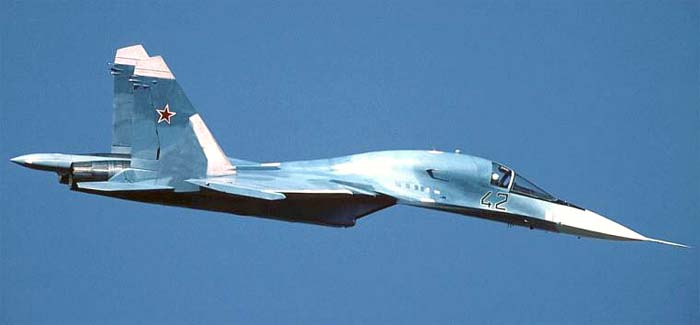


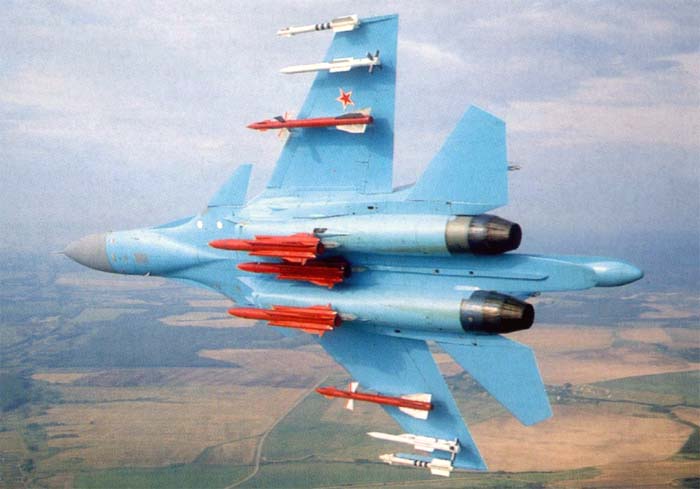
http://www.airwar.ru/enc/bomber/su34.html
if you look well at the pictures, you can see the Su-33KUB follows more the general arrangement of the Su-27B while the LERXes, radome, crew cabin station, sting fairing and hump in the Su-34 are unique in the Flanker family
Stealth is a factor in the shape the Su-34 nose radome has, however like very likely sideslip vortex asymmetry too plays its part.
If you have looked at the F-111 and Su-24 both aircraft also match the canopy shape with the radome shape, in the Su-34 the basic radome canopy geometry is in a very general mannner closer to the F-16s where a flattened ogive is followed by a bulgy canopy with LERXes and ventral inlets.
The Su-34 has a radome that is a compromise of stealth and aerodynamics and this has always been the case
MiG-23MLDThe ride quality is nothing else than the gust response of an aircraft. The vertical load factor (when we consider vertical axis only) changes with the airspeed flucturations (and angle of attack, but lets consider a purely hotizontal gust).
The function is:
n ~ CL ~ IAS² * WingArea * Lift Curve Slope * Angle of AttackCanards only help in controlling the aircraft, the gust response is largely similar. The discomfort of low level flight is due to gusty conditions with high dynamic pressure. The pilot also needs to control the flight path, which may cause high workload (lots of disturbance, probably resonance with aircraft modes).
For a gust load allevation it is rather necessary to use wing trailing and leading edge devices, which normally have insufficient reaction time. The canards on the B-1B were necessary so that the flight control system could control pitch, the elevators were not fast enough.
Thanks i like this definition, i want to ask you this i am not an aerodynamist, do you think the Su-34 has good controlability at level flight at sea level and Mach 1.1 because for what you are saying the Su-34 has several control devices and must be able to use them properly to stay controllable, and do you think the general aerodynamic configuration does play a part in controlability?
The response of aircraft to stochastic atmospheric turbulence plays an important role in aircraft-design (load calculations), Flight Control System (FCS) design and flight-simulation (handling qualities research and pilot training). In order to simulate these aircraft responses, an accurate mathematical model is required. Two classical models will be discussed in this thesis, that is the Delft University of Technology (DUT) model and the Four Point Aircraft (FPA) model. Although they are well estabilished, their fidelity remains obscure. The cause lies in one of the requirements for system identification; it has always been necessary to relate inputs to outputs to determine, or identify, system dynamic characteristics. From experiments, using both the measured input and the measured output, a mathematical model of any system can be obtained. When considering an input-output system such as an aircraft subjected to stochastic atmospheric turbulence, a major problem emerges. During flighttests, no practical difficulty arises measuring the aircraft motion (the output), such as the angle-of-attack, the pitch-angle, the roll-angle, etc.. However, a huge problem arises when the input to the aircraft-system is considered; this input is stochastic atmospheric turbulence in this thesis. Currently, during flight tests it still remains extremely difficult to identify the entire flowfield around an aircraft geometry subjected to a turbulent field of flow; an infinite amount of sensors would be required to identify the atmospheric turbulence velocity component’s distribution (the input) over the vehicle geometry..In an attempt to shed some more light on solving the problem of the response of aircraft to atmospheric turbulence, the subject of this thesis, it depends on the formulation of two distinct models: one of the atmospheric turbulence itself (the atmospheric turbulence model), and the other of the aircraft response to it (the mathematical aircraft model). As concerns atmospheric turbulence, stochastic, stationary, homogeneous, isotropic atmospheric turbulence is considered in this thesis as input to the aircraft model. Models of atmospheric turbulence are well established. As for mathematical aircraft models, many of them have been proposed before. However, verifying these models has always been extremely difficult due to the identification problem indicated above. As part of the mathematical aircraft model, (parametric) aerodynamic models often make use of (quasi-) steady aerodynamic results, that is all steady aerodynamic parameters are estimated using either results obtained from windtunnel experiments, handbook methods, Computational Aerodynamics (CA) which comprises Linearized Potential Flow (LPF) methods, or Computational Fluid Dynamics (CFD) which comprises Full-Potential, Euler and Navier-Stokes methods. In this thesis the simplest form of fluid-flow modeling is used to calculate the time-dependent aerodynamic forces and moments acting on a vehicle: that is unsteady Linearized Potential Flow (LPF). The fluid-flow model will result in a so called “unsteady panel-method” which will be used as a virtual windtunnel (or virtual flighttest facility) for the example discretized aircraft geometry, also referred to as the “aircraft grid
sourcehttp://www.darenet.nl/nl/page/repository.item/show?saharaIdentifier=tuddare:oai:tudelft.nl:078317
MiG-23MLDdon’t flatter yourself. As usual, rather than concisely addressing a specific topic you gallop off on a tangent at 900 mph and bury the thing in minutia. Business as usual I suppose. No need to waste your time responding with another 3000 word, 10 picture essay.
I am not flatering my self i am just answering in the way you wanted, aerodynamics can explain you many aspects and they can explain you that is not a software program only it is a whole aerodynamic configuration.
You base your analisys in an ultranationalistic feeling that the F-15E must be better, when in reality is probable the Su-34 has more complex aerodynamics and a better designed airframe to make it a low rider at Mach 1.
I have answered why the Su-34 has a flat and blunt nose to avoid assymetric yaw movements and side slips at high AoA, if the nose, canards and LERXes work well probably the aircraft is also very controllable at level flight too;)
the extralift in the forebody of the Su-34 also allows for less trimming by the elevators
MiG-23MLDThanks for the lesson. I’d have never guessed that the primary axis of rotation for an aircraft are pitch, yaw, and roll. :rolleyes: :rolleyes: :rolleyes:
probably you need this lession too

http://www.nasa.gov/centers/dryden/news/FactSheets/FS-008-DFRC.html
The second aircraft made its first flight on Jan. 19, 1991, with Deutsche Aerospace chief test pilot Dietrich Seeck at the controls. Despite the fact that the number one and two aircraft had identical external dimensions, X-31 number two experienced stronger yaw asymmetries than aircraft number one. For this reason, X-31 team members began to refer to aircraft number two as the “evil twin.” The team tested aircraft number two with varying lengths of extended nose strakes and found that it could get the two aircraft to fly identically with 8 1/2 inches of strake length on the second X-31, making it an evil twin no longer.
http://www.nasa.gov/centers/dryden/news/FactSheets/FS-009-DFRC.html
Significant yawing moment asymmetries were encountered during the high angle-of-attack envelope expansion of two X-31 aircraf These asymmetries caused position saturations of the thrust-vectoring vanes and trailing-edge flaps during some stability-axis rolling maneuvers at high angles of attack. The two test aircraft had different asymmetry characteristics, and ship 2 has asymmetries that vary as a function of Reynolds number. Several aerodynamic modifications have been made to the X-31 forebody with the goal of minimizing the asymmetry. These modifications include adding transition strips on the forebody and noseboom, using two different length strakes, and increasing nose bluntness. Ultimately, a combination of forebody strakes, nose blunting, and noseboom transition strips reduced the yawing moment asymmetry enough to fully expand the high angle-of-attack envelope. . Analysis of the X-31 flight data is reviewed and compared to wind tunnel and water tunnel measurements. Several lessons learned are outlined regarding high angle-of-attack configuration design and ground testing. (23 refs.)
http://stinet.dtic.mil/oai/oai?verb=getRecord&metadataPrefix=html&identifier=ADA419040
Now tell me why the Su-34 has a blunt nose?
read here http://www.bihrle.com/site/pdfs/aiaa2000-4104.pdf
AbstractA full-scale F-15 forebody wind tunnel test was
conducted at the Langley Full Scale Tunnel. The goal of this program was to assess the impact of radome imperfections on the aerodynamic characteristics at high angles of attack. The results would support the possible revision of fleet F-15 radome maintenance requirements to prevent future high angle of attack departures associated with forebody side force and yawing moment asymmetry.The force and moment data as well as the surface pressure measurement obtained in the wind tunnel indicated that a high angle of attack aerodynamic offset could be triggered by minute forebody surface anomalies.Small imperfections near the apex of the radome caused significant forebody flow asymmetry while gross repair patches and ridges further aft on the forebody had minimal effects. Specifically, the direction and magnitude of the aerodynamic offset were very sensitive to minute geometric anomalies on or near the radome nose cap. Further aft from the radome apex, significantly larger imperfections were required to produce the same offset.These data clearly demonstrated the development of forebody aerodynamic asymmetry is primarily a function of the imperfection’s proximity to the apex of theforebody.Introduction Sub-scale high-angle-of-attack wind-tunnel testing on aircraft configurations with slender circular ogive forebodies have consistently revealed significant yawing moment and side force offsets at zero sideslip inthe 50° to 70°α region (e.g., Ref. 1,through 4). Research efforts on sub-scale forebody flow characteristics at high angles of attack have demonstrated the aerodynamic sensitivity to small geometric conditions on the forebody(Ref. 5). More specifically, the sub-scale F-15 wind tunneldata collected for the Air Force’s Keep Eagle Program in 1993 also indicated the F-15’s tendency to exhibit directional bias at high angles of attack (Ref. 6). These results were confirmed in subsequent high angle of attack flight tests (Ref. 7). While these and other tests have been empirically correlated to results observed in flight, questions relative to the applicability of sub-scale test results to full-scale aircraft have persisted; i.e., if offsets are observed in subscale laminar flow conditions, will they be reproduced at full scale Reynolds numbers where fully turbulent flow conditions exist?In 1995, a nose-slice departure following an abrupt full aft-stick input for a symmetrically loaded F-15C was reported at Nellis AFB. Observed irregular radome conditions were suspected to be the cause of the aerodynamic anomaly that led to the incident. Following the replacement of the radome, the aircraft demonstrated acceptable high angle of attack behavior. This prompted an investigation into the F-15’s high angle of attack forebody aerodynamic characteristics at the Langley FullScale Tunnel using the actual full-scale radomes.Prior to the wind tunnel entry, McDonnell Douglas had conducted a survey on the F-15 forebody conditions to identify surface imperfections sustained by the radomes in their operational environment. With such information, the wind tunnel test program was to assess the forebody imperfections’ impact on the F-15’s highangle of attack aerodynamic characteristics. These activities supported the formulation of radome/forebody maintenance requirements to minimize future occurrence of departure associated with forebody aerodynamic asymmetry.Nomenclature The units of physical quantities used herein are represented in U.S.
MiG-23MLDOh, of that I have no doubt. It’s always easier to tweak something decent than to try to completly change the qualities of something bad. The only point I’m trying to make out of all of this is that the F-15E has a higher wing loading than the SU-34 so without active ride control on either of them the F-15E probably has a better ride however, they’re close enough that the system the SU-34 has is probably enough to make it better than the Eagle WHEN IT’S USING RIDE CONTROL. Even WITH it’s system it may not match an F-111 or Su-24 BUT it will be better than not having it.
Sferring all of that is pure guessing, aerodynamically speaking you can not prove the Su-34 has a worst ride than the F-15E, that can only be known only if Sukhoi and Boeing or the USAF and The VVS compare data.
You can not simply say has lower wing loading has worst ride, first you do not know a very well made study of the Su-34 aerodynamics in which they give you specific data and where you can compare it with the F-15E.
The only reason i guess the Su-34 has better ride is simply its canards help at low speed and that must be an improvement over the Su-27B which is basicly an F-15 type of aircraft.
I am only guessing too, but i do not think the canards do not aid it, the Su-33 got its canard to aid during the carrier low speed aproach, in the Su-35 also improved handling.
Aircraft have ventral fins and dorsal fins as yaw control surfaces, the horizontal tail also helps the aircraft trimming the aircraft, canards in yaw and pitch or roll, basicly all the control surfaces aid trimming in pitch, roll and yaw and add stability by trimming non laminar flow. if you get involved with the aircraft aerodynamics you will know that many aircraft surfaces do stabilize turbulent flow, ventral fins do that in aircrat like the J-10 or Su-27, canards can control yaw and pitch or damp pitch up or down movement.
http://www.voodoo.cz/falcon/agf.html
In few words saying the Su-34 is less controllable than the F-15 is only a over stimation of the aerodynamics of the Su-34.
In fact see the Su-34 has no ventral fins a sign it has better stability for the mission it flies than the Su-27B and consider the Su-34 flies at low altitude and fast speeds
MiG-23MLDExactly and it’s due to wing loading. You could get around it with active ride control /gust alieviation / whatever-you-want-to-call-it on the F-15E if it had a few more surfaces. The F-15 ACTIVE with canards and TVC could be programmed with it if the canards can move quickly enough. That’s also why the SU-34 would have a smoother ride down low because it’s got that. Turn it off and the SU-34 would probably be bouncing more than an Eagle because of the loading issues, turn it back on and you could probably get it as smooth as a Fencer. I’m not sure why it’s so difficult for Mig-23MLD to wrap his head around the concept.
You’ll note those canards are angled down to give them authority in both pitch and yaw. They work in conjunction with the section of rudder below the horizontal stabilizer to smooth out the ride.
I think most of what you or me are doing is guessing, computers help aerodynamics some times in reacting quicker before the disadvantages of an aircraft configuration do appear, however the Su-34 very likely has more controllability than the F-15E.
Its canards, flattened nose radome, LERXes and computers must allow it to fly low and fast better than a Su-30M, the F-15E still has basic F-15A/C aerodynamics, yeah it has better and quicker reacting computers to allow it to fly smoother but it does not mean the aerodynamics of the F-15 were designed for a low altitude interdictor.
The Russians probably could had fielded the Su-30M as a Su-24 replacement in the same way the americans did with the F-15E when they replaced the F-111.
However the evidence shows the Su-34 was custome built to make it a low altitude interdictor and much of the airframe was modified.
the Su-33KUB also shows you that the Su-34`s flattened radome must have its design advantages in the area of stealth and aerodynamics and the bluntness of the Su-34`s radome seems to go along with yaw controlability, the canards only can be explained as in the Su-33 as low speed control devices since the Su-34 is basicly a bomber.
MiG-23MLDYou’re missing the point. A fly-by-wire aircraft does not inherently have ride control. F-16s don’t have it. Super Hornets don’t have it. Aircraft geometry has absolutely NOTHING to do with whether or not an aircraft has it. To have ride control you have to have the required control surfaces AND your software needs to be written to make use of them in that regard.
Man a computer can be programed to use different softwares, it is not if it has fly by wire or not, simply the software it uses, but the geometry of an aircraft is very important because it is the aerodynamic behavior an aircraft has what determines its software, its aerodynamics are the whole real limits an aircraft has.
The F-117 has a software that gathers information from all the aerodynamic sensors and flies the aircraft accordingly.
Aerodynamics limit the aircraft, some flight envelops are impossible to some aircraft while others can have them.
It is obvious the Su-34 has modern computers and at low altitude and high speed or at Mach 1 and sea level the Russian engineers did their best to make it fly with the least turbulances and the closest to the ground.
Now the question you are avoiding is it is the F-15E airframe designed to fly low and fast? the answer is not, the F-15E is not much different to an F-15B, while the Su-34 is an aircraft vastly modified from the Su-27B.
The F-15 was designed few years later after the F-111 and in its design there were different flight parameters from the F-111, they just make it a F-111 replacement because the F-15 could use different software and carry more warload, but the F-15 never was designed as a low altitude interdictor.
Also now many modern weapons have longer range and can be fired far from the air defences than before eliminating the need to get close to the target.
The F-117 also is launched first to anihilate defences and priority targets making easier the mission for the F-15E
MiG-23MLDThe times are gone, when a striker flew the whole mission at low level nearly.
There is no longer such a concentration of weaponary and coverage by sensors, like it was in former Central Europe.
Most of the mission profiles had shifted to medium heights. Just the defended areas around the intended target have to be penetrated at low level and max ~600 kt dash close to target. A Su-24 f.e. can cruise with ease at ~450kt low level all the time before dashing at 600 kt as long as fuel does allow, without bouncing the crew and the striker to pieces. A F-15E can not do something similar in general. To avoid too much bouncing at low level it has to reduce cruise speed there to ~300 kt+ related to loading. In a brief dash it can reach ~600 kt too, but it has to reduce that speed after a few minutes related to severe bouncing. Here the details do kick in. General claims do not help, because all does depend on the circumstances of every mission, which can differ considerably. Related to low level flying, the Su-24 faces less speed restrictions, except from the unfavourable fuel consumption of its engines compared to a F-15E. If the very low level cruise is >300 kt or >400 kt does not matter really, als long as the striker is not detected by the hostile defence. The main difference between VG, high-wing-load and other strikers is the practical time and speed envelope at very low level available. Even a MiG-29/F-16 can do a brief high speed dash at low level, but it will run into high buffeting will reduce its targeting capability or it has to reduce speed to regain that.
The big B-1B has VG and canards to give it “unlimited” high speed low level capability. The Su-34 is not in a similar way “unlimited”. It is better than the F-15E related to that, but not as good as the Su-24 f.e. All three will not differ in max dash speed, but will due in low level cruise speed or time to do so.
I agree the F-15E must have its advantages, it is a good fighter, has good warload carrying capacity and probably is cheaper to operate.
The mission also must have changed a bit and the attack tactics too.
MiG-23MLDUnless the computers are ACTIVELY CONTROLLING THE RIDE NONE OF THIS MEANS ANYTHING. Does the Su-34 have ACTIVE RIDE CONTROL OR NOT? I’m not just talking about fly by wire.
edit:
Okay this is from warefare.ru on the Su-32
“Su-32FN/MF: Preseries Su-32FN (T10V-4 `45′) first flown 28 December 1994, exhibited at 1995 Paris Air Show; then stated to be in production to replace Su-24s of Russian Naval Aviation; programme reportedly suspended early 1997 before a fully equipped true prototype could fly. Su-32MF designation first appeared in 1999 to describe a `multifunction’, export version. Some French sources suggested that the type had received a new ASCC reporting name `Fallback’, by July 2000.
This version designed to attack hostile submarines and surface vessels by day and night in all weathers, although official drawing shows slightly different shape to nose compared with land attack version; was intended for parallel manufacture at Novosibirsk. Probably common to both types are Su-32MF’s active artificial intelligence system to support pilot in critical situations; active gust alleviation smooth-flight system to damp turbulence in low-level flight at high speeds; liquid-crystal EFIS with seven CRTs; and Sorbtsya active ECM jamming pods on wingtips. Planned specialised equipment includes Leninets Sea Dragon avionics suite, with `Sea Snake’ coherent maritime search radar, a ventral sonobuoy pod containing 72 buoys of various types, MAD, IIR, IRTV system and laser range-finder.”As you can see it’s not just a function of being fly-by-wire or having lots of control surfaces. It’s something that has to be DESIGNED IN SPECIFICALLY. Whether this has been carried over to the Su-34 or not I do not have any info on.
I did not say it has nothing to do with computers flying the aircraft, the only thing i said is even if both aircraft have computers aiding the pilot different aerodynamics will represent different rides.
If you have flown in a Boeing 747 you have experienced turbulances, you know how scary are for passangers not used to fly, the Su-34 and F-15E also experience turbulances and the ride on a F-15 is totally different to the ride of a Panavia Tornado due to aerodynamics.
The nose radome is also very important to contrability at yaw, since any assymetry in vortices flow do create differential forces upon the nose radome that do create yaw oscillations in aircraft and unwanted nose movement that can endanger the aircraft and even create flat spins like it happens sometimes in fighters like the F-14.
you can not reduce controlability to a computer, but you have to see the whole design aerodynamics play a very important part, pilots do have computers because these react faster than humans but even with computers bad aerodynamics can not be controlled, modern aircraft need good aerodynamics and good computers
The question was basicly where the Su-34 stands in flight controlability and ride comfort with respect the F-15E or F-111? in my opinion the Su-34 must be between the F-15E, Su-30 and the F-111, Su-24, perhaps it is even much closer to the F-111 than to the F-15E.
Also the F-111 is a very stable aircraft once it flies supersonic due to the Center of lift moving aft and the fact its center of gravity also moves aft once the wings are swept, this forced the F-14 designers to add glove vanes to the F-14 and notches to the MiG-23MLD since VG wing aircraft are very stable
MiG-23MLDThere are two ways to smooth out the ride; 1. have a high wing loading or 2. use an active ride control. (Or like the B-1B you can have both.)
If you don’t have an active system then the quality of the ride is going to be largly based on wing loading. All the control surfaces in the world aren’t going to help if they’re not actively controlling the ride and will actually make things worse by increasing the area. Do you have any evidence that the Su-34 has active ride control? Yes or no. If it doesn’t then it’s back to wing loading which the F-15E likely has won.
Sferrin
Aircraft aerodynamics are more complex than just that, to have a smooth flight you have to have controlability in roll, pitch and yaw, asymetries in the flow create modifications in the flight path and can stall an aircraft, a computer which basicly all the modern aircraft have now aid the pilot to control the aircraft in fact any modern aircraft has computers to basicly translate the pilot`s intentions to the aerodynamic control surfaces, however aircraft are still ruled by physics, and they need to create a controllable flow over the aircraft surfaces.
The entire aircraft from radome to nozzle and wing tip to wing tip can create diferences in flow and air pressure to modify the flight path.
Radomes for example do create vortices and these vortices can help in controlability, the Su-34 has a flattened nose radome, contrary to the Su-33KUB, how can we explain that?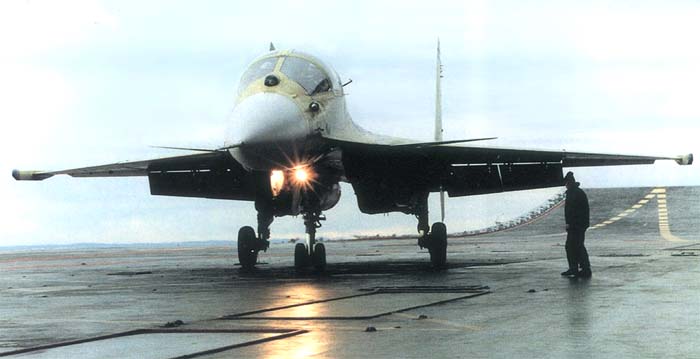
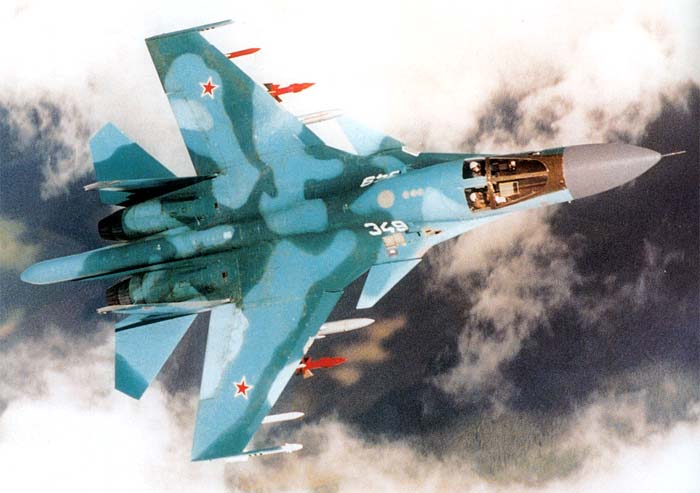
http://www.airwar.ru/enc/fighter/su33kub.html
The most logic explanation rests with their mission, in my opinion the Su-47 Berkut and Su-34 Fullback have blunt and flattened nose radomes to have controbaility at yaw, the F-15 also has a slightly blunt radome but it is not flat, if you have standed in front of an F-15 you can see the F-15`s radome is not sharp as a needle but blunt it basicly has a very blunt cap at the front part of the radome.
The X-29 also has a flattened nose radome to control vortices separation and have more controlability at yaw.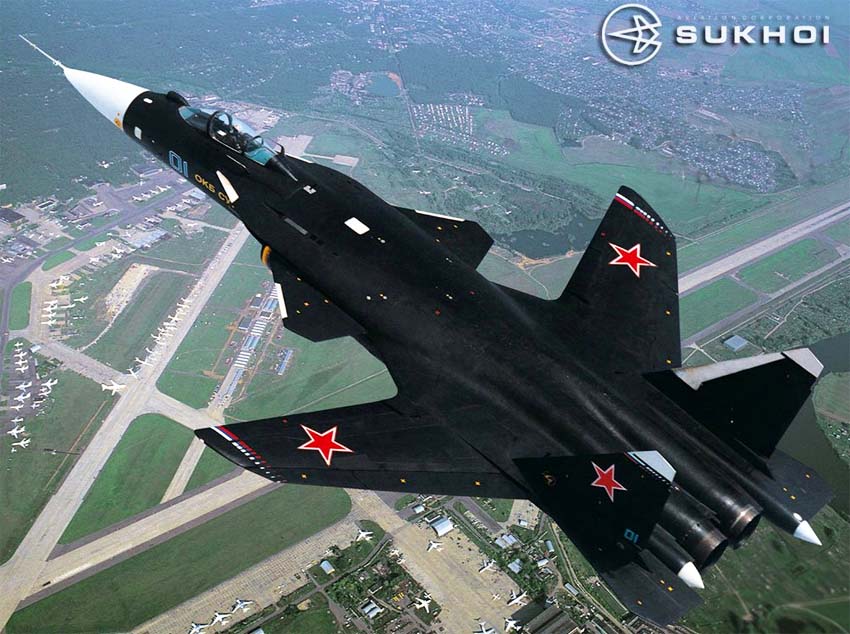
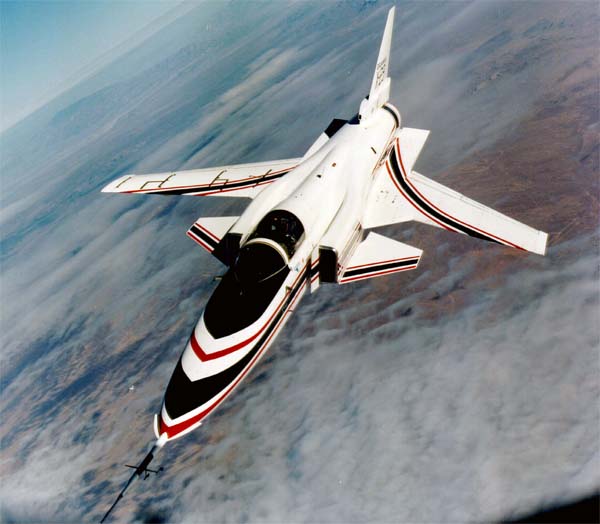
The MiG-29 also has flattened plates in the pitot tube, the Su-34 has LERXes and canads that suggest a more complex vortices control than the F-15E.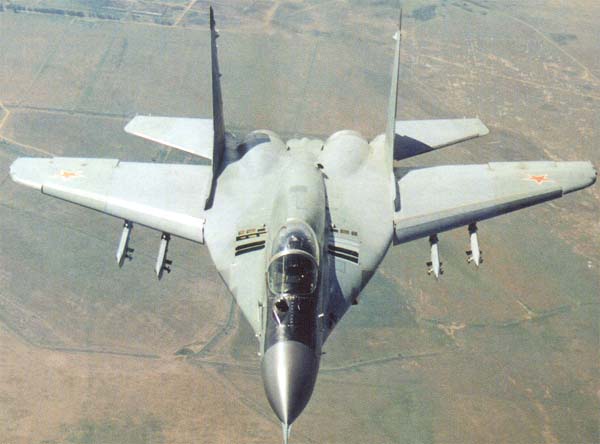
In my opinion the F-15E is a fighter but not a low speed striker in the league of the F-111 or Su-24
MiG-23MLDDepends also if they use active ride control on the Su-34 like with the B-1B. If not it’s likely worse than the F-15E as it’s probably got a lower wing/body loading.
I do not think it is worst than the F-15E, the F-15E aerodynamics lack several things the Su-34 has, the canards i guess help the aircraft at high speed low altitude flight giving it an extra aerodynamic control, also if the Su-34 gets in the future thrust vectoring nozzles well that will further enhance the fighter/bomber.
What i meant is with a dedicated low rider like the B-1B, F-111, Su-24 and Tornado that have VG wings with different wing settings how does the Su-34 compare?
The F-15E has less control surfaces and a very compromized wing for high speed dashes and good agility at some transonic speeds and altitude, but i do not think it can emulate an F-111, Tornado or a Su-24.
the Su-34 has more control surfaces, it has a wing with less emphasis in high speed, form my point of view the Su-34 must have a better ride than the F-15E and i guess this must be true because even the Su-30M was not chosen to replace the Su-24 and the Russians even let the Su-24 soldier more years than the F-111.
MiG-23MLDThe Su-30M was a PVO project that had nothing to do with strike capability. It was developed as a fighter group leader that would use its superior radar to detect and designate targets for the cheaper less capable fighters operating with it. The west called it a mini AWACS, but it was more like getting the GCI officer out of the van and into the back seat of the Su-30M and to bring his radar with him and put it in the nose of the aircraft.
Frontal Aviation and Strategic Aviation weren’t interested in the Su-30M because they had the Su-34 model for the role.
It was the export or Su-30MK model that sparked international interest in being a fully combat capable two seater that lent itself to improved combat capability in intercept and ground attack through having two crew and a full sized radar. (unlike at the time the two seat Fulcrum…)
Except the Hornet can fly from carriers.
I remember reading something about the withdrawl of the Ravens hit the AF quite hard as the replacement was Naval… some version of the A-6 or something… can’t remember off the top of my head, but it was subsonic and had problems getting to where it was needed and moving with fast strike packages.
In the case of Russia it is true, the Su-34 made more sense so the Su-30M was not of interest, however China uses the Su-30 like the USAF flies the F-15E, if Russia wanted they could had opted like the USAF to replace the Su-24 with the Su-30M, however it seems the Su-34 is a more sophisticated machine and better suited to the Russian needs, so they will fly Su-34 instead of the Su-30M.
MiG-23MLDMiG-23MLD
I second your thoughts and agree 100% on the mater of the F-111.
I have seen the speed, terrain-following and weapons load capability of the ‘Pig’ from a grunts view on the ground, as I have seen F/A-18A Hornets, trying to do the same job!
The Hornet has nothing on the ‘Pig’ in these areas!
Regards
Pioneer
Well, a few months ago i read that VG wing aircraft have a good low altitude high speed ride, even the MiG-23M had a good high speed low altitude ride and this was a thing that even the F-16 and F-15 could not do if they were going to chase a MiG-23.
It was also demostrated by an F-111 shaking off iraqi fighters and even making them crash if they tried to chase the F-111.
A dedicated striker like the F-111 with terrain following radar and VG wing must be an excellent low altitude high speed flyer.
The Su-34 is an enigma to me, i guess it has a better ride than the Su-30 which is in many ways an F-15E equivalent, the Su-34 with its canards and terrian following radar

MiG-23MLDThe F-111 probably had scored some success if the program had not nuked its own budget and schedule. Probably one related to the other: “There is no thing like free lunch”, as Milton Friedman knows, and the very capable F-111 proposal of the 1960s was probably not possible within that budget. The common problem, see F-35.
The F-15E was as far as I know basis for F-15 versions for Singapoor, Saudi Arabia, Korea and Israel (later deliveries in some cases). I don’t know about specific differences between F-15B/D and F-15E, but I guess the later has tougher structure and of course much more black boxes built in, it looks they didn’t even change the radar too much (no Terrain Following Radar).
I do not agree with that opinion too much Schorsch, i think limited budget depends in the nation, in the US limitations mean propesperity for another air forces.
Even compared to Europe or Russia, the USAF has very few limitations in what respects budget.
The Su-24 for example has not been replaced even despite Russia has Su-30M to replace it or Su-34s. In Europe that basicly has an economy as powerful as the US and even has signs of becoming even more powerful, the military budgets have more limits.
http://bvvaul-barnaul.narod.ru/11orap-4.htm
Only China seems to have a similar budget to the US where military programs can be more important than the economy and welfare of the whole nation.
In my opinion the F-111 was simply retired to continue the cycle of rearmament that characterizes the US military complex.
The F-111 probably even in 2008 can deal with the vast majority of threats the F-15E can defeat, with ASRAAMs, cruise missiles, AMRAAMs and new radars the F-111 very likely can remain a potent weapon for at least ten years more.
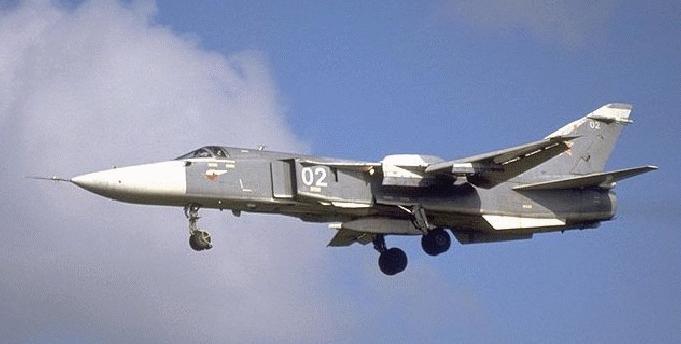

http://www.fas.org/man/dod-101/sys/ac/row/su-24.htm
http://www.ausairpower.net/APA-NOTAM-211107-1.html
http://bvvaul-barnaul.narod.ru/Mar-Su-24mr-3.htm
http://narod.yandex.ru/100.xhtml?bvvaul-barnaul.narod.ru/1976-6.files/1976Bes_056.jpg
http://www.ipmsnymburk.com/forum/viewtema.php?ID_tema=27592
The Russians do have a real limited budget and they chose to keep the Su-24 for at least 15 years more.
MiG-23MLDAt least you bring me to smile. Up to 10 Su-34 per year in Russia and you call it “mass manfacture”. 72 Su-34 till 2015 gives an avarage of 8 per year.
The Russian AF does the testing work to keep the Su-34 alive, because it is unable to pay the producer for that. There are still some shortcomings to fix with the examples delivered to get that combat ready really.
I do not blame the Russians for that practical solution. I do understand the Russian intention to bolster confidence into own capabilities through good news. But I have the patience too, to wait what will become true really.
Pointing to some shortcomings in time will dumpen some unrealistic claims. Otherwise we have “super-fighters”, which for “unknown reasons” do not live-up to the exspectations rised by some propagandist.
Sens
Things are not like that, if you review history, you will find the numbers build of each new generation of aircraft have reduced a lot from the 30,000+ Me-109 and Il-2 built during WWII, to the 15000 MiG-15s built in the 1950s, to the 5000 MiG-23s or F-4s built in the 1960s and 1970s to the more conventional numbers of today, in fact the F-16 is perhaps the only fourth generation fighter that is getting close to the numbers of F-4 build and only because it has had a longer production of almost 35 years since the mid 1970s to the present. The MiG-29 and Su-27 are more or less close to the F-15 and F-18 construction numbers.
The MiG-31 and F-14 never reached 800 built they were in the region of 600 aircraft
The JAS-39 is not even close to 500 aircraft built to cite a modern example in fact less than 230 are operational today.
The F-111 had also a few hundred aircraft built, less than 600 were built, the Su-24 reached a little bit more than one thousend aircraft built, however the Su-34 might get a little bit more than 300 including export aircraft perhaps more if it is lucky
Now the F-22 are build in few hundreds and it is not that the Su-34 is not good, it is simply that it is a very sophisticated aircraft, the Russians have upgraded its avionics constantly to keep it viable as a modern aircraft, the Su-27IB could had entered production in the mid nineties probably if the economic situation had allowed it but economic crisis and the fact the Su-24 still was numerous and capable enough delayed even more the program.
But in general the Su-34 is following a design path similar to the Rafale or Eurofighter


 Sign In








