 MiG-23MLD
From 2010 the Su-34 will start to replace the Su-24MK.
The present testing is related to make the Su-34 combat worthy. It is still system-integration work and to hammer out procedures for front-line service. Creating manuals for personal using that f.e.. Similar thing with airliners, the A-380 built f.e. were used to demonstrate and verify the specifications. Only after that they were certificated and handed out to an airline for regular use. For that work you are in need of several flight hours and missions related to that. The series example delivered right now are in use for that testing purpose only. Fitting a weapon onto a pylon or installing a device does not make a working system. None do blame the producer for that, just the wishfull believer, who do take the first info about something new as present reality.
Of cause will future Su-34 personal receive a first training about the Su-34 in that test unit, but that does not make that trained personal and their unit combat ready really. To achive that level a given number of missions and related flying hours has to be demonstrated and to be verified, before a unit will be declared combat ready. Related to the experiences of the personal and the complexity of the systems, that will take 1-2 years. After that enough experiences will have been built-up and the capabilities of the new system will be explored and widened from that unit.
From 2012 we can except that a frontline Su-34 regiment will beat a seasoned Su-24MK regiment in a bombing competition.
The three sqdns within a regiment do have different levels of readines (classes/level) at all, through the fluctuation of personal.
Two decades after the USAF started to replace its F-111 (1992) the Russian will scaling down the number of Su-24MK (2012).Even in an AF with less limitations in funding and less scope of modifications it took its time to do so.
“The first unit to get the F-15E was the 461st Tactical Fighter Training Squadron (TFTS), which was part of the 405th Tactical Training Wing at Luke AFB in Arizona. It achieved IOC in July of 1988. The first operational F-15E unit was the 336th Tactical Fighter Squadron of the 4th Tactical Fighter Wing (now just the 4th Wing), stationed at Semour Johnson AFB in North Carolina. It achieved initial IOC in October of 1989. In June of 1990, the F-15E competed in the USAF’s *Long Rifle* gunner meet held at Davis-Monthan AFB in Arizona and scored first and second in the contest.”
“The 48th Fighter Wing based at RAF Lakenheath converted from the F-111F to the F-15E during 1992. The first to convert was the Wing’s 492nd FS, with a second squadron (either the 493rd or 494th) converting later.”“TF-15A ‘Strike Eagle’ Second development TF-15A modified during 1982 for dedicated air-ground operations to potentially replace the F-111. Company funded demonstrator.”
24th February 1984 Production go-ahead for F-15E.
11th December 1986 Maiden flight of F-15E prototype.
1988 First F-15E delivered to the USAF.
Man the reality is something in between, the first Su-34s are basicly operational models that are used to see design flaws under operational conditions, also these have been delivered to the Russian air force.
Already in 2006 manufacture of operational models did begin and deliveries to the Russian air force began in 2006, of course these aircraft need to be tested before the main mass production rate is launched, now they are only building six aircraft a year, next year they will build 10.
they will have a total of 24 by 2010, by that time the first regiments will be formed, what you are confusing is the fact these aircraft have already been delivered to the customer, yeah the Russian air force, these are not prototypes, since the mass manufacture of operational models has began and the first operational models have been delivered to the Russian air force.
MiG-23MLDI am not surprised to learn that you red and present that information your way.
The Rosbalt news did quote the following:
The second stage of tests Su-34 will be completed in 2009
“is passed the second stage of state joint testing, in which participate all 10 aircraft Su-34.”
“The second stage of the tests of impact aircraft Su-34 will be completed in 2009,”So from 2008 till 2009 ten Su-34 will be tested. The two delivered at first and went through the first stage plus the ones delivered during the second stage till 2009.
I red a lot of state joint testing and not of operational work in a frontline-unit.
As I quoted before, that is still done by the Su-24MK units alone. Just from 2010 we may see the first unit of Su-34 working to become operational really and start the future replacement of the Su-24MK.18.10.2007 17:20 of VVS of Russia will until 2015 stock up more than 70 aircraft Su-34
02.08.2007 19:03 Su-34 it is transmitted to the armament VVS of Russia
So in 2015 we may see three regiments of 24 Su-34 each.
Sens
The current Su-34 are in a similar stage to the F-111 combat Lancer units, they are new models, but they are operational series aircraft, these Su-34s are series production aircraft and not prototypes, it is true, they are in tests, but these test are operational tests to see if during this early phase of operational deployment there are things to correct and to familiarize the Su-34 to the first operational crews and from them stablish the best training and flying technics for future units
This is an early prototype the Su-27IB T-10V-1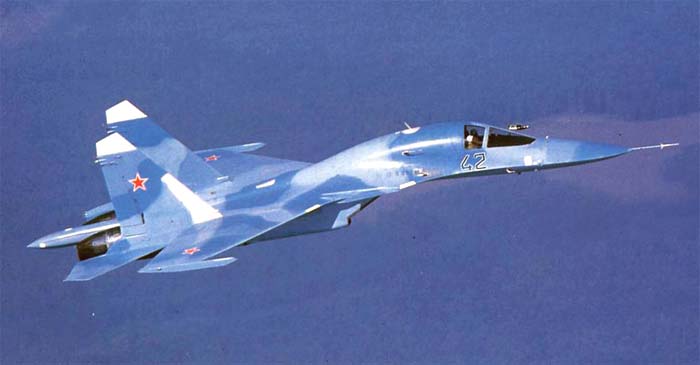
but the current models delivered to Lipetsk are operational models
sourcehttp://www.airwar.ru/enc/bomber/su34.html
This is an operational model
http://www.ausairpower.net/APA-Fullback.html
Has the Su-34 finished the replacement of the Su-24? no it has not
has it started the replacement of the Su-24? yes it has

source http://www.f-111.net/models/inlets/index.htm
It will take time to form the first operational unit with 24 aircraft, yeah by 2010 they will have the first operational unit in the 16th air wing, however the operational deployment has began
MiG-23MLDNot going into the nonsense about the use in Gulf War I stick to the numbers presented by you.
You still claim future intentions as present reality.
You can fight with that only, what is at hand really at a given date.
In 2007 there was no operational Su-34 in the Russian AF, but several Su-24MK ones.
Two Su-34s were delivered to the Russian AF and did service at test-centers.
It is intended to equip two regiments at least. Neither in 2008 nor 2009 we will see the first full combat-ready regiment of that and the related mission work has be done by Su-24MK regiments.
“Thus, by 2010 we should buy a whole regiment of Su-34 aircraft in the number of 24 aircraft, “- said Defense Ministry.”
Второй этап испытаний Су-34 завершится в 2009 году
МОСКВА, 14 ноября. Второй этап испытаний ударного самолета Су-34 завершится в 2009 году, говорится в сообщении ОАО «Компания «Сухой».
Как отметили в компании, главнокомандующий ВВС РФ генерал-полковник Александр Зелин и генеральный директор «Сухого» Михаил Погосян проконтролировали в Липецком авиацентре ВВС опытно-войсковую эксплуатацию серийного самолета Су-34.
The Second phase of Su-34 tests to end in 2009
MOSCOW, November 14. The second phase of tests of the Su-34 to end in 2009, the report said JSC “Company” Sukhoi “.
As noted in the company, Chief of the Russian Air Force Colonel General Alexander Zelin and “Sukhoi general director Mikhail Pogosyan” at the Russian air force aircraft test centre of Lipetsk, the military test operation of serial Su-34 aircraft is being carried out
See that it is from 2007 November
further more
Специалисты Липецкого авиацентра во главе с генерал-майором Александром Харчевским в течении трех месяцев проводят полеты на Су-34 в соответствии с программой войсковых испытаний. По их результатам отрабатываются методические пособия по технике пилотирования, навигации и боевому применению. , В настоящее время на аэродромах Липецкой, Астраханской и Новосибирской областей проходит второй этап государственных совместных испытанийв которых участвуют все 10 самолетов Су-34.
It says basicly ten Su-34 are being tested in three airfields among them Lipetsk
Specialists of the Lipetsk aviation test center headed by Major General Alexander Harchevskim are going to spend three months flying the Su-34, in accordance with the programme of military tests. Based upon the results of the Su-34 technical manual its technology, flying, navigation and application in combat will be tested. Currently at the airfields of Lipetsk, Novosibirsk and Astrakhan, the second phase of joint state tests is being carried out, in which a total of 10 Su-34 aircraft are taking part.
MiG-23MLDNot going into the nonsense about the use in Gulf War I stick to the numbers presented by you.
You still claim future intentions as present reality.
You can fight with that only, what is at hand really at a given date.
In 2007 there was no operational Su-34 in the Russian AF, but several Su-24MK ones.
Two Su-34s were delivered to the Russian AF and did service at test-centers.
It is intended to equip two regiments at least. Neither in 2008 nor 2009 we will see the first full combat-ready regiment of that and the related mission work has be done by Su-24MK regiments.
“Thus, by 2010 we should buy a whole regiment of Su-34 aircraft in the number of 24 aircraft, “- said Defense Ministry.”
Sens
Man we are in the end of 2007, already in few days is going to be 2008, in practically less than a week by the way happy new year, see that it was planed at least 8 aircraft since 2006 to 2008, by 2009 they will have around 18
Now very likely they have 8 series production Su-34 plus another few test aircraft and early prototypes at least 6-8 prototypes if my memory does not fail.
So they have more than 2 operational series aircraft
MiG-23MLDAdd the missing details to your claim.
How many Su-34 were delivered in 2007?
How many of that are in front-line service in 2007?
Why do the Russians an avionic-upgrade to their Su-24MKs right now?See WAP about the Gulf War.
The F-15s did escort nothing. They flew CAP-mission in a shielding areas and were alerted, when an Iraqi fighter slipped through.
By the way, related to the same identification problem, when an airspace is filled by numerous fighters moving at high speed. The SEAD assets did come along with strike packages at medium height and had nothing to do with the way, the F-111 and Su-24MK strikers had been operated in Central Europe, the intended main battle ground during the Cold War.When the first Su-27s did enter service in the scond half of the 80s, it was with the PVO at first. The T-10 design had to fullfill a role similar to the F-15.
Even the F-15E was around before the Su-27 did enter service.
The later Su-27IB had to replace the Su-24s from the 90s already, but the SU did collapse before.
In that years the Russians were ten years late only.
To avoid misunderstandings, that was not so in all military areas and in some areas the Russians had a lead too sometimes.
Sens
Of course you can not see a reality, the F-111 bombers needed SEAD and protecion by fighters, and when the EF-111 were attack the F-15 jumped in right away it means obviously they were close. The F-15 did scort the fighters since they had to avoid Iraqi fighters to attack them, some of them did attack the attack package and the F-15 defended the attack formations.
In Europe it would had been the same and even more becasue the NATO planers knew even bombers like the B-1B and FB-111 had a very difficult mission, they knew only the F-117 and B-2 were probably the best bombers to penetrate the Warsaw pact defences.
However in 1999 a MiG-29 was attacked by F-15 just minutes before it could intercept an F-117, it means simply even stealth aircraft need scorts.
Now in 1989 the Soviet Union and the Warsaw pact had very large armadas of aircraft and SAMs and these would had meant scort fighters and SEAD aircraft for each attack unit.
The Russians knew it too They knew the Backfire and Su-24 were not stealth aircraft they knew the Su-24 had a range that allows it to have a scort of Su-27s and in Europe the West had also large armadas of fighters and these would had intercepted the Su-24s, so the Russians designed the Su-27 to protect its main bomber
The Su-34 is different it is a fighter/bomber that in some terms can defend its self, not like the Tu-22M rear gun that basicly is a waste of money, but with long range air to air missiles and long range air to surface missiles.
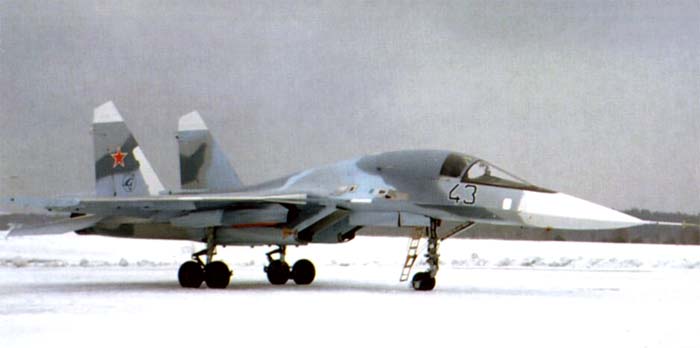
source
http://www.airwar.ru/enc/bomber/su34.html

http://lenta.ru/news/2006/01/17/glavkom/
ВВС России планируют в этом году закупить 6 таких самолетов. Предполагается, что с 2008 года эти машины будут закупаться партиями по 10 самолетов в год. Потребности российских ВВС в этих самолетах до 2020 года составляют около 200 единиц. Су-34 заменят стоящие на вооружении в ВВС РФ бомбардировщики Су-24.
The Russian Air Force plans to procure this year (2006) six Su-34s. It is anticipated that by 2008, 10 aircraft per year will be deliver. The Russian Air Force requirements for these aircraft till the year 2020 amounts to about 200 units. Su-34 will replace the Su-24 in the Russian Air Force
sourcehttp://armstass.su/?page=article&aid=43328&cid=25
Он отметил также, что в настоящее время такие темпы поставок невозможны, и ВВС получают по 6-8 машин этого типа в год с возможностью ускорения темпов постройки в дальнейшем.
He also noted that the current rate of such deliveries is impossible, and the Russian Air Force is recieving six to eight of these machines of this type (Su-34) per year with the possibility of accelerating the pace of construction in the future.
http://www.lenta.ru/news/2007/10/30/bomber/
So probably Russia has around twenty four or thirty Su-34s including prototypes
ВВС России получат два полка новейших бомбардировщиков
В ближайшее время на новый бомбардировщик Су-34 будут перевооружены два полка 16-й воздушной армии, сообщает РИА Новости со ссылкой на заявление командующего 16-й воздушной армии генерал-майора Александра Белевича
Russia will receive two air force regiment advanced bombers
In the near future , the new Su-34 bomber will equip two regiments of the 16 th air wing, RIA Novosti has reported with a reference to a statement by the commander of 16th air wing and Air Major-General Alexander Belevicha.
http://lenta.ru/news/2007/08/02/fullback/
К 2010 году ВВС России получат полк фронтовых бомбардировщиков Су-34, сообщает РИА Новости
By 2010, Russia air force will receive a regiment of front-line Su-34 bombers, source :RIA Novosti.
В 2006 году будут закуплены два серийных самолета Су-34, в 2007 году – еще шесть, а в 2008 году – 10. Таким образом, к 2010 году мы должны закупить целый полк самолетов Су-34 в количестве 24 штук”, – сказал глава Минобороны
In 2006, two series production Su-34 will be purchased; in 2007, six more will be recieved and in 2008 , ten more Su-34s will be purchased. Thus, by 2010 we should buy a whole regiment of Su-34 aircraft in the number of 24 aircraft, “- said Defense Ministry
http://lenta.ru/news/2006/03/23/su34/

Первый бомбардировщик Су-34 поступил в липецкий центр боевого применения и переучивания летного состава ВВС, сообщает РИА Новости.
Самолет прибыл в Липецк из Новосибирска, где осуществляется серийное производство новых бомбардировщиков. Первоначально прибытие Су-34 в центр было запланировано на 31 июля 2007 года, но его пришлось отложить из-за мелких неисправностей машины. Передача новых самолетов липецкому центру планировалась еще в прошлом году, но не была осуществлена из-за запаздывания с развертыванием производства.
Первые два Су-34 были переданы ВВС в декабре 2006 года, они поступили в Ахтубинский государственный летно-исследовательский центр. В 2007 году ВВС намерены приобрести шесть машин этого типа, начиная с 2008 года, темпы производства вырастут до 10 машин с дальнейшим увеличением после 2010 года. В общей сложности программа производства Су-34 рассчитана до 2020 года. За это время вооруженные силы должны получить около 300 новых бомбардировщиков.
Напомним, что по заявлениям высокопоставленных офицеров ВВС, в ближайшее время планируется перевооружение на новые машины двух полков 16-й воздушной армии, прикрывающей центр европейской части России.
The first bomber Su-34 entered operational service at the Russian air force test center of Lipetsk , source RIA Novosti.
The plane arrived in Lipetsk from Novosibirsk, where the serial production of new bombers is taking place. Originally, the arrival of Su-34 in the center was scheduled for July 31, 2007, but it had to be postponed because of small malfunctions. The transfer of new aircraft to the Lipetsk test center was planned in the previous year, but was not implemented due to the delay in the deployment of production.
The first two Su-34 were transferred to the Air Force in December 2006, they reached the state Akhtubinsky flight research center. In 2007, the Air Force intends to purchase six machines of this type, starting from 2008, the rate of production will grow up to 10 aircraft with further increases after 2010. A total program production Su-34 will run till 2020. During that time, the armed forces should receive about 300 new bombers.
Quoting statements of high-ranking Air Force officers, in the near future it is scheduled that the new machines will be delivered to two regiments of 16th Air wing, at the center of European Russia.
MiG-23MLDNeither the F-111 nor the Su-24 had escort fighters! Related to speed, range and mission profile that were a burden only.
In the 70s there were F-15s but no Su-27s to “escort” something.
Do you ever read, what you try to tell to the public, at least your phantasy to create a virtual reality is unlimited!
If there were not your constant problem with the details, which proof that claims wrong easily.
Even in 2007 the Su-24 was not replaced by the Su-34 and will not be so for the next decade in total. Just a few Su-34 are built and ordered so far. The few ones delivered were used in testing only to reach front line service in the future.
Sens yea yeah yeah, so then the F-15 did not scort fighter bombers in the gulf war, specially those EF-111 that were attacked by MiG-25s, the Su-24 was usually scorted by Su-27s in fact its very well known the Su-27 was designed in part to scort Su-24s.
The Russians by the way are building Su-34s to replace its fleet of Su-24 so the replacement is taking place now
Brandon had 400 hours in the EF-111A flying 150 combat hours in 28 missions in both the F and EF models
… Mirage gave chase to EF-111A over Western Iraq, fired 1 missile, as the Raven headed for the deck, but an F-15 was after it
… EF-111A evasive break to low altitude using chaff/flares
… hard right turn to supersonic speed
F-111F/F-15E/B-52’s that had both F-4G Weasel and EF-111A support and the F-117’s were also involved in front
MiG-23MLDAnd that’s all that is germane to my arguments. 🙂
It’s a fair statement to make in non-specific terms, and I agree with the USAF that more F-22s should therefore be procured. The latter is precisely why they originally made this statement, which was either quoted or paraphrased on the FAS website. Of course, then when Boeing complains about the USAF putting down a fighter that they’re trying to sell abroad (in its more advanced forms), I’m sure that the USAF will put in a good word for it privately to other air forces. They’ll say that the new AESA and avionics are top-notch (true) and the upgraded (IPE) engines give it power superior to that of potential adversaries (also true), but to the public, the Pentagon, and the Congress they will say that the beat-up old F-15 (earlier variants) is outdated and only the F-22 will be good enough. It’s a bit of doublespeak, but I don’t blame them for trying.
That’s the spirit! And I disagree with an equal measure of baseless confidence! Take that! Oh, yeah? Yeah! 😀
It is interesting how the F-15 can get involved in a F-111 thread, well the F-111 was in part replaced by the F-15E so it is fair to say that basicly both the Su-24 and F-111 were replaced by their scort fighters, the F-15 and Su-27 evolved into the fighters that replaced specialized bomber/strike aircraft.
In the case of the Su-24, its stable brother used to scort it, but, eventually replace it.
The Su-24 was replaced by the Su-34 a very modified Su-27, the F-111 by a strike variant of the F-15.
Now if you tell me the F-15 is better than the Su-27 i consider that depending in the variants and upgrades in question that question can be answer or that statement being proved.
But in general terms as far as agility and acceleration the Su-27 shows superiority, speed is relative because the F-15 usually flies at speeds less than Mach 2.5.
The area where the F-15 has always been quit good is avionics and only this has kept it competitive against fighters that are more agile and sometimes better armed.
The F-15 being a big aircraft, had the potentiality to be an excellent strike fighter, same is the Su-27.
But as far as superiority in air to air the F-15 has not been the best dogfighter since 1978, since that year the F-15 was either less agile or less capable as a fighter, the, F-16, MiG-29, Mirage 2000, Su-27, JAS-39, Eurofighter, J-10 and Rafale once they were deployed showed the F-15 is only king of fighters because it only has fought either strike aircraft (Su-22s, MiG-23BN/MiG-27), third generation fighters (MiG-23M, Mirage F1, MiG-25 and F-4Es) or a few MiG-29s without the tactical assets and numbers to give victory to the nimble MiG-29.
However since the F-111 a need for a fighter that could double as a bomber was forcing designers to create machines with contradictory or very difficult to fill specifications, either it was a dedicated bomber like the Su-24 or F-111 or an air superiority with secondary strike capability like Su-30MK or F-15E.
The Su-34 is a fighter/bomber with the best of both worlds but also with some short comings too is not as agile as the F-15 or original Su-27 niether has the warload and range of the dedicated strike bomber F-111 on internal fuel and without external fuel tanks nevertheless the F-111 range is similar only with internal fuel and only with external fuel tanks the F-111 can surpass the Su-34 in range.
However it can fight as the Su-27 at BVR combat and bomb as a F-111 at low altitudes and speeds
http://www.globalsecurity.org/military/systems/aircraft/f-111-pics.htm

MiG-23MLDJust becouse it is planned it does not mean that it is there.
i do agree however it does not mean it won`t happen too, i guess the aircraft will have all those features in the operational model
MiG-23MLDDo you have actual evidence that the rearward looking radar has been installed or that the rearward firing AA-11 has entered service. The latter has dropped of the map and the former is an information black hole. Originally the Su-34 was intended to have radars from Leninets but there seems to have been problems with these and there have been rumors that one of th other radar houses has been working a on a new system. Furthermore look at the second picture you posted and you will see that the tail sting is incomplete, there is no way that that contains a radar.
I can not answer you that question simply because i do not know the answer to this however i think it was planed as part of the operational equipment of the Su-34
MiG-23MLDEntering service 40 years later!
It is like comparing a MiG-15 from 1948 with a MiG-29 from 1988.
I think you misundestand me, for me the F-111 is a great aircraft, one of my favorites, when i compared it to the Su-34 is to say in terms of fighter bomber capability, the Russian Su-34 achieved the goal of a fighter with real bombing capability of course it is because the design is newer and it is a more sophisticated airframe but the americans can not do the same with the F-15 as the Russians did with the Su-27.
the single seat Su-27 can change its forward fuselage quit easily not only in tandem seating but also side by side, the F-15 can not do that simply because the forward fuselage is flanked by the inlets and it can not change its cross section quit easily as the Su-27 does.
Perhaps the F-16 could do it but it is too small and it is a singled engine aircraft.
The Su-27 and Su-34 have the same inlet/engine nacelles arrangement, as the Su-30MKI or the Su-33KUB and the changes are virtually minimal, that is a great feature of the Su-27 in terms of growth potential, the ventral inlets with podded engine nacelles allowed for an easy modification of the forward fuselage cross section with a facility that only few aircraft can have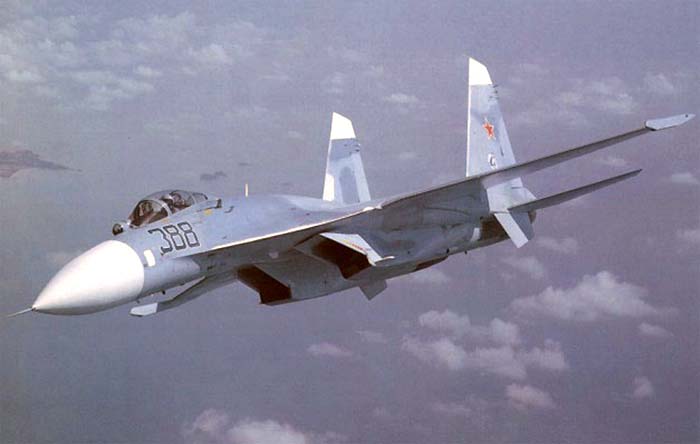
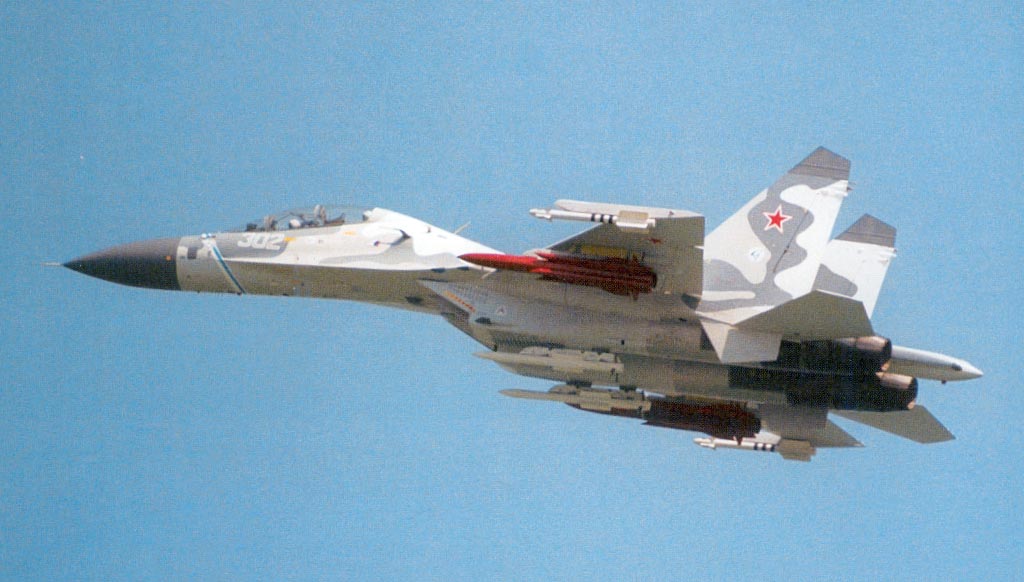

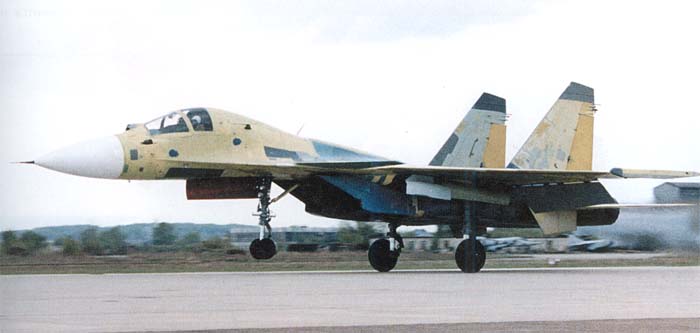
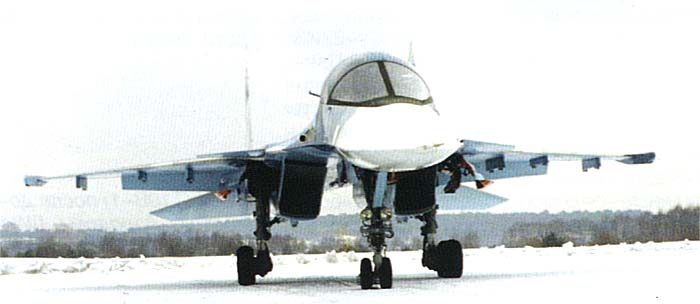
In the case of the F-15, the fighter trainer F-15B variant with tandem seating became the base of the fighter bomber variant F-15E, the F-15E did not change too much in aerodynamics from the original single seat F-15A/C fighter variant basicly it was an F-15B; in the F-111 case, it is a bomber fuselage with a bomber cabin with side by side seating but the Su-34 is a real match of a fighter fuselage with a forward crew cabin of a bomber
source http://www.airwar.ru/main.html
MiG-23MLDMy choice of the term “leaner” refers to lower structural weight and less internal fuel, which is analogous to a person with smaller bones and less fat. Given the Su-27’s leading edge flaps and other more modern aerodynamic features, it undoubtedly has an advantage in maintaining energy during hard turns, but I doubt it’s much slicker, if at all, while merely cruising (additionally, the Su-27 will have to burn fuel at a faster rate during actual combat). The main difference would be in the additional drag from the F-15C’s external tanks, of course, at least before they are dropped. According to the figures you quoted, carrying drop tanks all the way yields a maximum range of 4445 km compared to 4000 km for the Su-27, despite the extra drag. Dropping the tanks, whenever that becomes necessary, further improves on the F-15C’s range advantage (as long as they aren’t dropped too early, although in that scenario it would matter less anyway).
Read their statement again carefully–they said that a bunch of modern fighters are “variously superior” in a bunch of different aspects of performance. This does not imply any specific comparisons, such as the Su-27 having a higher T/W than the F-15C, and it certainly does not mean that all of these fighters are superior in all respects to the F-15C because that would be a lie. The real point was to make a broad statement about the need for the USAF to upgrade.
A lot of different things are going on right now, and people in various organizations are trying to decide upon the best upgrade path. The topic at hand was how the F-15C hypothetically compares to the original Su-27, not how one force structure compares to another, and the same applies to comparing the upgraded F-15C to the Su-27SM. Besides, if the USAF were so worried about 24 Su-27SMs, they might send the 100+ F-22s they currently have against them. 🙂
It’s that special and unique, huh?
What’s your point? The website wasn’t specific at all (deficiently so in this case), but I believe that I figured out what their numbers really meant and stated it. The numbers we use have to make sense no matter what the source.
This makes perfect sense to me, but then why is there the notion of a “normal” (as in usual, as in most common) internal fuel load at all? If you’re right, then the answer must be the other possibility I had brought up: marketing hype. This hype has fooled plenty of people over the years. The Su-27’s design is still a great and extremely versatile design regardless, but it’s not quite everything people commonly believe that it is–like all designs of a given level of technology, there are tradeoffs and compromises, and there’s nothing wrong with that.
MiG-23MLD, those are some good points about the strengths of the Su-34. 😎 Does it still have a rear-facing radar in that oversized stinger?
Up to what i know it has a rear facing radar, however the first models did not have them, now the latests batches must have them, if it is correct it can fire rearwards the AA-11s as a self defense or guide the otehr missiles once it goes away form the battlefield trying to stay away from the target`s respose and counter attack

sourcehttp://gorod48.ru/association/news-3889.html

MiG-23MLDYes, going just by the numbers–internal fuel only with no weapons–the F-15C has a T/W ratio of approximately 1.14 while the original Su-27’s is approximately 0.97; also, the F-15C’s fuel fraction is 0.328 while the Su-27’s is 0.365. Therefore, the F-15C is a “leaner” fighter at the time of takeoff, sacrificing range performance with internal fuel for power.
Colorfully described, but irrelevant because I was describing the difficulty of comparing these two fighters directly using internal fuel only, given their different design philosophies. Representative combat scenarios have to be used so that the F-15C is not unfairly penalized for having a shorter range on internal fuel and the Su-27 is not unfairly penalized for having a lower T/W. Doing so gives us a clearer view of the engineering tradeoffs inherent in both designs.
It sure seems to be in many ways, but the discussion was limited to things like power and fuel, and the Flanker does have to pay a price for some of its capabilities. The main reason I responded was the statement that the Flanker has more powerful engines–yes it does, but it is still a less powerful fighter than the F-15C under most realistic circumstances. My theme was that things aren’t always what they seem.
I’m aware of that, but it’s beside the point.
Well, it’s an extra feature, isn’t it? Still not satisfied? OK, forget I mentioned it, then. My other two examples were more to the point in any case.
Of course it is affected, but since we’re talking about the F-15C specifically, I was thinking in terms of air superiority. The standard air-to-air load on the F-15C is eight AAMs, which it can carry regardless of how many external fuel tanks it is carrying. All it takes is a single centerline tank to match or slightly exceed the fuel fraction of the Su-27, leaving the two wing pylons (each capable of carrying a relatively heavy load) free for additional ordnance when required.
Be that as it may, the point is that the Su-27 is not more capable than the F-15C in every way. Going strictly by the numbers, the Su-27 seems to be of a very similar level of technology indeed, with the exception of its more refined aerodynamics. The F-15C’s design is leaner and more powerful, while the Su-27’s design gives it some advantages of its own. However, with regard to the subject of external tankage vis-à-vis extra-large internal tankage, it seems that the use of external tankage can actually yield advantages in both performance and range under some circumstances, at the cost of taking up space for ordnance, as you pointed out.
Well, I guess it just doesn’t pay to be nice. 😉 It’s not as though anyone expects the Su-34 to be a fighter anyway with that type of cockpit, which is not an issue with the Su-30 or F-15E, for example.
Sometimes you have to use what you have, and I was just pointing out a relative deficiency (on paper) of the Su-34 system when compared to similar systems. While it has greater range than the Su-30 and better crew comfort for long missions, it doesn’t carry more ordnance. The poster to whom I was responding seemed to want to know whether the Su-34 was simply superior all around to systems like the F-111, and the answer is no, it’s an “in-betweener” with certain relative strengths and weaknesses.
My comparison was limited to the merits of external fuel and the relative power of the two aircraft. Somebody suggested that the Su-27 is more powerful than the F-15C, but the opposite is actually true in most cases in terms of T/W.
That is a rather vague statement made by an entity that has a strong interest in convincing the Pentagon and Congress to procure a next-generation air dominance fighter in greater numbers, namely the F-22. I happen to agree with them for many reasons that I won’t get into here, even though the F-15C upgraded with AESA and JHMCS would be a formidable platform for quite some time.
We have to be careful with the notion of “combat radius” because these can entail very different mission profiles. The hypothetical scenario I described in my last post favors the F-15C in terms of range and performance when it carries two external tanks, which is typical. If you want the actual numbers I used, here they are:
Start of mission:
Su-27: 16380 kg empty weight, 9400 kg internal fuel, 2×12500 kgf thrust, 0.97 T/W, 0.365 fuel fraction
F-15C: 12700 kg empty weight, 6200 kg internal fuel, 2×1854 kg external fuel, 2×10782 kgf thrust, 0.95 T/W, 0.438 fuel fraction
Fighters meet at the midway point when the F-15C drops the empty tanks:
Su-27: 16380 kg empty weight, 5692 kg internal fuel, 2×12500 kgf thrust, 1.13 T/W, 0.258 fuel fraction
F-15C: 12700 kg empty weight, 6200 kg internal fuel, 2×10782 kgf thrust, 1.14 T/W, 0.328 fuel fraction
Obviously, some very simplistic assumptions are made for this hypothetical scenario, such as equivalent fuel burn rates, but their listed maximum ferry ranges in these configurations are fairly close, with the drag of the F-15C’s external tanks apparently balancing the additional thrust needed for the Su-27’s larger size.
As you can see, at the midway point, raw power is similar but the F-15C’s fuel fraction is better, which shows us the advantage of carrying external tanks; it’s like a less extreme version of having multiple rocket stages. Closer to the F-15C’s base, the Su-27 will have better power but an even worse fuel fraction, of course, and as others have pointed out, the difference in power is mitigated to some degree by the F-15C’s ability to jettison excess fuel quickly. Closer to the Su-27’s base, the F-15C’s power advantage will be greater and its disadvantage in fuel state will be less severe. The key figure above is the F-15C’s superior fuel fraction with external tanks.
The external fuel figure for the F-15C here looks strange–why should it be different from that of the F-15A? To me, it looks about right for two conformal tanks, but I’m talking about two external 610-gallon tanks (at 6.7 lbs/gallon for JP-8).
Ah, this means that the Su-27 carries around a bunch of space that it supposedly doesn’t use all of the time. Obviously, this is difficult to reconcile with the USAF doctrine of loading tactical aircraft full of fuel for every combat mission (you never know when it might come in handy).
A question that I’ve always had is whether operators of the Su-27 and its many variants ever fill the aircraft with their “normal” internal fuel load–which is little more than half of the maximum capacity–as part of their doctrine. If not, then perhaps the whole notion is just marketing that makes the Su-27’s performance numbers look better in order to increase sales, much like how the USAF keeps trying to make the F-15 look worse so that they can get more F-22s.
Certainly not the basic Su-27, as far as I’ve ever seen.
Neither aircraft are going to go much faster than the other–probably Mach 0.85 or below for most of their missions, at least until they’re preparing to attack. The F-15C with external tanks has a superior fuel fraction, therefore it will generally go farther and/or have better T/W performance at most points during missions.
This is not something I had intended on getting into, but I doubt that the Su-35’s (probably the Su-30MK variants in the real world) radar is superior to the AESA that equips some (and eventually all) F-15Cs.
The Su-34 has several advantages against aircraft like the Su-24 and F-111, the first advantage is air to air missiles, while the F-111 and Su-24 were limited to short range missiles the Su-34 can fire from AA-10 to AA-12, this is important because this means the aicraft is a long range interceptor too
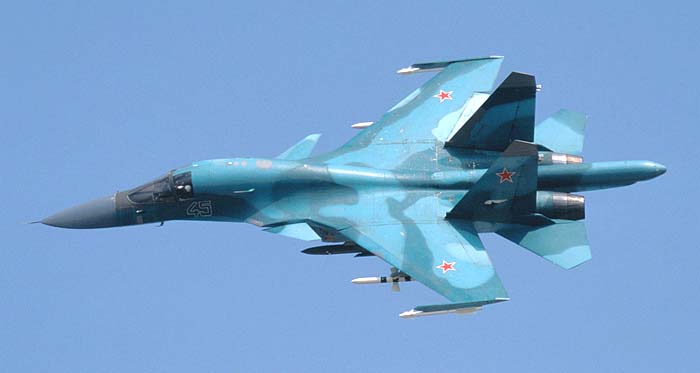

The F-111 and Su-24 were only armed with short range missiles for self defense only.
Crew comfort is also important the aircraft can fly easily 10 hours and it is only limited by pilot endurance.
the Su-30 and F-15E are fighters, however they do not have the crew cockpit design to be considered bombers, and the Su-24 and F-111 do not have the air to air capability the Su-34 has.
The Su-34 series also has the advantage of having new built airframes contrary to the Su-24 and F-111 that have old airframes built around 20 years ago or more and some stealth treatment, a thing that the F-15E and Su-30 have not.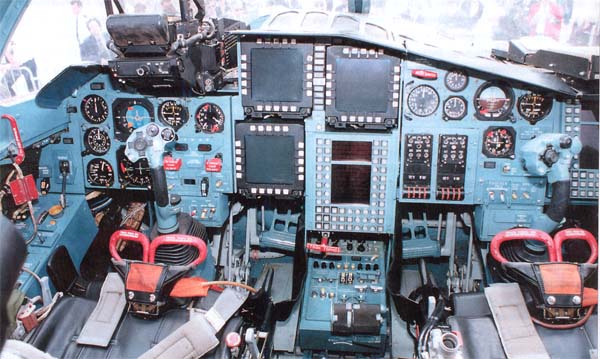
The max overload allowed to the Su-34 is slightly higher than the F-111 and Su-24 too making it a slightly more agile bomber.
The canards also help the Su-34 at low altitude and high speed, something an F-15E pilot has not.
Avionics also are another feature that makes the Su-34 a superior bomber.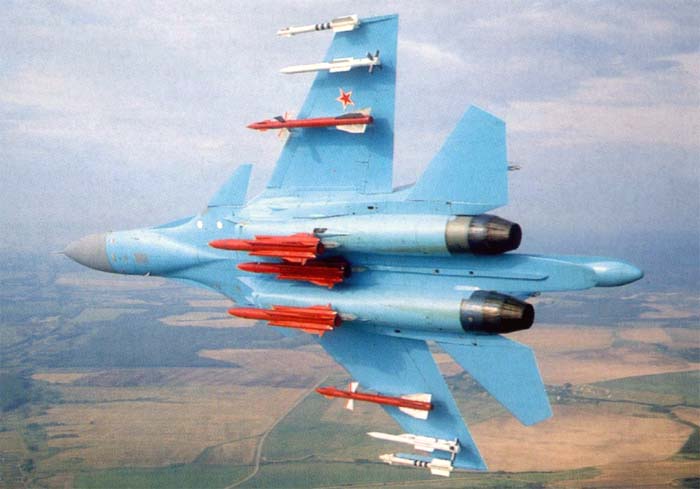
in fact the Su-33KUB
Is what the F-111B should had been
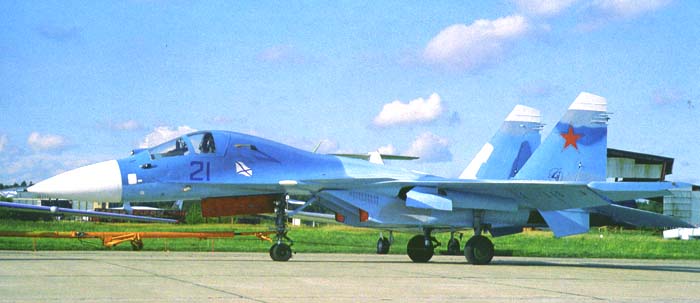
In few words the Su-34 is the aircraft Mc Namara probably would had liked the F-111 to be a long range bomber with real fighter capability
MiG-23MLDYou don’t get it either… the whole concept of an aircraft generation is marketing department BS. Ours can’t just be shinier, or faster, or prettier, it has to be in a whole new generation by itself.
Jezza… let me ask you… do you recall any discussion about fighter generation before 1990?
5th generation fighters were only created to show the supposed difference between the F-22 and all other fighters.
Why can’t the Russians make up a 0.5 generation? The US seems to have created 5 generations itself just to prove the supposed superiority of their current latest fighter.
The Mig design used curves rather than flat faceted surfaces and therefore was the same generation as the F-22 and a generation ahead of the F-117.
Rubbish. The F-22 clearly shows the curves of the B-2 stealth rather than the flat surfaces of the older technology F-117. All try to deflect certain frequencies of radar energy away from its emision source to prevent or reduce the chance of detection. The difference being the B-2 and F-22 were developed on morme modern computers able to calculate smooth rounded curved surfaces, while the F-117 was done with a slide rule and some putty.
Russia skipped the F-117 level of technology and went to B-2/F-22 curves because most desktop computers have the processing power to do the job now.
And a Mig-15, -17, and -19 are different aircraft but are also natural evolutions of the same basic shape. If a modern more powerful turbofan was available when the Mig-19 was being developed it would have been a single engine design too.
Only to a degree. It is perfectly possible to develop a small light supersonic fighter less than 10 tons with all the features of a modern gen 4 aircraft. The main problem for the Mig-15 was a lack of power and lack of refinement of the design (ie wing sweep, body shape… ie area rule, and all moving tailerons etc etc).
In all your descriptions of the generations there was no mention of flight range or radar range, just speed and BVR missile capability.
First of all it is a fighter, not a bomber, and second what generation requires a certain level of payload to qualify?
Only because of the size of the noses of the aircraft they go into are big. There are no requirements for specific range or performance of radar in the list you gave for fighter generations… just BVR capability, which is very vague in itself.
As I stated when I suggested it, the new PAK-FA will use 360 degree radars mounted in the leading and trailing edge of the wing surface. Such radars used in the new wing for the Mig-15(BS) would give excellent BVR capability. The extra power from the more powerful engine will certainly make the aircraft heavier as will the extra fuel carried and the weapons, but the point I am trying to make with this is not getting through.
If you define the different generations of fighter aircraft on specific features then fighters should be able to be upgraded or degraded between those generations. For example an F-16 in operation without AMRAAMs suddenly becomes a 3rd gen fighter because it no longer has BVR capability.
The F-22 is faceted, by facet you understand the diamond shaped flat surfaces that have angular jointures, the F-22 has a diamond shaped cross section that is a totally faceted forward fuselage , the inlets and the fuselage also form a pentagon cross section, and the inlets have a rhomboid cross section, in few words the whole F-22 is based upon the rhomboid figure and the planform aligned saw tooth leading and trailing edges, it is not a polyhedron faceted aircraft like the F-117 but undoutedly has a wedge prism shaped fuselage with a pyramid rhomboid based cross section radome in the YF-22 and a more rounded pyramid rhomboid based cross section radome in the F-22

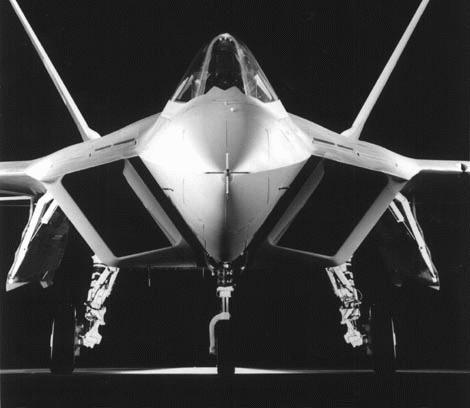
basicly the Wedge prism is the main polyhedron used in the F-22 aerodynamics
Man the MiG-15 is not useful for a fourth generation because basicly its aerodynamcis were made for a performance based upon payload and thrust specifications and it is limited by this performance to achieve some agility/payload/perfomance characteristics seen in the MiG-29.
The aircraft was not designed with the idea of a big radar and space to carry one, and further it is a waste of money and time try make it a fifth generation fighter/bomber , MiG has shown a design that has the same treatment the US has in the X-45, planform alignment and leading and trailing edge planform alignment within the parametes of angular reflection away from the source or radiation

MiG-23MLDMy point is that if the generations of fighters are defined by capabilities then the generations must be blurred. If a 4th gen fighter needs to exceed mach 2 then the F-18 doesn’t qualify and the F-16 barely makes it for example.
5th gen requires stealth but doesn’t define how stealth is achieved. The only faceted in service stealth aircraft I know of was the F-117. The B-2 and F-22 use curves rather than flat surfaces due to the increase in processing power of modern computers. A modified Mig-15 that uses plasma stealth instead of shaping could be just as stealthy… in fact it can be more stealthy in that plasma stealth absorbs all radio frequencies rather than just the high frequencies absorbed by RAM.
Shape does not effect long wave radar as long wave radar can’t even see shape.It doesn’t need a 5th generation engine to make it supercruise, a newly developed engine sized to fit a Mig-15 optimised for supercruise could be made if required to allow a Mig-15 to have one capability of a 5th gen fighter.
The difference that I am not interested in F-86s and really don’t care much about them, and that I was discussing Mig-15s.
If you define fighter generations by capabilities and nothing else then NO IT ISN’T MORE COMPLEX THAN THIS.
Perhaps the role of the fighter is a better indicator of the difference… of course then you have the problem of seperating the fighter from the interceptor from the fighterbomber.I disagree. Drop the requirement for operations at Mach 2.83 for the Mig-25 and you can put in more fuel efficient engines, change the wing profile to give more lift because low drag is not so important now, use more fuel efficient turbofan engines… like the Mig-31s engines but optimised for transonic flight rather than high supersonic flight and then use all that enormous space inside used up by all that Soviet era avionics with modern digital computers and systems and it would be easily comparable to the F-15 in performance. Its main problem was that it was intended to fly too fast to be a good airsuperiority fighter… which was ok because it was never intended to be an air superiority fighter.
Not really that different… extra seat, better engines, better radar, newer weapons.
The Su-34 was designed and put into service when there was no money. It is an example of how easy it is to modify an aircraft rather than develop a whole new one. When the Su-34s are available in numbers the Su-24 can be withdrawn and logistics will be simplified because of the similarity between the Su-34 and the Su-27 series. There was no similarity between the Su-24 and the Su-27 regarding anything except some weapons. For the same reasons the F-15E is in service instead of the F-111, though the changes made to the Su-34 were deeper and probably have made an aircraft closer to the F-111s potential capability than the F-15E is and certainly more than the Su-24 was till the very latest upgrades of the Fencer.
With new more powerful engines the Su-35 is reportedly able to supercruise. Fitting the F-22s engines to the F-15 and using an alternative stealth method like plasma stealth there is no reason why an F-15 cannot be upgraded to a supercruising stealth aircraft with AESA and other features of 5th gen fighters.
Again assuming stealth only comes from basic design with shaping and materials… how about if it comes from a pod that can be carried on a pylon?
So to be a certain generation of fighter it needs to be still in service… that means there are probably no 1st generation fighters left so 5th gen must become 4th generation etc.
But the F-22 is not faceted.
F-117 technology is already obsolete… there would be no benefit to making an F-117 now. If Fiji decided to design their own firearm they wouldn’t start by designing a musket, and then move from matchlock to wheellock etc etc and then move to the minne bullet and rifling and then develop cartridges and bolt actions then to develop gas operated automatic mechanisms.
Yeah… it is a direct copy of a Mig-21 experimental model… :diablo:
Now a fighter like the MiG-15 or F-86 carried radars like these
however see the diameter of modern radars still are quit big

So basicly limited radars can be fitted, even the Eurofighter`s caesar or captor are still too big to carry in a pod or in the fuselage of the narrow MiG-15 even the F-16`s radars are too big

MiG-23MLDYes that was the plan if things had kicked off in Europe, the Soviet plan was to use captured NATO forward airbases as the front moved forward. It was one of the reasons that Russian aircraft use the same connectors for the refueling points.
Former Soviet Union and East European Jet Fuels
Soviet kerosine type jet fuels are covered by a wide range of specification grades reflecting different crude sources and processing treatments used. The grade designation is T-1 to T-8, TS-1 or RT. The grades are covered either by a State Standard (GOST) number, or a Technical Condition (TU) number. The limiting property values, detailed fuel composition and test methods differ quite considerably in some cases from the Western equivalents.
The principle grade available in Russia (and members of the CIS) is TS-1.
The main differences in characteristics are that Soviet fuels have a low freeze point (equivalent to about -57 degrees C by Western test methods) but also a low flash point (a minimum of 28 degrees C compared with 38 degrees C for Western fuel). RT fuel (written as PT in Russian script) is the superior grade (a hydrotreated product) but is not produced widely. TS-1 (regular grade) is considered to be on a par with Western Jet A-1 and is approved by most aircraft manufacturers.
This means simply being able to use some NATO standard fuels, does not mean the Soviets used the same fuels, so the Su-24 does not use NATO fuels as you or Sens claim


 Sign In







