 Ross_McNeill
Correct Tony.
In ALSF survey detail the fabric remains were covered in more detail
https://www.wessexarch.co.uk/our-work/alsf-wrecks-seabed
Several pieces of textile were seen in different areas on the site. Some items were half-buried, while others were entangled in and around wreckage. The generally good preservation of the textiles suggests that it was buried until recently.
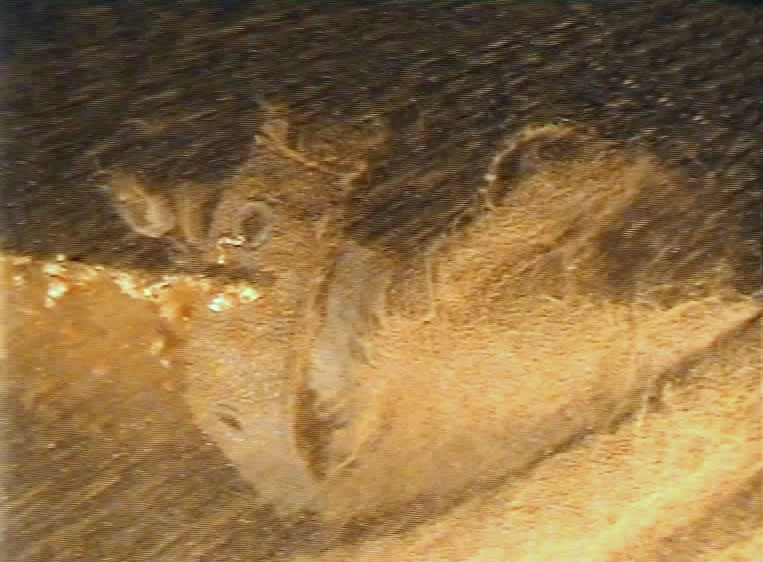
Most of the items on site were difficult to recognise. Strips of olive drab material were observed entangled around fuselage. White fabric, possibly parachute silk was also seen in several areas around the wreckage. A leather strap with buckle attached to olive or khaki fabric was stuck in a piece of aluminium fuselage on Wing 2.
To the west of the wreckage, a thin blue fabric with a white floral pattern lay half buried. This could be the remains of either a shirt or a scarf.
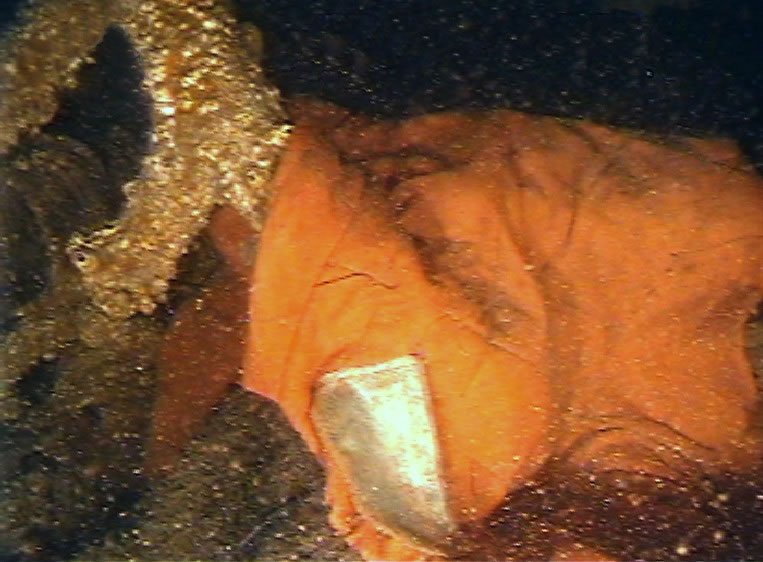
The most diagnostic item on the site was the orange lining of an olive flying parka. This was wrapped around Engine 1. A label attached to the lining is decorated with a floral border and reads “Original Snorkel Parka”.
This type of parka was not a standard military issue item during the Second World War, but looks very similar to the standard issue N-3 snorkel parka that was introduced with the formation of the USAF in 1947.
The N-3 snorkel parka or heavy flying jacket was based on prototypes tested from 1942- 1945. During the war it was common for military personnel to supplement issued clothing with privately bought items. The snorkel parka on the site could either be a test prototype, although the non-military label makes this less likely, or a private item bought by an airman to keep warm at high altitudes in the unpressurised and unheated aircraft.”
Ross
Ross_McNeillsea bed conditions are never absolute = variations occur from nothing to survival of the lightest fabric.
See this from 2005/6
https://www.wessexarch.co.uk/news/b-…r-site-wa-1001
But the facts have never sttood in the way of any Internet pundit so I expect to see this used to suit either extreme of opinion and all the shades of grey inbetween.
Ross
Ross_McNeillBowden is pull. Teleflex is rotational.
With Teleflex the outside of the cable is flxed at both ends to the equipment (via the C clamps in the shown linkage ga).
The inside portion of the cable spins in a lubricated tube and the exposed helix at the ends is used to move a toothed wheel to give
Ross
Ross_McNeillScoping study long since completed.
Ross
Ross_McNeillput a bucket into basin.
Fill bucket to brim with tap water – making sure nothing spills into the basin.
make a cradle out of string/thread to support the lump and use a spring balance to check it’s weight in air.
Still on the balance lower it into the bucket so that it is immersed fully, note weight in water.
remove the bucket from the basin – taking care not to spill any more water.
finally measure the amount of water displaced from the bucket into the basin.
simple maths of weight in air – weight in water and volume of water displaced will give the specific gravity of the metal.
A trawl through the internet will give the best match for your measured SG against a specific material.
Ross
Ross_McNeillWild goose chase – Cranwell and TNA hold no RCAF personal service records.
If he was commissioned the Canada Gazette is the best source – recorded personal number and name along with gradation date.
http://www.rafcommands.com/forum/showthread.php?5985-Canada-Gazette
Ross
Ross_McNeillDesk for the D4 breaks down more if you want it to – overhead/top/two side cupboards and centre drawer.
Take the side steps off the fuselage – use jacking castors on the base and the fuse/octagon/base will pass through a standard door (may need to unhinge door if not clear opening.
One word of caution – moving complete unit is nose/tail heavy and prone to overbalance. I used specially built support dolly to nose and tail to cross rough ground.
Different weights/lumps of other trainer types (basically ANT and D4 has sliding cockpit roof – D2 hinge up like Bf109)
Ross
Ross_McNeillAll that has been done so far is for the settled community to have given Heine a list of the items to be addressed.
I’ll say here I have not read any of the planning links – just saw her name so all this is written with no specific case knowledge – If the method described below is in the case files then Heine is working to a script.
Here’s how I saw it working on a series of local cases over a few years.
Move on and see if it is a tollerated site – council planners use these to meet targets without costs to planning dept.
If not tollerated then basic retrospective application by applicant but with formulaic application statements.
Heine gives the words but her costs are kept to minimum by no real address of site specific items.
Now the application can go one of two ways – either the planners decide or if public interest then planning council decide.
If planners then usual decision is acceptance – each year a number of sites need to be accepted and usually the planners are aware of assessment deficiency and likely loss at appeal on these grounds. Job done and Heine has her basic fee for no real outlay.
If it goes to planning council then community will raise most of the valid reasons for refusal. Planning Committee is made up of elected council who rely on settled community for votes. Usual outcome is refusal but against planning officers recommendations. Job part done. Heine still has her basic fee but is now set for gravy train and settled community has given her a list of valid items to be addressed.
Now on to appeal – Heine has now dispensed with need to deal with planners or planning council – as long as she does all the tick boxes as planning conditions then everything hinges on has the council provided the number of sites listed in the GTA they agreed with previously with the central gov Department. If the answer to this is no – then game over for the refusal – the gov appointed inspector will penalise the council negligence with an appeal win for the traveller – unless some exceptional new evidence produced.
If Heine wins on appeal – and she invariably does on the unmet need – then all her costs are borne by council by order of the inspector. So the settled community has not only done all her arguments for her but is also funding all her costs after the initial planning application.
Hard facts – but look at the results – now you see why the traveller community uses her all over the country for their cases. Settled community only usually comes up against her on a once per life basis so reacts in the same predictable way.
I was too late to get a defence set up for the council(s) negligence in doing the required GTA but it’s this that needs to be addressed before the appeal – everything else – such as crash location – is just rearranging the deck chairs on the Titanic.
ross
Ross_McNeillnot over Howard.
Had personal experience of Heine’s methods before.
she will appeal – appeal will address and call for planning conditions to be applied on issues raised at council meeting.
Eventual argument she will use is unfulfilled need and inadequacy of council traveller assessments – 99% of councils have let these assessments slip due to cuts but Heine uses this “as get out of jail free cards”
Just do a google search on her name to see all the appeals she has done over England and the copy and paste impact statements used.
Ross
Ross_McNeill“The B17 that supposedley ditched in a Norfolk lake shortly after take off, crew got out, but plane left there.
This one is true, Steve Carmichael sent me a sonar scan of this a decade ago (no mention of location, just ‘UK lake’)”
Well it did not take long after this zombie thread for the deeds and claims of this troll to resurface.
See posts 12 &13 on this thread and countless other threads on this forum and others.
Ross
Ross_McNeillBoth were tasked for Hach Patrol with take off on 9th at 22:20 for R3637 and 00:05 on 10th for R3881.
R3637 blew up at 03:00 on the 10th.
Ross
Ross_McNeillthe f1180 for Rex and crew
Ross_McNeillORB is wrong and quoted time and time again by those who do not delve deeper.
I investigated for my book and had the details confirmed by RAFAHB before the release of the casualty files.
casualty files give correct info as does both F1180 at Hendon
http://discovery.nationalarchives.gov.uk/results/r?_q=AIR%2081%2F1065&_ser=AIR%2081&id=C16484
http://discovery.nationalarchives.gov.uk/results/r?_aq=R3881&_cr=air%2081&_dss=range&_ro=any&_st=adv
Ross
Ross_McNeillCorruption of info.
R3637 Blew up in mid air near Cardiff. R3881 hit the power pole near Clee Hill. Unit had transferred to Coastal Command by the qualifying dates of the clasp.
Rowles was on R3637
But never let the real facts get in the way of internet fiction.
Ross_McNeillGeoff,
This MoD document on refurbishment/update of Type C Aircraft Shed may give some light onto the depth that MoD has put into considering reuse of wartime structures (similar reports are about for T2, Type E etc
annex I gives the cost comparisons for refurb work and a clear statement
“
….
Cost comparisons
No option for a solution can be given full consideration without some idea of cost
implications. Technical solutions on their own do not carry any merit unless they can be
proved to be economically viable.
Budget cost estimates are, therefore, given in this chapter for the basic work items in
connection with a typical Type C hangar, roof refurbishment. All costs are base
estimates, in that they are ‘raw’ costs without inclusion of risk additions, preliminaries,
VAT or professional fees. A site specific investment appraisal of the various options
should take all such factors into account.
All estimates will require validation for a particular project and updating to current price
levels. They provide a rough guide for budgeting and comparison purposes.
If for security reasons a dado wall is built around the perimeter of the building, then extra
over costs will be incurred.
The costs for a new build hangar are not provided. It is unlikely that the Project
Sponsor’s requirement would be for the same footprint or height of hangar. Experience
indicates that a rigorous approach to determination of space requirement dictates a
smaller structure with commensurate lower costs.
…”
Ross


 Sign In







