 SolarWarden
9 Insights on the F-35A From 31 Experienced Fighter Pilots:
-Air Force Gen. Herbert “Hawk” Carlisle, commander of Air Combat Command, this week declared the F-35A fighter jet ready for combat. While many pundits and politicians have questioned the worth of this jet, the only people who know the ground truth are the pilots themselves.
A total of 174 U.S. pilots currently have been trained to fly Lockheed Martin’s F-35A Lightning II. The Heritage Foundation recently interviewed 31 of these former F-15C, F-15E, F-16C, and A-10 pilots. Each expressed a high degree of confidence in the F-35A, their new fifth-generation platform.
Here are nine insights gleaned from those conversations:
1. Even with developmental restrictions that limit the F-35A’s responsiveness and ability to maneuver, every U.S. fighter pilot interviewed would pick the F-35A over his former jet in a majority of air-to-air (dogfight) engagement scenarios they could face.
2. A former F-15C instructor pilot said he consistently beat his former jet in mock dogfights.
3. A former F-16C instructor—and graduate of the Air Force Weapons Instructor Course of “Top Gun” fame—said the jet is constrained on how tight it can turn (G-limited) now. But even so, the rudder-assisted turns are incredible and deliver a constant 28 degrees of turn a second. When the Air Force removes the restrictions, this jet will be eye watering.
4. Three former F-16CJ Wild Weasel instructor pilots, those tasked with attacking surface-to-air missile sites, said a single F-35A can find and attack SAM sites faster and more effectively than three F-16CJ fighters working together.
5. The F-35A’s radar effectively can shut down enemy fighter and surface-to-air radars without those adversaries becoming aware they are being electronically attacked. Coupled with stealth, this jet is all but invisible to enemy radars.
6. A former A-10 instructor pilot said the situational awareness aids associated with the sensor suite of the F-35A allowed pilots to execute close air support missions as well or better than the A-10 in low-threat environments. The F-35A is the only multirole platform capable of conducting close air support in high-threat environments.
7. The research and development that went into the stealth skin of the F-35A removed the high-maintenance and sortie-limiting requirements associated with the radar-absorbing skin of the F-22, F117, or B-2. Stealth does not limit the F-35A’s ability to fly multiple combat or training sorties each day.
8. Bringing all the tactical sensors of the F-35A into a single display (sensor fusion) is still not optimized, and most pilots complained of “ghosts” or multiple displayed contacts for the same threat.
9. In full production, the F-35A is projected to cost less than the four-plus generation Eurofighter Typhoon, the French Rafale M, or the latest version of the F-15K Strike Eagle. It will outperform those jets and every other four-plus generation fighter in an air-to-surface role, and none of them would fare well against it in an air-to-air engagement.
Concurrent development of the F-35A certainly has had its challenges, and the risks for delays and cost overruns should have been factored into the acquisition process. They were not.
Component, sensor, and airframe development were (and still are) all happening at the same time, and even small changes in the weight, size, performance, and schedule of any component could affect the weight, size, performance, and schedule of the entire system.
The biggest single factor in keeping the program on time and under budget is effective, stable leadership. That leadership is now in place and the United States is on the precipice of delivering arguably the freshest, most advanced fighter technology ever fielded.
The gains and contracting lessons gleaned through concurrent development of the F-35A program are significant. The Pentagon needs to apply them to every major acquisition program for technology and systems that are susceptible to fielding obsolescence.
http://dailysignal.com/2016/08/05/9-insights-on-the-f-35a-from-31-experienced-fighter-pilots/
HA! F-35 pilots…. What do they know, right?
SolarWarden[ATTACH=CONFIG]247300[/ATTACH]
SolarWardenI couldn’t stop laughing at Solomon the way he went nuts. He thought he had a scoop for his blog that an Aim-120C missed a drone and once he found out he was wrong he went nuclear. lol.
SolarWardenLots of good news lately.
Even the critics have given up on calling everyone with any direct insight into the program liars.
One critic has been awfully quiet lately. I think you know who I’m talking about. 😀
SolarWardenUh-oh. Bad news for the F-35-contras.
The F-35 is so stealthy, it produced training challenges, pilot says:
-The F-35 Lightning II is so stealthy, pilots are facing an unusual challenge. They’re having difficulty participating in some types of training exercises, a squadron commander told reporters Wednesday.
During a recent exercise at Mountain Home Air Force Base, Idaho, F-35 squadrons wanted to practice evading surface-to-air threats. There was just one problem: No one on the ground could track the plane.
“If they never saw us, they couldn’t target us,” said Lt. Col. George Watkins, the commander of the 34th Fighter Squadron at Hill Air Force Base, Utah.
The F-35s resorted to flipping on their transponders, used for FAA identification, so that simulated anti-air weapons could track the planes, Watkins said.
“We basically told them where we were at and said, ‘Hey, try to shoot at us,’ ” he said, adding that without the transponders on, “most likely we would not have suffered a single loss from any SAM threats while we were training at Mountain Home.”
“When we go to train, it’s really an unfair fight for the guys who are simulating the adversaries,” Watkins continued. “We’ve been amazed by what we can do when we go up against fourth-gen adversaries in our training environment, in the air and on the ground.”
Watkins said he can take four F-35s and “be everywhere and nowhere at the same time because we can cover so much ground with our sensors, so much ground and so much airspace. And the F-15s or F-16s, or whoever is simulating an adversary or red air threat, they have no idea where we’re at and they can’t see us and they can’t target us.”
“That’s a pretty awesome feeling when you’re going out to train for combat,” Watkins concluded, “to know that your pilots are in an unfair fight.”
The pilots and crews at Hill have been putting the new fifth-generation fighter through its paces, in preparation for top Air Force brass declaring the plane operationally ready — a move expected within days.
The Air Force’s variant of the F-35 will make its first appearance at the famous Red Flag training exercise at Nellis Air Force Base, Nevada, in January 2017, Watkins told Air Force Times. Marine Corps F-35Bs have already reached initial operating capability and participated in the exercise this year.
Lt. Col. Steven Anderson, the 388th Maintenance Group deputy commander, said all the boxes have been checked for Hill F-35s to reach IOC, and that the base will be ready to send six-ship packages of the aircraft wherever they’re needed in the world.
“For most of us, this is a once in a lifetime opportunity to bed down a new weapon set and make it employable and bring this capability for the defense of our nation,” Anderson said. “Everyone from the youngest airmen on up through our wing commanders is totally invested in this program. We are all excited and very motivated for what we’ve accomplished over the last year and what we’re going to accomplish in the future.”
Hill now has 21 pilots ready to fly, with another three going through final certification training, Anderson said. Some 222 maintainers are also ready, with another 150 in training. The base has 15 F-35s now, with a 16th scheduled to be delivered in late August. Eventually, the base is looking to set up three full squadrons with a total of 72 aircraft by 2019.
Anderson said the base isn’t expecting any problems with getting enough maintainers or pilots to operate the planes.
“We don’t see any shortfalls in our maintenance and pilots right now,” he said. “We can project up to 18 months out to see where our pilots and maintainers are coming from, and we will have enough to stand up this unit. IOC, for us, it’s just getting us out of the starting gate.”
http://www.airforcetimes.com/story/military/2016/07/31/f-35-so-stealthy-produced-training-challenges-pilot-says/87760454/
Lulz. Brilliant. The poor f-35 pilots basically had to say, yoohoo i’m here, to the folks behind the radar screens in order to play.
Now that F-35’s are starting to go operational a lot more of its capabilities is starting to come out to the public. This fighter is a beast.
SolarWardenMarine Corps F-35B Stealth Fighter Is Ready for War, General Says:
-The Marine Corps expects to send its first squadron of F-35Bs to Japan in January ahead of a deployment with the 31st Marine Expeditionary Unit.
But there’s nothing stopping the Marines’ two operational squadrons of 5th-generation fighters from deploying earlier if called upon, Marine Corps Deputy Commandant for Aviation Lt. Gen. Jon Davis said Friday.
“We have a unit that’s ready to go right now,” Davis told Military.com following an event at the American Enterprise Institute in Washington, D.C. “If we think we need to do that, we’re ready to do that.”
Davis alluded to the Marines’ F-35 deployment plan, which calls for the permanent relocation of Marine Fighter Attack Squadron 121 from Yuma, Arizona, to Japan at the start of next year and two subsequent F-35 deployments with Marine Expeditionary Units by 2018.
If a combatant commander calls for a unit to deploy for combat or for another contingency mission, Davis said it would be necessary to re-evaluate those plans.
“Do we keep that on track, or do we do something different,” he said. “That’s up to the national command authorities.”
In an address to the think tank, Davis bragged that the F-35 had been “phenomenally successful” in recent tests that required the aircraft to locate and destroy targets and face off against notional enemy fighters.
“We’ve got a jewel on our hands,” he said. “Everyone who flies a pointy-nose aircraft in the Marine Corps wants to fly this.”
Earlier this month at the Farnborough International Airshow, Davis’ deputy, Col. William Lieblein, said the Corps plans to deploy F-35 squadrons aboard three MEUs and aboard one aircraft carrier by 2021.
Davis confirmed Friday that, in addition to the deployment of VMFA-121 from Japan with the 31st MEU, a second squadron would go out on a pump with a West Coast-based MEU in 2018.
Davis’ comments align with those of Air Force Gen. Hawk Carlisle, head of Air Combat Command, who told reporters this month that he would be ready and willing to deploy the F-35A Air Force variant of the aircraft at the behest of the relevant combatant commander as soon as the Air Force declares initial operational capability, which could happen as soon as early August.
The comments refute criticisms about aircraft software glitches and technical issues, including a dense report released this year by the Pentagon’s director of Operational Test and Evaluation, which raised concerns about maintenance downtime and software delays.
“Some of the technical challenges facing the program will take years to correct, and as a result, the F-35’s operationally demonstrated suitability for combat will not be known until 2022 at the earliest,” staff with the Project on Government Oversight said of the report in a blog post.
On Friday, Davis noted that the F-35 was not only a capabilities boon for the Marine Corps, but an opportunity to retire aging AV-8B Harriers and F/A-18 Hornets that are nearing the end of their service lives.
The Marine Corps recently pulled 23 Hornets out of the “boneyard” at Davis-Monthan Air Force Base in Arizona to help the service maintain its combat and training presence until more F-35B squadrons are activated. The Marine Corps currently has two active F-35 squadrons, with three more planned to stand up by 2020.
“We’re going to get out of those airplanes as quick as we can,” Davis said. “And the only way we can get out of them is when the F-35s arrive.”
http://www.defensetech.org/2016/07/29/marine-corps-f-35b-stealth-fighter-is-ready-for-war-general-says/
Just more good news for the F-35. This can’t be healthy for the psyche of the F-35-contras. If news comes out of Red Flag that F-35B’s were able to beat F-22’s…. Oh boy.
SolarWardenAn update against the type of fighters the F-35B will train with at Red Flag.
-Marine Corps F-35s will go head-to-head with F-18s, F-22s, F-16s, and more at Red Flag:
For the first time ever, six US Marine F-35s took part in Red Flag, a hyper realistic, three-week-long training exercise that takes place in the skies above Nellis Air Force Base, Nevada.
The fifth-generation jets will take part in aerial combat and close-air support drills, as well as mock war games against opposing forces as part of the exercise. Red Flag is scheduled to run from July 11 to July 29.
Red Flag represents an important test for the troubled jet, which has so far been a nightmarish project running behind and over budget. In previous simulations of combat against legacy platforms, the F-35 embarrassingly failed against F-16s.
However, in more recent simulations, the improved F-35 simply dominated F-15s in dogfights.
The Marine pilots seem optimistic about the F-35s’ prospects in the simulated combat, and they are pleased with the work it has done so far.
“We’re really working on showcasing our surface-to-air capabilities,” Maj. Brendan Walsh, an F-35 pilot said in a Marine Corps press release. “The F-35 is integrating by doing various roles in air-to-air and air-to-ground training.”
“With the stealth capability, the biggest thing that this aircraft brings that the others do not is situational awareness,” Walsh said.
“The sensor sweep capability that the F-35 brings to the fight, not only builds those pictures for me, but for the other platforms as well. We’re able to share our knowledge of the battle space with the rest of the participants in order to make everyone more effective.”
As with any warplane, the capability of the platform is directly tied to the skill of the pilot, and exercises like Red Flag provide unparalleled opportunities to train in realistic situations. This year, the F-35 will train with F-16s, F-22s, F-18s, B-52s and other current Air Force, Army, Marine, and Navy platforms.
Lt. Col. J.T. Bardo, the commanding officer of the Marine flight squadron taking part in Red Flag said of the F-35: “If I had to go into combat, I wouldn’t want to go into combat in any other airplane.”
http://www.businessinsider.com/f-35s-realistic-combat-action-red-flag-2016-7?hl=1&noRedirect=1
F-35’s taking on AESA F-15’s were a pretty good test but the real test of the F-35’s stealth, SA, EW/ECM and BVR will be agains the F-22.
If the F-35 comes out on top against the F-22’s there may be a lot of hurt and angry people in here…. Or they’ll say it was rigged for the F-22 to lose.
SolarWardenImagine SolarWarden’s comments if Russian fans were claiming the T-50’s superiority based on results on exercises against a MiG-21.. :confused:
Unfortunately russian media is sate/Putin run and they may have some issues with facts.
SolarWarden-F-35 pilot explains how he dominated dogfights against multiple A-4 aggressors. Every time.
In March 2016, we published an article written by Major Morten “Dolby” Hanche, a Royal Norwegian Air Force experienced pilot with more than 2,200 hours in the F-16, a U.S. Navy Test Pilot School graduate and the first to fly the F-35.
In that post “Dolby” provided a first-hand account of what dogfighting in the controversial F-35 looked like to a pilot who had a significant experience with the F-16.
Here below, reposted under permission, you can read the latest story “Dolby” has written for Kampflybloggen (The Combat Aircraft Blog), the official blog of the Norwegian F-35 Program Office within the Norwegian Ministry of Defence.
Although it’s written by someone with a bias for the plane (he flies the F-35 as the Assistant Weapons Officer with the 62nd Fighter Squadron at Luke Air Force Base in Arizona), once again it’s worth a read as it provides some interesting details about the way the Lightning II performs during mock air combat against several adversaries.
Someone may argue the A-4 Skyhawks are quite obsolete aircraft and not even comparable with modern 4th generation enemies. True, but these are the same aggressors that train many modern combat planes (don’t forget the F-22s practice their air-to-air skills against the T-38s) and take part in Red Flag exercises.
To summarize what has been written about the F-35 dogfighting capabilities in the past:
1. we debunked some theories about the alleged capabilities of all the F-35 variants to match or considerably exceed the maneuvering performance of some of the most famous fourth-generation fighter, and explained that there is probably no way a JSF will ever match a Eurofighter Typhoon in aerial combat.
2. at the same time we also highlighted that the simulated dogfight mentioned in the unclassified report obtained by War Is Boring according to which the JSF was outclassed by a two-seat F-16D Block 40 (one of the aircraft the U.S. Air Force intends to replace with the Lightning II) in mock aerial combat involved one of the very first test aircraft that lacked some cool and useful features.
3. more recently, we reported that the F-35 were not shot down by the F-15E aggressors in 8 engagements during recent joint drills, and that it was not the first time the F-35 proved itself able to fly unscathed through a fighter-defended area because not a single Lightning II was shot down during Green Flag 15-08, the first major exercise during which the F-35 flew as main CAS (Close Air Support) provider in 2015.
Needless to say, each of the above news stories caused much debate, with many analysts suggesting the exercises where the F-35 performed fairly well were just PR stunts arranged in such a way the JSF could not be downed, and others claiming more or less the opposite.
Whatever you think, here’s the new story by “Dolby.”
Air Combat in the F-35 – an update
In this post I’m giving a brief overview of my impressions after having flown several sorties over the past few weeks against A-4 Skyhawks. This post is intended as a supplement to my previous posts on modern air combat and stealth.
First thing first – is it relevant to train air combat against an old A-4? Can we draw any relevant lessons from this at all? After all, this is an aircraft that served during the Vietnam war!
I believe this kind of training is relevant for several reasons:
*The F-35’s sensors and “fusion” provides me as a pilot with good situational awareness. For an F-35 to simulate an opponent against another F-35, it has to restrict the effects of fusion and the various sensors. Even then it is difficult to “dumb down” the aircraft enough. It requires discipline to not be tempted to using information that an opponent in reality would not have access to.
*The A-4s we faced in these exercises had sensor performance along the lines of our own upgraded F-16s. They also carried jammers intended to disturb our radar.
*The pilots we faced were very experienced. We are talking 2000 hours plus in aircraft like the F-16, F-15E, F-15C and the F-22, with detailed knowledge of “fifth generation” tactics and weapons. When also cooperating closely with intercept controllers on the ground (GCI) they could adapt the training and offer us a reactive and challenging opponent. Note the word “reactive.”
*The A-4 is a small aircraft with a corresponding signature. Many potential opponents in the air are bigger and easier to find than the tiny A-4.
So what did I experience in my encounters with the A-4? I got to try out several different sets. (Everything from one-on-one “Basic Fighter Maneuvers” to one F-35 against two A-4s, two F-35s against two A-4s, two F-35s against four A-4s and three F-35s against four A-4s). I am left with some main impressions.
*The individual sensors of the F-35, one for one, are good. I flew one sortie alone against two A-4s, and limited myself to using only the radar during these sets (no support from ground controllers, no Link-16, no data sharing from other formation members, no support from passive radar warning systems or IFF – Identification Friend or Foe). Nonetheless my radar detected the targets in time for me to optimize my intercept, deliver weapons at range, and if necessary, arrive undetected to the visual arena.
*“Fusion” means both automatic control of the various sensors, and the combination of all different sensor data into one unified tactical picture. I believe “fusion” to be one of the most important aspects of the F-35. “Fusion” allows me to focus on the tactics, rather than detailed management of my sensors. In my encounters with the A-4s, “fusion” worked better than I have seen it before. It was reassuring to see how well it worked. The good «situational picture» that I saw provides us with several advantages; we can make smarter tactical decisions, and it takes less time before we can gain full “tactical value” from fresh pilots. (I had to smile a little when two of us in the F-35s effortlessly kept tabs on four opponents. That is no trivial thing in the F-16.)
*The most important lesson for me personally was to see just how hard it was for the A-4s to find us, even with GCI support. We deliberately made high-risk tactical decisions to see just how far we could stretch our luck, and still remain undetected. At least for my part, this reinforced my confidence in the effectiveness of our tactics. I hope all my colleagues in the F-35 get to have the same experience as I have.
(BFM – F-35 against A-4, might not be fair. Still, the A-4 started as the offensive part every time. At the end of each set, I was pointing at the A-4. Every time.)
https://theaviationist.com/2016/07/11/f-35-pilot-explains-how-he-dominated-dogfights-against-multiple-a-4-aggressors-every-time/
I think this F-35 pilot was told what to say…. Right, Msphere? 😀
SolarWardenTheir game is pretty much done. You can only call every F-35 pilot a liar for so long… and soon F-35s will start to show up at exercises.
As we speak F-35B’s are partaking in Red Flag and are likely having a similar result as the F-35A’s did when they shot down 8 F-15E’s AESA fighters in a recent exercise. I love how the F-35-contra’s tried their hardest to spin those results. In two years these anti-F-35 haters will likely no longer post on these forums.
SolarWarden-Lockheed Martin is spying a possible sale of its F-35 Lightning II Joint Strike Fighter (JSF) to Switzerland as that country looks to reconstitute its aborted fighter replacement programme, a senior company official told reporters on 7 July.
Speaking ahead of the Farnborough International Airshow, Lockheed Martin’s executive vice president and general manager for the F-35 programme, Jeff Babione, said that the company “absolutely” sees potential for a prospective sale to the Swiss.
“The Swiss [fighter replacement programme] will be a great opportunity to offer the F-35 – absolutely it would,” Babione said, adding; “It would do well in any open and transparent competition.”
The Swiss Air Force has an urgent need to replace its outdated Northrop F-5 Tiger II fleet, much of which has already been grounded by cracking issues, and will also need to begin phasing out its ageing Boeing F/A-18 Hornets in the not-too-distant future.
In April 2015 the Swiss Federal Department of Defence, Civil Protection, and Sport (VBS [previously DDPS]) announced that the country is to relaunch its efforts to procure a new fighter type following the decision by the Swiss people on 18 May 2014 to reject the funding for the Saab Gripen E replacement in a referendum not only scuppered air force’s plans to retire its 54 Tiger IIs. Shortly after announcing this, the VBS said that the 31 Hornets would be added to the replacement programme.
The VBS is believed to have begun its preparatory work, with a planning, testing, and procurement preparation report for the procurement of a new fighter, known as a PEB-2017 Credit, due to be submitted to the Swiss parliament in 2017. The VBS plans to select a new fighter type in 2020, with parliamentary approval and the award of funding in 2022 and deliveries from 2025.
The government has previously stated that the new process should include two of the three shortlisted candidates from the previous effort: the Gripen E and the Dassault Rafale.
http://www.janes.com/article/62103/farnborough-2016-lockheed-martin-sees-f-35-potential-in-switzerland
Too much good news overload. This has been a bad couple of weeks for the F-35-contra’s.
SolarWardenBut that wasn’t a “dogfight” and you know that. You’re just playing dumb to try to win an argument you can never win. Everyone with a a brain knows it was a basic maneuver test and it had nothing to do with any actual air-to-air combat exercise. You also know that this F-35 was a test plane and had none of its combat software for it to participate in any exercise. But keep believing that BS if it makes you feel better.
SolarWardenF-15E Strike Eagles unable to shoot down the F-35s in 8 dogfights during simulated deployment:
The U.S. Air Force F-35A fleet continues to work to declare the Lightning II IOC (initial operational capability) scheduled in the August – December timeframe.
Among the activities carried out in the past weeks, a simulated deployment provided important feedbacks about the goal of demonstrating the F-35’s ability to “penetrate areas with developed air defenses, provide close air support to ground troops and be readily deployable to conflict theaters.”
Seven F-35s deployed from Hill Air Force Base, Utah, to Mountain Home AFB, Idaho, to carry out a series of operational tests which involved local-based 4th Generation F-15E Strike Eagles belonging to the 366th Fighter Wing.
In a Q&A posted on the USAF website, Col. David Chace, the F-35 systems management office chief and lead for F-35 operational requirements at ACC, provided some insights about the activities carried out during the second simulated deployment to Mountain Home (the first was in February this year):
“The F-35 recently deployed from Hill to Mountain Home where crews, maintenance and support personnel conducted a number of missions. During that deployment, crews attained a 100 percent sortie generation rate with 88 of 88 planned sorties and a 94 percent hit rate with 15 of 16 bombs on target.
These numbers provide a positive indication of where we are when it comes to stability and component performance.”
“Feedback from the events at Mountain Home will feed into the overall evaluation of F-35 capabilities. The second evaluation will take place in the operational test environment with F-35 mission sets the Air Force intends to execute after IOC. All reports will be delivered in July and feed into the overall F-35 capabilities report. The ultimate goal is to provide a needed capability to the warfighter to execute the mission. It is not calendar-based or event-based.”
“The feedback from unit operators in place today has been very positive for the F-35, not just concerning performance but the ability the aircraft has with other platforms. In particular at Hill, integration with the F-15E (Strike Eagle) has gone very well. We’ve also been demonstrating the ability to put bombs on target. All of that information will be provided to us in the formal IOC readiness assessments.”
The following interesting chart accompanies the Q&A.
It shows some stats about the deployment.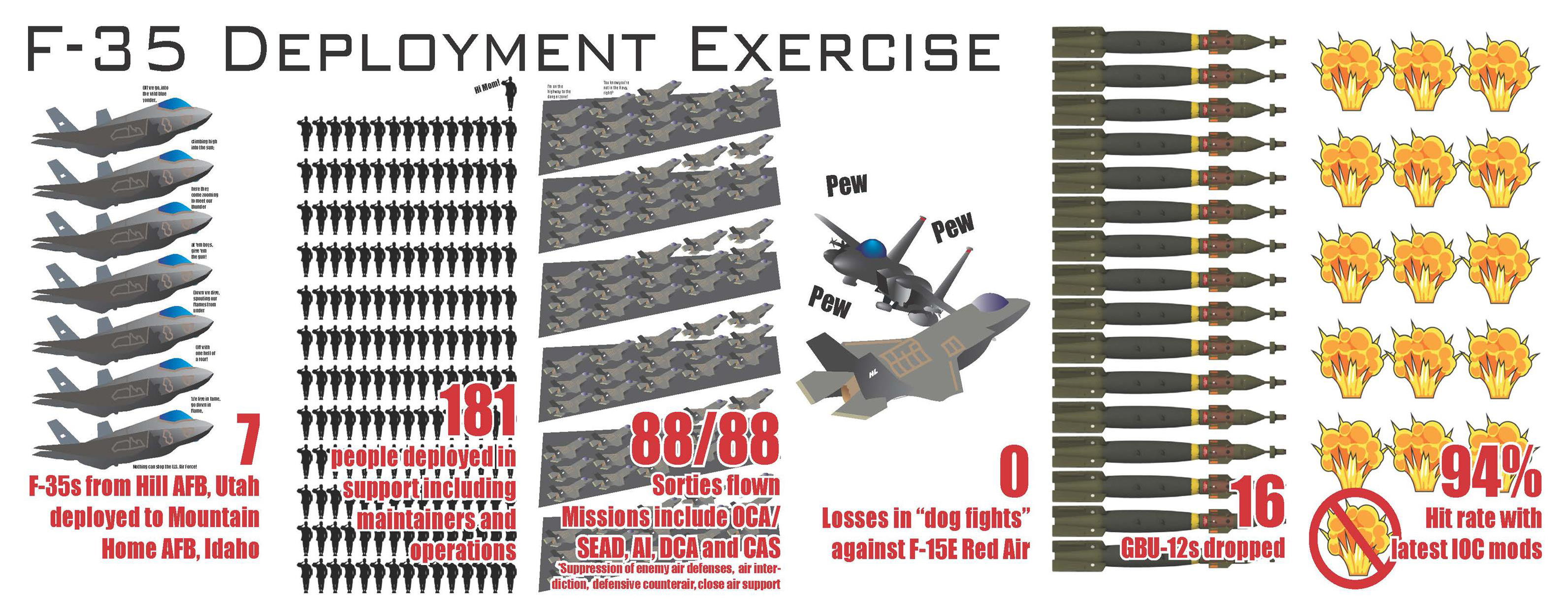
The fourth column shows something interesting: during the exercise, the F-35s were challenged by some F-15Es and suffered no losses.
Even though the graphic does not say whether the F-35s did shoot back at the F-15Es some analysts (noticing also the “pew pew pew” in the chart….) have suggested the JSFs achieved stunning 8:0 kill rate against the Strike Eagle.
However, the “zero losses” may simply mean that the F-35s were able to complete their assigned strikes without being shot down by the aggressors of the Red Air: considered that the F-15Es were probably equipped with the AN/APG-82 AESA radar and the Sniper ATP (Advanced Targeting Pod), the fact that the Strike Eagles performing DCA (Defensive Counter Air) were not able to “find” and/or “engage” the almost-IOC F-35s can be considered a huge achievement for the pricey, troubled 5th generation multirole combat plane.
Actually, this is not the first time the F-35 proves itself able to fly unscathed through a fighter-defended area: not a single Lightning II was shot down during Green Flag 15-08, the first major exercise conducted, more or less one year ago, on the National Training Center at Fort Irwin, California, during which the F-35 flew as main CAS (Close Air Support) provider.
At that time, several analysts claimed the participation of two test aircraft in the exercise was just a PR stunt, since the aircraft was still quite far from achieving a combat readiness required to really support the troops at war.
Let’s see what happens this time…
https://theaviationist.com/2016/06/27/f-15e-strike-eagles-unable-to-shoot-down-the-f-35s-in-8-dogfights-during-simulated-deployment/
Haters in 3..2..1……
SolarWardenVery much this. I forgot all about the landing gear.
With those humid conditions, the engine might have sucked mass flow like a drunk dragon partying in a summer barn!You’ve got it right, not me. The first pilot had an eye on his trajectory and speed indicator. The second one was more focused on not breaking anything.
Like WOW! I had no idea you knew what those two F-35 pilots were thinking. Not to mention you knew what they were thinking in Dutch! You must be one of those people that have ESPN and can read other peoples thought, huh? Read my mind… But don’t post what I’m thinking cause it’s about a couple of people in here and i don’t want to get in trouble.
SolarWardenClose up of vertical takeoff.
Has to be CGI! I’ve heard from folks in here and “experts” in other forums that this pig can’t turn or climb. I’m calling BS on all these videos.


 Sign In







