Dare2
Dare2Gripens is brand new hardware 98 times or someting more bandwith. and its all given away..
Gripen has 0 combat experience and nearly as little hours to prove anything being remotly superior.
Not a single Dassault aircraft was lost to a FCS fault either.
As for bandwidth i’m curious to know how even SAAB would know.
Dare2In the recent Flight article it says “a complete set of new-generation sensors is set for 2012”.
I assume this would then be F4? Is that correct?
The most important 2012 new sensor will presumably be the AESA; but what will happen to the other sensors? Any details on those?
I am sorry if this has been answered before…
Perhaps the info was lost in the noise cluter… 😎
AESA, MAW and OSF NG.
For the Defense system Thales are developing a new generation of IR/Optical All-Weather sensors based on those proposed for the A400M, possibily available for 2012 but we don’t know if it is the future RAfale defense system.
The F3+ seems to be the accepted denomination i have never read of F4 on official sources since the Korean bid.
Dare2Dassault might not be willing to give away their excellent digital fly-by-wire technology…
They still can develop a new version for KC-390 based on those of the Falcon 7-X, Embarer wouldn’t say no to this and the Rafale FBW, as advanced as it is, is still of an older generation than that of F-35 (all-electric with no hydrolics actuators), i bet Dassault are already studying their next generation FCS today.
Dare2I salute Dare2 for his restraint on this.
I have flown with some great women pilots there is no restraining needed for being complimentary, they (the girls) wouldn’t even be arguing.
Cdt Virginie Guyot will not be PAF leader before the next season, for the time being she is flying on the “Charognard” position, just behind the leader as seen in this 2009 tour picture (Source French Mindef).
Dare2Just out of curiousity, are you deriving those numbers from calculating the times, or were you able to have a non-audio disabled viewing where these stats were being discussed, or is it just a guess?
ONE good way to do it is to take a fixed camera PoV, and compute the frame number from turn roll-in to roll-out.
obligatory
I think maneuvers at <450 knots are primarily for airshows, what matters are >Mach 1.
I desagree, often merges occurs at higher speeds and then the fight gets “all dirty” with maneuvring speeds as low as 200 kt, it doesn’t mean though that supersonic speeds are never used as opposed to what has being suggested by some recent PR work.
My personal opinion is that it will depends on your aircraft best part of the flight envelop at the ceiling you are starting the fight at, weapon of choise, adversary performances and weapons engagement envelops; this all should determine your tactics and Machs.
Sustained turn rate, maneuvring (speed bleed rate) and acceleration contribute to an aircraft’s combat performance and survability by increasing its ability to maneuver in either offensive or defensive modes. GAO June 1996 Navy Aviation. ns96098 PDF
A Higher stablelised Cruising Mach will be an advantage, a higher Operational Mach will be an advantage, a higher DASH Mach will be an advantage, so are turning capabilties, climbrate, acceleration, things haven’t changed since the Red Baron.
Dare2It looks like a modern jet with stealth features, there aren’t many ways to answer for these requierements…
Dare2Ferté-alais 2009: Red Arrows
Ferté-alais 2009: Red Arrows/ Battlestar Galactica music
envoyé par h_barre. – Futurs lauréats du Sundance.
Dare2Isn’t that Flt Lt Charlotte Fenn? Charlotte is the Red Arrows Junior Engineering Officer. I don’t see any wings on her flying suit.
http://www.raf.mod.uk/reds/behindthescenes/jengo.cfm
http://www.airliners.net/photo/UK—Air/British-Aerospace-Hawk/1364349/L/
TJ
Could any of the Red Harrows enthusiasts post a video of their recent displays?
I had the pleasure to see them perform at Farnborough, great show!
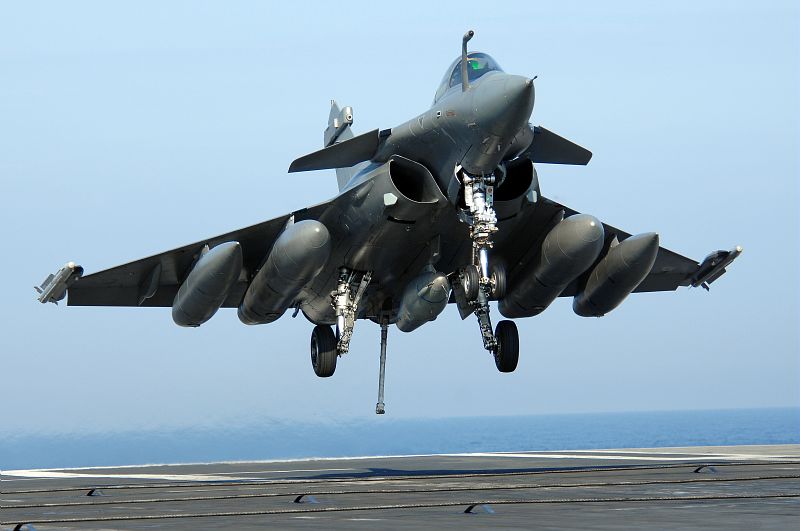
Dare2Dare2 look closer. 😉 You can just see in the picture the fins of an Exocet missile under the belly, so this is the anti-ship config (1x Exocet, 2x 2000L, 6x MICA).
Kovy had posted before a great picture of the “Super Nounou” Dare is referring to. The config is 2x 2000L, 2x 1250L, buddy pod and 2x MICA.
Yeah i also suspected a case of wrong photo posted in this article and also the number of tanks quoted as being 2.000 l doesn’t fit in the article?
Anyway, good exercise, we’re getting closer and btw there are TWO to FOUR MICAS (most likely two) missing in this picture compared to my weight estimate, that’s yet another 224 kg/448kg without mentioning the pylons (The ventral ejectors are slightly heavier)…
Douglas refueling pod:
Weight : 390 kg
Internal fuel : 149 l = 119.2 kg
M = 200 kg extra basic empty according to our last datas.
This would give us basic empty. 10.500 kg (F1 are lighter).
M Internal fuel is 4.750 kg = 15.759.2 kg without tanks and weapons (and pylons)
MICAs 448 kg. (4 Extra MICAS).
Pylons 285 kg. (Rough estimate).
Fuel 5.200 kg
2.1692.2 kg
This leaves a 507.8 kg margin for the fuel tanks, 731.8 kg with four Micas, 965.8 kg with two MICAs, it still could be launched with 4 X 2.000 l and two MICAs, if the external pylons were cleared for the 2000 l that is, fact is we still don’t really know which is correct.
Now if i can put my hands on a few archives…
Dare2I don’t think the picture necessarily represents the Rafale in the configuration that the article mentions. The legend merely states: “A rafale being catapulted from the CdG”. That said I, like scorpion, find the 2X2000+2X1250L configuration more likely.
Nic
Perhaps well but the difference in weight would be even larger although the weight in fuel would be roughly correct if we don’t take that contained in the pod itself, at 9,950 kg including 4.750 kg internal, thats makes for heavy pylons/MICAs/Pods.
http://www.aviation-francaise.com/FC-NACELLE-RAVITAILLEMENT-DOUGLAS.htm
So let’s try it this way:
Douglas refueling pod:
Weight : 390 kg
Internal fuel : 149 l = 119.2 kg
M = 200 kg extra basic empty according to our last datas.
This would give us basic empty. 10.500 kg (F1 are lighter).
M Internal fuel is 4.750 kg = 15.759.2 kg without tanks and weapons (and pylons)
MICAs 448 kg. (4 Extra MICAS).
Pylons 285 kg. (Rough estimate).
Fuel 5.200 kg
2.1692.2 kg
This leaves a 507.8 kg margin for the fuel tanks…
Dare2To me just one tank is visible on that image and given the fact that the aircraft carried 6 MICAs and the outer wing pylons aren’t used it looks more like 2 x 2000l + the buddy-buddy pod. That config is shown in the video “one day on deck” as well.
The source quoted a weight of ten tons which is confusing, the external fuel weight without pod is <> 6.400 kg, that would be roughly 2.1890 kg without the tanks, their pylons weight that of the ventral MICA ejectors, + pod, a bit short though the aircraft is a F1 and might not have all the equipement of the F2 standard.

Dare2I thought 3 would be the max. Could it be that they got it wrong in that article? Possibly 2 x 2000 l and 2 x 1250 l?
The tanks, (intern like extern all have the same profile), all look like 2000 l to me, that’s 3.200 kg of fuel external without the pod but in absence of a better view it is still hard to say…
Dare2Is it known if all former F2 Rafale M are already converted to F3 standard. The aircraft shown in the picture is a former F2 example. Quite nice one for that matter. MN site states MTOW with 24t instead of 24.5t.
CdG catapulted a Nounou at 22.2 tons on 21/06/2007 (date of edition of the article).
http://www.meretmarine.com/article.cfm?id=105033
This included: 4 X 2000 l tanks under the wings, a Refueling pods, full internal fuel and 6 X MICAS AAMs.
That’s the heaviest i heared of, it was apparently the first time the aircraft used its post-combustion from the deck, before the launch, but it is possible they cleared the aircrats for 24 t, they also started using 2000 l tanks purchased after they borrowed a few of them for Operational testing (Afganistan) from Dassault.
Dare2Btw on the defense.gov website there are the various services as sub sites. Could it be that they are independantly maintained? The AdA’s Rafale info is very short and with some different data than on the MN page.
The MN site changed twice is less than a month recently, they also changed the photos but i have the past 2 original pages and it is interesting to compare.
The photo from this link is a F3.

http://www.defense.gouv.fr/marine/decouverte/equipements/aeronefs/rafale_m
More pictures.
http://www.defense.gouv.fr/marine/base/mediatheque/photos/dossier_pack_photos/rafale
Video of operations on USS Enterprise.
Rafale sur USS Enterprise
http://www.defense.gouv.fr/marine/base/mediatheque/videos/rafale_sur_uss_enterprise
Dare2No the dispensers on the back. Those directly behind the wings are the chaff dispensers.
Scorpion, Karman is the German name fot the inventor of the encester of the wing-fuselage blended area.
http://fr.wikipedia.org/wiki/Theodore_von_K%C3%A1rm%C3%A1n
He designed first fairings to make the junction wing-fuselage less draggy.
Ultimately all fighters came to use them and the even developed with new benefits like reduced RCS, increased internal volume, lower transonic dragwave etc.
So their extention is well where these boxes are embeded, this is not the back of the aircraft.


 Sign In