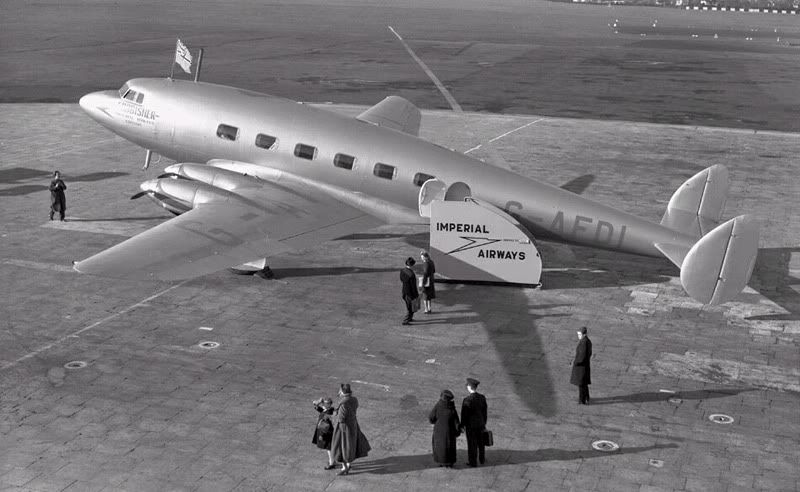
Imperial Airways’ De Havilland D.H.91 Albatross, G-AFDI, at Croydon. Powered by four 525h.p. de Havilland Gipsy Twelve series I engines, driving D.H. constant speed airscrews which were encased in close fitting circular section nacelles culminating in perfectly matched spinners. Cooling was by means of air being led to the back of the engines from intakes in the leading edge of the wing.

De Havilland D.H.91 Albatross, G-AFDI, of Imperial Airways at Croydon. Named ‘Frobisher’, was delivered to Imperial Airways Ltd in October 1938 and became the flagship of a new ‘F’ class which carried 22 passengers and four crew.

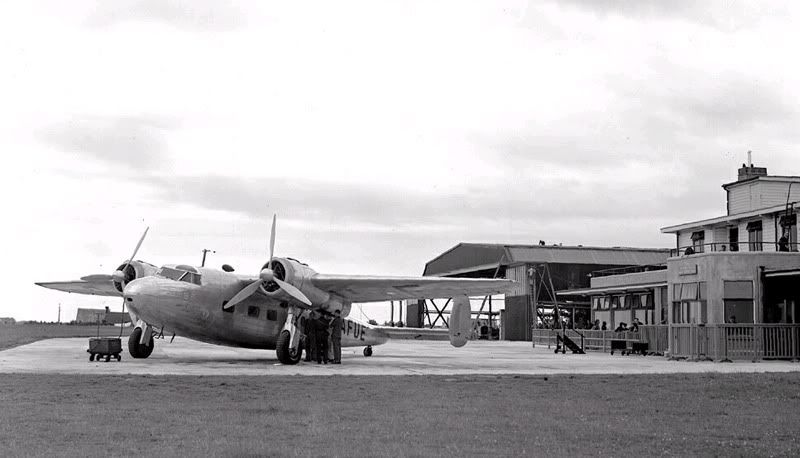
De Havilland D.H.95 Flamingo, G-AFUE, owned by De Havilland Aircraft Co and loaned to Guernsey & Jersey Airways Ltd for proving flights between Heston, Eastleigh, Jerrsey and Guernsey. With the outbreak of war, this aircraft was impressed in RAF service and lost in a flying accident 4 October 1940.


An aerial view of the International Rallye at Lympne, 1936. Amongst the many British registered aircraft are examples from Belgium (OO-ALL), Germany and India.

The Fw Vintage even for 1936 is this Caudron G.3 tainer, OO-ELA. It is being escorted from above by Caudron 630, OO-TSF. The Caudron G.3 was used in World War I by the French and both the Royal Flying Corps and Royal Naval Air Service. This example was brought to Britain in 1936 by Ken Walter and still survives today, displayed in the Royal Air Force Museum, Hendon.

The Fw 44 quickly turned out to be Focke-Wulf’s first commercial success. Here one of the German crew of Fw 44, D-ETIS, relaxes before it’s turn to fly before the crowd at the 1936 Lympne International Rally.

The ill fated Fairey Fox, G-ACXX that crashed in Italy killing the crew of two durung the 1934 MacRobertson Air Race. Of interest are the brick quarters in the background, still being used at RAF Mildenhall today.

A nice study of Douglas DC-2, PH-AJU, named ‘Uiver’, at Mildenhall. Flown by an experienced K.L.M. crew led by K.D. Parmentier, the DC-2 won the handicap element of the 1934 MacRobertson Air Race.

De Havilland DH.89A Dragon Rapide, ZK-ACO, named ‘Tainui’ and flown by Squadron Leader J.D. Hewitt and Flying Officer Kay. They finished third in the handicap race and fifth overall.

B.A. Eagle, G-ACVU, race number ’47’ taxiing at Mildenhall prior to the MacRobertson Air Race, October 1934.

Fairey Fox I, G-ACXO flown by R. Parer and G. Hensworth, retired from the MacRobertson Air Race in Paris, but later completed the route, arriving in Melbourne on the 13 February 1935.

Airspeed AS.8 Viceroy, G-ACMU taxiing at Mildenhall prior to the 1934 MacRobertson Air Race.

Lockheed DL-1A Vega, G-ABGK named ‘Puck’. Flown in the 1934 MacRobertson Air Race by J.Woods and D.C. Bennett, the latter commanding the RAF Pathfinder squadrons during World War II.

De Havilland DH88 Comet G-ACSS ‘Grosvenor House’ being pushed into one of the hangars at Mildenhall, 1934 MacRobertson Air Race. This aircraft, flown by C.W.A. Scott and T. Campbell Black, won the air race, reaching Melbourne in an elapsed time of 71 hours.

Boeing 247D, NR257Y, ‘Warner Bros. Comet’ flown by Colonel Roscoe Turner and Clyde Pangborne wearing race number ‘5’ in the 1934 MacRobertson Air Race. They would arrive in Melbourne, after flying 11,325 miles, in third place in a time of 92 hours 55 minutes 28 seconds.