Stealth Spy
As a part of these trials, they should have each of these contenders dogfight every other :diablo:
.. and publish the results :dev2:
Mig-35 FTW 😎
Stealth Spyvery sad 🙁
Stealth SpyIs “supercruise” one of the goals of the PAK-FA project?
Stealth SpyCongratulations!!!
Stealth SpyI’ll be there tomorrow 🙂
I hope I can get a few good pix 🙂
Stealth SpyI Know you guys are going to dismiss this …but here it is anyway.
Here is thew original Article about it:
http://www.secretprojects.co.uk/forum/index.php/topic,2162.msg28404.html#msg28404
The LCA’s FBW systems were tested on one such F-16 ….:)
Stealth SpyThe usual ….
Who wants to bet if the indigenous Indian carrier will be delivered on time ?
The Russians are not the only ones who delay. Check this :
[i]After Gorshkov, another Navy project hit by delay[/i]
The bad news for Navy shows no sign of stopping. The country’s most ambitious ship-building project, construction of a 37,500-tonne indigenous aircraft carrier (IAC) at Cochin shipyard, is running way behind schedule. Sources said current projections show IAC will be ready for delivery to Navy earliest by 2015, after completion of construction and trials, instead of the earlier date of 2011-2012.
The IAC project, cleared by the government in January 2003 at a cost of Rs 3,261 crore after several years of dilly-dallying, is lagging behind on “almost all fronts”.
“First, there was a big problem in getting 20,000 tonnes of special quality steel for it till SAIL stepped in. Then, there was a huge delay in procurement of bulb bars. Once these was sorted out, other problems crept in,” a source said.
“The detailed designs and pre-production work also took a lot of time. As per revised plans, the keel of the warship was to be laid in October 2007 but this has been postponed by at least an year now. Consequently, the project cost will also go up substantially,” he added.
All this will add to the woes of Navy, already grappling with huge delays in some big-ticket projects. The induction of the decommissioned Russian aircraft carrier Admiral Gorshkov, for instance, will not be possible before 2010. Rechristened INS Vikramaditya, this 44,570-tonne carrier was supposed to be operationally ready by August 2008, as per the Rs 6,900 crore package deal signed with Russia in January 2004.
Then, of course, there are slippages in the gigantic Rs 18,798 crore project to construct six Scorpene submarines at Mazagon Docks, slated for delivery between 2012 and 2017.
In the IAC project, the government has even signed two contracts worth 28 million Euros with Italian firm Fincantieri for design, integration, installation and commissioning of the IAC’s propulsion system, apart from consultancy in detailed engineering and documentation.
“But despite the steel being cut at the Cochin shipyard in April 2005, the ship construction began only in November 2006,” said the source.
To be charitable, one can argue this is the first time India is building an aircraft carrier, which has been the preserve of only US, UK, Russia and France so far.
But almost all defence projects of India suffer from huge time and cost overruns, underlining the lack of proper planning. Though the Navy has projected the need for three aircraft carriers to emerge as the most potent force in the region, it is making do with only one, the 50-year-old INS Viraat, at the moment. Be that as it may, once it is ready, the 252-metre-long IAC will have two runways with ski-jumps and a landing strip with three arrester wires, with the flight deck being around 2.5 acres.
With 160 officers and 1,400 sailors, the ship will be able to carry 12 MiG-29Ks, eight Tejas Light Combat Aircraft and 10 helicopters. Powered by four LM2500 gas turbines generating 80 MW, the carrier will be able to attain a maximum speed of 28 knots and be operationally deployed for 45 days at a stretch.
Stealth Spyhttp://www.barc.ernet.in/publications/nl/2007/200707-1.pdf
Report on MMR from BARC Newsletter for July 2007
Any comments from experts?
I’m waiting for overscan/aerospacetech’s comments on that.
Stealth SpyWho wants to bet if the indigenous Indian carrier will be delivered on time ?:diablo:
Does anyone smell HMS Invincible ??? If I an not mistaken, there were rumours about it being “gifted”/sold to India not very long ago …. :rolleyes:
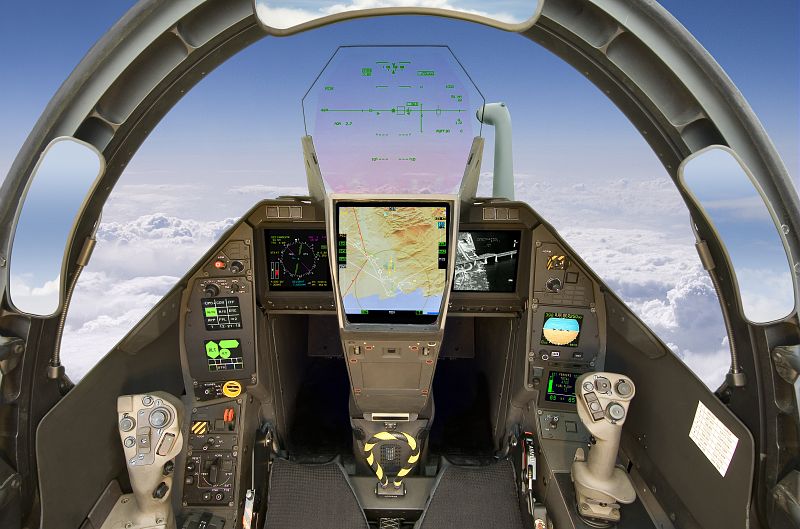
Stealth SpyThe new official cockpit picture :
Thanks for posting. That really is top notch.
Stealth SpyCheck out this thread :
Stealth SpyThe Su-34 for instance comes with a toilet and a microwave:cool:
and PiBu and Flanker_Man had a contest for getting pics of these first … what’s the latest on that :confused: :rolleyes:
Stealth SpyThe only operational terrorist group with an airforce ?
Tamil t’s are a bunch of ceasefire breaking losers.
Stealth SpyA “not to be missed” link on the Zhuk-AE :
http://www.defense-update.com/features/du-1-07/aesaradar_zhuk_AE.htm
On the parked MiG-35 visting VIPs could get a closer look at the Russian latest AESA radar – the Zhuk-AE AESA, developed by Phazotron NIIR Corporation. India is already operating the BAR phased array radar on its Su-30MKI and has specified AESA as a critical element of the MRCA platform. This radar was developed with modular approach, enabling upgrading existing Zhuk ME/MSE radars, into the phased array equipped MFE/MSFE standard, deployed in MiG-29/Su-27 platforms.
This 3cm (X-band) radar. The Russians designed their radar to produce linear power output at the range of 6-8 watt, to address available power (provided by the aircraft) and performance (range). The radar uses multiple four channel transceivers modules generating an output of 5watt per channel, installed on a liquid cooled base plate to dissipate the generated heat. If a specific transceiver is overheated, it will be switched off by the radar computer until it cools down.
Zhuk-AE can detect aerial targets at ranges up to 130 km (head on) in both look-up or look down modes. Look-up tail-on detection range is 50km (40km look down). The radar can track 30 aerial targets in the track-while-scan mode, and engage six targets simultaneously in the attack mode.
The radar provides target designation data for various Russian made missiles such as the R-27R1(R1E0, RVV-AE, R-73E, Kh-31A, Kh-35E and R-27T(TE) missiles. The radar can distinguish and count closely flying targets as well as identifying targets with known signatures. Close maneuvering combat mode optimizes the system’s performance to provide effective vertical scans, coverage of the HUD field-of view, and slew to follow the helmet sighting angles. Special optimization is also provided in the helicopter detection mode, detecting and attacking slow-flying and hovering targets. In the air/surface mode the radar supports ranging, mapping and tracking of moving targets, The radar supports real-beam, Doppler beam sharpening and focused synthetic aperture modes, offering different map scale expansion, map ‘freezing’, and tracking of four targets, including ground or sea-surface moving targets. It has a sea-surface search mode. The Zhuk AE can detect a destroyer size target at a range of 200 km.
Stealth SpyFinally …
What’s this red circled?
Its an electro-optical targeting module.
Check this out :
MiG-35 is equipped with an optronic target tracker, identical to the system used on the Su-30MKI. [u]For precision air-to-ground attack missions, the aircraft can be equipped with a conformal electro-optical targeting module, installed under the right air intake.[/u] The aircraft is equipped with radar warning, electro-optical missile launch warning and laser warning sensors, and integral active self protection (jamming, chaff and flare) as part of the integral self-defense system. The aircraft has four additional hardpoints and can haul an external payload in excess of six tons.
– from http://www.defense-update.com/products/m/mig35.htm



 Sign In