 Bager1968
It would be interesting to see the wing shape from above…
It would be nice to see the wing-shape at all!
Very careful control of what is shown, eh?
Bager1968Tuzla is a word of Turkish origin which means “place of salt”. There are several places that have this name:
* Tuzla – a city and municipality in Bosnia and Herzegovina
o the city of Tuzla is also seat of Tuzla Canton
* Tuzla – a commune in Constanţa County, Romania
* Tuzla – a district of the city Istanbul in Turkey
* Lake Tuz – the second largest lake of Turkey
* Tuzla island – an island in the Strait of Kerch in Ukraine
* Tuzla village – a village just outside the city of Famagusta (Gazimağusa) in north eastern Cyprus
* Tuzla – a coastal community in Adana Province of Turkey.
* On the Bulgarian Black Sea Coast:
o Lake Shabla or Shablenska Tuzla, a saline lake near Shabla in Bulgaria
o Taukliman or Nanevska Tuzla, a small lake near Kavarna in Bulgaria
o Balchishka Tuzla, a small lake and balneological resort near Balchik in Bulgaria
* MS Tuzla, a Romanian ferry in service 1985-96
Bager1968The idea of 6x fleet carriers in the 1960s (4 CV-1952 plus Eagle & Ark Royal) is a bit of a wet dream. Cut the number in half & we have something plausible. 😉 Here’s what I think is the most realistic scenario:
There is a difference between “Best-case” scenarios, depending on what your underlying economic assumptions are.
Anyway, perhaps the program would be a bit more stretched than I laid out, with more years between the first & second “batches”, and even only one on the building slip at a time, instead of the two-at-a-time I proposed. That would place #3 commissioning around 1967 (in time for an un-modernized Eagle to be placed in reserve), and 1970 for #4 (to replace Ark Royal).
Thanks for the heads-up on the catapults… I see I need to make a change in my drawings & program details.
Bager1968re F/A-18RN’s fleet, I notice no Intrepid.
She’s there… you just have to read past the names.
The names are “class names” (except for singular ships), to the right of the name the first column is “No. of Units”… the number beside Fearless is “2”.
Therefore, that line represents both Fearless AND Intrepid.
The next column after that is “refit/reserve”… indicating how many of the class is unavailable for operations.
Bager1968The first problem I see with the “Perth” type Ikara installation for the Type 82 is that the RN already rejected it!
Remember, the RN went to the covered “zareba”* mount for Ikara to protect the launcher from icing up in the North Atlantic winter (and from wave impact in the forward positions they mounted them in)… there is no way you can fit two of those amidships on anything less than a battleship!
Now, there is room for improvement in the RN Ikara launcher itself… they built a massively-over-engineered (and mechanically-fragile) launcher, capable of aiming rapidly and precisely to within tenths of a degree of azimuth… for a winged, remotely flown, “in-flight steerable”, torpedo-dropping drone “missile”!!!
The Australians, in contrast, built a simple, robust, relatively “approximately-aimed” launcher, placed in uncovered mountings on the stern of their type-12 frigates and amidships on both beams of their “Perth” class DDGs (modified USN C. F. Adams class ships).
This site has a good examination of the RN Ikara system.
http://middle-watch.com/ikara.htm
Note that Bristol was unique in a lot of ways, not least the first deployments of Ikara and Seadart. Designated GWS-40 the Bristol fit had two tracking aerials, although they could only control one missile at a time they ensured full 360 deg cover and ensured the ship could manoeuver violently while still maintaining missile guidance.
*za·re·ba also za·ree·ba (z-rb)
n.
1. An enclosure of bushes or stakes protecting a campsite or village in northeast Africa.
2. A campsite or village protected by such an enclosure.
3. The covered well mount for the Ikara ASW weapons system launcher on Royal Navy ships, particularly HMS Bristol and the Ikara conversions of the Leander Type-12 Frigates.
Ikara: Australian Aboriginal word for “throwing stick”
Bager1968In jazz and blues, a blue note (also “worried” note) is a note sung or played at a slightly lower pitch than that of the major scale for expressive purposes. Typically the alteration is a semitone or less, but this varies among performers and genres. Country blues, in particular, features wide variations from the diatonic pitches with emotive blue-notes. Blue notes are often seen as akin to relative pitches found in traditional African work songs.
mandatory characters
Bager1968After this thread sort of died here, he re-posted it there to try to get more discussion going… and there it is seeing much more participation than here.
I guess he should have asked about Hunters or Lightnings.
Bager1968Actually isn’t Sea Gripen meant to be STOBAR?
SAAB has stated the Sea Gripen would be available in either STOBAR or CATOBAR* versions, depending on the needs of the customer (one for India, the other for Brazil).
* I hate that acronym, should be either CATOAR (Catapult Assisted Take-Off, Arrested Landing) or CALAR (Catapult Assisted Launch, Arrested Landing), not Catapult Assisted Take-Off, But Arrested Landing (the “but” indicates the two aren’t normally used together, but they usually are, with the vast majority of aircraft carriers built over the years having been {and still are} equipped this way).
STOBAR is fine, as Short Take-Off has not normally been used with Arrested Landing, therefore the “but” is appropriately used, since only one in-service aircraft carrier and 3 being built or modified use this configuration.
8 Aircraft Carriers and one LHD with “ski jumps”, and many more LHAs & LHDs without “ski jumps”, have operated in the STOVL configuration (Short Take-Off, Vertical Landing).
And lets not play up the similarities between B and C too much, one of them has a honking great lift fan in its belly.
The other has not only larger fuel tanks and a larger internal weapons bay using the space the first uses for that “honking great lift fan”, but also a larger wing which provides more lift… which would be useful for a non-catapult launch profile.
That is what likely would allow it to use the “ski jump” carrying the same weapons payload as its “vertical” half-brother, but with more fuel (longer range) and a greater “bring-back” weight.
Remember, the F-35C also has stronger landing gear for those high-sink-rate arrested landings, which would be able to handle launching at higher gross weights than the F-35B… as long as the nose gear can handle the rearward (and increased downward) stresses caused by the “ski jump” (this is what the S-3 had problems with).
Bager1968That looks pretty darned good!
I’ve no complaints with any of it, although you mentioned an expected reduction in Counties of 5, but you only reduced 2.
As for CVA-class names, the two names I have seen in contemporary documents are:
CVA-01 Queen Elizabeth
CVA-02 Duke of Edinburgh.
CVA-03 Prince of Wales would therefore be the most likely choice, considering the name would be chosen while Ark Royal IV (R09) was still in service… even if R09 was not modernized, and was decommissioned before Eagle (R05).
Nicknames for the class could be “Royal” class; “Title” class, or “Family” class (Mother, Father, Eldest Son).
Of course, if the principle is carried to the extreme, you could see the 3 ASW/Commando carriers named Princess Royal, Duke of York, and Earl of Wessex… for the other 3 Royal brats (Princess Anne, Prince Andrew, and Prince Edward), in order.
Two of those have been used before in the 20th century for RN ships… Princess Royal for the Lion class Battlecruiser in 1911 (and 4 times before that) and Duke of York for the King George V class Battleship in 1937 (and once before that).
Queen Elizabeth had, of course, been also used by the RN, for the lead ship of the 1913 Battleship class, Duke of Edinburgh had been used by the RN for the lead ship of the 1903 Armoured cruiser class, and Prince of Wales for the King George V class Battleship in 1937 (and 6 times before that).
Only Earl of Wessex would be without previous use in the RN, although an ASW/Commando helicopter of the name was in RN service at the time, so it would seem appropriate for an ASW/Commando carrier, right?
😀
Bager1968Nearly 160 sailors and officers on board two Indian Navy attack submarines had a lucky escape when their vessels collided at a Mumbai harbour jetty while one of them was attempting parallel berthing with the other.
Slow news day, and a journo desperate for a “scoop” = hysterical exaggeration of a fairly minor, “routine” mishap.
The only “lucky escape” they had was if their tea spilled onto the table instead of their lap… as that would have been the main effect on the ships or crews.
The moving sub was likely doing 1 or 2 knots max… less than walking speed.
Bager1968Or quoting the entirety of a 50-line post to reply to a 1-line statement therein.
Drives me nuts, especially when the next poster quotes both entire posts… the whole original post and the entire reply including the whole original post again!
Bager1968Grey Area… in support of keeping this here… I just posted the info Don provided on the HA version of this thread… I finally found it on page 9!!!
Bager1968Thanks to Don Chan on MM…
http://www.defence.org.cn/article-3-1277.html
http://bbs.tiexue.net/post_1369206_1.htmlROCAF, 11th Group flew F-100A until 1984. 48th Squadron was the last F-100A squadron of the world.
ROCAF F-100A retired in September 1984, after three crashed in June, July, and August 1984; one crash per month.
Bager1968Good points.
I agree a post-1970 modernization makes more sense, but the first two will still get an upgrade of at least their catapults and arresting gear in the late 1960s, for the new generation of aircraft.
I don’t know about the running costs, but unless the RN comes up with a better STOVL aircraft than the Harrier/Sea Harrier, they need the catapults… which in that time-frame means high volumes of fairly high-temperature steam. There have been proposals for “waste-heat steam generation plants” using the exhausts of the GTs, but it is more likely that a couple of boilers would still need to be fitted to power the catapults.
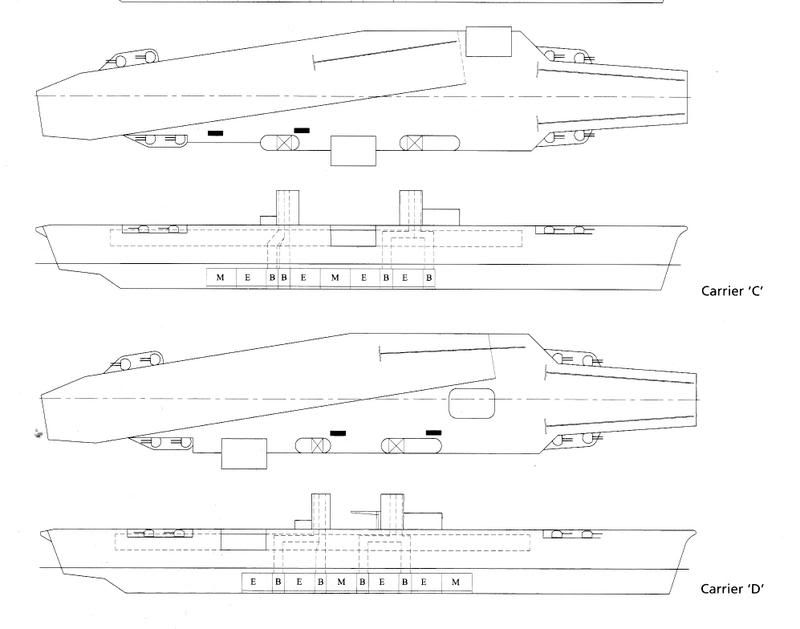
By the way… here are the historic “two best” variants of the CV1952 design.
All of these had the same problem wrt the aft part… the standard hull design for UK carriers tapers only a little at the stern, with a full-width flight deck, not drastically tapering as these show. That was the first change I made for my drawings.
Moving the aft part of the angle deck to be more centered reduced the angle from 9° to 7°, but did not change the forward location of the landing path.
HMS Ark Royal 1970s
Bager1968And bashing LM on pricing vs. cost. He is basically saying that LM is pressuring its subs to lower their pricing to offer (part of) the next batch of production vehicles at a low fixed price, with the promise of making the difference up on later buys. Stay tuned.
Yeah… LM showed (and others) him to be uninformed, by delivering the last set of F-35LRIP aircraft at below the expected cost, so he has to invent claims of dirty dealings by LM to try to maintain a semblance of credibility.
I’ll take the reality of actual events over paranoid conspiracy rantings from a very biased loudmouth any day.


 Sign In







