Bager1968
Related News:
A California-based aerospace firm is finalizing plans to partner with a Ukrainian aircraft maker to pitch up to three aerial tankers in the U.S. Air Force’s multibillion-dollar KC-X competition.
Better story linked here:
http://www.flightglobal.com/articles/2010/07/02/343992/us-company-partners-with-antonov-in-surprise-kc-x-bid.html
Bager1968While you could validly argue for moving this thread, note that this thread was placed here because the first version, which WAS in “Historic Aviation”, saw little comment.
In addition, many of those posting here don’t read ‘HA”, so they wouldn’t have seen it had it not been posted here.
‘Modern Military” has regularly discussed aircraft that are no longer in service, if they were around from ~1970 on.
Bager1968The aircraft will be assembled in the US, but built in the Ukraine.
Meanwhile, an online Wikipedia entry on the An-12 turboprop cites a book reference to a concept for the An-112, which is described as a jet-powered, swept-wing variant of the Soviet Union’s 1950s-era response to the Lockheed C-130.
Wonderful.
Bager1968I doubt it was designed for repeated flights at <200’AGL @ 8,000’+, nor for the wing-stresses of fast pull-ups combined with a sudden off-load of payload.
It was during that exact maneuver (drop retardant & pull-up to clear terrain) that the C-130 & PB4Y had their wings break off in 2002.
I may be wrong, but that is a major concern here in Colorado, where there are over 50 peaks that exceed 14,000′.
The Neptune was designed for low-altitude flight and sudden maneuvers, being an ASW plane designed during the era of low-altitude weapons deployment.
Bager1968There are major flaws in your assumptions.
That would require a very major change in Britain’s economic situation at the end of WW2 for a start.
You have the RN deciding in 1952 that the Centaur class is nearing obsolescence, and need to be replaced post-haste. The problem is that 1952 was before they were even completed (historically), and all aircraft under design in 1952 were perfectly capable of operating off these 4 ships.
Yes, by 1958 or so they were recognized to be too small, but that is too late for your scheme.
What would work is to take off from the historic time-line in 1950, rather than 1945 (as your scheme requires in order to start construction of the 4th Audacious-class ship, and continue with the third past its historic 23%).
There are still only 2 Audacious-class ships remaining, Eagle (ex-Audacious) & Ark Royal (ex-Irrisistible), and the RN sees the need for improvement.
The change comes when it is decided to NOT modernize any of the existing fleet carriers (so no 8-year fixing-up of Victorious), and to not re-design Hermes with the deck-edge elevator, but to build new ships instead.
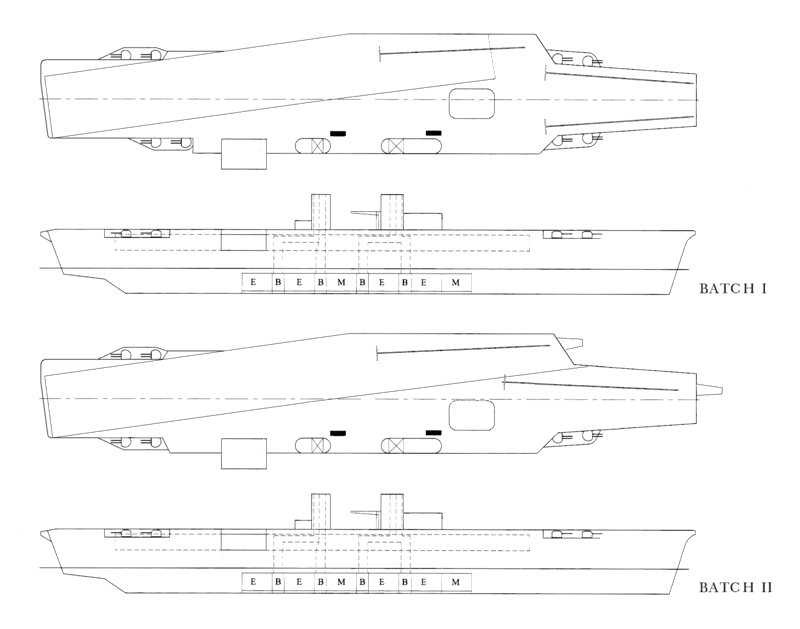
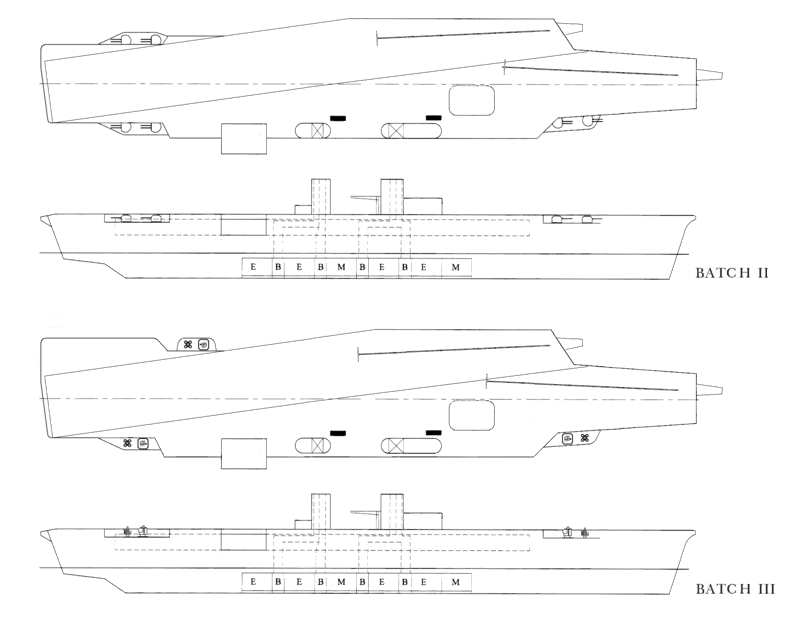
Two “CV-1952” class ships are laid down in 1953-54. They will complete around 1958-59 (perfect timing to fill the slots of Victorious & Hermes in the historic RN). They will be fitted with a full 7° angle, and with 3 steam catapults (corresponding to the historic BS-4/4A, one on the angle and two on the bow).
Two “CV-1952 Batch II” are laid down in 1956-57, to replace the 3 ships of the Centaur class in 1961-62. These will be fitted with an enlarged flight deck (more deck parking), and with only 2, but more powerful, catapults (corresponding to the historic BS-5/5A). This will give the RN 6 large carriers, and the Centaurs will all 3 be converted to “Commando Carriers”.
Then, in around 1964-67, the 2 “CV-1952 Batch I” would be brought up to the new “Batch III” standard, and the 2 “CV-1952 Batch II” ships would follow in 1968-70. All 4 would be fitted with even more powerful arresting gear and 2 catapults (call them a BS-5B, halfway between the BS-5A on the waist of the historic Phantomized Ark Royal and the BS-6 of CVA-01) and water-cooled JBDs, to operate either Phantoms or a naval BAC-583.
This allows a budget-conscious UK to choose to retire Eagle & Ark Royal around 1970 without replacement.
The Audacious class would make bad Commando Carriers, with their large crew requirements and maintenance-intensive propulsion systems.
The Centaurs would be well adequate, and if Hermes is completed in the late 1950s as the prototype of the concept, then the RN would have 4 large carriers and 4 commando carriers… not a bad fleet for the 1960s-mid 1980s.
Here are my design variants for the 3 CV1952 versions:
Bager1968Piaggio PD.808 RM MM62014, a radio-calibration version that is equipped for medium- and high-altitude calibration of navigation aids.
That plane just looks sweet in general… I wonder if there are any available on the civilian market (sold off by the AMI)?
I looked at http://www.vataware.com/aircraft.cfm?code=P808, and it listed 5 flights by a PD 808 last year, the last in June… three were “unknown” and two were listed as operated by German Air Express.
Bager1968That aircraft has 3 windows down the side, so I expect it is one of the transport or trainer versions.
The one in this pic only has one window, I expect it to be an ECM version. http://rides.webshots.com/photo/2816365800079267387zrTKjv
Only 24 examples of this type, with low-set wings and aft-mounted turbojet engines, were produced, and 22 of these went to the Italian Air Force. The first aircraft were configured for the utility role, but the last six aircraft were completed as electronic platforms with cabin accommodation for specialist electronic intelligence equipment and its three operators.
PD-808 VIP six-seater for government and military VIP transport duties;
PD-808 TA nine-seat transport and navigation trainer;
PD-808 ECM electronic-countermeasures version; and the
PD-808 RM radio-calibration version that is equipped for medium- and high-altitude calibration of navigation aids.
Bager1968I am a civillian instructed from air cadets llanbedr.
we have the jindavik and we are trying to sell it, to buy the squadron a much neede minibus. the current asking price is £20,000 but this is negotiable, are you intrested?
Shelly
Hm… considering the other typos, I’m not sure about the validity of the post… unless an “air cadet instructed” is no longer required to have a basic command of the language.
Either that or it was a long, tiring day dealing with the “kaydets”. 😉
* spelling
** capitalization
*** both
Bager1968Doesn’t really look bad at all… the nose-gear collapsed, a little nose damage (mainly to the plexiglass… might get an aluminum-covered nose) and an engine to replace.
It seems the hydraulics went while taxying, and with no brakes it went off the tarmac, through a fence, and down a slight embankment.
The aircraft, which was being used to drop fire retardant on two wildfires in northern Colorado, experienced hydraulic problems and the pilot had difficulty stopping the plane, Segin said.
“It was a rolling crash,” he said. “It rolled through a fence and came to stop on a highway. The crew is fine.”
The cause of the crash is under investigation, he said.
An airport firefighting crew quickly extinguished a small fire in the engine, Segin said.
http://www.denverpost.com/news/ci_15384952
The pilot reported a “hydraulic failure” onboard, Forbes said. He attempted to apply the brakes on the bomber, but to no avail. The left engine on the plane caught fire, she said, but was quickly put out.
The P2 Neptune air tanker at Rocky Mountain Metropolitan Airport Saturday that crashed Saturday afternoon was moved off of 120th St. back through the hole in the fence into the tanker area.
For a video of the tanker being moved, go to http://www.dailycamera.com.
Cliff Grassmick / June 27, 2010
http://www.dailycamera.com/broomfield-news/ci_15382320


Bager1968Well, thanks. But they look more like LPDs than LCACs.
Any news on the Zubr?:)
Ummm… PLAN 071 LPD with flooded docking well and off-loading an LCAC.
Look at the top 3 pics again, that is a LPD, with a LCAC backing out of its stern well.
Below are pics of smaller conventional boats inside the LPD’s well dock.
Bager1968And i thought T-35 lightning2 was the replacement 😮
There are NO plans for a 2-seat version of the F-35… nor of the F-22!
Especially not a “T” version!
What is a Kawasaki T-1?
There is no such plane.
There was a Fuji T-1… it was a Japanese-designed & built 2-seat trainer based on the F-86 Sabre.
First flight was in January 1958. It was retired in March 2006. 2 prototypes, 4 pre-production aircraft, 40 T-1As, and 20 T-1Bs were built, for a total of 66 aircraft.

There IS a Kawasaki T-4… it is a subsonic intermediate jet trainer aircraft, which replaced the T-1s and T-33s with the JASDF.
The first XT-4 prototype flew on July 29, 1985. The first production aircraft was delivered in 1988.

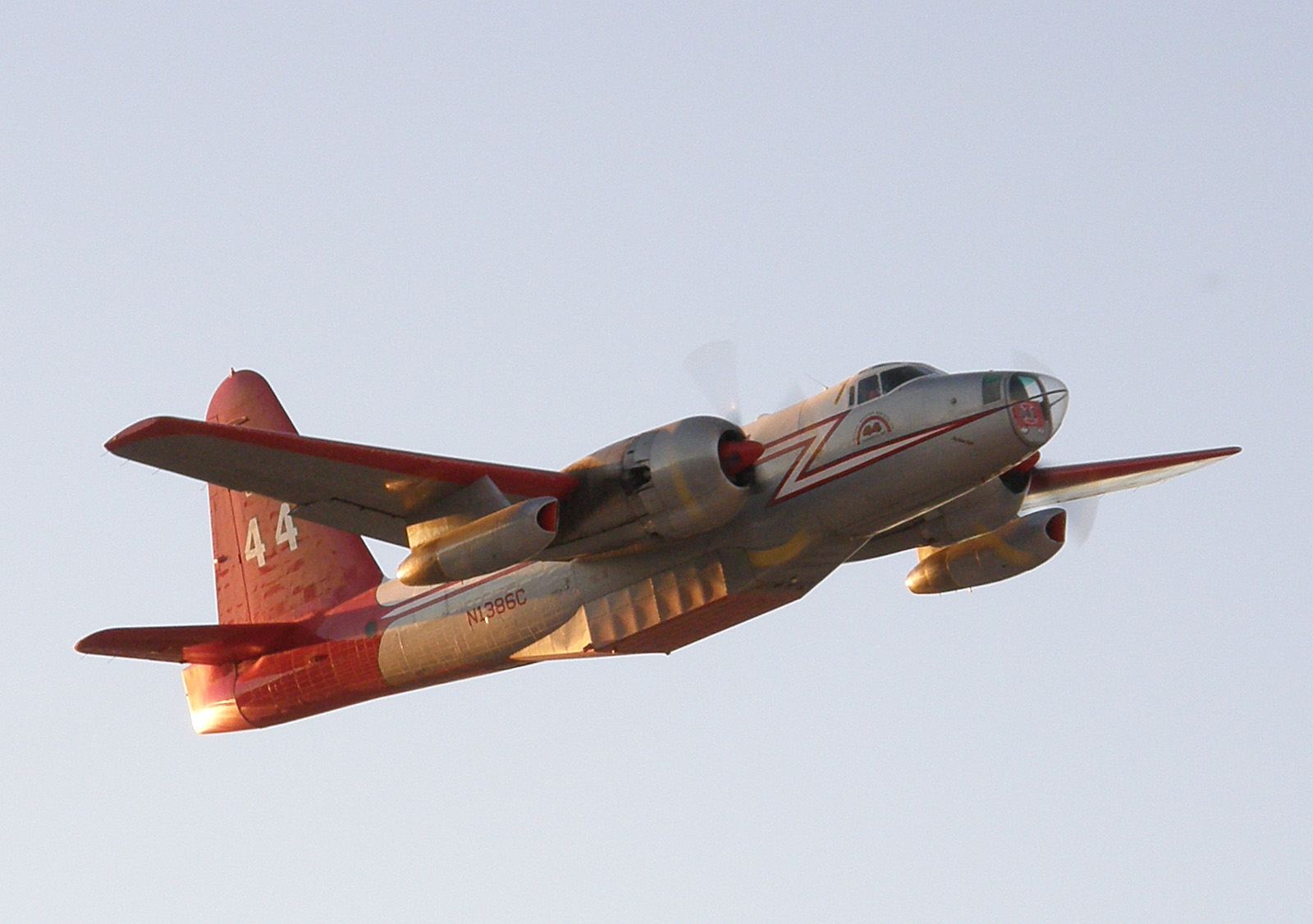
Bager1968Lockheed P2V-5 Neptune, N1386C Tanker #44 was built for the U. S. Navy as BuNo 128422 in 1951. It is operated by Neptune Aviation Services of Missoula, Montana.
Here is N1386C in my home-town (Grand Junction, Colorado) exactly 3 years ago:
Neptune-Aviation-Services/Lockheed-P-2E-Neptune
Bager1968Presence or absence of a hook means little or nothing… most modern “small” combat aircraft, from US to European to yes, Russian, have a hook for use with emergency arresting gear on land runways.
The F-15 & F-16 have them, as do lots of other non-carrier “fast jets”.
Bager1968Just as an aside, the F-35 (all versions) has a fixed-geometry intakes for the engine, which is what limits the maximum speed.
For it to go much faster, variable-geometry intakes would be required… as at speeds above ~M1.7 the airflow has to be modified to prevent compressor stall.
The intakes are the limiting factor, not engine thrust, aerodynamics, or weight/drag.
During the design phase the decision was made to not fit variable-geometry intakes, as the primary missions the aircraft is intended to perform do not require M2 speeds, and the added weight & maintenance issues were considered detrimental to the aircraft’s primary requirements (especially for the STOVL & carrier versions).
Note that the USN & USMC are very satisfied with their F/A-18 variants… which also have fixed intakes, and a max speed of Mach 1.7 (F/A-18C) at 30,000+ ft. and Mach 1.6 (F/A-18E) at 30,000+ ft.
Bager1968On Thursday June 17, 2010, Direction Generale de l’Armement (DGA), the French defence procurement agency, successfully carried out the test firing of two Aster 30 missiles from the Royal Navy barge Longbow. The barge was operated from the DGA Missile Test Range at Ile du Levant (Var district) on behalf of the UK Ministry of Defence.
Carried out as part of the French-Italian-British Principal Anti-Air Missile System (PAAMS) program, these firings were intended to validate modifications that were made to the Aster 30 missile after launch failures in 2009. [/I]
Not quite, these are the RN’s specific qualifications for the Aster/PAAMS/Sea Viper, tougher requirements than the previous deloyments.
Wrong… read the article again!
The Aster 30 missile had suffered repeated failures in the terminal phase (the missile failed to accept maneuver updates, the problem was not the ship-board guidance system) for more than just the RN, and had to be modified.
These are the last set of tests to confirm the problems have been fixed… not for any special RN requirements!


 Sign In